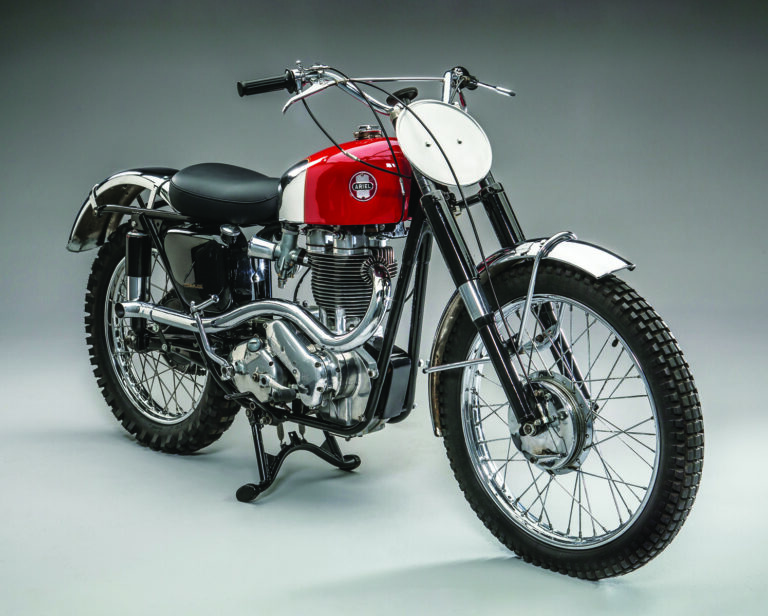
Engine: 499cc air-cooled 4-stroke single, 81.8mm x 95mm bore/stroke, 9.1:1 compression ratio, 34hp @ 6,000rpm
Carburetion: 1-3/16in Amal Monobloc
Transmission: 4-speed, oil bath clutch, chain primary
Electrics: Magneto ignition/no generator or battery
Frame/wheelbase: Tubular steel frame, 56in (1,422mm)
Suspension: Hydraulic telescopic front fork, swingarm rear
Brakes: 7in (178mm) drums front and rear
Tires: 3 x 21in Dunlop Universal front, 4 x 19in Dunlop rear
Weight (dry): 318lb (144.2kg)
Seat height: 31in (787.4mm)
Fuel capacity: 3gal (11.4ltr)
High school English classes usually include lessons on the many works of Shakespeare.
In choosing a name for his high-wheel bicycle circa 1870, British industrialist James Starley did well to recall his own study of The Tempest — opting to insinuate that if Ariel could fly, so too could his bicycle. Starley was not, however, likely thinking that any of his wheeled products would ever fly — even if it was off a dirt jump set up for scrambles or motocross action. But that’s what the 1955 Ariel Hunter Scrambler seen here on these pages could do.
Ariel’s story begins in 1869, when engineer and inventor Starley was working as a foreman for the Coventry Sewing Machine Company of Birmingham, England. According to the Ariel Motorcycle Club of North America, the company decided to quit producing sewing machines and their intricate components and became the Coventry Machinists Company. Starley saw a brighter future in putting people on wheeled goods and began producing bicycles. It was Starley, together with partner William Hillman, who patented the spoked wheel held together under tension.

From bicycles to motorcycles
In 1870 Starley and Hillman built their first high wheeler with the name Ariel on the headstock. Ariel — along with many other manufacturers, both American and British — soon latched onto the idea of the safety bicycle. These were so-called because both front and rear wheels were roughly the same size as opposed to the high wheel bikes of the day.
It’s hard to determine just who exactly can claim the invention of the chain rear drive, but some say it was Starley’s nephew, John Kemp Starley. His Rover safety bicycle was released in 1885, although he came up with the idea for a chain drive several years before. During this period of time, the Ariel name passed through a number of owners and was licensed for use by others. However, by 1896, the Dunlop company had acquired the Ariel name and established the Ariel Cycle Co., which was acquired by Cycle Components Manufacturing Co. in 1897. This is when Charles Sangster, a name familiar to many who follow the British motorcycle industry, joined as managing director of Cycle Components and the name Ariel was used on a powered tricycle equipped with a single-cylinder De Dion engine.
Ariel’s inaugural motorized products were tricycles and quadricycles, and these machines proved their reliability and speed during trials in England. With that success, the idea of adding a motor to an Ariel two-wheeler wasn’t far behind, and the company’s first prototype motorcycle, fitted with a 2.5 horsepower Minerva engine, appeared in 1901. A production model became available for purchase in 1902.

Charles Sangster took control of Ariel in 1902 and he moved the company from strength to strength, introducing several remarkable models of the day, many of them powered by Kerry, Minerva or White & Poppe engines. In 1918, Sangster’s son, Jack, became responsible for Ariel and he broadened the firm’s position in the motorcycle industry as he developed larger, increasingly more powerful machines with help from talented designer Valentine Page.
Page had worked at J.A. Prestwich, a renowned engine builder, before joining Ariel in 1925. At Ariel, Page was responsible for penning a new line of single cylinder machines, starting with a 557cc sidevalve engine and a 496cc overhead valve model. The last engine had a bore and stroke of 81.5mm by 95mm and formed the basis for Ariel’s single-cylinder line that ran for more than 30 years after Page designed it.
From Square Four to Red Hunter
Now, we need to introduce another name that would become synonymous with the British motorcycle industry, Edward Turner. In 1928 young Turner was a manager of a motorcycle shop in Peckham, England. He conceived the idea for a square four motorcycle engine and drew up plans. Shopping his 4-cylinder design around the industry, it was only Sangster at Ariel who was interested. Sangster hired Turner, and the Ariel Square Four was released in 1931.

By the early 1930s, Turner took charge of developing new Ariel product and chose to build a model called the Red Hunter that was released in 1932. The Red Hunter was powered by a high-performance version of Page’s 500cc OHV single. Turner had a flair for designing eye-catching machines, and the Red Hunter, finished in a brilliant red paint scheme over a chrome gas tank, sold well. Eventually, the Red Hunter name was also applied to smaller, but still sporting, 250cc and 350cc singles.
The Red Hunter range carried on until the advent of World War II, when production focused on equipping the military with a hardy 350cc OHV single-cylinder model based on a competition frame with higher ground clearance. After the war, Ariel was sold to B.S.A., and the line of machines was slimmed down to include the 1,000cc Square Four and the single-cylinder 350cc and 500cc machines in De Luxe and Red Hunter trims — still with rigid frames and girder forks.
The 500VH Red Hunter
Recognized by its official VH model designation, we’re narrowing our attention solely to the 500cc Red Hunter. The engine in this motorcycle featured vertically-split alloy cases housing steel flywheels — as opposed to the cast flywheels found in the De Luxe version. The big end of the Red Hunter’s steel connecting rod was supported on the parallel crankpin on a double-row caged bearing. In the Red Hunter single, the crank turned in three bearings: a single roller bearing on the timing side and both a roller and ball bearing on the drive side.

Crank pinion and timing gears were placed in a circular chest cast into the right-side case half, while the top end of the Red Hunter engine featured an iron barrel held to the cases with four studs and an iron head with pushrods hidden in two chrome tubes between the crankcase and the head. Alloy rocker boxes were bolted above the valve stems and a compression release was housed in the exhaust rocker box. Located directly behind the cylinder was a Lucas magneto/dynamo and for an extra cost, the Red Hunter could be ordered with a twin-port head and either high-rise or low exhaust headers.
Power from the crank was fed through a spring-and-cam compensating sprocket on the left side of the engine through a single-row chain to a dry twin-plate clutch and a 4-speed Burman transmission. In 1946, the girder fork was dropped in favor of Ariel’s telescopic model that had been designed by Val Page during the war years. Frames were still rigid, however.

The big news for 1948 was Ariel’s experimental all-alloy 500cc OHV engine based on the Red Hunter platform. The aluminum barrel featured a cast iron liner, and now incorporated the pushrod tunnels and was topped off with an aluminum head. The all-alloy engine was seen at the Travers Trophy trial in 1948, but more news about it wouldn’t be heard until August 1949 when it became the powerplant in a rigid-frame competition-based Red Hunter model called the VCH, available in a Trials or Scrambler format. Stripped of its headlight and taillight, the VCH was equipped with a racing BTH magneto, alloy fenders and a low exhaust pipe with upswept muffler.
Moving on
By 1950, the VCH was still a rigid frame machine with a telescopic fork, but Ariel did experiment with an Earles fork design in both trials and scrambler trim. On the scrambler, the Earles fork was fitted to a new duplex front downtube frame with swingarm rear suspension. The experiment with the Earles fork was short lived, but in 1954, most of the Ariel line was equipped with the new swingarm frame, including two new models that replaced the VCH. These were the Hunter Trials, or HT, and the Hunter Scrambler, or HS.

In the Scrambler, the all-alloy 500cc engine with a Lucas racing magneto saw its compression ratio increase to 9.1:1 and was now fitted with a lumpier cam and could deliver 33 horsepower through its 4-speed Burman transmission. Gears in the transmission were standard road ratios, and an owner altered gearing by changing out front and/or rear sprockets, depending on riding conditions.
Wheels were 21-inch up front followed by a 19-inch out back, and the rims were laced onto half-width hubs with 7-inch brake drums. Instead of alloy fenders, these were now narrow chromed steel. The gas tank adhered to the Red Hunter scheme, finished in the attractive red paint over a chrome base.
At that point, apart from a few changes such as the style of 1-3/16-inch Amal carburetor used and, in 1956, the addition of full-width alloy hubs both front and rear, the Scrambler model did not change. Approximately 1,000 examples of the HS were made during the model’s run from 1954 to 1959, when Ariel dropped all production of 4-stroke motorcycles to focus on lighter weight 2-stroke machines with the Leader and Arrow. Ariel built their last two-wheeled motorcycle in 1967, and from a company that produced the likes of the Square Four and Red Hunter models, rather ignominiously, their final model in 1970 was a 49cc trike.
Adding to the collection
One of those 1,000 Ariel Scramblers produced turned up for sale in 2018 at the Mecum auction in Las Vegas. That’s where Throttlestop Museum partner Jim Balestrieri saw the machine, with frame number DUS501 — the DUS prefix denotes it’s the HS model, and engine number LK517, with LK the correct prefix for the 1955 HS.

“I was familiar with Ariel Square Fours, but when I saw this Hunter Scrambler it was a completely different motorcycle,” Jim says. “The Square Four is an elegant and elaborate tourer, and the Scrambler is all business. I have a friend who is a history nut about off-road bikes, and he told me to pay attention to that market. I’m not an off-roader, but this Ariel Scrambler is lovely and it’s something of a rare bike.”
Jim bid on the Scrambler and won the auction, and the Ariel was delivered to Throttlestop in Elkhart Lake, Wisconsin (closed during much of the covid pandemic, the museum is now open three days a week — check throttlestop.com for details). There, the motorcycle was cleaned and detailed and briefly fired to life before being drained of gasoline and pickled for display. It is an older restoration with a couple of scars, but Jim says overall the Scrambler fits very nicely into their always-expanding displays in their 20,000 square foot facility.
He concludes, “Even if you’re not a fan of off-road bikes, there’s a sense of artwork in the alloy engine, the sweep of the high-rise exhaust pipe and that red paint on the chrome tank; that paintwork is amazing.” MC
A Stunning Capture of an Elegant Engine
The Ariel Red Hunter engine print will inspire you to hop on your bike and take a ride! This 16 x 20-inch print-on-demand metallic print was created by professional motorsports photographer Daniel Peirce. And being a metallic print, this beautiful piece features an unmatched depth and color richness, plus a subtle 3D effect. To top it off, each print is signed and numbered by Peirce himself. This item is available at MotorcycleClassics.com/store or by calling 800-880-7567. Item #3548.