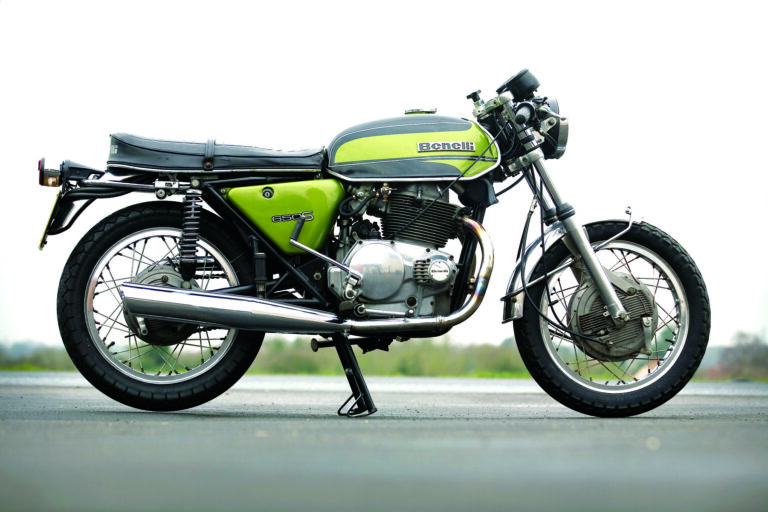
Benelli 650 Tornado
Years Produced: 1971-1976
Power: 52-57hp @ 7,200rpm
Top Speed: 97 mph (period test)
Engine: 643cc (84mm x 58 mm) air-cooled, OHV parallel twin
Transmission: 5-speed, chain final drive
Weight/MPG: 480lb wet/40-50mpg (avg.)
Price then/now: $1,779 (1973)/$2,000-$9,000
Timing may not be everything, but bad timing can scuttle the best of plans. Through most of the 1960s, parallel twins dominated the U.S. market for half-liter-plus motorcycles. And while Honda’s CB450 could give a British twin a good run, Bonnevilles and Lightnings ruled the strip and the sales charts. Not surprising, then, that Pesaro-based Benelli — then the biggest motorcycle maker in Italy — would plan a 650cc parallel twin aimed at U.S. buyers.
Well established as the supplier of Wards-Riverside commuter bikes, Benelli should have had a strong tailwind. But U.S. importer Cosmopolitan lacked an adequate dealer network, and like other makers of big twins, Benelli hadn’t reckoned with Honda’s game-changing 1969 CB750 Four. Just when Benelli was gearing up for its new kickstart-only, OHV, drum-braked twin, Big Red’s smooth four-banger arrived with an overhead cam, electric start and disc brake. The game was over before it started.
Not that the Tornado was a bad motorcycle. Designer Piero Prampolini used his experience with racing engines to pen a compact short-stroke, overhead-valve twin-cylinder engine with horizontally split cases and wet sump lubrication. Below the 84mm pistons were roller bearing rods driving a built-up 360-degree crankshaft with a large central flywheel running on four main ball and roller bearings. A single helical gear on the crank drove both the camshaft (also running on rollers) and the mutiplate clutch. The 5-speed tranny drove the back wheel by chain. The 58mm stroke sucked mixture through a single 30mm Dell’Orto VHB carb. A DC generator supplied the 12-volt electrical system, with ignition by battery/coil and contact breaker. Electrical components were by Bosch.
The power unit sat in a dual downtube spine frame with a Marzocchi front fork and dual coil spring/dampers at the rear, and spoked wheels running on Borrani alloy rims. A double-sided, single-leading-shoe front brake and rear SLS drum provided stopping power. A makeover for the 1973 season included a Bosch alternator and electric start — but the drum brake continued until production ceased in 1976.
The first Tornado prototype was shown in Milan in 1967, though it took four more years for production machines to appear. Cycle World‘s tester reported that the 1971 Tornado usually started first kick, but required a “healthy lunge” on the pedal. The long-throw, right-side shifter (one up, four down) was “deliberate rather than crisp,” and the clutch pull “fairly stout.” At low speeds, the Tornado “handles extremely awkwardly,” feeling top heavy, said the tester, putting this down to the engine being located high in the frame. This was a result of Prampolini’s wet sump design with the oil reservoir under the engine, raising the crankshaft above the level of the wheel axles.
On the street, though, the Benelli turned out to be a “high-speed roadburner,” with “superior road holding.” It also proved to be durable and reliable throughout Cycle World‘s test. “The more miles it accrued, the smoother and more responsive it got. It didn’t start vibrating or leaking or making strange noises.” The only concerns were the lack of an air filter on the intake and a seat that was overly firm, combining with the stiff suspension to give a harsh ride.
The electric-start Tornado S2 arrived in 1973 with higher compression, a pair of 29mm Dell’Orto VHBs, and a new seat and windshield. U.K. moto-journalist Rod Gibson tested the 1973 bike and noted that the engine thrived on revs and needed to see 4,500rpm to develop real power. Vibration was far less than a British twin though many components like fenders and handlebars were rubber mounted.
The Tornado struggled on until 1976, when new, cost-cutting Benelli owner Alejandro de Tomaso pulled the plug. Rugged and retrospectively stylish, Tornados now command a premium price in the classic motorcycle market. MC

1973-1980 Triumph T140 Bonneville
Years Produced: 1973-1980
Power: 50hp @ 7,000rpm/110mph
Engine: 745cc (76mm x 82mm) air-cooled, OHV parallel twin
Transmission: 5-speed, chain final drive
Weight/MPG: 390lb (dry)/45-50mpg
Price then/now: $1,995 (1976)/$3,000-$10,000
By 1974, Triumph’s Meriden factory was worker-occupied, dependent on government support, and had one product line: the 750 Bonneville and its single-carb sibling, the 750 Tiger. The machines that emerged from the workers co-op used the familiar 360-degree parallel twin engine, but now with five gears and a front disc brake. Much attention was focused on fixing the Bonnie’s notorious deficiencies: Oil leaks were moderated; much improved Amal Mk2 carburetors were used from 1976; and electronic ignition followed in 1979. Shifting switched from right to left side in 1975, and a rear disc was fitted from 1976 — but electric start had to wait until the T140ES of 1980.
An anachronism at the time, the T140 is now a capable and rideable classic — a viable alternative to modern retro bikes. Parts are easy to find, and servicing is simple. Lightweight, easy to start, with responsive controls, a relatively smooth engine and confident handling, they’re deservedly desirable and still relatively inexpensive, excluding the most sought-after models like the limited-edition Silver Jubilee of 1977, and the T140D Special of 1979.

1969-1979 Yamaha XS650
Years Produced: 1969-1979
Power: 53hp @ 7,000rpm
Engine: 654cc (75mm x 74mm)
Transmission: 5-speed, chain final drive
Weight/MPG: 428lb (wet)/45-55mpg (avg.)
Price then/now: $1,399 (1972)/$3,000-$7,000
Benelli wasn’t the only bike maker wanting to build a better Bonnie — and the Tuning Fork guys got their first 4-stroke pretty much right. The XS650’s 360-degree crank and camshaft ran on roller and ball bearings, with horizontally split cases and a chain-driven single overhead cam. Starting was by kick-only until an electric starter was added for 1972, the same year the twin-leading-shoe drum front brake was swapped out for a disc. Early models were criticized for excessive vibration and poor handling, though both issues were later addressed with a heftier frame and use of rubber mounts.
Cycle World tested a 1979 XS650F and enjoyed its quick steering, light handling, broad powerband and relative lack of vibes, though a combination of transmission lash and jerky throttle transitions made traffic a chore. But it was the character of the XS that appealed to Cycle World: “It sounds like a motorcycle, not a two-wheeled Porsche; and feels like a motorcycle, not an electric golf cart.” Cycle Guide summed up: “It doesn’t leak, it doesn’t break, it doesn’t require much attention and it doesn’t cost much.” And with more than 500,000 built, there are still plenty around.