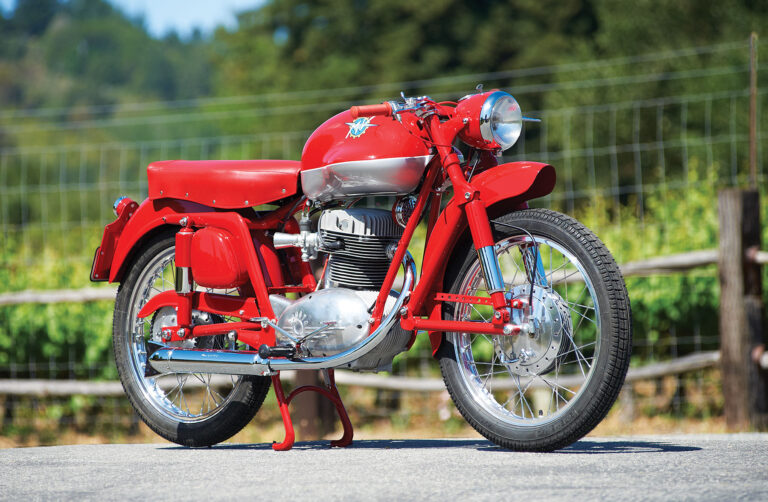
- Claimed power: 15hp @ 6,700rpm
- Top speed: 84mph
- Engine: 172.3cc air-cooled SOHC single, 59.5mm x 62mm bore and stroke, 8.2:1 compression
- Weight (dry): 246lb (112kg)
- Fuel capacity/MPG: 3.7gal (14ltr)/80mpg (observed)
- Price then/now: $448/$10,000-$16,000
It’s more fun to ride a slow bike fast than a fast bike slow, goes the old saw. The Italian Motorcycle Federation and Motoclub Terni must have agreed, because their efforts are mostly responsible for reviving the legend that is the Motogiro d’Italia.
Not that the slow bikes were all that slow. But it was a fatal car crash in another famous contest, the 1957 1,000-mile Mille Miglia, that saw street racing of all kinds — two- and four-wheeled — banned in Italy. When the Motogiro re-emerged it was as a regularity trial, where the objective was to arrive at the right time, not first to the flag.
In its glory years from 1953 to 1957, the Motogiro (motorcycle tour) was a multi-day street race around Italy run on motorcycles of 75, 100, 125 and 175cc, celebrating many famous marques and creating heroes along the way. Laverda and Ceccato excelled in the tiddler classes. Benelli and Ducati did well in the 100 and 125cc groups. Prominent in the prestige 175cc class were Mondial, Morini and Bianchi. And in the last of the legacy Giros in 1957, Remo Venturi was first home on the fabled MV Agusta CSS/5V Squalo.
Venturi’s Squalo (Shark, for the shape of its race fairing) was the ultimate development of MV’s CS range of 175cc machines, the sporting versions of which wore a distinctively shaped gas tank that earned the nickname Disco Volante, or flying saucer.
The 1953 CST introduced MV’s unit construction single-overhead-cam engine, with 6.5:1 compression and 18mm carburetor for 8 horsepower at 5,200rpm. It was the company’s first 4-stroke motorcycle. The swingarm frame, a beefier development of that used on the previous 125 and 150cc 2-strokes, was built up from tubular and pressed steel components and also wore a sturdy telescopic fork while running on 17-inch wheels. A chain spun the overhead camshaft, with a gear primary drive to a multiplate clutch and 4-speed gearbox. Drive to the rear wheel was by chain. Brakes were 7-inch (180mm) single leading shoe front and 6-inch (150mm) rear.
The Tourismo series bikes (CST, CSTL and CSGT) sold well through the 1950s, and were joined by the CS Tourismo Economico (CSTE) with a pushrod engine, and cheaper suspension and brakes. But sporting riders were looking for more — not less.
First came the CS model with 7:1 compression, a 22mm Dell’Orto carb and 11 horsepower at 6,700rpm. The CS introduced the Disco Volante gas tank, which was carried over to the even sportier CSS.
Launched in July 1954 and fitted with hairpin valve springs, magneto ignition, 8.2:1 compression and a 25mm Dell’Orto SS racing carburetor, the CSS produced 15 horsepower at 6,700rpm, giving it a top speed of more than 80mph. Both the CS and CSS ran on 19-inch wheels, with an Earles-type fork for the CSS. The CS was relaunched in 1957 with generator/coil ignition.
Between 1954 and 1958, roughly 4,500 CS and only around 500 CSS Disco Volantes were built. Now they’re in heavy demand as one of the choicest motorcycles for the modern Motogiro d’Italia and its many tribute events around the world, where the legacy formula of pre-1957 and maximum 175cc is applied.
In Motorcycle Classics December 2013, owner Barry Porter described riding his CSS Disco Volante to Margie Siegal. “You don’t go into a turn, grab the brake and power out like on a large capacity bike. All you have is 175cc with a few horsepower and virtually no torque. You become a momentum manager. The goal is to maintain and manage speed through a corner to maximize exit speed. It’s fantastic to work on that skill. You become one with the bike.”
“The best place to ride it is with other Giro-isti on other small bikes. That’s the real fun.” MC
Contenders: Two more 175cc Italian singles

1957 Aermacchi Chimera 175
- Claimed power: 13hp @ 6,500rpm
- Top speed: 68mph (110kmh)
- Engine: 172.4cc air-cooled OHV horizontal single, 60mm x 61mm bore and stroke, 7:1 compression
- Weight (dry): 269lb (122kg)
- Fuel capacity: 5.3gal (20ltr)
- Price then/now: $212 (approx.)/$15,000-$25,000
Motorcycle buyers are notoriously conservative, especially about styling. But the scooter boom of the 1950s led makers to assume that fully-enclosed motorcycles would also sell well. The 1955 Series D Vincent, 1958 Ariel Leader, and 1957 Aermacchi Chimera all attest to the contrary. Practical, yes: desirable …?
Underneath the Chimera’s pastel-colored, space-age bodywork was a simple unit-construction 175cc pushrod 4-stroke single with a sturdy roller-bearing bottom end, bevel gears driving the wet clutch, and a 4-speed transmission.
And while the Chimera (Dream) created a sensation at the 1956 Milan show and was well received by the motorcycle press, its ingenuity and futuristic styling failed to impress potential buyers. To rescue the project, designer Alfredo Bianchi ditched the bodywork, traded the monoshock rear end for a conventional swingarm and a pair of coil spring/dampers, and dressed the resulting motorcycle with period sport styling. The Ala Verde and Ala Rossa were the result. The soundness of Bianchi’s basic design allowed the subsequent development of 250 and 350cc versions successful on street and track. And, of course, the Chimera is now a collectible classic.

1957-1962 Motobi Catria Lusso
- Claimed power: 12hp @ 6,800rpm claimed
- Top speed: 70mph (period test)
- Engine: 172cc air-cooled OHV 4-stroke single, 62mm x 57mm bore and stroke, 8.8:1 compression
- Weight: 252lbs curb (period test)
- Fuel capacity: 4.8gal (18ltr)
- Price then: $569 (1962)
If covering up the engine didn’t work, why not improve its aesthetics? Giuseppe Benelli must have thought so. After an internecine spat, Giuseppe quit the family firm and set up on his own as Moto-B Pesaro in the Adriatic resort of that name. First came 2-stroke singles, then a 200cc twin with rotary valve induction. Distinctive was the dome-shaped cylinder/head, the profile of which was invoked by the 1956 4-stroke OHV Catria.
Suspended from the 1957 Catria’s pressed steel spine frame was a unit construction OHV wet-sump engine and 4-speed transmission with helical gear primary. Like the MV and Aermacchi 175s, the Catria performed well in competition, winning the Italian Junior Championship in 1959.
Cycle World tested a Catria Lusso in 1962 and found it “offers an uncommonly fast and strain-free cruising speed,” as well as “stability, outstanding brakes and impressive cornering abilities,” concluding, “don’t miss any chance you may have to try the Motobi; it’s a real little gem.”
After Giuseppe’s death in 1957, his two sons reconciled with the Benelli family, though Motobi kept its engineering independence for some years.