1983 Harley-Davidson XR1000
Engine: 998cc air-cooled OHV 45-degree V-twin
Top speed: 112mph in 1/2 mile (period test)
Transmission: 4-speed, chain final drive
Weight (wet): 500lb (227kg) (approx.)
MPG: 46mpg (period test)
Back in the early 1980s, Harley-Davidson executives were still a bit nervous about the viability of the company. After all, they were trying to sell old-fashioned pushrod, two-valve, air-cooled V-twin machines in an era of multis with double overhead camshafts, 4-valve heads and liquid cooling.
Shortly after Harley bought itself back from AMF in 1981, the decision was made to junk the revolutionary Nova prototype AMF had been developing, which had a V-four engine incorporating all those contemporary innovations. However, something decidedly kick-ass was needed to convince the faithful that this 80-year-old company still had what it takes to whoop the upstarts, and it had to be done on the cheap. What to do?

Harley’s answer was to get to work on an engine that was first sold to the public in 1952 as the 45-degree, 45ci, unit-construction K-model. That K was a 750cc flathead, later upped to the 883 KH, and then revamped to the overhead XL for 1957, with an 883cc XLR version for the racing crowd.
Racing creation
A change in the AMA’s racing rules led Harley to build the iron-barreled XR750, a de-stroked XLR, which debuted in 1969. Though it wasn’t very successful, it was the beginning of a legend, as it was followed by the alloy XR750 in 1972, which did become a tremendously successful racer.
In the Seventies, some of the Juneau Avenue gang thought that a street-going version of the XR750 should be built, but that turned out to be a non-starter, as neither the engine nor the chassis had any hope of being turned into something with lights and a kickstand. The idea never really went away, however, and after the Harley buy-back in 1981, Willie G. Davidson pushed the idea that a Sportster-based bike with an XR-based engine could be turned into a pretty ferocious piece of machinery.
Willie had designed the stylish-but-underpowered XLCR Café Racer a few years before, a bike that looked good, ran slow and sold poorly. This was going to be an entirely different proposition, with a 1,000cc engine using a combination of XLX Sportster and modified XR750 parts. The end result would become the Harley-Davidson XR1000 and in theory, it sounded easy and inexpensive.
Choosing the pieces
Dick O’Brien, famed head of H-D’s racing department, took charge. A stock Sportster bottom end was specified, but using special barrels and heads. All this would be bolted into the new XLX chassis introduced for 1982, whose welded steel tubes gave it a more sophisticated look and feel than the old version, which had been made using individual castings. Harley’s engineers had figured out how to balance too stiff with too flexible, creating a frame that had the possibility of handling quite well, assuming the proper suspension components were used.
However, life wasn’t that simple, and problems with the XR’s development immediately began to show themselves. The XR750 alloy cylinders would not do, as they were too small (750cc) and even if enlarged they would not fit the XLX cases. New iron cylinders with an 81mm bore were made, and new aluminum pistons required new connecting rods. The V-twin’s fork-and-blade con-rods (one rod rides inside the other on the crankshaft), bolted onto the single-throw crankshaft, remained the same, as did the four rather low-lift “Q” camshafts under the right side cover, providing a broad and smooth torque curve.
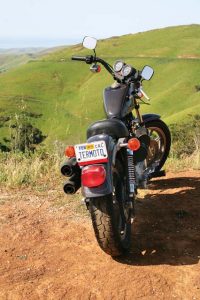
One advantage here was that the new cylinders were designed to use through-bolts rather than the standard Sportster design, which had separate bolts holding the cylinders to the cases and then the heads to the cylinders. There was more finning to aid heat dissipation, but many owners still added an aftermarket oil cooler, including the owner of our feature bike. It’s a very sensible addition.
Head work
Complicating things further, the XR750 heads had to be recast for the XR1000. The new heads used slightly larger valves to allow for the increased 998cc displacement, and also offered better support for the valve guides, considering that this was intended to be a high-mile street bike, not a constantly rebuilt race bike. After basic machining in Milwaukee, the heads were all sent to flow-guru Jerry Branch’s shop in California. Branch did the porting and polishing, shimmed the double valve springs, and put in titanium collars and keepers. None of this was cheap.
One big difference between the iron XL and alloy XR heads was that the valves were set at an included angle of 90 degrees on the stock Sportster versus 68 degrees on the XR. This allowed for a shallower combustion chamber and a flattish-topped piston on the XR, which helped create a shorter route from the spark plug to the combustibles.
High-test gasoline went in through a pair of 36mm Dell’Orto pumper carbs, which both hung out on the right side of the engine wearing large K&N air filters. The average rider on the solo saddle would have his knee just in front of the forward filter, but the presence of all this was noticeable, especially to those with shorter legs.
On the left side of the engine, matching header pipes ran forward, then curved sharply back and over the top of the primary case before concluding in a pair of well-baffled megaphones. It looked great, but when tucked in on the XR, the rider’s left leg was often too close to the exhaust. Heat shields helped a little, but not when stuck in traffic on a 90 degree day.
Performance package
Harley claimed 70hp at 5,600rpm, along with 48lb/ft of torque at 4,400rpm. That power traveled along a triplex primary chain to a multiplate wet clutch, through a 4-speed Sportster transmission and out to the back wheel on a 530 chain. A fifth gear would have been a welcome addition.
The chassis was, unfortunately, a trifle Sportsterish. With the engine securely bolted in place, the unbalanced 45-degree V-twin transmitted a good deal of vibration to the rider. The Showa 35mm front forks had a lengthy travel of 6.7 inches and no adjustment. The rake was 29 degrees, with 4.5 inches of trail, and a wheelbase of 60 inches. At the back, a pair of Showa shocks offered 3.25 inches of wheel travel, with preload adjustability.

This was pretty basic suspension, especially considering what other 1,000cc sport bikes were offering in 1983.
The nine-spoke cast wheels wore Dunlop Sport Elites, which were pretty good tires at the time, with a 100/90 x 19-inch on the front and a 130/90 x 16-inch on the back. The factory offered an 18-inch wheel for the back as an option for the serious go-fast guys. Front brakes were good, with a pair of 11.5in rotors (the first production Harley to wear dual discs) squeezed by single-action calipers, but the rider got remarkably little feedback. Squeeze the lever and you stop. Squeeze the lever harder and you stop quicker, but the lever doesn’t move any farther. The rear wheel wore the same disc with a double-action caliper.
With 2.2gal of premium gas in the tank, the XR1000 weighed just more than 500 pounds. In case an XR1000 owner wanted to go racing, Harley also advertised a hop-up kit with 10.5:1 pistons, hotter cams and an unmuffled exhaust system that claimed to offer an extra 20 horsepower.
Racing pedigree
An XR1000 prototype was on the road in the fall of 1982, and being tested at Daytona, when somebody saw a racing potential in the Battle of the Twins class. It may have even been pre-planned all along. One way or another, Dick O’Brien took the notion to heart and set about building a race version nick-named Lucifer’s Hammer, which was truly exotic. It ran a 10.5:1 compression ratio and put out more than 100 horses at the rear wheel at 7,000rpm. It still used a four-speed transmission, and everything was bolted into an old XR750 double-cradle frame, with Italian wheels, forks and brakes. Gene Church rode it to the top of the podium at the Daytona BOTT in 1983, which perfectly coincided with the release of the XR1000 and made for great publicity.

Lucifer’s victory set the stage, and H-D dealers hoped to be flooded with calls for this new hot rod. The XR was a great-looking bike; all muscle with a tiny tank, minimal fenders and nothing covered up with flimsy plastic panels.
The good and the bad
New owners found starting their XR1000 easy, with a nice little button on the handlebar. The Dell’Ortos did have chokes, but these were rarely needed thanks to the accelerator pumps. It had a strong engine and would turn in quarter-miles in the 12s with a speed of more than 100mph. The noise was wonderful, and not at all like a Sportster. But the price to be paid was in vibration, and to wick it up to 5,000rpm was enough to shake your fillings loose. If you were going to win a race, you could put up with it — but not for a brisk ride on the back roads. Even so, the engine was so tractable that rolling along back roads at 3,000rpm was entirely pleasant. Remember, this was the 55mph era.
Another inhibitor for the enthusiastic rider was the small supply of gas, as the 2.2 gallons could run out in 80 or so quick miles; the 3.3-gallon optional tank was a very sensible choice. The riding position was tough, with the carbs and cleaners sticking out on one side, exhaust headers burning through your blue jeans on the other, and Sportster peg-positioning a little too far forward. Rearsets would have been nice, but would have compounded the air cleaner and exhaust problems.

Then there was the matter of the suspension. If you wanted to ride the XR on smooth roads at not-too-unreasonable speeds, everything was fine. But for serious work, the forks and shocks were just too soft, and the shocks didn’t offer enough travel.
There was also the XR’s peculiar desire to turn left. The exhaust system on the left weighted the bike to the left, and the bike consequently enjoyed going that direction more than going right, even on a straight road. It was nothing that couldn’t be managed, but it was an annoyance, nevertheless.
The almighty dollar
The XR1000’s steep price turned out to be a major drawback. Harley had hoped to build this bike on the cheap, as the company could not afford a loss leader. Yet with all the unexpected mods that had to be made, the MSRP ended up just shy of $7,000. The main problem here was that the XLX Sportster went for $4,000 and it looked a lot like the XR. To add to the XR’s misfortune, for its 1983 introduction the company color stylist had it painted in nondescript gray. The second year Harley had the good, if too late, sense to give it their traditional orange and black racing colors.
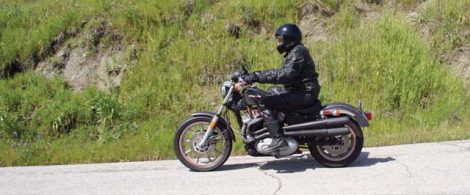
The XR1000 was an impressive machine, a raucous, barroom-brawling bike for the brawling kind of rider. For the average Joe, the XLX was a lot cheaper and looked roughly the same. Harley turned out 1,000 XR1000 models in 1983, and did not sell them all, whereas 5,000 XLX models rolled off the showroom floors. A further 700 XR1000s were built in 1984, but most were sold at discounted prices later on, and the model was discontinued.
The XR1000 is considered mildly collectible now, but not yet valuable. An immaculate 1984 model sold at the 2010 Quail Motorcycle Gathering auction for $8,000 — a pretty bad return for a $7,000 investment 26 years ago. But if you’re looking for XR750 performance in a Sportster package licensed for the street, it’s the only show in town. MC
Press Reports
“As Cotton Mather always promised, sacrifice brings rewards. For the XR1000 rider, those rewards are good power, excellent handling and a motorcycle that’s enormous fun to ride.”
— Cycle World, March 1983
“It’s not the XR750, but it’s the next best thing.”
— Cycle Guide, May 1983
“No one could accuse the XR of flaunting high technology, but it isn’t run-of-the-mill Harley fare, either.”
— Cycle Guide, August 1983
“What most of us thought we wanted when the XR moved from rumor to reality was a race bike for the street. What we got was a street bike that could be raced. It was more than a Sportster, but less than an XR750.”
— Cycle World, March 1993