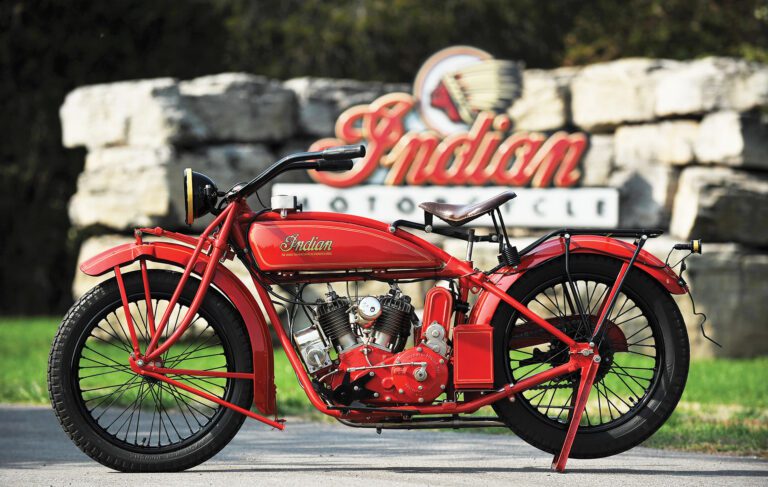
1923 Indian Scout
Claimed power: 11hp
Engine: 596cc (36.4ci) air-cooled 42-degree sidevalve V-twin, 70mm X 78mm (2.75in x 3.0625in) bore and stroke, 4.5:1 compression ratio (est.)
Top speed: 55mph (est.)
Weight (dry): 315lb (143kg)
Fuel capacity/MPG: 3.5 gal (13.2ltr)/50mpg (est.)
Price then/now: $295 (est.)/$15,000-$30,000
“Come on — don’t be hemmed in — see the country on an INDIAN! Ride when you please — where you please — in solid comfort.”
So proclaimed the Indian catalog. The Roaring Twenties was a unique era in America, a time of dance marathons, jazz bands, speakeasies and bathtub gin. Prosperity meant that people had money to spend on fun — including motorcycles, which were transitioning from simple, inexpensive transportation to sport vehicles to satisfy an increasingly leisure-oriented society.
Getting from place to place was becoming more enjoyable and less of an endurance contest. Thanks to legislation passed between 1919 and 1921, the roads were getting better. Motorcycles were getting better, too, and American motorcycle riders of the Twenties had their choice of several different made-in-America brands, including Ace, Cleveland, Henderson, Harley-Davidson and Excelsior. And the first choice of many sport riders of the time was the Indian Scout.

In its day, the Scout was considered fast, stable and reliable. It was in many ways one of the first sport bikes from an American manufacturer. Unlike many of its contemporaries, instead of a collection of not very well matched parts, the Scout was an integrated design. And although the Scout’s 596cc V-twin was smaller than much of the competition, a Scout could bang tires with the best of them. Riders raced Scouts and set out on long-distance, record-setting trips on them, as well.
The story of Charles B. Franklin
The Scout was the brainchild of talented designer and motorcycle racer Charles B. Franklin. Born in Ireland in 1880, Franklin was trained as an electrical engineer. In 1903, shortly after graduating from school, he started competing on the then-new motorcycles, with his first mount a Belgian FN. Franklin was not particularly enamored of the FN, and soon moved to a custom bike powered by a JAP (J.A. Prestwich) V-twin and built up with Chater-Lea frame parts. He was selected for the 1905 and 1906 British international racing teams, and competed on the Isle of Man in 1908 and 1909.

In 1909, an American manufacturer came to compete in the Isle of Man TT. Hendee Manufacturing Company was then one of the largest motorcycle manufacturers in the world, building 4,771 motorcycles under the Indian brand name that year. It had sales agents in England, Ireland and Europe, and was heavily involved in racing in both the U.S. and Europe. W. Lee Evans came in second on an Indian, while Franklin came in fourth riding a Triumph.
Franklin decided Indian was the marque for him. In 1910, he turned up on the Island on an Indian V-twin but crashed after his rear tire blew out. He also started an Indian dealership in Dublin, Ireland, and was a regular competitor on an Indian at the Brooklands track in England. The next year, Franklin was part of the Indian Isle of Man factory team and scored his best finish, coming in second. Indians took the top three places that year.

Franklin spent the next few years selling and racing Indians, but in 1914 most of Europe became embroiled in World War I, and racing stopped for the duration. The Irish Indian distributor, Billy Wells, hired Franklin to manage the Indian sales and service depot in Dublin in 1915, but had to close the depot because of the war after only one year. The U.S. had not yet entered the conflict, and Wells was able to transfer his protégé to Indian’s Springfield, Massachusetts, factory, where Franklin went to work in the design department.
Changes at Indian
In 1915, Indian was in a time of transition. The company was started in 1901 by George Hendee to build a motorcycle designed by Oscar Hedstrom. It was powered by an inlet over exhaust single-cylinder engine that was a development of the De Dion engine invented in France prior to 1895. Over the next few years the Indian, which at first looked like a bicycle with an engine, gained a twistgrip throttle, sprung front forks and its trademark Indian Red paint.

The company introduced its first V-twin in 1905 or 1906. By 1908, options included an all-gear primary drive that was good for the life of the motorcycle, mechanical intake valves (the earlier “automatic” or atmospheric intake valves had a tendency to either stick open or stick closed) and magneto ignition, a major improvement on the previous dry cell sparking.
Prior to 1907, Indian’s foundry work had been contracted out to the Aurora Automatic Machinery Company. Hendee decided that Indian should have its own foundry and borrowed a lot of money to build it. This had unforeseen consequences. Indian was never again able to get out of debt, and the interest ate up the profits. The banks put their own directors on the corporation board, and they repeatedly clashed with both Hedstrom and Hendee. Hedstrom got tired of the infighting, and he left in 1913; Hendee left in 1916.
Meanwhile, Indian hired Charles Gustafson Sr., an expert on sidevalve engine construction, away from rival Reading Standard. Sidevalve engines, where intake and exhaust valves are situated next to each other to the side of the piston and actuated by cam gears through tappets, are capable of a surprising amount of power if the cylinder head is shaped correctly. Given the metallurgy and lubrication technology of the time, sidevalve engines had many advantages. They were cheaper to build than the earlier inlet over exhaust valve configuration, and easier to keep running, especially given the low octane gas and primitive oils then available.

Gustafson designed a new generation of sidevalve engines for Indian. First on sale in 1916, the new Powerplus models quickly proved themselves. The 61-cubic-inch V-twin version featured a 3-speed gearbox, webbed flywheels, chain drive and rear suspension. Leaf springs fore and aft took the bumps out of the road.
Franklin began to explore the possibilities in sidevalve engine design. He was involved in designing a racing chassis, a competition transmission and a special clutch assembly. Importantly, it is thought that Franklin discovered the “squish” principal independently of engine designer Harry Ricardo, who is usually credited with the discovery. The squish principal increases engine efficiency by reducing the combustion chamber height above the piston to a minimum, literally squishing the fuel/air charge and creating turbulence to promote complete mixing of the fuel/air mixture for better combustion.
Beginnings of the Scout
Franklin-designed Indian racers set records and cleaned up on the track. Franklin soon got the opportunity to design a road machine for Indian, and the Scout, which appeared in late 1919, is a testament to his engineering abilities. The first Scouts were 36.4-cubic-inch (596cc) V-twins with bore and stroke of 2-3/4 x 3-1/16 inches. They had an innovative double-loop cradle rigid frame (the Powerplus leaf spring rear wasn’t used because it didn’t function well at speed), leaf spring front forks, a 3-speed sliding gearbox with hand shift and foot clutch, total loss lubrication and a single band brake in the rear wheel.

The one-piece webbed flywheels in the Scout engine were supported by roller bearings on both sides. Each of the twin cylinders, angled 42 degrees apart, had a dedicated camshaft with one cam lobe to operate both intake and exhaust valves. Cylinders and cylinder heads were cast in one piece with removable caps above the valves. These were a weak point as the valve caps tended to draw heat. A removable head was introduced in 1925.
The separate engine and transmission were bolted together in semi-unit construction, with power transferred by a helical gear primary drive that was so stout it would outlast the motorcycle. As with all contemporary motorcycles, the oiling system was total loss.
Franklin paid a great deal of attention to engine cooling. A weak point in sidevalve designs is distortion of the cylinder due to heat from the exhaust valve. To combat this, Franklin swung the valve pocket away from the cylinder and used the longest fins he could while also ensuring there was air space between the cylinder and the covers that encased the valve stems.
The Scout was a hit, and was soon joined by the larger 61-cubic-inch Chief. Hillclimbers, including competition star and Indian factory rider Orie Steele, proved themselves on Scouts. Record breakers were drawn to the Scout, and Paul Remaley set a record time for both the Canada to Mexico route and the transcontinental route on a Scout in 1923. Several hundred Scouts were purchased by police departments in Massachusetts and Pennsylvania.
Unfortunately, Indian’s engineering prowess was not matched by managing acumen. By the 1920s, Indian was run by speculators, some of whom were actually stealing from the company. E. Paul DuPont learned of the shenanigans and was able to purchase Indian cheaply in 1930, due to the prior owners’ fear of exposure. Shortly afterward, Franklin contracted cancer and had to take a leave of absence. He died in October 1932, at the young age of 52.
The legacy continues
The legacy of Charles B. Franklin, his race bikes, his Scout and his Chief, lives on. Although the excellent frame he designed for the late-1920s 101 Scout was discontinued in 1931 because of the Depression, the Scout bounced back in 1934 as the Sport Scout and carried the Indian banner in American motorcycle competition through the early Fifties.

The 101 Scout, with a 45-cubic-inch engine and a longer wheelbase, was a staple of stunt riders for years, and is still used by some Wall of Death shows. Yet while 101 Scouts and Sport Scouts are so popular that people are still making parts for them, the earlier Scouts are rare. Don Hart, a Canadian construction company owner who collects vintage American motorcycles, picked up our feature 1923 Scout at a bike show in Canada.
“I’ve always liked antique cars, but a while back I bought a 1943 Harley-Davidson WLC,” Don says. “That started my collecting antique motorcycles. I saw this bike [Indian Scout] and liked the looks. At the time, I had nothing that old.” Don is too busy to do his own restorations, so he likes to buy bikes that are completely restored. This one was no exception, and it came to Don exactly as you see it here.

The leaf spring front forks look strange to modern eyes, but people with experience riding leaf spring fork Indians praise their handling. The Scout’s double cradle frame was a Charles B. Franklin innovation, and it handled exceptionally well for the era. And the seat springing arrangement took a lot of the bumps out of the rough bumpy roads of the 1920s without creating the handling problems of early rear springing arrangements.
“This Scout is a good example of early motorcycle history,” Don says. “The looks, the styling and the longevity of the model all appeal to me. I have always liked Scouts.” Fortunately, almost 100 years after the Scout was first introduced, we can still enjoy them for what they were, one of America’s first true sport bikes. MC