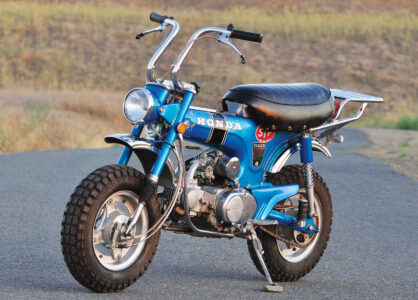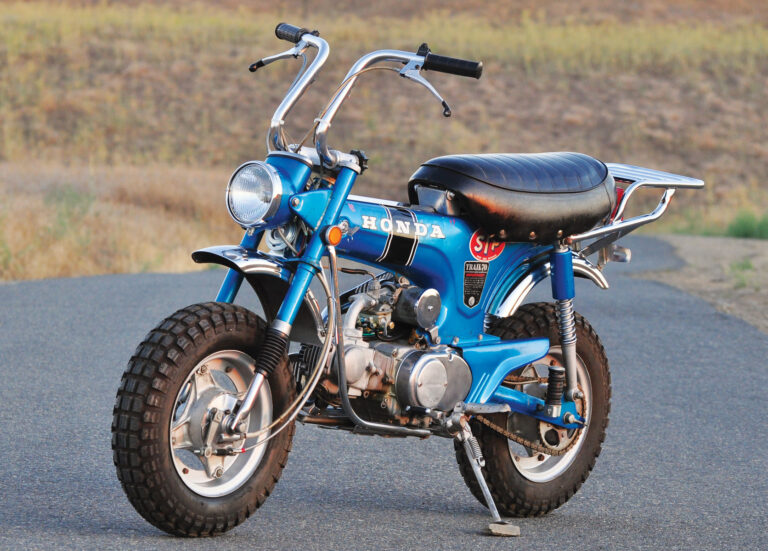
1970 Honda CT70 Trail 70
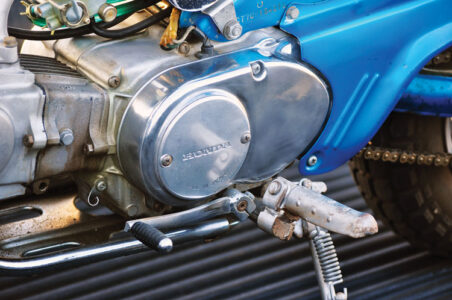
- Engine: Single-cylinder, 4-stroke, OHC, 1.85in x 1.63in bore/stroke, 5.0hp @ 8,000rpm, 8.8:1 compression ratio
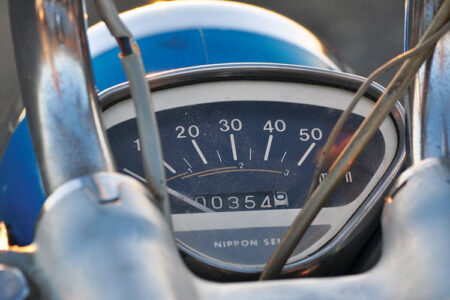
- Top speed: Approx. 30mph
- Carburetion: Single 15mm Keihin carburetor, polyurethane foam filter
- Transmission: 3-speed, semi-automatic, chain final drive
As the 1960s began drifting into a deep slumber, and while 1967’s original Summer of Love slowly settled into its counter-culture hangover, one that blurred the minds and memories of that carefree generation, there was a change in the motorcycling world, too. The industry was growing — even maturing — at a rate like never before.
And just as the disco era managed to stay alive through the 1970s, the mini-bike market had expanded to join a growing motorcycle industry into the 1980s. It was a time when specialized motorcycle designs and platforms dominated the showroom floors. Soon enough, bikes sporting names like Ninja and Interceptor became popular, later to be joined by chopper-like Custom Specials sporting buckhorn handlebars and “King & Queen” two-up seats that further distinguished them from the growing legions of motocross and off-road bikes, and the list goes on. Two-wheeler mania had feverishly spread across America and around the world.
Mixed into the fray, mini-bikes had also become viable and profitable products for motorized two-wheel transportation, not to mention for recreational riding, and even for racing. And so, the mini-bike “love” spread among riders of all ages and backgrounds. As history reminds us, the emerging mighty minis of the late 1960s and early 1970s had ushered in a fleet of new, exciting, and slightly larger and faster mini-bikes.
As you can imagine, the new generation of mighty minis benefited from larger-displacement engines producing more power to match the new-generation minis’ sophisticated chassis, which were larger and stronger than what previous mini-bikes had offered. The larger mini-bikes’ reconfigured chassis also boosted overall performance and comfort, thanks to improved suspensions that also benefited from larger and stronger wheels and tires. In turn, that allowed for more effective brakes to slow them down more quickly. Clearly, the new generation of “mighty minis” quickly gained a following of owners and riders, young and old alike. Welcome to the age of mighty minis, super minis, big minis… or whatever mini pronoun you prefer to describe them.
Period motorcycle magazines of the late 1960s picked up the pace, including ads featuring the reimagined mini-bikes that boasted more muscle, more rider and passenger space, and, for that matter, more everything. The new bikes, it seemed, were based on the age-old jingoistic motto that Americans perfected long ago from our Star-Spangled past: “If bigger is better, then even bigger is even better-er!”
Benelli was among the first mini-bike manufacturers to buy into that theory, touting the new generation of 1969 Benelli mini-bikes as “miniaturized motorcycles that are road legal.”
Elsewhere that same year, Bonanza’s magazine ads featured their new-generation mini-bike that echoed similar messaging with its “Big Bike Power Mini.” It was a model that boldly used Hodaka’s proven four-speed 100cc two-stroke engine for power, and it was among the better-performing small-bore engines of the time. The following year, Bronco declared that its MiniMite was “Built Tough to conquer the rough Backwoods.” And the beat went on.
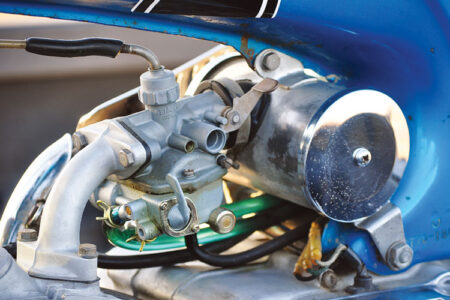
Then, as if a bad LSD trip struck the new generation of “muscle minis,” Honda Motor Co. spiked the punch bowl with the CT70 Trail 70 mini, a model that was one step above Honda’s big-selling Z50 Mini Trail. In typical Honda fashion, the new mighty mini elevated the quality and performance level among the new big-bore mini-bikes. The minis that failed to keep up fell to the wayside. Yet, despite or because of the CT70’s overnight success, American Honda’s marketing team seemed confused in settling on a common model name that best described the new, larger mini’s introduction to the U.S. market. Early magazine reports and road test articles ranged from calling Honda’s new model Mini Trail CT-70, CT-70 Mini, CT70 Trail, among various other configurations.
DAX on, DAX off
In truth, when Honda engineers began developing the upgraded CT70 project, they originally used the code name “Dax,” or “Mini-Trail DAX,” because the new mini-bike’s profile emulated the unmistakable profile of the lovable dachshund dog, known for its long and low profile that’s visually disrupted by the adorable canine’s four stubby legs. Soon after its release to the world market, the CT70’s DAX label proved especially popular with the Japanese domestic market and Europe’s world market. But “DAX” failed to catch on in America. Bottom line, though, is that the CT70’s long and low press-steel frame, with its stretched backbone and stubby wheels and tires, gave the impression of a dachshund dog. Thus, the DAX label was used in various world markets (plus future, and upgraded, models as well), but initially not in America. Regardless of the bike model’s name, the DAX concept resulted in a refined ride for a mini-bike. In later years, new models, some sporting modern electronic fuel injection and such, have used the DAX model name.
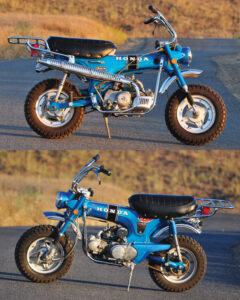
Regardless, and whether it’s DAX on or DAX off, there was logic to the original CT70’s peculiar platform that Honda packaged in a stylish press-steel frame that, in typical Honda fashion, was strong and supportive. Certainly, too, the frame’s longer nose-to-tail dimensions allowed for the larger and longer seat that, in a pinch, could handle two-up riding for junior-size kids or full-grown adults. The seat also doubled as an access hatch that concealed the sub-gallon fuel tank tucked neatly within the frame and the folding seat. A unique adjustable venting system prevented gas from sloshing out when/if the mini-bike was transported in an automobile trunk.
Most of all, though, the bike’s longer frame, a design that was often referred to as a T-bone frame, allowed for a longer wheelbase and bigger 10-inch wheels and tires front and rear. More traction spells better handling, bigger brakes offer superior stopping performance, and simply put, more rider and passenger space means more leg room for rider and passenger.
Unlike the formidable, yet smaller, Honda Mini Trail 50 that Honda had based on the original Z50 series, the larger CT70 was equally tailored for riders of all age (and size) groups. But unlike the original Z50 platform, the CT70 offered versatility in a market that grew to include riders of all age groups looking to join the “nicest people” on their Hondas. In fact, Honda’s engineers and stylists learned quickly that the early Z50 mini-bikes had gained similar versatility simply by replacing the Z-bike’s original low handlebars with higher bars to help make way for larger riders. Thus, the “High-Bar” Z50 in 1968, in all probability, led to the CT70’s folding high-rise handlebars as a standard feature. Of course, shifting through the automatic transmission’s three-speed gearbox remained easy and straightforward, which cleared the path for inexperienced riders to accelerate their learning curves as novice riders. At this point, it should be noted that for the first few years, Honda also offered the CT70H version with an optional 4-speed transmission with a manual clutch — much like a real motorcycle! That variation lasted only a few years and is on the most valued CT70.
Otherwise, most early CT70s retained the same down for neutral, up for first, second, and third shift pattern that kept the bike’s automatic transmission’s moving parts in lock-step before returning the gears to neutral by shifting down three times when stopping. By all rights, and generally speaking, if you could reach the CT70’s shifter, you should be capable of riding the 140-pound mini-bike.
Despite all the CT70’s wholesome qualities, the lads at Cycle World magazine couldn’t resist ragging on the DAX name in their initial report, making no bones about the new bike’s name, cooly stating: “For some unfathomable reason, the model name of the bike is ‘Dax,’ after the dachshund dog. Among the Dax’s more prominent features,” they continued, “are the detachable front fork, folding handlebar, three-speed transmission with automatic clutch, and press-steel T-bone type frame.”
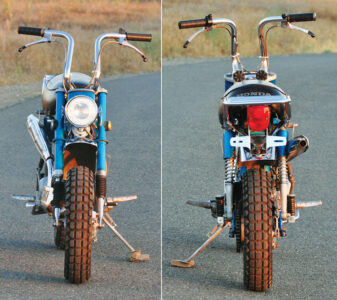
Despite having no earth-shaking or groundbreaking technology in the CT70’s makeup, the bike’s straightforward technology represented the best that Honda offered in 1970, and that’s saying a lot about the new design. The new and noticeably larger mini-bike checked in as a proven platform that quickly became a longtime success story in terms of performance, sales, and popularity among owners. Production began with the 1970 model, and variants with new and more powerful engines have since found their way into the CT70’s lineage. Perhaps the biggest takeaway concerning this well-worn model is the versatility and ease of operation that helped make it near and dear to so many people since 1970 and counting. Chances are good that a walk through a motorcycle parking lot, swap meet, or vintage bike show might put you within range of a restored or well-worn CT70, of which some model years sported some very colorful original paint schemes. Candy Gold, Candy Sapphire Blue, and Candy Rivera Blue were among the offerings. Candy Blue Green, Mighty Green, Candy Emerald Green, Candy Topaz Orange, Candy Ruby Red, Candy Yellow Special, and Tahitian Red were among the offerings through the early 1980s.
In fact, while exploring the recent AMA Vintage Motorcycle Days Swap Meet out in Ohio, members of this magazine’s staff encountered several CT70 owners, and the common thread about Honda’s CT70 that’s shared by owners was pretty much the same: For instance, Mike, from Medina, Ohio, eagerly stated about his small CT70 collection that included parts for sale at the swap meet: “It’s a Honda. What more do you say?” he told us. Like many CT70 owners, Mike, now in his 60s, has been a CT70 rider and owner since his boyhood. “I owned one when I was a kid,” he said, “and I continue riding them today.”
All In the Family
In fact, our featured CT70 was acquired by my neighbor Jim when he was 11 years old. His father, Stan, bought a pair of first-year CT70s for Jim and his 14-year-old brother Tom. They took delivery of their bikes where they grew up, in Whittier, California, a small suburb about 12 miles southeast of Los Angeles. Looking back, Jim recalls their boyhood experiences with their new blue minis. For the most part, their riding focused on roaming various vacant lots and open spaces that Whittier offered at the time. Jim picks up the story from there: “My biggest memory was riding along the railroad tracks that were down the block from our house,” he starts off. “We’d get home from school, and first thing we did was fire up the minis, then head down to the tracks where we just kept riding back and forth, back and forth. The local fire station was next to the tracks, and the firemen would come out and watch as we went back and forth, back and forth.” Pause now as Jim shakes his head before continuing. “We never tired of that, and a few times we offered to let the firemen ride our bikes… and they took us up on the offer!” He continued, “and they rode… back and forth, back and forth.” Several of their friends bought CT70s, too, including two brothers, Brian and Gary, each riding one of the standard-shift H-models with 4-speed transmissions. “They had the fastest bikes,” adds Jim.
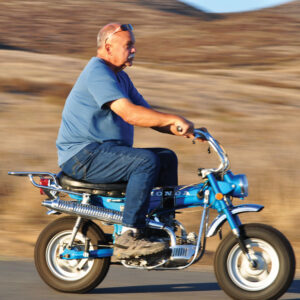
Jim also recalls the day he rode his Honda CT70 to the gathering spot where his fellow teenage friends (he was a sophomore in high school by now) gathered to share gossip and simply hang out. His girlfriend at the time showed up later, and while Jim and his friends continued joking, teasing each other, and sharing stories as teenagers will do, she busied herself polishing her fingernails. Unnoticed, his girlfriend began painting her initials on Jim’s CT70!
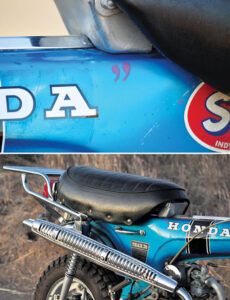
“I wasn’t paying attention,” recalls Jim, “and things got a little out of hand — no pun intended,” said Jim, “and when I got up to leave I noticed that she had painted her initials, both letters set between curlicue apostrophes on the bike’s frame (on both sides and directly beneath the two-up seat).” By the time Jim rode home, the nail polish had dried. Keep in mind that EPA standards were much lower then than they are today, so the dried lacquer proved hard to remove. He managed to remove the initials, but by the time he rubbed on the apostrophes, the nail polish was fully dry, and you can easily spot them today on the bike’s pressed-steel frame. To this day, the four markings, two on each side of the bike, remain as part of the faithful mini-bike’s well-earned provenance.
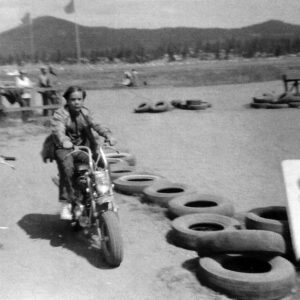
Perhaps Jim’s fondest memory took place at a rundown go-kart track in Big Bear City, a winter resort town in the nearby San Bernardino Mountains. Jim said, “It was a summer day, and the owner of the track was there, but nobody was racing around the track.”
“So, our dad gave the track owner $10, and he let us ride our bikes on the track the remainder of the day. We pretty much had the whole track to ourselves. We finally ran out of gas.”
The Happy Days continued, too, when the two brothers, now a little older and with broader aspirations than to putt-putt back and forth over railroad tracks, passed along the bikes to their cousins, Bill and Chuck, who gladly accepted the keys to begin their journey on two wheels. The bikes were returned to Jim and Tom a few years ago, and the reunion offered a final opportunity to get a photo of Jim, Tom, and their father, Stan, alongside the two mini-bikes. Sadly, Stan and Tom passed away from illnesses a short time later. In addition, Tom’s former bike has since been acquired by a collector, but Jim remains true-blue to his CT70 that resides in his Southern California garage. And a quick glance at the bike’s frame confirms who it belonged to — Jim! The frame still displays those four “beloved” apostrophes!
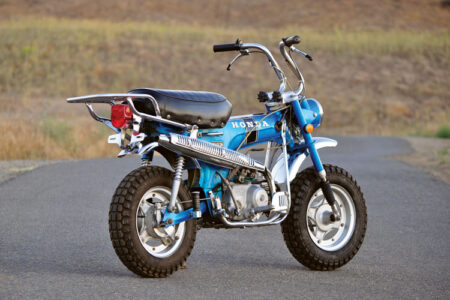
Fittingly, Jim’s bike checks in as a survivor, one that retains its original chrome and blue paint that, in turn, wears every minor chip, ding, dent, and rust scar the bike earned the past 55-plus years; and that includes the four “love tattoos” applied back in the day. Even the Honda’s seat upholstery has survived the years, which include additional mileage after Jim and Tom passed along the identical CT70s to their cousins, who continued the family legacy with “their” bikes that included riding them at family gatherings. Finally, in 2015, Bill and Chuck returned the bikes to their older cousins, and the reunion included Papa Bear Stan, the man who got the show on the road in the first place, accepting the return of the bikes’ keys.
So, there you have it, all you mini-bike fans. We’ve also included a brief sidebar to include my own CT70 war adventure that featured a friend and me with our CT70s. And we invite you to send us your mini-bike (of any make or vintage) story, too, that we can post on the Motorcycle Classics website. Until then, remember, it’s Dax on, Dax off. MC
Speed is Only Relevant to How Fast You’re Going
Dateline: Orange, California, 1973 — Turning the clock back to 1973, when I was a young man: My good friend and I had purchased a couple of matching used CT70s from another friend who originally bought them for his two boys. John and I usually spent time on our minis, chasing each other and a couple of other “grown-up kids” with their mini-bikes at Bonsai Race Track, an abandoned mini-bike race track in Anaheim, California. The track began as a small MX raceway on a vacant street corner adjacent to Anaheim Stadium, where the MLB California Angels played their home games.
One night, John and I were working on my Formula Vee race car when we got the itch to play on our mini-bikes. As the clock approached midnight, we began closing up the garage when John fired up his CT70 and started popping wheelies in the alley. Naturally, I followed suit, and eventually we worked our way onto the street. Back in 1973, Orange, California, was a typical suburb that usually experienced little or no neighborhood traffic, so there was no need to worry about cars on the road as we continued popping wheelies… until we heard the sound of a V-8 engine’s angry 4-barrel carburetor’s secondary butterfly valve WFO (Wide Flat Open). We looked up the empty street only to stare at the single police car, lights flashing, and in pursuit of… us. Of course, we hastened to escape, our 70cc engines grunting and working hard to return us to my garage. Within seconds, the police car intercepted us, and Officer Barney told us he was going to cite us for “Exhibition of Speed.”
“But there’s nobody watching us ‘speed,'” said I, motioning with empty hands to the empty street. To which Barney replied, “I saw it,” before he began writing John’s and my tickets. When he handed me my citation, I scanned it, noticing the box in the upper corner that stated: “Approximate Speed… 0 to 3 mph.” It was the slowest speed recorded on any (and there were many) traffic violations during my formative years. If you can get below that “top speed,” I’d love to hear from you. Until then, Gas it, Starbuck!” –Daingerous Dain