1969 Honda S90
- Engine: 89.6cc OHC air-cooled single, 50mm x 45mm bore/stroke, 8hp @ 9,500rpm, 8.2:1 compression ratio
- Top Speed: 60 mph
- Carburetion: Keihin
- Transmission: 4-speed, gear primary drive
- Electrics: 6V alternator, battery and coil ignition
- Frame/wheelbase: Pressed steel T-type frame, 47in (1194mm)
- Suspension: Telescopic front fork, dual shock rear
- Brakes: 3.5in drum front and rear (90mm)
- Tires: 2.50 x 18 front and rear
- Weight: 176lb (79.8kg) dry
- Seat height: 28in (711.2mm) approx.
- Fuel capacity: 1.85gal (7.0ltr)
When Frank Brezsnyak resurrected a pair of Honda S90s, he simply wanted to honor all that was mostly original about the small-bore motorcycles and never intended to perform near-concours restorations. For someone who was introduced later in life to the world of powered two-wheelers and had limited mechanical experience, he met the challenge with enthusiasm.
Motorcycles were the furthest thing from Frank’s mind when he met his future wife, Shirley, in 2011. But Shirley had a pair of 50cc Honda Jazz scooters in her Calgary, Alberta, garage, and she also had her motorcycle license. Enter Shirley’s brother, Brian. Frank laughs and says of Brian, “He’s retired, and he’s kind of a role model of how a retired guy should live. He has a motorhome, and at that time, a Honda Gold Wing. He and his wife, Joanne, would go into the states, park the motorhome, and cruise around on the Wing.”
Frank continues, “One time, Shirley and I were in Palm Springs, and Brian and Joanne were nearby. Shirley suggested we rent a motorcycle, and we’d all go for a ride. I didn’t have a license, but Shirley did. Because of the scooter, she’d taken rider training and had a license, but I didn’t think renting a big machine was a good idea, especially when she had never ridden a big bike before and I would be the passenger. She was full of confidence, but thankfully, collective wisdom prevailed.”
Returning to Calgary, Frank took motorcycle rider training and got his permit. About a year later, he bought a Honda Shadow, rode it for a season, and followed that with a new 2017 Indian Roadmaster. Knowing she wasn’t well-suited to being a passenger, Shirley then bought herself an Indian Chief and became acquainted with riding a larger machine. In the interim, though, the little Honda Jazz scooters sat in storage.
“In 2020, we started to think they’d be fun to poke around on, but they needed carb jobs and some cleaning up,” Frank says. “I took the carbs apart, cleaned them, and rebuilt them, and that was my first foray into any kind of motorcycle repair. I worked as an engineer for a living, but I wouldn’t have considered myself a really handy guy. But we got those Jazz scooters going again, and it was pretty rewarding.”
That experience with the Jazz scooters planted a seed, and two years ago, as he approached retirement at age 60, Frank began thinking about a hobby and figured a classic motorcycle might be just the ticket. That’s when Shirley surprised him with a 1969 Honda S90 as a 60th birthday and retirement present.
Honda’s S90
In 1958, Honda’s first motorcycle in the U.S. was the Cub. A popular 49cc four-stroke with pushrod-operated overhead valves, the Cub had a step-through frame and three-speed semi-automatic gearbox. In the early 1960s, the Cub was followed by the twin-cylinder Dream and Hawk models. Those CA and CB machines offered something to riders with more serious aspirations, but there was a missing middle, even though in 1963, Honda offered the “Touring 90,” or C200.
The C200 was more of a motorcycle than the Cub. Though still with a pressed steel frame, it wasn’t a step-through, and there was a proper gas tank on the backbone. Forks were pressed steel, too, with Honda’s leading link suspension. Its engine featured pushrod-operated valves with a forward canted all cast-iron top end. It offered riders a genuine clutch and four gears, but sporty it was not.
In 1964, Honda filled that void with the S, or Super, 90. With none of the clunky plastic shields or fenders of the more utilitarian step-through Hondas, the S90 was a revelation.
“The Honda S90, or the ‘Super 90’ as some are already calling it,” said a Cycle World article in the February 1965 issue, “is a genuinely remarkable little machine.” The motorcycle featured a new 89.6cc all-alloy engine with a chain-driven overhead camshaft and an over-square bore and stroke of 50mm by 45mm. For Honda, then-famous for its small-bore machines, it was the way the company was moving, having earlier in 1964 just introduced their first “little” engine with an overhead cam in the step-through C65 Super Cub, then the OHC Sport 65, also with an overhead camshaft, for 1965.
In the S90, the single piston moved in an iron-lined alloy cylinder, and the big feature was the alloy head and its camshaft. Early S90s built from ’64 to ’66 employed a Mikuni, while in ’67, Honda switched to Keihin carburetors. Regardless of the make, the carb sat at the end of an impressively long intake manifold, and the air cleaner, Cycle World said, was of “vast proportions that looks like it would do a good job for an engine twice the size.”
The connecting rod turned on a caged roller bearing while the crank itself was supported on each side by ball bearings. It produced 8 horsepower at 9,500rpm and between 4.7 and 5ft/lb of torque at 8,000rpm. Power was sent through a geared primary to a wet multiplate clutch, into a constant mesh 4-speed gearbox, and to the rear wheel via chain final drive. Top speed was just over 60 miles an hour.
“The most significant change in the Honda lightweight,” Cycle World continued in its “Road Impression,” “is the use of telescopic forks, hydraulically damped. Previously, Honda employed the leading link system, which works fine but offers only a very short distance of vertical travel, consequently limiting the damping ability of the suspension. Adding a sporty touch are the accordion dust covers over the sliding joint on the forks. A metal or plastic sleeve will do the job as well, but we like the ‘big bike’ touch.”
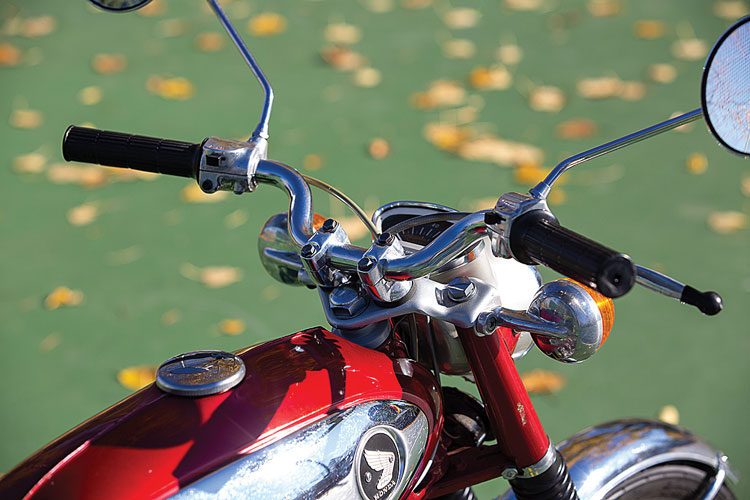
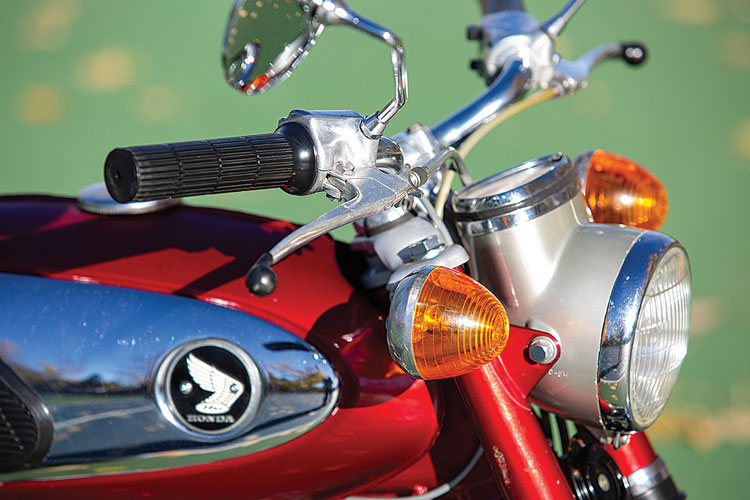
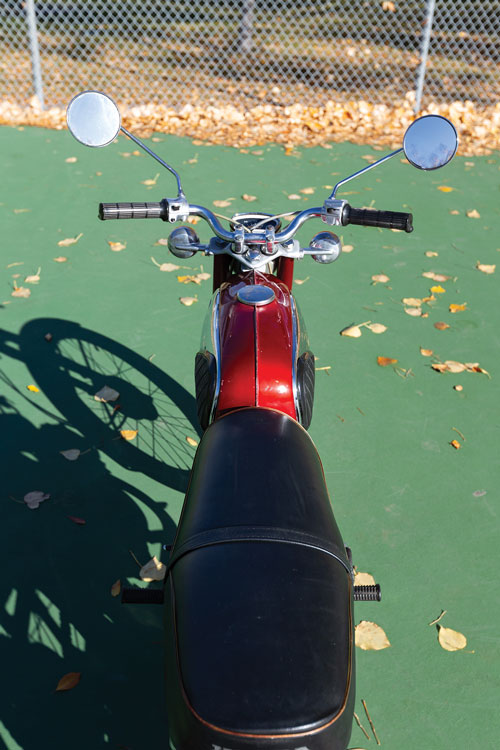
All of this was packaged in a T-shaped pressed steel frame, and “big-bike” 18-inch wheels were at either end of the S90. Drum brakes were well up to the task of slowing the machine. With its stylishly shaped 1.84-gallon fuel tank with chrome side panels, it was a sporty-looking bike with narrow metal fenders. The front fender smartly emulated the guard of a Honda Grand Prix race bike, and front and rear fenders were painted silver. The S90 was equipped with a fairly low-rise handlebar, and the four main colors available were White, Black, Scarlet, and Royal Blue. For the 1968 model year, Honda added signal lights, and, that year, fenders were flashier in chrome and colors were glitzier with candy finishes.
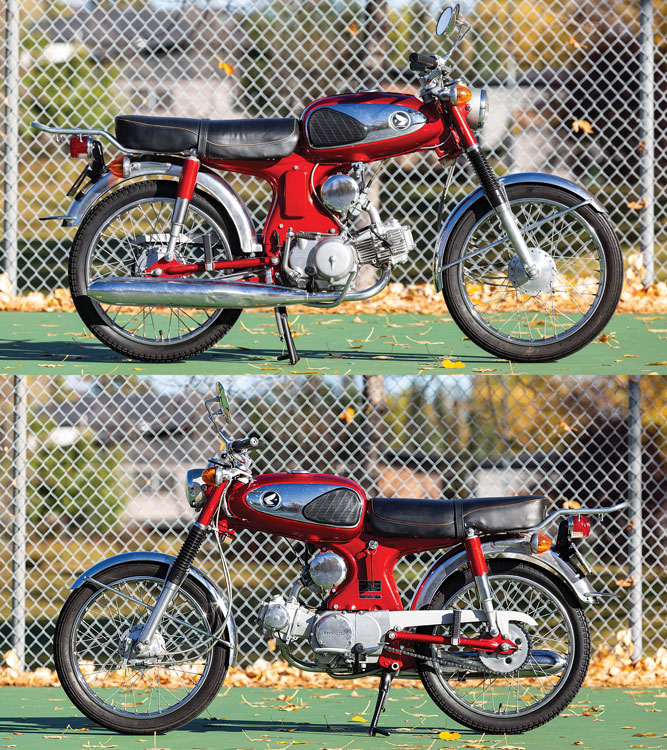
Period Honda advertising circa 1968 said of the updates, “This Honda adds style to the popular lightweight sports bike. Fun and easy to ride safely anywhere you go — in town, on the highway, or off the road. Plenty of power, whether riding solo or double. Quick acceleration in any of the four gears. It blasts up steep slopes quickly, too.”
Honda quit producing the S90 in 1969, and by then, some 92,793 of them had been sold in America. The bikes were incredibly popular, especially in states where it was legal to ride smaller motorcycles at age 14 with the proper license.
Delving into the project S90
In Calgary, Shirley found the first 1969 Honda S90 for sale on Facebook Marketplace. It was in a neighborhood not far from their home, and the seller told her he’d had it for five or six years and that he’d bought it from someone in Edmonton, Alberta’s capital city. In fact, it still wore an Alberta Cycle sticker, a well-known Edmonton dealership. He wasn’t going to do anything with the project and had decided to move it on.
Overall, it appeared to be complete, although there was lots of rust. The tires were flat, and it wasn’t running, but the motor did turn over. “I didn’t really do much with it immediately, as we winter in Texas, about a half hour north of San Antonio. We were on our way down, and honestly, I wasn’t quite sure if it was a good or bad barn find,” Frank recalls. “But when we got to our place in Texas, I did begin ordering some parts and pieces for it.”
When Frank and Shirley got home the next spring, they managed to get the Honda to fire and run, but didn’t take it for a ride. Instead, the bike was taken apart to begin a sympathetic restoration. Both Frank and Shirley really began wrenching as a team during the process, and they met Dave and Rex Fisher, Calgary brothers who specialize in repair and restoration of older motorcycles under their MotoBros banner.
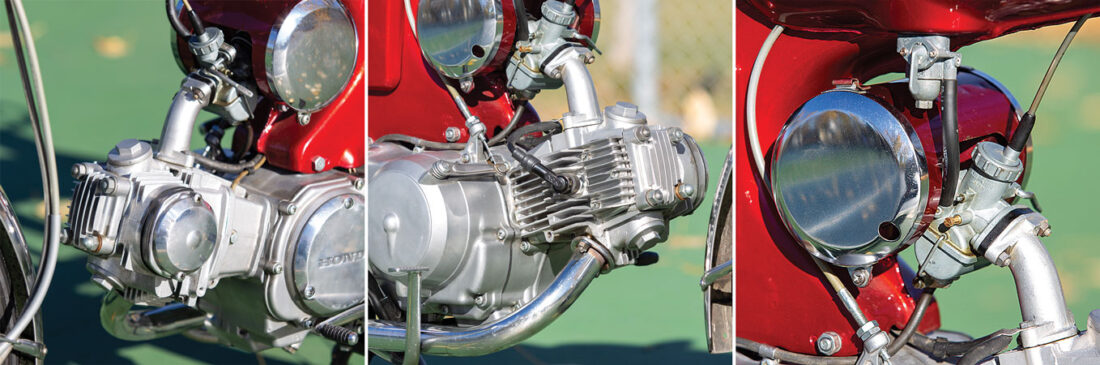
“The engine, even though we think it had around 3,500 miles on it, looked pretty rough externally, and I was talking to Dave about it one day,” Frank says. “I asked him, ‘If I took it apart, how tough would it be to get it back together?’ He said that it’s not a bad engine to work on. So, I thought I’d go ahead and tackle it.”
They also met Jim McVee, someone Frank says was similarly critical in fostering their enjoyment of working on vintage Hondas. As a young man, Jim had worked at Alberta Cycle in Edmonton and could have originally assembled Frank’s S90. Now living in Calgary, Jim has a large accumulation of parts for old Hondas and extensive knowledge.
“Jim, Rex, and Dave really took us under their wings and taught us so much,” Frank says, “from how to true a spoked wheel to the intricacies of everything engine. So, apart from some of those initial online purchases, eBay and YouTube were last resorts for parts and know-how. We have Jim and the guys at MotoBros on speed dial. They’re very special humans.”
Taking plenty of photographs as they went along, and working with parts books diagrams with support from Jim McVee and MotoBros, the engine and bike were completely dismantled. All the alloy components were vapor blasted by Rex at MotoBros. Crankshaft and con-rod bearings were all in usable condition, and the standard cylinder bore and piston were within tolerance with no signs of damage, such as scoring or rust pitting. Rings were replaced, however, and the engine reassembled with all new gaskets. If a problem arose, they relied on guidance from Jim, Dave, and Rex, who were all happy to assist.
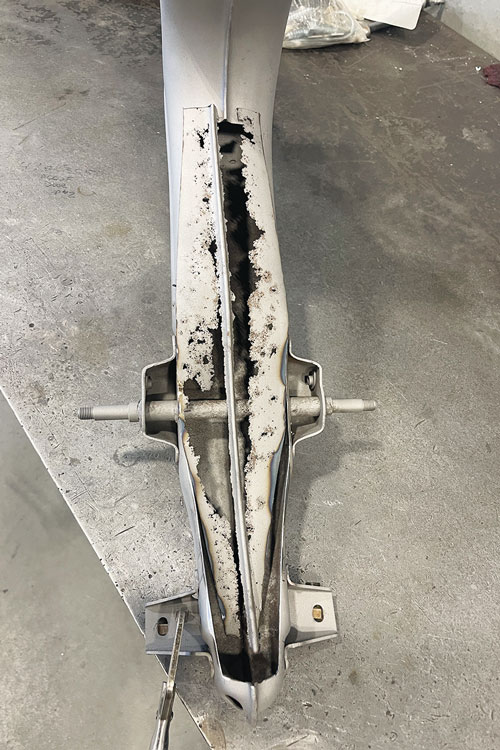
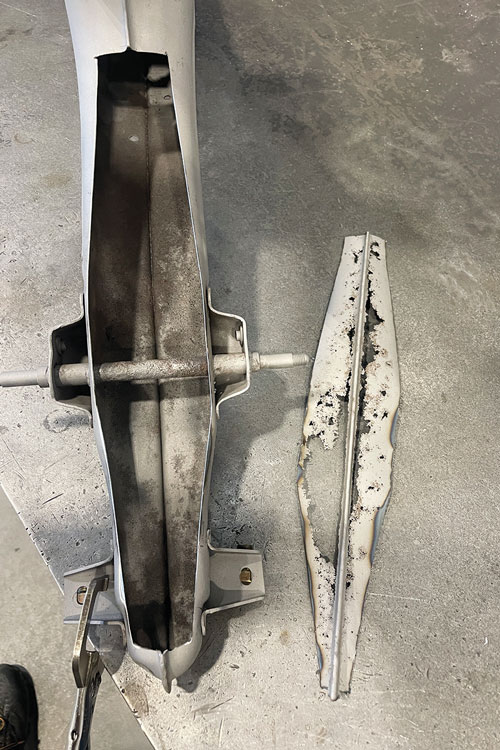
“It was a pretty great learning experience,” Frank says of the first full Honda motor rebuild. The engine, however, couldn’t immediately go back in the frame. When the S90 was all apart, a significant amount of rust under the frame’s tail section was found. They showed the frame to Jim, and to Dave and Rex at MotoBros. “Pieces of the frame were actually chipping out, it was that bad,” Frank recalls. “Those bikes, with a hollow tail frame, are apparently notorious for having mice nesting in them if they’ve been sitting. This one was full of mice bedding and dead mice, and mice urine is very damaging to metal. It was pretty much wrecked.”
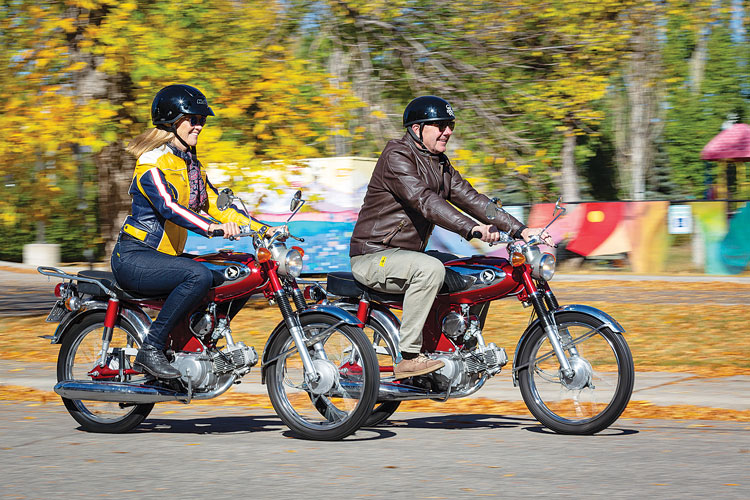
The couple was directed to seek specialized help from Calgary welder and fabricator Derek Pauletto at Trillion Industries (see sidebar). “He said he could fix it, but it would be best to have a donor frame to take pieces from to weld onto this,” Frank says. Instead of simply swapping parts onto a donor frame, it was important to them to keep the serial number of the original ’69.
“The paperwork was all good on that frame’s serial number, and going another route would have meant to us that the bike just wasn’t original,” Frank explains. “It was kind of important to get that frame done.”
However, they had trouble sourcing a compatible frame until a friend in their local Indian Riders Motorcycle group, who is also an S90 enthusiast, offered up a suitable candidate. “It really took a village,” Frank says.
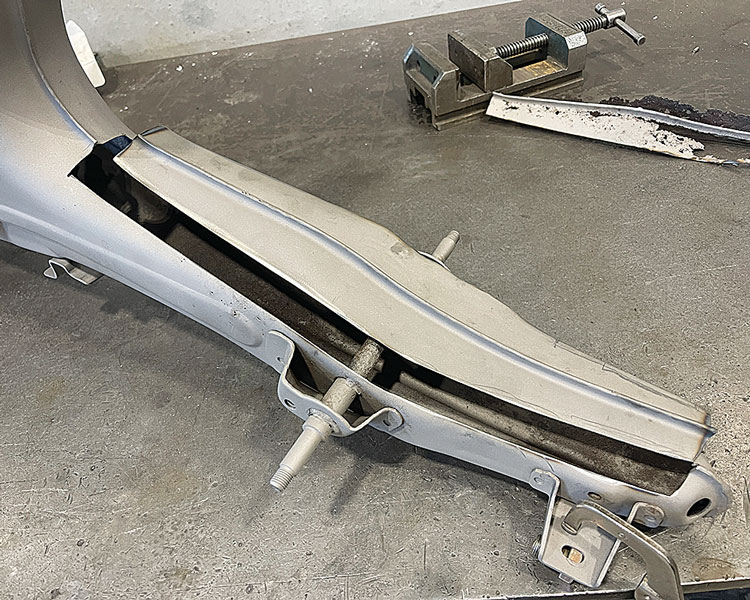
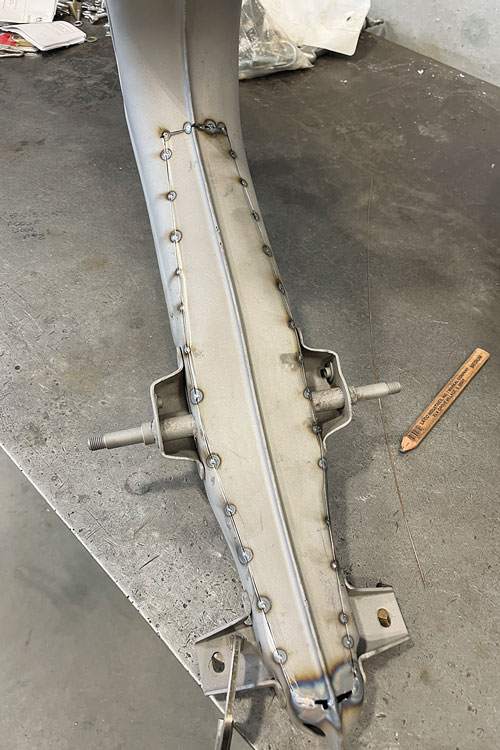
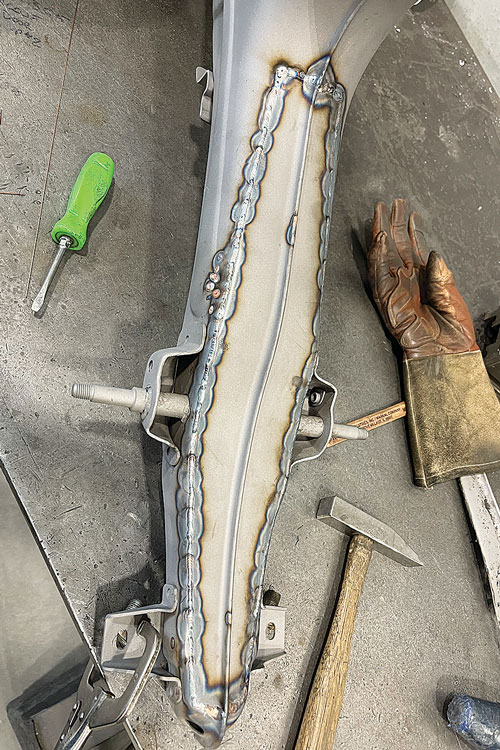
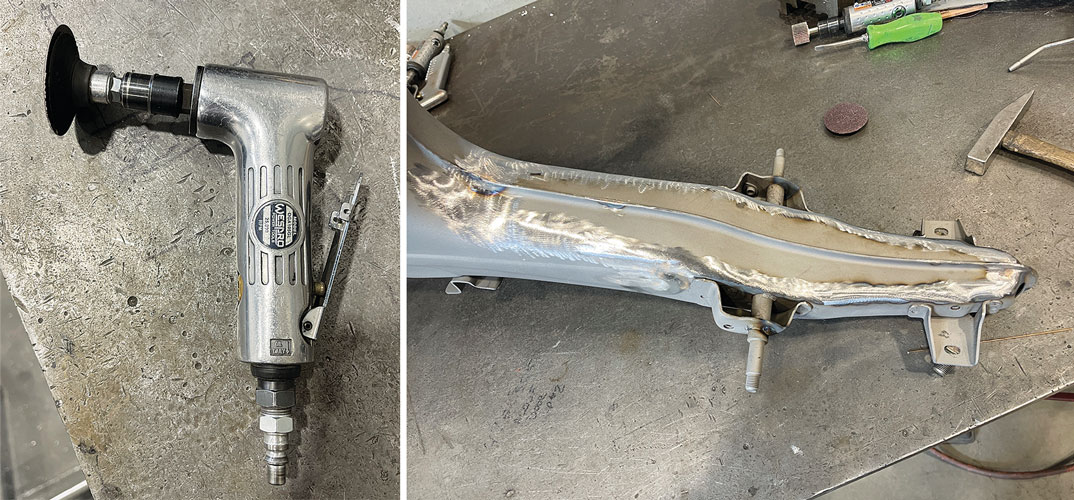
Derek at Trillion Industries performed some rather serious metal surgery, trans- planting sections of the donor frame, and once the repair was complete, the guys at MotoBros suggested powder coating the pressed steel chassis. They helped color match the candy red, but didn’t have an oven large enough to do the job. MotoBros knew a garage-based powder coater with a big homebuilt oven, however, and put Frank and Shirley in touch.
“That meant the welding had to be perfect, because you can’t use body filler when powder coating, and Derek’s job was fantastic,” Frank says. “The powder coater told me to come out, and that we’d do it together, and I saw the whole process. It was pretty cool.”
On with the rebuild
With the finished frame back in hand, Frank and Shirley cleaned and detailed all other components. The gas tank, shocks, fork shrouds, and swingarm are still in original Honda paint. There are signs of patina, including a couple of dents and scrapes on the muffler and wear on the fork ears. Even the seat is stock, with one small patch concealing a tear.
“It’s incredible to take a rusted piece of 60-year-old chrome and with a lot of patience, time, and a little bit of the right cleaning product, recover its original gleaming state,” Frank says. “As we got into the bike and learned more, it was apparent that this one was a truly good barn find and set us up for success on the first restoration.”
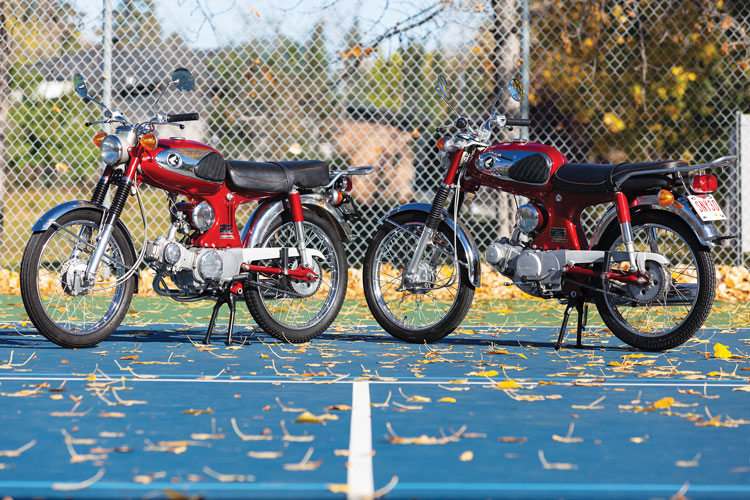
He continues, “We wanted to keep as much of the originality as possible. That was more important than just putting all new parts on it. I know that powder coating a bike can be something of a contentious decision in the vintage bike world, but it was the only viable route, as color-matching the one dip paint process and candy color from the ’60s was something most painters wouldn’t tackle economically, and the powder coat color is a pretty good match. We wanted a rider-quality machine.”
Hub bearings were replaced, but the brake shoes are original. New tires went on the chrome rims that were simply polished back to a shine. A replacement speedometer had to be sourced, as the original had a broken bezel. Jim McVee had an authentic unit as a temporary option, and plans are afoot to rebuild the original speedometer. In the meantime, the replacement is in the headlight bezel.
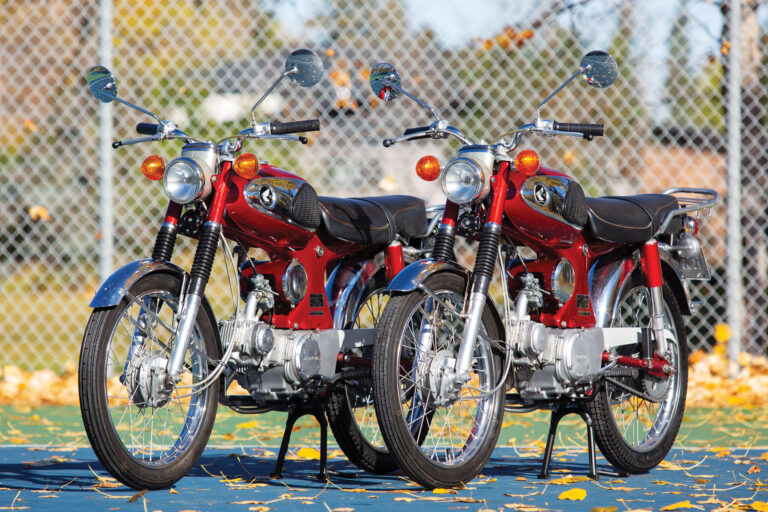
All that work took place in 2023, and when wrapping up the rebuild, Shirley found another 1969 Honda S90 for sale on Marketplace in Calgary. This S90 was exactly the same color, and the bikes are only 43 serial numbers apart; Frank thinks they would have likely been on the assembly line on the same day in Japan.
The engine was seized on the second bike, and they needed to source a second-hand cylinder and cylinder head together with a new piston and rings. With some help from Jim McVee and Dave and Rex at MotoBros, they rebuilt the second S90. Frank says, “The engine was the big chore on that bike, but the paint was all in good shape, and no mice had been in that frame. Shirley simply had the bike’s original paint clear-coated.”
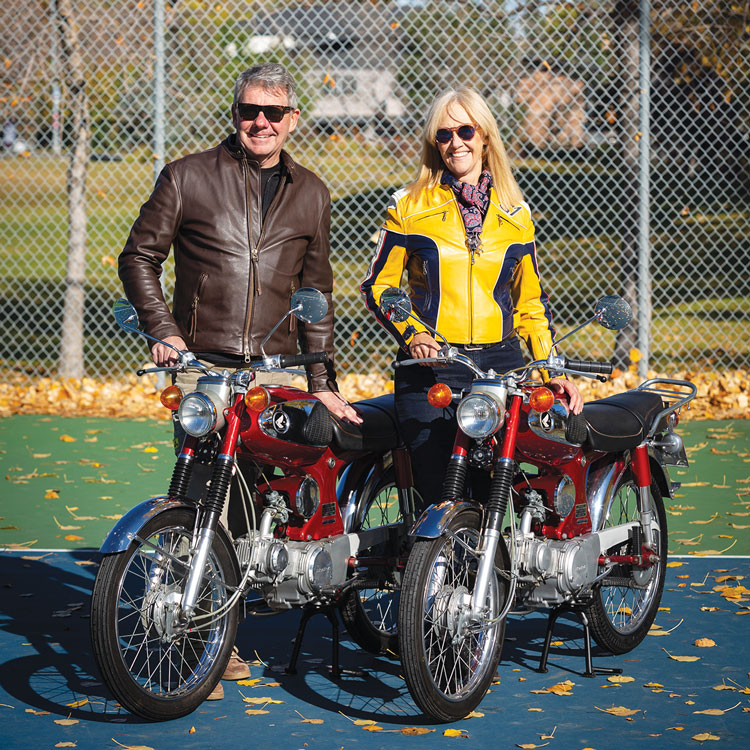
It was another mechanical restoration, again sympathetically leaving as much original as possible while striving to source necessary replacement parts that are genuine Honda, whether new old stock, or used and correct for the bike and the period. New tires went on the rims, new bearings into the hubs, and plenty of elbow grease was used to polish the chrome. Frank and Shirley work together on the projects in their 21-foot by 21-foot double car garage, and most work is done during the summer months in Calgary, as the couple is in Texas over the winter.
“Our highway bikes are big Indian baggers,” Frank says. “We ship them down to Texas by truck, fly down ourselves, and spend the winter. Then, we ride the bikes back to Calgary (roughly 2,100 miles). When we’re in Texas, the Indians are the only transportation we have. We’ve updated the Indians and, since 2018, when we started riding big bikes, have toured nearly 125,000 miles on them. It’s an incredible way to experience, and not just see, the world.”
Taking a deep dive
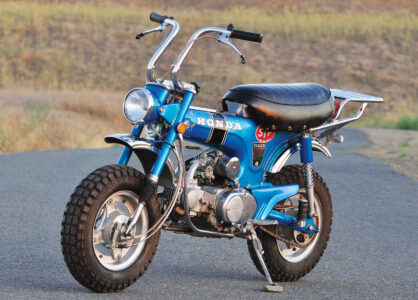
Most days during the summer months, the couple picks out a matching pair of vintage Hondas and runs them around town. They can pick out a pair because they were seriously bitten by the old Honda bug, and, in three short years, have acquired several vintage Hondas. Most are from the ’60s, some are slightly newer, and they’ve got another S90, this one a blue 1965 example.
So, from thinking fixing a classic bike would be a cool hobby, Frank and Shirley have taken a deep dive into the world of old Hondas. With Shirley shopping, and them wrenching as a team on the rebuilds, the couple now have 19 Hondas, including the three S90s, a Dream, a CM90, CM91, two CB160s, four Jazz scooters, three CT90s, a CL90, two C70s, and a Super Cub 125. They’ve joined the Vintage Japanese Motorcycle Club, and the hobby has become a passion.
No serious issues were encountered getting either project S90 to run and run properly. “They’re pretty good,” Frank says of the 90cc bikes when they’re out and about on them. “They’ll easily go 50mph, and because they’ve got a clutch, they’ll get up and go. We don’t often take the busier roadways, but we will when necessary.”
Reactions are always favorable, too. Lots of thumbs up and smiles, “and I think the S90s are pretty cool because they’re old and to see a husband-and-wife restoration team roll up on a matched pair is rare,” Frank says. “People come up and reminisce or ask what they are, and it’s really rewarding to have them on the road, having taken them from bikes that look pretty rough to all shiny and running and riding like new.” MC
Trillion Industries’ rust repair
When faced with the ravages of mouse urine damage in the S90 frame, Frank took the project to Derek Pauletto at Trillion Industries in Calgary. Instead of attempting to source another 1969 S90 frame, Frank was determined to keep the original serial number. At Derek’s suggestion, Frank found a donor frame to help with the repair.