
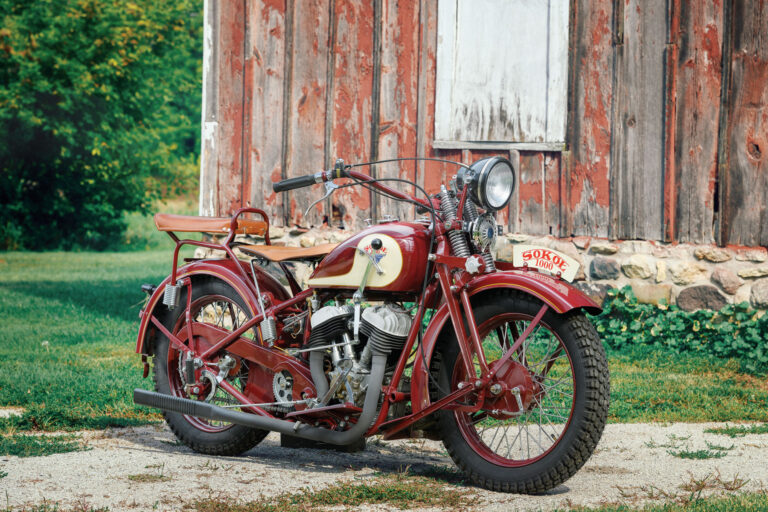
1936 Sokół (Falcon) 1000
- Engine: 60.72ci (995cc) air-cooled flathead 45-degree v-twin, 83mm x 92mm bore and stroke, 5:1 compression ratio, 18hp @ 3,000rpm
- Top speed: approx. 100km/h (62mph)
- Carburetion: Single CWS carburetor
- Transmission: 3-speed, hand shift, chain primary and final drive
- Ignition: 6v, Bosch distributor, coil ignition
- Chassis: Dual downtube steel cradle/57.7in (1,465mm)
- Suspension: Leading link spring fork, rigid rear
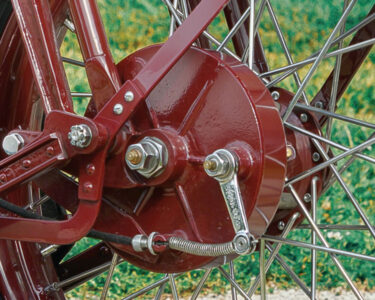
- Brakes: 7in (178mm) drum front and rear
- Tires: 4.40 x 19in front and rear
- Weight: 595lb (270kg)
- Seat height: 31in (780mm)
- Fuel capacity: 5.3gal U.S. (20ltr)
So rare is a Sokół 1000 motorcycle, even in Poland, where the machines were made during the 1930s, that more than 50 years after the last bikes rolled out of the factory, they were mostly just a fable. That’s according to collector Andy Koczwara of the St. Charles Motorcycle Museum and Art Gallery in Illinois. And he ought to know, having grown up in Tarnów, Poland, attending vintage motorcycle rallies and swap meets.
“When I grew up in Poland, it was basically like a myth about the Sokółs,” Andy explains. “They are very rare. We never had a chance to see one at a show, and never saw one being ridden. The name was around, but they just didn’t appear anywhere.”
Now, however, Andy has a beautifully restored 1936 Sokół 1000 in his museum. Far from a myth, his Sokół 1000 is a reality in metal. He prizes it highly and enjoys sharing the Sokół (pronounced so-coal) and its story with others.
Mr. Motorcycle Andy Koczwara
From an early age, Andy was immersed in motorcycles. In the 1950s and ’60s, his father, Franciszek, raced and was a team mechanic building and tuning speedway machines in Poland. By the time Andy entered the scene in the 1970s, his father was a well-respected mechanic with a small collection of vintage machines. As a youngster, Andy knew his way around the shop and the toolbox, and when he turned 14, he told his father he wanted to race speedway.
“He disagreed with me,” Andy says. “He didn’t want to see me racing and told me if I wanted to race, I’d have to find a home and somebody who was going to help me with motorcycles because he wasn’t going to get involved. But, instead, he told me we could work together on bikes. Before I tested for my license, we rebuilt a 1956 East German AWO 250cc four-stroke, and I took my motorcycle test on that at 16.”
At 17, Andy restored a 1936 BMW R35. He sold it, then bought and restored a 1935 BMW R51. Again, he sold that and bought another BMW, this one a 1933 R66. “My father taught me a lot, and then I started to be smarter than him. But most of the things I know about engine building, I learned from my father.”
Andy’s mother was born in the United States, and his mom, brother, and sister were in America when he joined them in 1991. At 21, he had a dream of becoming a certified Harley-Davidson mechanic and eventually going back to Poland to open a H-D dealership. Life took a different direction, however, when he began driving a truck to earn a living and piloted a rig through all 48 contiguous states. With money earned from his wages, Andy established his own thriving trucking company and continued to collect motorcycles in the U.S., only returning to Poland to visit friends and family. After more than 30 years in the States, he has managed to accumulate close to 275 machines.
“My father and I always talked about opening a motorcycle museum, and about three years ago, after he passed, I decided to pursue that dream and opened the museum and art gallery in St. Charles,” Andy says. “It’s a little bit too small, but I can show about 100 bikes at a time.”
At the St. Charles Motorcycle Museum and Art Gallery, the Sokół takes pride of place in a prominent location. Andy considers the Sokół 1000 to be a flagship of Polish motorcycle production as it was designed and engineered entirely in Poland.
Poland’s fledgling motor industry
Post World War I, Poland had managed to shrug off foreign rule to become an independent state. Transportation became a critical component of reconstruction, but the country had relatively little access to reliable vehicles. Also required was military transport, and according to a story found on auto-histories.org, to repair many of the vehicles left behind by retreating armies, Poland’s Defense Ministry established the Centralne Warsztaty Samochodowe (Central Automobile Works) in Warsaw. Shortened, the name became CWS.
Initially a service and repair facility in buildings once housing German factories, CWS was soon crafting military bodies to fit older Ford Model Ts. These ambulances and armored vehicles were used by Poland’s forces during the 1919 to 1921 Polish-Soviet War. Then, hoping to establish a Polish automobile industry and under the direction of Kazimierz Meyer, CWS lobbied the Defense Ministry to allow the company to develop its own Polish-designed and built vehicle.
“In 1921, the ministry finally gave the go-ahead, but only for the development of an engine prototype, permission to be granted for the development of a whole vehicle if the powerplant proved a success,” the auto-histories.org story explains. “The motivated team of engineers at CWS, led by a very talented man by the name of Tadeusz Tanski, immediately go to work.”
Many of CWS’s engineers had trained in France and been employed by western automakers. Early in 1923, the team’s Type T1 inline-four cylinder prototype powerplant with aluminum block and pistons proved successful. The 2,984cc liquid-cooled engine produced 45 reliable horsepower, and design of the rest of the automobile was allowed to proceed, culminating in 1927 with the first T1 car.
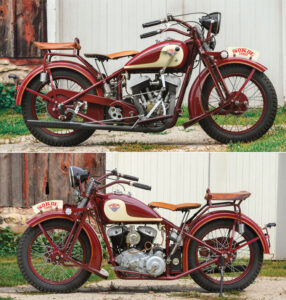
Around that same time, the Defense Ministry distributed detailed specifications for a heavyweight motorcycle for army use. Working to meet the military’s needs and essentially reverse-engineering a Harley-Davidson chassis and an Indian Chief engine, by 1929, CWS prototypes of a model dubbed the M55 S-0 were constructed. These early M55s, however, were not reliable, and improvements were made with the M55 S-III of 1930. It is speculated that fewer than 200 examples of the second-generation motorcycle, with its 995cc V-twin four-stroke engine, had been built as the machines continued to struggle with reliability issues.
The CWS M 111/Sokół 1000
In 1931, a decision was made by Panstwowe Zakłady Inzynierii (National Engineering Works), or PZInz, which became the parent company of CWS, to return to the drawing board. The objective was to build a robust model ready for heavy-duty use by Poland’s military in all conditions, and instead of a total redesign, engineers took what worked of the M55 and re-worked what did not.
On the M55s, it is reported that valves broke and valve seats in the flathead design were prone to failure. Also, cam lobes easily deteriorated. On the chassis, front fork springs were breaking, and sidecar lugs were cracking. Notably, the kickstarter was on the right-hand side of the bike, placing it between machine and sidecar, where it caused operator knee and ankle injuries when attempting to start the V-twin engine.
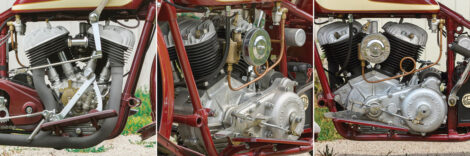
Setting out to improve on quality and resolve these issues, the 45-degree V-twin engine of what became the CWS M 111 featured an 83mm by 92mm bore and stroke and retained sidevalve architecture, but compression increased from 4:1 to 5:1. The carburetor was made by CWS, as was much of the rest of the motorcycle. If the parts were not made by CWS, other Polish producers supplied the pieces, and it is thought 95% of the machine was Polish-made. Very little was sourced from outside of the country.
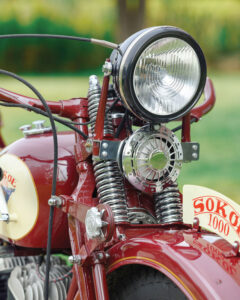
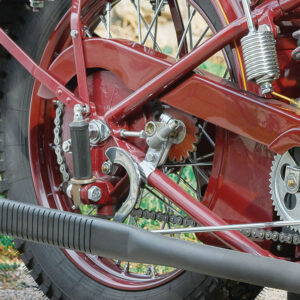
Rated at 18 horsepower at 3,000rpm, primary drive by chain transferred power to a 3-speed hand-shifted gearbox via a multi-plate oil bath clutch. Clutch operation was by a left foot pedal, while the shift lever was on the right-hand side of the gas tank, which held approximately 20 liters of fuel. Final drive was by chain. The tubular steel cradle frame with duplex front down tubes was beefy and well-reinforced with a rigid rear design. Up front, the fork featured leading links with improved springs and dual friction dampers on each side to help control rebound.
Handlebar controls were reversed, with throttle on the left and spark advance on the right, each by twist grip. The throttle had been located on the left at the military’s request. It was thought it would be easier for an operator to dismount the machine if it became stuck in difficult conditions and help the sidecar passengers more easily dislodge the outfit and control it while in first gear without having to reach across the motorcycle.
In solo trim, the machine weighed 270 kilograms (595lb) and rolled on 19-inch wheels equipped with drum brakes. Most often fitted with a well-sprung sidecar, the 375-kilogram outfits were destined for military use, but starting in 1933, upon release of the CWS M 111, a handful were sold for other utility purposes and to civilians. Vastly improved in quality, the M 111s were not inexpensive to purchase at 4,200 zloty, or in U.S. currency at the time, $800.
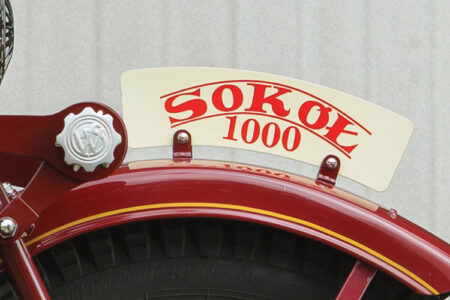
At some point in the mid-1930s, the brand name changed from CWS to Sokół, although the initials were still used on tanks and castings. Translated from Polish to English, Sokół means Falcon. Production ran until September 1939 with few, if any, changes in specification until the advent of World War II with Germany bombing the CWS factory. Approximately 3,400 Sokół 1000s left the CWS works prior to that destruction.
Rare machine
“At the outbreak of World War II, many of the Sokółs were captured by the German army,” Andy says of the Sokół 1000. “I think many of them were sent back to Germany, to steel mills, and the steel of the Sokółs was melted and used to make barrels for the tanks. The German army seemed to take great pride in destroying them because they didn’t like that we had such a great bike built in Poland right before World War II.”
Furthermore, Andy says if a Sokół did survive in Poland in the post-war period, many of the V-twin engines were used by farmers to power machinery. “Farmers disabled the bikes and just used the engines because Poland was completely destroyed after World War II, and whatever people could use to help with farming, they would.” BMWs left behind by German forces, Andy says, suffered a similar fate. Frames would be cut and the powerplant repurposed.
“For the collection, it was a long-time dream to have a Sokół 1000,” Andy explains. “They are a flagship of Polish motorcycle history, built by Polish people, and I was fortunate to be able to purchase this one from a friend in Poland. I’ve known him for about 20 years, and he’s got about 300 restored motorcycles in his personal collection with probably another 100 in line for restoration. He’s a well-known collector with two full-time mechanics working in his shop doing the restorations.”
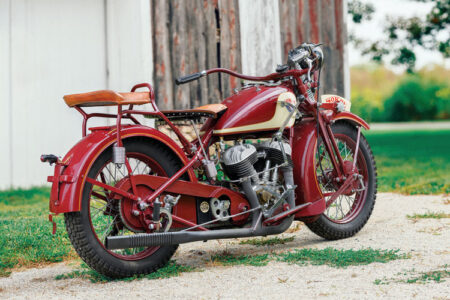
Andy was able to purchase the 1936 Sokół 1000 about two or three years ago because it was headed to a U.S.-based motorcycle museum where it could be prominently displayed and the Sokół story told more broadly.
While Andy is a competent mechanic and restoration enthusiast who has participated in vintage motorcycle events such as the Cannonball Run, his specialty lies with BMWs. The Sokół 1000 had been completely restored in Poland, where, although rare, parts are more easily accessible. It’s not known what kind of service this particular Sokół saw in Poland, but Andy thinks if it wasn’t a civilian machine, it could have once been a post office or police department motorcycle. Given their expensive purchase price, it is thought less than 200 of the 1933 to 1939 Sokół 1000 production machines were purchased by civilians.
Far from only being on display, Andy has started and ridden the Sokół 1000. To start the V-twin, he pumps a little oil into the crankcase, retards the timing using the right-side handlebar twistgrip, pre-primes with fuel, kicks two or three times, and it starts. With its foot clutch and 3-speed transmission, Andy says, “It’s a very powerful bike, and a pleasure to ride.”
“When my father was alive, for probably more than 30 years, we’d talk about bikes almost every single day,” Andy concludes. “The day before he passed, we were talking, and he was really asking me to open up a museum and share the collection with people, so I had to do it. And, it would have made him very happy to know the pride of Poland’s motorcycle industry, a Sokół 1000, is front and center.” MC
St. Charles Motorcycle Museum and Art Gallery
Located 35 miles west of Chicago, St. Charles was established circa 1833 on the banks of the Fox River. Originally called Charleston, the name was changed to St. Charles as another town in Illinois had earlier claimed Charleston. According to the city’s website, “Over the years, St. Charles has received numerous recognitions for its architecture, top-notch schools, parks, events and entertainment, and as a top place to live and raise a family.” It is also a fantastic place to visit for those interested in vintage motorcycles, because on March 1, 2025, Andy Koczwara opened the doors to the St. Charles Motorcycle Museum and Art Gallery.
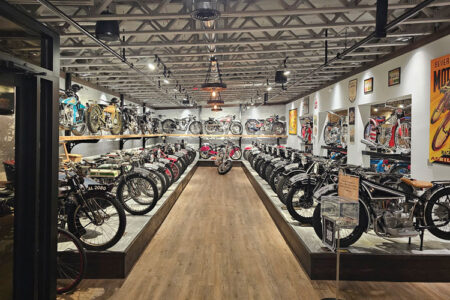
Over the years, Andy and his father, Franciszek, had often discussed establishing a museum. Pursuing that dream and honoring his father, Andy bought a 13,000 sq. ft. former Cork and Fork restaurant at 1317 E Main Street. After renovating the interior, he now displays more than 100 machines from speedway to board track to wartime Harley-Davidsons and everything in between. Complementing the motorcycles is a well-curated art gallery. Andy also hosts tours for children with special needs, and he works with local high school students to encourage them to build or restore vintage motorcycles.
Museum and art gallery admission is by donation, and the building is open from 11 a.m. to 7 p.m. Wednesday through Sunday. Visit the museum’s helpful website at StCMotorcycleMuseum.org, or email the museum at info@stcmotomuseum.org.




 1000)