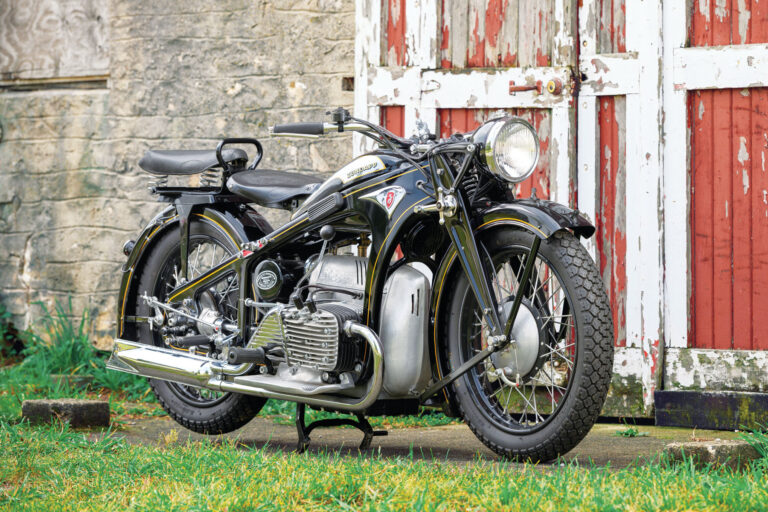
1937 Zündapp K800
- Engine: 804cc air-cooled side-valve flat 4-cylinder, 62mm x 66.2mm bore/stroke, 5.8:1 compression ratio, 22hp @ 4,300rpm
- Top speed: 120km/h (75mph) w/o sidecar
- Carburetion: Single 22mm Amal
- Transmission: 4-speed hand shift, chain as opposed to gears, oil bath two plate clutch, shaft final drive
- Electrics: Bosch 6v generator, Bosch distributor w/coil and points ignition
- Frame/wheelbase: Pressed steel cradle, 55.1in (1,400mm)
- Suspension: Pressed steel double spring girder fork, rigid rear
- Brakes: 7.5in (190mm) single leading shoe drum front and rear
- Tires: Metzeler 3.50in x 19in front and rear
- Weight: 473lb (215kg) approx.
- Seat height: 28.3in (719mm)
- Fuel capacity: 4gal (15ltr)
Honda gained plenty of attention in 1974 when it launched its Gold Wing. With an opposed 4-cylinder, liquid-cooled engine and shaft final drive, in the mid-1970s, the model was a game changer in the touring market. As innovative as it was, the Gold Wing wasn’t the first production motorcycle to feature a flat-four powertrain. Some 41 years earlier, German manufacturer Zündapp, pronounced TZOON-dap, released its flagship model, the K800, with an air-cooled, opposed 4-cylinder engine and enclosed shaft drive to the rear wheel.
Since its launch, hundreds of thousands of Gold Wings have left Honda’s facilities. In contrast, in the pre-war era when it was leaving Zündapp’s factory, the K800 was a machine that “Was more unique and more expensive to make, and as a result, not as many of them were built,” says Andy Koczwara, owner of this 1937 K800. “In that timeframe, the Zündapp K800 was not like the BMW R12 or even the Zündapp KS600. Those machines were made in larger numbers.”

Andy owns and operates the St. Charles Motorcycle Museum & Art Gallery in St. Charles, Illinois. Regular readers might recall the feature on Andy’s Sokół 1000 two issues ago. He enjoys finding and riding, as well as preserving, a diverse range of machines in the collection. He says he’d been looking for close to 20 years for a Zündapp K800 when, two years ago, this 1937 example appeared at Mecum’s mega Las Vegas motorcycle auction.
His friend, Pim van den Bergh (Zundapp Fool on Facebook), specializes in Zündapp machines. Andy and Pim were at the 2024 Mecum auction, and while Pim did not view this motorcycle thinking Andy would buy it, he says it’s a presentable 1937 Zündapp K800 with a few pieces that are incorrect for the production year.
He says, “The thing you have to remember with these Zündapp K800s, they are all pre-war bikes that went through hell. Anything could have been done to keep them running. People did all kinds of stuff, with old engines in new frames or just about anything else just to keep them going. When people find them later, they’re often not all correct.”
Zündapp history
The firm Zünder-und Apparatebau GmbH in Nuremberg, Germany, was instrumental in producing weapon componentry during the First World War, and in fact, the name translates to “detonator and apparatus construction company.” Formed in 1917 by Dr. Fritz Neumeyer and Friedrich Krupp, by war’s end in 1918, the pair split and Neumeyer assumed control of Zündapp (from Zunder und Apparatebau). He sought to diversify the company, and in 1921, launched the Z22 motorcycle.
Only five Z22s were built late in 1921, with full-scale production commencing in 1922. Described as a simple and reliable 211cc single-cylinder two-stroke model, it was dubbed the “Motorrad für Jedermann” or “motorcycle for everyone.” Final drive was via belt direct from the crankshaft pulley to the rear wheel, and there was no form of clutch.

However, according to an article by Geoffrey Wood published in the October 1973 issue of Cycle World, “The Z22 proved to be a reliable model which was easy to control, and it became an instant success on the sales floor.”
Updates soon included a 3-speed gearbox, still with belt drive, until 1924, and the K249 with a 249cc two-stroke engine now featuring chain final drive. Zündapp was quick to introduce a positive lubrication system in 1925 to its new Standard model. Still a two-stroke 250cc single, a pump was employed to pressure feed oil from a remote tank to help prolong cylinder and piston life.
Zündapp was working from four separate factories until 1928, when Neumeyer moved the company into a larger, newly completed facility. From this factory, Zündapp continued to produce primarily utilitarian two-stroke machines, but buyers for the models had become sparse as Germany suffered through the depression beginning in 1929.

Despite working through difficult financial times, in the early 1930s, Zündapp investigated building a car and worked with Dr. Ferdinand Porsche on the development of the Type 12, a vehicle powered by a rear-mounted, liquid-cooled 5-cylinder radial engine. It was Neumeyer who wanted to use this engine type, and it was a decision with which Porsche disagreed. Three prototypes were produced before plans were shelved, and although Zündapp pursued it no further, in an oversimplified explanation, Porsche’s involvement helped pave the way to what became the Volkswagen Beetle, powered as it was by an air-cooled flat four engine.
Zündapp heavies
Having built two-strokes since 1921, in 1930, Zündapp saw the value of including four-stroke models. According to Wood in his Cycle World story, “In an effort to do this quickly and with little tooling-up expense, they decided to obtain Python engines from the British Rudge factory. The new model was a 500cc single in standard and super sports trim. These good-looking singles gave Zundapp a more comprehensive range, plus some time to develop its own four-stroke machines.”
Next, Zündapp lured German engineer Richard Küchen away from Triumph-Werke Nuremberg (TWN) to design an entirely new range of machines. Born in 1898, Küchen began designing motorcycle engines just after the First World War. In his early years, he developed both a liquid-cooled two-stroke and a 350cc four-stroke, which were dubbed “K” for Küchen engines. Built in large manufacturing facilities, the Küchen engines were supplied to several different German motorcycle companies.

TWN hired Küchen in 1931 to create a four-stroke range, but Zündapp’s offer apparently proved more attractive, and he took his creativity to their drafting table. Tasked with creating a line of motorcycles that went beyond Zündapp’s primarily utilitarian two-strokes, Küchen came up with the K-series four-stroke models, all with flat, or horizontally opposed engine architecture.
Debuted in 1933 at the Berlin Motor Show, models included the K400 and K500. These were 398cc and 498cc flat twins with side valves and shaft drive. Instead of “K” for Küchen, the “K” in the Zündapp range stands for Kardanantrieb, which translates to “shaft drive” in English. Released in 1933, the smaller machine lasted only a single year, while the K500 was built until 1939.

All the “heavy” K models are stunning in their Art Deco styling, with pressed steel frames, girder forks, and chrome panels on the gas tanks. However, the stars of Küchen’s new K models introduced in 1933 were the flat fours, the K600 and K800. A limited number of K600s were produced, with as few as 26 believed to have left the factory. Zündapp carried on with the K800, and it was the largest and most expensive machine the company built. Yet, it proved a popular mount either as a solo or sidecar tug for those who could afford the purchase price.
Zündapp’s K800
“What makes the K800 unique?” Pim van den Bergh laughs when asked the question. “That pressed steel frame gives it such an iconic look with that huge engine hanging inside there. And, they have those beautiful Art Deco lines.”
Strong and simple, the pressed steel frame gave the K800 a 55.1-inch wheelbase and a rigid rear, with the sprung rubber solo saddle providing the only rider comfort. Up front, pressed steel was employed in a double-spring girder fork with a hydraulic damper and adjustable friction damping. Wheels were 19-inches front and rear with 7.5-inch single leading shoe drum brakes at both ends.

In 1933 and 1934, the pressed steel frames were riveted together and the K800 engine, at 797cc, produced 20 horsepower. In 1935, capacity increased to 804cc with a slight bump in horsepower to 22. The frame rails were now welded together, no longer joined by rivets. Headlights and speedometer changed, too, moving from a trapezoidal-shaped speedo to a small round 25mm gauge, then to a larger round 35mm instrument, all by Walzen. In 1937, they went to a more traditional 80mm Veigel speedometer.
Production ended in 1938, but several were constructed as the K800-W for military use at the start of World War II. Pim estimates that as many as 6,000 K800s were built with serial numbers, while there’s literally no accounting for the number of military machines built in 1939 as they were not stamped.
K800s were never sold in the United States, and Pim says, “Some of the ones that are here now were brought back by GI’s after the War, and many of the K and KS Zündapps here show weld marks on the frame as the returning soldiers cut the frames to fit them into their foot lockers.”

Pim has rebuilt several Zündapp engines, but of the K800 powerplant he says, “That four-cylinder engine is my least favorite to do, because it’s tricky to get the alignment of the front and rear bearings in the block absolutely correct and the cranks and rods require a great deal of attention. In general, though, once they’re together, set up, and you take care of them, they’re pretty reliable.”
Küchen’s flat four featured a light all-alloy block. Cast passages in the block act as intake runners to deliver fuel mixture from the single 22mm Amal carburetor, which is hidden atop the rear of the engine under a weather-proof cover. The cast intake passages arrive at the cylinders, where they branch between the pistons into a “Y” shape where the side valves send the mixture into the combustion chambers. Bore and stroke of the engine is 62mm by 66.6mm for 804cc with a conservative 5.8:1 compression ratio.
Exhaust ports are to the front and rear of the cylinders, creating a very handsome-looking 2-into-1 header and muffler system, one on each side of the machine. The top engine cover has 14 cast in louvers toward the front to provide heat dissipation for a gear-driven six-volt Bosch generator. At the front of the engine, also under separate cover, are the gears and chains that rotate the centrally located camshaft, oil pump, and Bosch distributor and coil ignition, providing a very clean, all-enclosed and streamlined design.
Chains in the ‘box
Mated to the engine is Küchen’s unique transmission, which features four duplex chains and sprockets as opposed to pairs of gears. It’s a robust system engaged and disengaged via a two-plate clutch in oil and shifted on the right by hand using a lever mounted on top of the transmission in an “H” pattern, much like an automobile but without the reverse. Output is sent directly to the rear drive shaft.
“The chain driven transmission was unique to Zündapp, and they carried on with that on all their big four-stroke bikes up until 1958,” Pim says, and continues, “The Achilles heel of the K800 is the third cylinder, which is the left rear cylinder, as it usually runs hot. If it fails, that’s the one that gives up first. There is a more modern fix, often with a bit of increased piston to cylinder clearance or an abradable coating on the skirt and thermal barrier coating on the crown to help keep heat away.”

Pim adds, “The most expensive part to fix in a K800 is the crankshaft. It has a pressure fed oiling system, and the crank is hollow, and oil gets fed through the crank to the big ends of the connecting rods.” That works great, he says, until the oil gets dirty and the engine runs hot, and the connecting rod big end lubrication ports begin to coke up. Originally, the connecting rods featured split big ends with cage and needle roller bearings. “You need extremely clean oil for that to work well, as any contamination could cause one of those rollers to stop rolling, and instead of rolling they begin galling the crank bearing surface,” Pim explains. “I convert the split rods to take half shell big end bearings and grind the cranks to suit different under sizes so there’s a whole new life available for these engines when the crank wears down.”
Andy’s Zündapp K800
Andy Koczwara is intimately familiar with pre-War BMW twins but also has 11 Zündapp heavy K-models in his motorcycle collection. “Zündapp was always seen as competition to BMW,” he explains, and continues, “In Germany, there was always a feud between Zündapp and BMW loyalists, about which brand was better. That was almost identical to the feud here in the United States between Harley-Davidson and Indian.
“The K800 was an expensive machine, and only very rich people could afford the purchase price,” Andy says. “It was a very powerful machine, and very smooth to ride with that chain drive transmission.”
After winning the Zündapp at the Mecum auction, Andy brought it to his shop where he started the K800 and test rode it on his long, private driveway. Compared to a BMW flat twin of the same era, “It’s a completely different sound and a bike that’s not really even comparable to a regular boxer twin because the four-cylinder engine just sounds so different, and it’s so smooth. You can put a glass of water on top of the cylinders, and you can’t see any vibrations in the water; it’s amazing.”

And it’s relatively easy to start, although Pim says in order for a Zündapp four to fire, “You really have to flood the system, as fuel has to flow through a labyrinth of ducts all the way from the back of the engine, over the top and then down between the two cylinders with a very small port that feeds the two intakes.”
With the system flooded and the cylinders primed with fuel, the choke closed, and the ignition switched on with the key in the headlight, a kick or two on the left side kickstarter brings Andy’s K800 to life. After his test ride, he drained all fluids and pickled the machine for display in his St. Charles Motorcycle Museum. Ultimately, the Zündapp K800 is a motorcycle Andy envisions pulling out of the collection and fully servicing in preparation for a road trip adventure.
He says, “One day, I’m going to take this bike from the museum, prepare it to be fully ridable and put some miles on it by going for a long ride. Just like the K800 itself, that will be absolutely lovely.” MC
The first flat four
In April 2026, at the Bonhams Spring Stafford Sale (Bonhams.com), a circa 1902 Holden sold for £41,400, including premium. That is roughly $55,000 U.S. for a motorcycle that is a significant example of early powered two-wheeler development. Designed by Sir Henry Capel Lofft Holden, the 1895 prototype of the machine, according to the Bonhams’ auction write-up, “is thought to be the first two-wheeled British motorcycle, and probably also the earliest road-going vehicle of any type powered by a four-cylinder internal combustion engine.”
Holden was a career military man with a brilliant mind, developing not only weaponry but also the famous Brooklands racetrack — and motorcycles. Holden’s first two-wheeler initially featured an air-cooled flat-four-cylinder engine, which is most interesting for its layout. While the Zündapp K800’s flat-four is laid out across the frame, the Holden’s is a fore-and-aft arrangement.

This is how Bonhams described the 1,182.8cc Holden engine: “The cylinders are arranged horizontally in the form of two steel tubes with brass water jackets, though early prototypes were air-cooled. A double-ended piston is fitted centrally in each tube. A rod, a bit like a long gudgeon pin, passes through a central hole in each piston and protrudes on each side of the engine through a cutaway in each cylinder. This rod is connected directly to the rear wheel by long cranks on each side, in the style of a steam locomotive. Thus, the rear wheel also acts like a flywheel.”
The rear wheel is much smaller than the front, and by the time this circa 1902 model was built by The Motor Traction Company of Kennington, all its technology was quickly being bypassed by other manufacturers. Also expensive to purchase at the turn of the 20th century, it’s thought no more than a handful might have been built, and production, limited as it was, ended late in 1902.