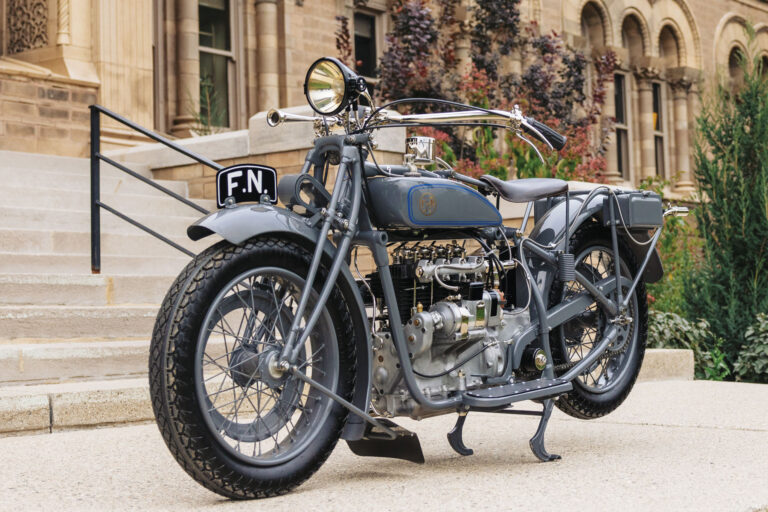
1925 F.N. M.50 Four
- Engine: 748cc air-cooled IOE inline four, 52mm x 88mm bore/stroke, unknown compression ratio, 14hp @ 2,500rpm
- Top speed: 54mph (87km/h) approx.
- Carburetion: Single AMAC carburetor
- Transmission: Bevel gear primary, 3-speed hand shift, chain final drive
Century-old Belgian-made Fabrique Nationale motorcycles are unique machines. Although the company made single-cylinder models, F.N. might be better known for its line of four-cylinder machines built from 1904 to 1926. After that, F.N. dropped the four to focus solely on single-cylinder motorcycle production.
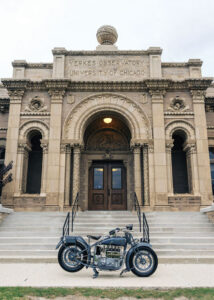
So that makes a 1925 F.N. M.50 four a machine that was near the end of the line. In the U.S., just such a model has been painstakingly restored and recently returned to the road by Donovon LeVan of The Good Old Days vintage motorcycle shop in Burlington, Wisconsin. It took not only his skills and expertise, but the efforts of several other craftspeople to pull off the stunning result.
Donovon toiled for close to four years on the 1925 F.N. M.50 in these photographs. It took him that long as he began the project while working with Brady Ingelse at the well-respected restoration shop Retrospeed in Belgium, Wisconsin. Donovon had it running while there, took it apart, and then pushed pause as he and his girlfriend opted for a change.
“I was commuting 75 miles a day round trip to Retrospeed, and we were looking to move out of Milwaukee to a smaller town, and we found a place in Burlington, about 35 miles southwest of the city,” Donovon explains. “And I’d always kind of had it in the back of my mind that I’d like to open my own shop someday.”
Donovon considers Brady a significantly important mentor. “He was nothing but supportive, and he understood,” Donovon says of Brady. “Because I’d taken the 1925 M.50 apart before I left Retrospeed, it was decided that I should take the project with me, since it would not make sense for someone else to restore it from pieces.”
F.N. fours
Before Fabrique Nationale designed and built its first production four-cylinder machine in 1904, there was Colonel Capel Holden’s steam-powered four. Holden constructed the steam four in 1895 and followed it with an 1,100cc water-cooled flat four fueled by gasoline. Manufactured in limited numbers from 1899 to 1902, according to motorcycle historian Paul d’Orléans in a story at TheVintagent.com, one of these fours is held in the London Science Museum’s collection.
German maker Dürkopp created a four-cylinder machine around the same time as F.N., but there is scant information regarding the motorcycle. It was, however, F.N. that impressed with its four, as d’Orléans notes, “The Belgian Fabrique Nationale (F-N, still an arms manufacturer) claimed the next viable, serially built 4-cylinder in 1904: it was truly the world’s first production inline four, which laid the pattern of most fours until the 1920s. The F.N. motor was designed by Paul Kelecom with a 362cc capacity, ‘atmospheric’ inlet valves over the exhaust valves, a single-speed shaft drive to the rear wheel, and a top speed of 40mph.”
Arranged inline with a larger space between the second and third cylinders when viewed in profile, F.N. was focused on adequate engine cooling. Cylinders incorporated “cast ribs,” which is how F.N. described its use of fins, and the cylinder heads were non-detachable as they were cast as part of the cylinders, which was not unusual at the time.
Supported by five bearings, the crankshaft was housed in a horizontally split cast-iron crankcase. Sparks were provided by a Bosch high-tension magneto in conjunction with a distributor. Before building its first motorcycle in 1901, F.N. had manufactured shaft drive bicycles, and the feature carried over to its early single and four-cylinder motorcycles.
A book published by F.N. in 1907 said the rear drive system, “Is constituted by a countershaft, the front end of which is provided with a pinion engaging with a similar pinion on the crankshaft, whilst to the other end is secured a bevel pinion engaging with a bevel wheel secured to the hub of the back wheel.” F.N. said the shaft drive provided “great uniformity of motion” when coupled with its smooth-running four-cylinder engine.
Changes to F.N.’s Four were limited but included increased capacity to 410cc in 1906 and then 498cc in 1910. An optional clutch was offered by 1910, followed by a two-speed gearbox in front of the rear hub drive case. Early models were pedal start, but circa 1913-14, a three-speed gearbox with multiplate clutch and kickstarter were incorporated in the larger 748cc Four, or Type 700.
Production halted during WWI but resumed in 1919. The big fours with a 52mm x 88mm bore and stroke continued to roll out the factory doors, and by 1921, the new 750T produced 8 horsepower. These fours now incorporated a longer chassis with the fuel tank mounted between the two top frame rails and continued to feature shaft drive until 1923.
End of the shaft
Because they were expensive to produce, F.N. altered the design of both its single- and four-cylinder machines in 1923, dispensing with shaft drive and converting all models to chain final drive. On its new M.60 346cc single, the engine featured overhead valves and, rather innovative for the time, employed unit construction with the crankcase and gearbox joined together in one casting.
F.N. historian and author Guy De Becker wrote in his book Quand la F.N. Avait 2 Roues, (When the F.N. Had Two Wheels), “In the fall of 1923, F.N. was one of the first firms to [combine the] engine block with the gearbox. This [unit construction] system avoids the loss of oil and protects more delicate [internal components]. The new model marks a turning point in the F.N. style because the shaft-drive is replaced by a chain, a more economical system to build.”
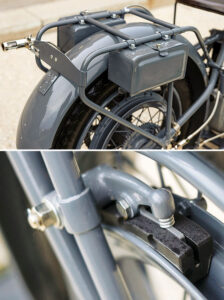
That same year, the four became the M.50, and the gearbox, with a right-angle input, took the power to an external sprocket and chain final drive. Updated with a full cradle frame, the M.50 four-cylinder engine still employed an F-head valve design. While the machine was a comfortable touring bike and reflected some of theemerging design trends in the motorcycle marketplace, the model was becoming slightly antiquated and would be dropped from F.N.’s lineup in 1926.
Two interesting facts are that the year F.N. dropped shaft final drive, 1923, was the same year BMW launched its first flat twin. Incorporating a rear drive shaft, BMW has carried that design feature through the succeeding decades, and it is now synonymous with the company. Also, it was the agility and the power of the much lighter 346cc M.60 single that likely encouraged F.N. to halt production of the four-cylinder model. The four made about 14 horsepower at 2,500rpm with a top speed of 54mph and weighed approximately 353 pounds, while the 275-pound 346cc single made 10 to 12 horsepower at 3,500rpm and had a comparable top speed of 53mph.
De Becker notes in his book, “the performance of the M.50 barely exceeds that of the (346cc single-cylinder) M.60, whose power is very close. It is also more manageable and more economical.”
Throttlestop’s M.50
Jim Balestrieri of the Throttlestop Museum in Elkhart Lake, Wisconsin, is a fan of all things F.N., and especially the Belgian manufacturer’s four-cylinder motorcycles. He has owned two other F.N. Fours, a 1906 example and another from 1912. That 1912 Four, the ’06, and a rare 1947 F.N. Model 13 have moved on, but Jim wanted an example of one of the last F.N. fours produced and purchased this 1925 M.50 to add to the Throttlestop collection.
Donovon picks up the story on the M.50, which was an older restoration painted an incorrect color that did not appear to be in rough shape when it arrived at Retrospeed. He says, “I started on this at Retrospeed early in 2022. One of the first things I did was get it running and riding to see how mechanically it functions; you learn a lot about a bike doing that.”
He continues, “I’d never even ridden a bike from the ’20s prior to this, and there were a few things to learn, such as how the oiling system works and how the gearshift works. I only made it about five miles on a test ride before the engine seized, and that’s when it came back to the shop and I really started going over it as it came apart. What was missing? What seemed incorrect? What was broken? Who did we need to engage for specialist repairs?”
The various sub-assemblies were grouped in large piles and Donovon began his research. Of tremendous help to him was the F.N. Facebook Group and Jacques Maertens in particular. He says they are a passionate group of enthusiasts, and Jacques sent him everything he had on the M.50. Much of the paperwork required translation, as many of the texts pertaining to the F.N. are in French.
He was surprised by some of the things he learned. For example, on the older restoration, the wheels had been painted as assemblies. Donovon wondered if the restorer had simply been lazy and painted the rims, spokes, and nipples all together. “There were things done differently in the ’20s, and I came to find out no one was lazy, that was actually what they did for rust prevention back in the day — painted the wheels assembled,” he says.
As the machine came apart, Donovon took hundreds of photos. “I wish I were better at taking notes, but I cannot emphasize enough, you can never take too many photos, there are so many things you want to reference as it goes back together,” he explains.
Under restoration
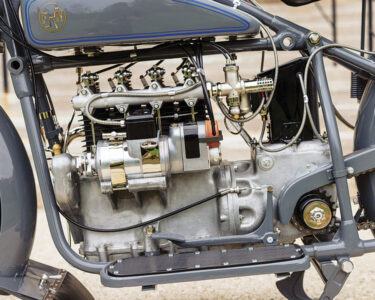
The source of the engine seizure was not a stuck piston, but a seized crank bearing. Around 1910, with updates to the earlier four-cylinder engine, the crank moved from five bearings to just two, one at each end of the shaft. According to Donovon, “Obviously, it’s a four-cylinder with four connecting rods, but it only has one crank bearing at each end of the crankshaft. The rest of the crank just floats in the crankcase, but it’s obviously very robust. It was the front bearing that seized.”
The crank journals required welding and were then ground slightly oversize to suit the connecting rod bearings. Forged steel connecting rods and caps feature a bronze bearing, and these were honed to obtain the correct clearance. Cylinders and pistons were all in good condition, but the cast-iron barrels were honed slightly and then refinished black using phosphate conversion coating, or the Parkerizing method. New rings went on all four pistons.
The transmission bearings were all replaced, and Donovon made punches of the correct inner and outer diameters to make and install the felt oil seals in both the engine and gearbox. The output shaft of the 3-speed transmission had a threaded housing that took a felt seal, but it was modified to accept a modern rubber lip seal. Input from the crankshaft to the transmission is through a bevel drive, and setting all the correct tolerances was time consuming.
“It was a specific sequence of how it all fit in, and you’d set one tolerance, and it would affect another, and I had to make some special tools to get the transmission apart and back together,” Donovon explains.
The Bosch G.F.B.4 combined magneto and 6-volt generator required restoration. The magneto produced decent spark when tested, but when running, delivered an intermittently weak spark. The armature and condenser tested good, but Donovon made a re-magnetizer to return the mag’s magnetic strength. Brushes were cleaned and bearings replaced, and the magneto and generator were back in service with strong spark.
3-D printing to the rescue
Looking more like a piece of wood riddled by termites than a cast aluminum intake manifold, Donovon says the intake runner was the one piece of the motorcycle that was in the worst condition. Attempting to fill the holes and painting the manifold was simply unacceptable. He reached out to Chris Redmond of Arrow Mfg. in Milwaukee. With a 3-D scanner, Chris scanned the old manifold and created a digital file, which he was able to tweak to make a few slight improvements to the original. Mounting holes, for example, were not centered, and Donovon figured if one was going to be cast, it might as well be made perfect. Chris 3-D printed a couple of plastic manifolds before committing to creating a plug that could be used to sand cast a new manifold.
With the rough casting in hand, Donovon faced the flanges on his mill, drilled the mounting holes and cut threads for an end cap at the front and a screw-on fitting for the AMAC carburetor at the rear. The rest of the intake manifold was left in the correct raw sandcast state. After Donovon found an image of an original F.N. M.50 with rubber handlebar grips featuring the F.N. initials molded into the rubber, Chris helped recreate them.
As the project progressed, Donovon prepared fasteners for refinishing. Wanting the M.50 to appear as close to factory correct as possible, piles were made ready for bright nickel plating and satin nickel plating. Many nuts and bolts were also dull cadmium plated, and most of this work was done by Belmont Plating Works in Franklin Park, Illinois. “It’s a lot of decision making, and there are a couple of ways to go about it,” Donovon says of hardware refinishing choices. “You can observe what the last person did, and there’s a lot of looking at photos for details. And then, there’s some intuitive guessing and deciding what seems right if you can’t find a concrete answer to what finish would go where.”
The F.N.’s seat was present but had a piece of leather glued over it. As Donovon peeled off the leather, he discovered the original leather cover underneath. Although very brittle, this stock cover showed fine stitching details and revealed how it was bonded to the seat pan with little internal rivets. Donovon took it off, refinished the seat pan and delivered both pan and original cover to Adam Nisiewicz of Pierce Street Seats in De Pere, Wisconsin. Adam accurately recreated the original cover and faithfully restored the saddle.
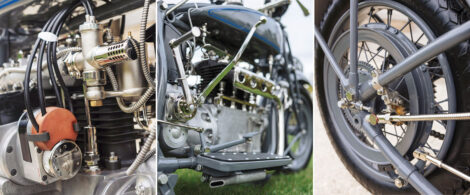
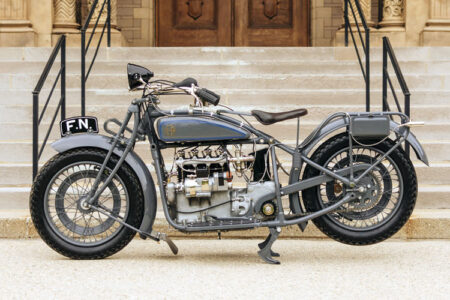
Anything gray on the M.50, including frame, leaf spring girder-style fork, stand, wheels, chainguard, floorboards, rear rack, and toolboxes, was painted by Jason LeCavalier of Artismo Customs in Waukesha, Wisconsin. Decals with the F.N. logo of a crossed rifle and pedal crank in the correct red and gold were sourced through Pelders Transfers in the Netherlands. Jason applied the transfers and the finely laid blue double pinstripes on the tank, which is made of heavy brass panels.
Coker Tires delivered the 4.00 x 18in balloon tires for the wheels. From the F.N. factory, Donovon says these would have been an even larger balloon-style tire, but that size simply does not exist. Unusual brakes comprise front and rear V-groove sheaves or pulleys bolted to the heavy-duty spokes. When the front right handlebar brake lever is pulled, or the right rear foot pedal is pressed, a block with friction material is forced into the V-groove of the pulley for braking.
First start
Donovon had the M.50 fully assembled and adjustments made by October 2025. With the external springs and rockers of the intake valves, he wanted to fire it after photographs had been taken. “With the external valvetrain, I figured once it was running and riding, everything might start to get a little dirty, and I wanted it perfect for the photos,” Donovon says.
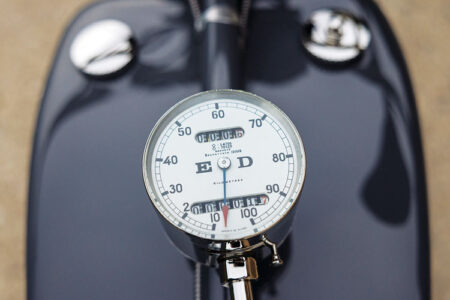
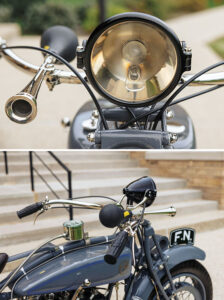
After photos were taken, Donovon went through the starting procedure, which he says is not elaborate. Turn on the fuel petcock, mounted on the bottom right side of the tank, quickly tickle the AMAC carburetor to ensure the remote float chamber is filled with fuel, and kick. There are no choke and no ignition adjustment for advance, as it features fixed timing for the spark. Although there is no choke, left and right twistgrips control the AMAC carburetor. The right hand is the throttle, and the left adjusts the fuel/air ratio while riding. All ancillary components function, including the rear wheel gear driven speedometer mounted above the gas tank. Donovon restored the speedometer internals and finished it with a new brass dial cut by water jet. On the face of the dial, artwork was created to replicate the original and then pad printed in place. He had earlier tried silk-screening the graphic on the dial face, but some of the fine lettering details were lost in the process.
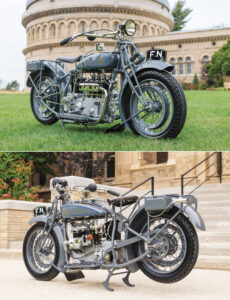
“I was very nervous about the clutch working or not,” Donovon explains. “There are 14 all steel plates in the clutch, with no fiber discs. I had new plates water jet cut, and I wasn’t sure if it would squeal or slip, but it works flawlessly. You disengage the clutch with your left foot, and the larger left-hand lever allows you to hold the clutch in so you can put your foot back on the ground. There’s not enough leverage with the handlebar lever to disengage the clutch.”
Underway, “the engine is very smooth,” Donovon says, and adds, “It’s honestly just about as smooth as any ’70s or ’80s inline four. It’s a pretty bouncy ride, though, and I think some suspension damping in the front would go a long way. Maybe some stiffer springs for the seat.”
Shifting is a deliberate process. “You can’t just click to the next gear like any modern machine. There is a shift detent that locates each gear, but there is a space between each gear that is essentially a neutral. Downshifting is unusual. The revs have to be very low in order to downshift, otherwise you just grind gears. I was very surprised how well it takes throttle. It revs quicker than I would have guessed. Overall, it is absolutely beautiful to ride.”
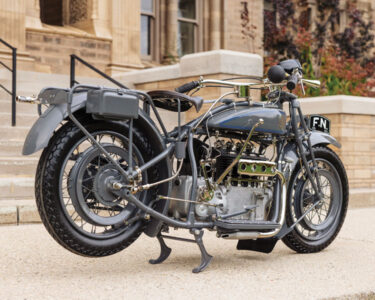
Donovon says the machine when running is artistry in motion with the valvetrain fluttering and the oil sight gauge, mounted on the right side near the front under the gas tank, indicating that vital lubricant is flowing to the moving components. The restored F.N. M.50 made its first public appearance in late February 2026 at the Mama Tried show in Milwaukee. That is where owner Jim Balestrieri got to see the finished machine in the metal, as he had only seen progress photos from Donovon.
Jim says, “Donovon is gifted with these F.N.s, and this one is now a century old. In 1925, I see it as the best that era of motorcycling had to offer. I love these four-cylinder pre-war motorcycles, and F.N. was known for its four-cylinder engines, and this one is a stout technological marvel of the day.” He adds, “The color combination of the gray paint and blue accents, black tires, and the chrome and black engine details sets this thing off. It’s really a beautifully restored motorcycle.” MC
The Good Old Days
Donovon was 22 when he began his motorcycle restoration career in 2016, working with Brady Ingelse at Retrospeed in Belgium, Wisconsin. Growing up on a farm in northwest Wisconsin, Donovon began riding a neglected 1975 Yamaha XS650 when he was 15. Moving to Milwaukee to study architecture after high school, Donovon soon found it wasn’t a good fit and instead got a motorcycle repair technician degree online through Penn Foster. Before he’d finished the program, Brady hired him, and while he had a good grasp of the basics, Donovon says most of what he learned about restoration was gained working hands-on under Brady’s tutelage, and he’s forever grateful for that opportunity.
When the decision was made to move to a smaller town in Wisconsin, Donovon and his girlfriend found a spot in Burlington. He gave Brady his notice early in 2022 and left in May. “I was looking for a space to rent in the area but couldn’t find anything. I set up in the home garage, and that lasted a couple of months. I learned about a machine shop in town that had been in business since the 1950s, and I went knocking on the door, looking to see if I could take on some kind of apprenticeship while continuing to work on motorcycles. The owner told me he was looking to get out of the business and wanted to sell everything, including the building and all the tools.” Donovon went to the bank and applied for a loan. It was an arduous process that took about nine months to approve before he could close on the deal early in 2023. “While waiting for the loan, we made a deal so I could rent 250 sq. ft. in a corner of the building for motorcycles while the owner/machinist continued to work,” Donovon says. “The roof leaked, and it was a big ordeal at the time. I would have to put tarps over the bikes in my corner, machines were getting leaked on, there were buckets everywhere. Through the winter I would shovel the roof after every snow otherwise it would constantly stream into the building. It was pretty miserable.”
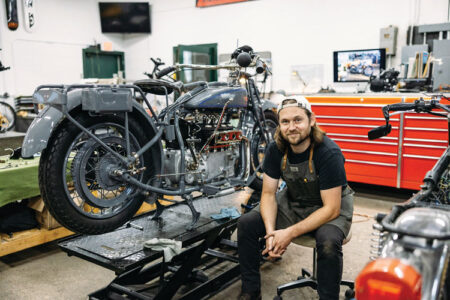
Donovon continues, “When the loan was finally approved, the machinist retired, and I took ownership of the 2,200 sq. ft. cinder block building. I put a new roof on it and began cleaning out piles of raw materials and sold several metalworking machines and tooling.”
Donovon kept two mills, a metal lathe, surface grinder, band saw, bench grinder and belt sanders, and plenty of tooling for the mills and lathe. He also kept a good selection of raw materials and began learning how to operate the machine tools while employing them on his motorcycle restoration projects.
“I was learning out of necessity, and with raw material to burn through, it helped out a lot. I’ve gotten good at it, and it’s become an absolute necessity,” Donovon says. “I think machining and vintage motorcycle work go hand-in-hand. At Retrospeed, we had a dedicated machinist, off-site, but it’s absolutely critical, and I use this stuff almost every day.
“Getting into bikes of the ’20s, ’30s, ’40s, and ’50s, nothing really just pieces together. You can’t just get a part and bolt it on like you can an ’80s Japanese motorcycle. Sometimes it just comes down to making parts that you need.”
Since opening, Donovon has hit the ground running with projects including several F.N.s, REX, Standard, Excelsior, Laverda, Moto Morini, Panther, Douglas, MV Agusta, AJS, and Norton and BSA. He has customers from Wisconsin, to Atlanta, to California, to Rhode Island, and he says, “I feel very fortunate.”