1912 FN Four

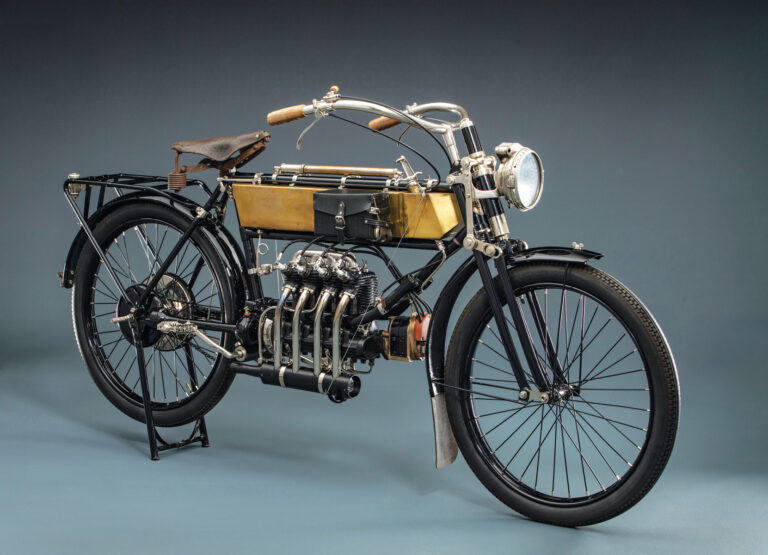
- Engine: Air-cooled 498cc atmospheric intake over mechanical exhaust, inline four, 52.7mm x 55.5mm bore and stroke, 5hp
- Top speed: 40mph (65kph) est.
- Carburetion: FN
- Transmission: Single speed
- Electrics: Bosch ZFN4 magneto/distributor
- Frame/wheelbase: Steel tubular cradle frame/54in (1,372mm)
- Suspension: Leading link front fork, rigid rear
- Brakes: Rear only, internal expanding and hand-operated contracting band on 8in (203mm) drum
- Tires: 2.50 x 26in front and rear
- Weight: 200lb (91kg), est.
- Seat height (adjustable): 33in (838mm)
- Fuel capacity: 1.5 US gal (5.7ltr)
When pioneering engineers were hard at work in the nascent motorcycle industry at the turn of the last century, single-cylinder and then twin-cylinder engines reigned supreme. However, some early builders had devised multi-cylinder platforms. Take British engineer Colonel Capel Holden; he developed a water-cooled opposed 4-cylinder engine around 1894.
Meanwhile, fellow British designer Charles Binks, perhaps better known for his carburetors, designed an inline-four in 1903 that was branded as an Evart-Hall. Quantity production never ensued, and the Binks machine lasted until 1905. Then there was FN, or Fabrique Nationale d’Armes de Guerre of Belgium, and its 4-cylinder model.
Arms to wheels
First introduced to the public in 1905, FN’s Four wasn’t the earliest example of a multi-cylinder machine, but the company does have the distinction of marketing the first full-production four. Fabrique Nationale got its start in 1889 as an arms manufacturer, building under license Mauser-designed rifles. Looking to diversify, FN launched shaft-driven bicycles in 1896, together with chain-driven models. While continuing to make great strides with arms production, FN further diversified with the production of automobiles in 1899, followed shortly after with a motorcycle in October 1901.

Jim Balestrieri of Wisconsin’s Throttlestop Collection is intrigued by the early development of motorcycles. He’s had two early FN Fours, one a 1906 — which he recently sold, and the 1912 machine seen here — which he plans to keep. A student of the early days of powered 2-wheelers, Jim says, “FN came out with their bicycle, then they put a 133cc 4-stroke single-cylinder motor in it, increased it to 188cc and then 300cc, and then all of a sudden they come out with an inline 350cc 4-cylinder model with shaft drive — it’s 1905 and just like that, FN went right to a four as opposed to constructing a twin, like many other manufacturers had begun to explore.” By the end of 1904, in a relatively short period of time, FN had managed to sell more than 6,000 motorcycles and its 4-cylinder model was set to launch.
FN’s engineering and mechanical genius was Belgian Paul Kelecom. He was responsible for the single-cylinder models and was behind the development of the 4-cylinder engine, which was placed inline with the frame, and transferred power to the rear wheel via shaft drive. Late in 1904, an FN development engineer put the Four through its paces touring Europe — without suffering any tremendous mechanical grief. Once in volume production, the Four proved to be a popular model. FN chalked much of that success up to how smooth the engine ran.
Early improvements
According to a 100-page book produced by FN in 1907, the company described the power delivery of single-cylinder motors as “jerky.” Part of that issue, FN maintained, was due to the primitive flat or V-belt drives of the era that, when too tight, transferred power pulses throughout the machine. In addition, due to stretching, maintaining consistent tension on a belt drive was elusive. The Belgian company also wanted to move away from a “bicycle with a motor attached” and designed a frame specifically for the 4-cylinder engine and incorporated an early form of sprung front suspension. Another point of improvement, FN noted in the book, was a better ignition system provided by magneto as opposed to earlier designs such as trembler coil and battery.
In electing to use a shaft drive rather than a troublesome belt, FN benefitted from experience gained from their chainless bicycles. On the Four, FN fit a pinion gear to the front of a driveshaft which meshed with a pinion on the rear of the crankshaft. At the rear, a bevel drive gear on the shaft worked in tandem with a bevel gear in the rear hub. The shaft ran in bearings and was enclosed in the grease-filled right side lower rear frame tube. For FN, the shaft drive was clean and quiet, and in its literature, the company guaranteed it would work “perfectly.” As advanced as the shaft drive might have been, in the early model there was no way to uncouple the motor from the rear wheel, it was direct drive.

Of course, the beauty of the FN is its 4-cylinder engine. Inside a horizontally split cast-iron crankcase, the crankshaft rode in five main bearings. All four connecting rods were well-oiled by splash lubrication, and in the earliest engine, the stroke was 55mm. Above the case, four separate cylinders each measured in with a 45mm bore. When viewed in profile, there was a larger gap between the second and third cylinders than the first and fourth.
To help facilitate cooling, FN cast 11 fins on each cylinder. Cylinder heads were cast integrally with the barrel and are not removable. On the intake side of the equation are atmospheric, or automatic valves. Atmospheric valves open with vacuum suction created by the piston descending in the cylinder, allowing the fuel and air mixture to enter the combustion chamber on the intake stroke, and remaining shut during compression, ignition and exhaust strokes. Exhaust valves were operated mechanically, via a camshaft on the right side of the motor.
Frame features
The Four’s frame was purpose built for the engine, which helped take the machine away from its pedal-cycle roots and further advanced the concept of “motor-cycle.” The frame features a single front downtube which joins a casting that separates into two frame tubes. Rather uniquely, instead of running parallel to each other under the motor, these two tubes bolt to the upper half of the engine case. This gives the impression that the 4-cylinder power plant, which was taken to 410cc by enlarging the bore to 48mm in 1906, simply floats in the frame. There was no rear suspension; the wheel is mounted rigidly.
Between the two upper frame rails, FN placed a brass tank comprised of two compartments. A 1/2 gallon of oil fit in the front chamber, while the rear held 1-1/2 gallons of fuel. The saddle was a simple leather seat on springs mounted to a central seat post. Three years after launching the Four, in 1908 FN expanded into the United States with an export model Four and an office located in Boston, Massachusetts.
Four inspired

Regarding America, it seems a small handful of early American motorcycle pioneers drew some inspiration from the FN Four, creating their own interpretation of the inline multi-cylinder format. Percy Pierce saw his first FN Four on a European tour in 1908. He bought one and returned to America with it, where with help from the staff working in his father’s Pierce-Arrow Automobile firm, he reimagined the FN to create the first Pierce Four, which launched in 1909 and was produced to 1914. Other manufacturers perhaps taking some cues from FN include Henderson, Cleveland, Ace and Indian — the latter acquiring a four with its purchase of Ace in 1927. The last Indian Four was built in 1942, and since then no American machines have taken up the inline-4-cylinder arrangement.
FN and its Fours
In 1910, FN further enlarged the engine to 498cc with a bore of 52.7mm. An extra fin was added to each cylinder, taking the total from 11 to 12. Spark plugs, previously located vertically atop the cylinder heads, moved to the right side of the combustion chamber, between the inlet and exhaust valves. The intake manifold was also altered, which moved the carburetor from behind the motor to the left side, where it sits alongside cylinders two and three.
And, by 1912, FN offered an optional clutch to allow the engine to disengage from the rear drive, which our feature machine does not have. Also optional, by 1913, was a 2-speed transmission that was installed directly in front of the rear hub. A rear brake was operated by pedalling backward and was aided by an external band contracting around the same drum. That band brake lasted until 1913, when it gave way to a set of shoes acting against the front rim.
Shortly before the first World War, FN introduced the Model 700. This Four was now 748cc and was fitted with a 3-speed transmission mounted behind the motor, and it featured a kick-starter. Post-war, FN opted to manufacture only the larger Model 700 alongside its range of single-cylinder motorcycles. By 1921, the engine increased nominally in size one last time to 750cc and became the Model 750T. Perhaps in a cost-cutting measure, the famous shaft drive of which FN seemed most proud, was changed to a chain final drive on its Model M-50 Four in 1924. In addition, the frame became a full-cradle design.
Pair of Fours
To bookend the 1912 Four in Throttlestop’s collection, Jim also has a 1925 FN Model M-50 Four. Currently undergoing a full restoration, Jim says the 1925 M-50 is a significant model as it’s near the end of the line for FN’s 4-cylinder machines. Production of the Four ended in 1926, with FN opting to focus on its range of single-cylinder models. According to a book called Quand la FN avait 2 roues, or (loosely translated), When the FN Had Two Wheels, by Guy De Becker, this was because, “the performance of the M-50 barely exceeds that of the (350cc single-cylinder) M-60, whose power is very close. It is also more manageable and more economical.”

For Jim, there’s an allure to the FN Four because, as he says, “It’s all about innovation and society, which was really progressing at the speed of light at the turn of the 20th century. People went from riding a horse in 1895, to just 10 years later, being able to ride an FN Four in 1905. There was huge change in such a short period of time.”
Jim acquired the 1912 FN Four for Throttlestop’s collection three years ago from Yesterdays Antique Motorcycles in the Netherlands. It is a restored machine and features a unique oval-shaped acetylene headlamp that, unfortunately, does not bear a maker’s mark. The machine bristles with levers. On the top righthand side of the handlebar there’s a thumb-operated throttle control. Below that on the right is a hand lever for the rear band brake. On the left handlebar is a decompression lever. To the right side of the gas/oil tank, toward the front, is a lever that controls a muffler cut out flap. To the rear of the tank, on the left, another lever engages/disengages the pedals.
At the time of writing, no attempt has been made to fire up this Four, but it has the correct for 1912 Bosch ZFN4 upright magneto and distributor. Jim’s sure it wouldn’t take much work to get it to run, but to him, it’s all about the build quality and use of materials, such as brass, in the construction of the FN Four. He concludes, “To me, they’re really built like a gun; they’re interesting and very pretty creatures.” MC