1959 Triumph T120 Bonneville
- Engine: 649cc OHV air-cooled parallel twin, 71mm x 82mm bore/stroke, 46hp @ 6,500rpm, 8.5:1 compression ratio
- Top Speed: 115mph
- Carburetion: Dual Amal 376 ‘chopped’ Monobloc
- Transmission: 4-speed, chain primary drive
Bonneville. When connected to Triumph, that name is hallowed in the world of British motorcycles. Based on land-speed record-setting developments in America, Triumph’s launch of the T120 Bonneville in the late 1950s was a seminal point in motorcycle history. When shown late in 1958 for the 1959 model year, however, its debut was rather subdued — especially in America, where dealers had been clamoring for a highly tuned sports model.
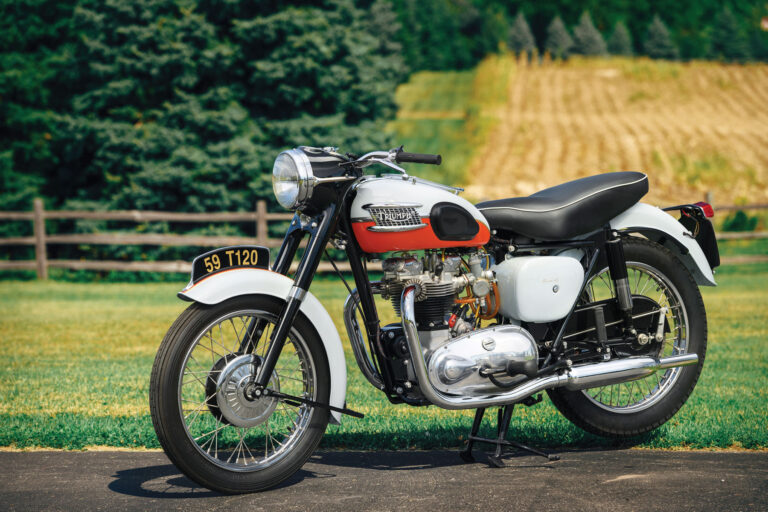
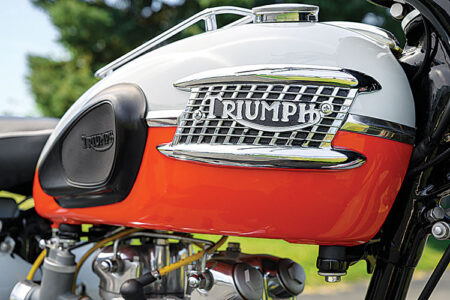
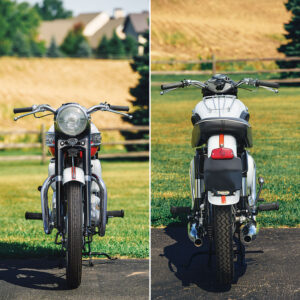
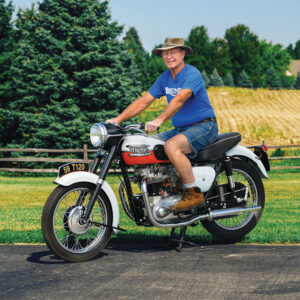
Some 1,881 Bonnevilles were made for ’59, and upon arrival in the States, few survived in the form in which they were delivered, with two-tone Tangerine and Pearl Gray tanks and deeply valanced fenders topped by a fork-mounted nacelle. Such was the case of the bike discovered by Marty Tellalian of Forest Park, Illinois. Now seen here as a well-restored example of a rare and desirable 1959 T120 Bonneville, his project bike started with only the bare bones.
Based on speed
Triumph’s Bonneville traces its history back to late 1953, when a group of Texas-based enthusiasts brainstormed a go-fast machine powered by a modified 650cc parallel-twin 6T Thunderbird engine. According to Triumph historian Lindsay Brooke in his book, Triumph Motorcycles in America, Triumph and Ariel dealer Pete Dalio of Fort Worth, together with mechanic Jack Wilson and aircraft engineer J.H. “Stormy” Mangham, hatched a plan to better the land speed racing records set by NSU of Germany on the Bonneville Salt Flats.
In 1954, Mangham built a streamliner powered by one of Wilson’s hot-rodded Triumph twin-cylinder engines that showed promise by turning 155mph under test. “The following year (1955),” Brooke wrote, “Mangham returned to Bonneville with one of Wilson’s methanol-fueled 650cc motors installed and twenty-seven-year-old Texas Short Track Champion Johnny Allen at the controls.” In the streamliner, which was then called the Devil’s Arrow, Allen clocked a 191mph one-way run on modified Firestone street tires. When equipped with good Dunlop speed rubber, the machine rattled off a 193.30mph two-way average run.
Mangham’s streamliner was 15-feet 8-inches long, and the fiberglass shell enveloped a chromoly-steel tube frame. When the crew returned to Bonneville in 1956, the machine was still powered by Wilson’s 6T Thunderbird engine with a cast iron cylinder head, “milled and re-ported to mount twin 1-3/8-inch Amal GPs (carburetors),” Brooke wrote. The crankshaft was specially built by Rich Richards in California, connecting rods turned on Cadillac V8 bearings, valves were from a Harley-Davidson KR, and a Lucas magneto provided ignition. Now named the Texas Cee-gar, in 1956, the streamliner managed a record-breaking average speed of 214.47 mph over the mile on the Bonneville Salt Flats, again with Johnny Allen in the cockpit.
“On September 6, 1956, at the Bonneville Salt Flats, Utah, a 650 c.c. Unsupercharged, Streamlined Triumph broke the World Motorcycle Speed Record at a mean average speed for one mile of 214 m.p.h.,” crowed a circa 1956 Triumph brochure. “The rider was Johnny Allen of Fort Worth, Texas. It is significant that the engine, gearbox, transmission, and wheels of this remarkable machine were built up from standard Triumph production parts, a striking testimony to the design, quality, and performance of the Triumph vertical twin engine and its accessories.”
Dual carburetors and the Bonneville
In 1956, Triumph’s racing 500cc T100 motorcycles were equipped with new twin-port cylinder heads with straight inlets. By 1957, Triumph altered the design with splayed-port inlet tracts and offered to speed enthusiasts the alloy twin-carburetor head as an accessory for the 500cc T100. The new head was not available for the 650cc engine until 1958. Again, offered as an accessory, there was significant demand for these twin-port alloy heads. They were used by American dealers and owners alike to upgrade the performance of the already sporty T110 and TR6 models.
According to Brooke, American distributors Triumph Corporation (East Coast TriCor) and Johnson Motors (West Coast JoMo) were well aware in ’58 that there was demand for a factory-built twin carburetor model. Letters were written to Triumph expressing interest in such a machine. “By all accounts,” Brooke wrote, “(Triumph designer) Edward Turner was hesitant about offering a twin-carb 650, and his reluctance then was not as difficult to understand as it may seem today.”
Brooke continued, “With each additional increase in horsepower, and the resulting internal stresses, Triumph’s vertical twin moved further and further away from Turner’s well-mannered, smooth-running original design.” Most importantly, “The downside of this development curve, Turner realized, was a hotter-running, rougher, more temperamental engine.”
Brooke noted other factors regarding Turner’s hesitancy, including aspirations for his newly developed models wearing rear enclosures, which Americans quickly dubbed “bathtubs.” As well, Triumph had been building plenty of popular machines for the U.S. market and had won many accolades on American tracks. Further, a new motorcycle in the Meriden-based factory might have been viewed as something of a complication. However, TriCor and JoMo were rather adamant and very persistent in their requests.
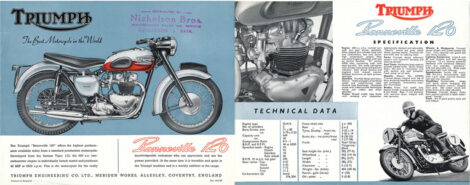
With that almost incessant pushing, Turner finally acquiesced late in 1958 with a factory-built dual-carburetor model. For a name, he turned to the American success on the salt flats, christening the motorcycle the T120 Bonneville. Announced late in the season, the new Bonneville was not included in any of Triumph’s brochures for 1959. Instead, a double-sided 7-inch by 9-inch leaflet was the only printed material the company released heralding the Bonneville’s arrival.
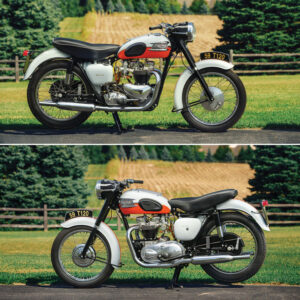
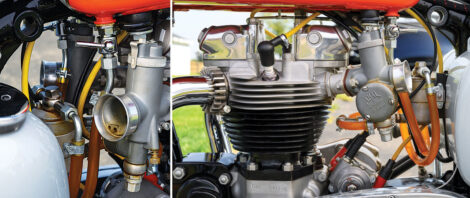
The brochure indicates the Bonneville was based on the Tiger 110, or T110, but was now equipped with the dual-carb head. Triumph’s parallel-twin engine with overhead valves featured a 71mm by 82mm bore and stroke for 649cc. Compression was 8.5:1 and, with a pair of remote-float Amal 1-1/16-inch carbs on the intake stubs, produced 46 horsepower at 6,500rpm. This was the first year for Triumph’s new one-piece forged crankshaft with the central flywheel held on with three large bolts. Previously, Triumph cranks were three-piece affairs, comprising two separate throws held together, and sandwiching the flywheel with six bolts and nuts.
In 1963, Triumph redesigned its 650cc engine to include the 4-speed gearbox in a cavity behind the crankcase, making it a unit design. All previous Triumph 650s featured a separate engine crankcase and gearbox casting, and after the introduction of its newest engine, the earlier models were described as “pre-unit” machines.
American reaction
As mentioned, at the time of its launch, the T120 Bonneville for 1959 looked more like a drably finished touring machine than a go-fast sports model. What U.S. buyers wanted was a motorcycle like the sporty TR6 Trophy, but with the dual carburetor head. According to Brooke, many dealers did exactly that and installed the accessory splayed-port cylinder head on a TR6 simply to satisfy customers.
“Meriden, realizing their styling mistake, changed the 1960 Bonneville to TR6 specifications, but not before a glut of original nacelled T120s jammed American warehouses,” Brooke wrote in Triumph Motorcycles in America. “These had to be sold off as 1960 models the next season. As if to emphasize this point, neither of the two major U.S. motorcycle magazines road tested a Bonneville in its inaugural year.”
Many 1959 Bonnevilles that landed in America were stripped of the nacelle and valanced fenders and customized to suit an owner’s tastes. That’s the condition in which Marty Tellalian found his ’59 listed on eBay in 2005. It was a frame with a bobbed rear fender, engine, gearbox, forks, custom oil tank, incorrect gas tank, and rusty wheels. The listing indicated the motorcycle was in Minnesota, about 350 miles away from Marty’s home. If he won the bidding, that made it easier to pick up rather than having it shipped.
“You could see the VIN indicated the bike was an early 1959 Bonneville, but it wasn’t listed as one,” Marty says of the eBay auction. “I wrote and told the seller that, and I wasn’t the only one to figure that out, but I stuck with the auction and ended up getting it.” That was 20 years ago, and in the interim, Marty set out to find as many new-old stock or good used Triumph parts as he could find. He wanted to make the Bonneville as close to factory correct as possible, with the parts going on shelves until it came time to resurrect the motorcycle.
Bonneville rescuer
Marty’s been connected to motorcycles since he was a youngster. His father first got him interested. “My dad turned 18 in early 1943, and he went right into the military,” Marty says. “When my dad got out of the military at 21, he bought a motorcycle and brought it home to Pittsburgh, but my grandfather wouldn’t let him keep it. I always thought that a little ironic — you could go off to war as a machinist mate on the destroyer USS McGowan that engaged in a number of sea battles, come back and buy a motorcycle, and your father says, ‘No, you’re not going to keep that.’ Different times. Still, my dad always liked them, and we bought one from Sears, and we bought a used Honda 90 that I rode around when I was in high school in the late 1960s.”
When Marty attended college, he always wanted a “real” motorcycle but couldn’t afford one until he’d graduated, gotten a job, and was working in Texas. With his first income tax refund check in the spring of 1976, he bought a used 1972 Bonneville T120V; the V stood for five-speed gearbox, and it was the first year the extra cog was offered.
In 1971, Triumph redesigned its 650cc models. Gone was the separate oil tank, and the engine was now mounted in a taller oil-bearing frame with new forks and conical hubs. The seat height was raised, and some of the traditional styling cues were altered with wire-stay front fender and headlight brackets. For 1972, Triumph lowered the seat height, and although there was nothing technically wrong with the redesign, some of the Bonneville’s earlier appeal had been lost. Triumph did its best with the Bonneville through turbulent labor disputes and economic conditions, but the last Meriden-built Bonneville went out the door in 1983.
“The ’72 was my first proper bike, and I went from a Honda 90 with centrifugal clutch to the 650cc Bonneville,” Marty says. “I survived, and I actually still have that Bonneville. I’ve always been drawn to English bikes in general and Triumphs specifically. They have a great look, they handle great, they’re so responsive.”
Marty rode the ’72 Bonneville into the late 1980s until having gearbox trouble. He spent time without a running motorcycle for several years, but would often rent a bike and tour the American Southwest. Eventually, he bought a used but modern Hinckley-built Triumph Bonneville to ride, repaired his ’72, and began collecting vintage BSAs such as a 1971 Thunderbolt and a 1968 Royal Star. Classic Triumphs included a running 1957 Tiger T110.
He purchased bikes to keep himself occupied during his retirement, but he worked longer than he thought he might. He’s competent with tools, but says, “I’m certainly not a mechanic. And when I did find the 1959 Bonneville in such poor condition, I wasn’t going to take a chance on somebody like me messing it up.”
Dale Matteson: 1959 Bonneville restoration expert
Born in 1949, Dale bought his first motorcycle at 17. It was a Suzuki, but all his friends rode English machines. Deciding he needed a British bike, they began hunting for one he could afford. That was a 1967 BSA Lightning, a twin-carburetor 650cc. “When I bought that BSA, I knew nothing about it, but I bought a manual and kept it handy and learned how to fix my bike,” Dale recalls. “Pretty soon, friends wanted me to work on theirs, too, and when that got to be more work than fun, I started charging them for it.” He moved to Walworth, Wisconsin, in 1975 and set up a shop in his 24ft-by-24ft garage and called it Dale’s Cycle. British motorcycle restoration jobs started rolling in at the tail end of the 1970s, and he’s been doing them ever since.
Equipped with a full toolbox, a bike lift, lathe, blasting cabinet and air compressor, and polishing equipment, Dale says he’s able to do most aspects of a restoration in-house, except for crank grinding and magneto recommissioning. He rebuilds heads, performs all aluminum polishing, and builds motors from the sludge traps up. Concentrating on building one full bike at a time, when parts go out for paint, plating or powder coating, he will take on other small, specialized jobs to keep busy. Currently, he’s working on his thirteenth 1959 Triumph Bonneville restoration, and has the bare beginnings of another that he hopes to keep for himself.
Marty’s 1959 Bonneville
Records provided from the Vintage Motor Cycle Club U.K. (VMCC) indicate Marty’s Triumph, as he bought it, is a numbers-matching machine with the correctly numbered gearbox. The Bonneville’s engine was assembled on October 22, 1958, and the bike was built on October 23. Four days later, on October 27, the machine was sent to Johnson Motors (JoMo) in Pasadena, California.
“It had good bones, and I started trying to assemble parts right away,” Marty says. “I bought the right fenders on eBay and did search for good used or new-old-stock parts, including the dual Amal carburetors and remote float chamber. As I was acquiring the parts, I had the boxes on the shelves in the corner of the basement. I’d open them up as they came in to confirm the pieces were correct and in good enough shape, but simply put them back in the packaging, waiting for the day this would all come together.”
That day came in 2023 when Marty loaded his truck with all the accumulated parts and the 1959 Bonneville rolling chassis and delivered them to Dale Matteson of Dale’s Cycle in Walworth, Wisconsin. Dale has restored a dozen 1959 T120s and is highly respected regarding British motorcycles (see sidebar).
Dale picks up the restoration story. “Marty’s bike was in rough condition, and it wasn’t running. It hadn’t been cared for and had been modified, and he’d done a lot of online shopping to find the right parts.”
He continues, “I open everything up and I don’t cut any corners, it’s all going to be new with a re-ground crank, all new bushings and bearings. I like to improve some of the bearings, for example, the steering head bearings came from the factory as loose balls. Timken tapered roller bearings are a great improvement, and I’ll do that because they’re not visible to the casual observer.”
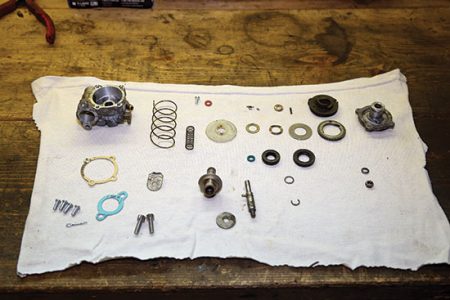
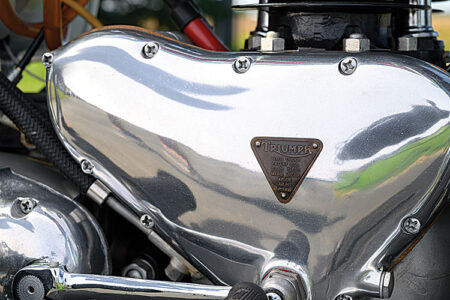
Dale cleaned the aluminum crankcase, gearbox case, and cylinder head in his glass bead cabinet before fitting the new bearings and serviced crank. Cylinder barrels were bored .020-inch oversize, painted, and fitted with new pistons and rings, while the cylinder head was treated to all-new guides and valves. The gearbox was inspected and freshened with new bearings and bushings, while the outer cover got a polish together with the timing cover and elegantly shaped chain case and rocker boxes.
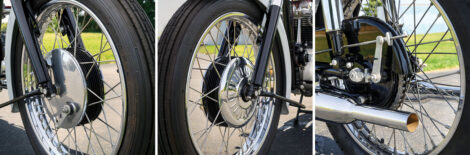
The chassis didn’t pose any problem, and anything that is black, such as the frame, stands, hubs, and other bracketry, were powder coated black. Dale cleaned up the fasteners and other hardware, including wheel axles, brake operating arms and cams, and had them all correctly cadmium plated. For the wheels, 19-inch front and rear, new chrome rims were laced to the hubs with stainless-steel spokes. From the factory, spokes were cadmium plated, but Dale says, “Those always rusted up in a year or two, and no one complains about the stainless-steel spokes.”
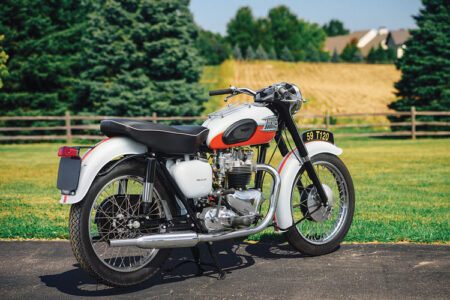
There was no real struggle putting Marty’s Bonneville together, Dale says, but to ensure all sheet metal pieces fit correctly, he first mocked up the motorcycle. Often, parts such as the fenders and the nacelle require light alterations to ensure everything lines up. Once satisfied all was good, fenders and gas tank were sent to Illinois-based Craig Ellis for Tangerine and Pearl Gray in the correct scheme. He also applied the black paint to the nacelle. Back together with a cloth-wrapped Lucas wiring harness, it took Dale one year to complete the restoration.
On the road
“I’ve run it and ridden it,” Dale says. “I’ve got a 10-mile circuit that I will typically break them in on. I run them on break-in oil so the piston rings can get seated very early on. I don’t beat it, I don’t rev it high, and at the same time, what gets the rings seated are larger throttle openings. I’ll go through the gears, and then slow down, and go through the gears again and gently accelerate to get that achieved.”
He adds, “In the end, everything fit properly, it runs great, and it looks good; it’s a fine machine.”
Marty picked up the finished Bonneville early in 2025 but says, rather unfortunately, that he’s unable to ride it. His balance isn’t good anymore, and he is afraid he won’t be riding too many bikes. “Especially with that ’59, I’m not going to risk that,” he says, and concludes, “It’s an iconic, legendary Bonneville that in Dale’s hands has become absolutely beautiful.” MC