1923 Ace Sporting Solo
- Engine: 78 cu-in (1278cc) F-head air-cooled 4-cylinder, 2.750in x 3.250in bore/stroke, 22hp, compression ratio unknown
- Top Speed: 120mph (est. — Ace Special Experimental Four-Cylinder XP4 achieved 129.61mph in 1923)
- Carburetion: Ace-Schebler
- Transmission: 3-speed, hand shift
- Electrics: Simms magneto ignition, Splitdorf 6V generator
- Frame/wheelbase: 1-1/4in steel tube cradle type, 59in (1498.6mm)
- Suspension: Leading link sprung fork, rigid rear
- Brakes: Dual external bands on each side of rear hub, approx. 5.5in dia., no front brake
- Tires: Siamese Cord Extra Heavy Duty 3.00 x 20in front and rear
- Weight: 365lb (165.5kg)
- Seat height: 27.5in (698.5mm)
- Fuel capacity: 3.75gal U.S. (14.2ltr)
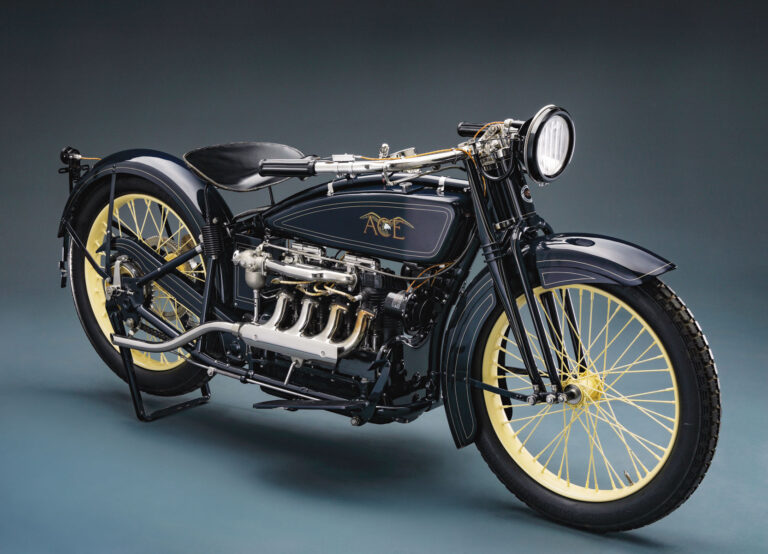
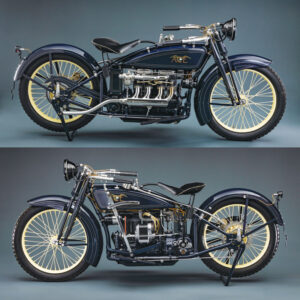
Remarkably low, lean, and purposeful looking, there’s something undeniably striking about a 1923 Ace Sporting Solo. Perhaps it’s the svelte fuel tank, tucked between the top tubes of the frame.
Or, that lovely 1278cc inline four-cylinder engine with its sinuous exhaust system. Maybe it’s the nearly flat pullback handlebars and the well-shaped sprung solo saddle. Although it’s hard to quantify the many attributes of the Ace Sporting Solo, for Jim Balestrieri of the Throttlestop Collection in Elkhart Lake, Wisconsin, it was the overall package that caught him by surprise.
“I was at a Mecum Auctions pre-sale event in Las Vegas,” Jim recalls. “It was in the fall of 2018, and it was before their big January sale for 2019. They had a room filled with more than 75 collectible motorcycles, and I remember laying eyes on this 1923 Ace Sporting Solo. I was stunned. It was like seeing a favorite movie star, and it just stopped me in my tracks.”
At the time, Jim admits he didn’t know much about Ace’s pedigree or its significance in the place of American motorcycle development. But he came away from that pre-sale Mecum event determined that if he bought only one motorcycle in 2019 to add to the collection, the ’23 Ace would be it. “All the stops came out, and it was an emotional attraction,” he explains.
Origins of the Ace
To understand the Ace, an introduction to its designer, William G. Henderson, must be made. According to Richard Schultz’s comprehensive and well-researched book, Hendersons: Those Elegant Machines, in 1882, William was born to Thomas Henderson and Catherine Winton. In the early 1900s, Henderson Sr. was vice president of the Winton Motor Car Co., maker of high quality automobiles in Cleveland.
The nascent motoring era owed much of its existence to the bicycle craze of the late 1800s. In fact, Winton was founded by Thomas Henderson’s father-in-law, Alexander Winton. A Scottish immigrant who set up the Winton Bicycle Co. in 1891, Winton soon began dabbling with internal combustion and four wheels. By 1897, Winton had driven one of his first automobiles from Cleveland to New York City and went on to build expensive-to-purchase and finely crafted machines.

Into this mix came William, who in the early 1900s had been working for auto and marine engine builder J.A. Brownell of Rochester, New York. William was passionate about designing powered two-wheelers, and, by 1910, he had a drawing of his unique four-cylinder motorcycle. As much as his father attempted to discourage him by pointing out flaws in the drawings, William only pushed harder to realize his dreams, and by 1911, he’d developed a prototype machine that gave way to the production Model A Henderson of 1912. These motorcycles are designed around an elaborately long frame featuring a 65-inch wheelbase with a pillion saddle mounted in front of the rider.
Early motorcycles retained vestiges of their bicycle origins, mainly with the pedals. Not so the new Henderson. According to a period leaflet reproduced in Schultz’s book, “The Henderson is different from other machines — it’s ahead of them all. The old-time and bothersome pedals are done away with. It has an aluminum platform with inserted rubber pads to prevent the feet from slipping. The machine represents power and strength, and for tandem use, there is nothing better on the market.” Of the four-cylinder engine, the brochure claims the Henderson was “built for endurance, power, and comfort. It is a machine that will stand up and give a good account of itself in every test – and when it comes to hill climbing, the Henderson will always be among the leaders.”
At the outset of Henderson’s existence, William was joined by his business-minded older brother, Thomas Jr. Although Henderson motorcycles sold well early on, due to material shortages caused by the First World War, the company soon fell on hard times. In late 1917, this led to bicycle magnate Ignaz Schwinn purchasing the company. Schwinn was already at the helm of Excelsior Motorcycles, and tooling and production of the four-cylinder Henderson moved from Detroit to Chicago. The brothers went with it, but the business arrangement was short-lived. Thomas resigned from Schwinn’s employ early in 1919, followed by William early in 1920.
Ace Motor Corp.
Schultz wrote that toward the end of January 1920, William had been “putting his okay on drawings” of parts for the soon-to-be-produced Henderson Model K 4-cylinder. Designed by Arthur O. Lemon, the Model K was a heavier-duty motorcycle, and William was said to be displeased with the direction in which Henderson four-cylinder motorcycles were heading. So, he broke his contract with Excelsior-Henderson and joined forces with Max Sladkin to form the Ace Motorcycle Corp. in Philadelphia, with a factory in the former Savage Arms facility.
“Will Henderson must have been drawing the new Ace motorcycle while he was working for Excelsior,” Schultz wrote, “because the Ace was being offered for sale only a few months after Will left Excelsior and formed the Ace Motorcycle Corp. in early 1920.”
A quote in Shultz’s book from a Motorcycling and Bicycling Illustrated article highlights William’s devotion to the Ace project. The story’s author wrote, “Starting with only his knowledge based on long experience and the memory of principles developed, Mr. Henderson created the four-cylinder Ace motorcycle as a completely new machine embodying his latest ideas and most matured thought. The new machine was placed on the market early in 1920 and made a profound impression.”
The Ace featured a 20-horsepower, 75 cubic-inch (or 1220cc), inline four-cylinder engine — just as the Henderson had. However, William smartly ensured no parts of the Ace machine could be swapped to a Henderson, thus negating any infringement on Schwinn’s Excelsior-Henderson patents.
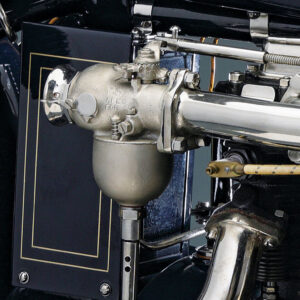
The Ace relied on valves laid out in the F-head format, where the intake valves are placed above the exhaust valves. In the accompanying images of the 1923 Ace Sporting Solo from Throttlestop, this F-head arrangement can easily be seen on the right-hand side of the engine, where the intake runner with its Schebler carburetor is over the spark plugs, with exhaust ports and four-into-one header below. A beefier horizontally split aluminum crankcase with splash lubrication ran with the single-plane crankshaft. The crank with a heavier flywheel was bolted into the upper half of the case and turned on three main bearings, all 1-1/8-inch diameter, but the front was 1-1/4-inch long while center and rear were 1-1/2-inch long. Bearings for crankshaft, four connecting rods and counter shaft were all Babbitt-lined bronze. An oil-bath, multiple steel disc crank-mounted clutch sat between the engine and the 3-speed hand shift transmission.

The four-cylinder engine was mounted low in a cradle frame with a leading link sprung front fork. Due to the low center of gravity, handling was described as remarkable. Large diameter 20-inch wheels anchored both ends of the Ace, and the machine had a 59-inch wheelbase with a 27.5-inch saddle height. Only the rear wheel featured a brake, with dual external contracting bands acting on each side of the hub. Overall, the early Ace weighed some 365 pounds.
To put that into perspective, for a quick but rather interesting comparison with a modern motorcycle, the single-cylinder Honda Rebel 300 that was offered for sale in 2025 comes remarkably close to the Ace’s specifications. The Rebel 300, with its 27-horsepower, liquid-cooled 286cc four-stroke single-cylinder engine with fuel injection and six-speed transmission, has a wheelbase of 58.6 inches, a saddle height of 27.2 inches, and a curb weight of 364 pounds.
Ace Sporting Solo
Although popular with buyers wanting a quiet, smooth, and fast machine, Ace struggled into late 1920 and through 1921 due to an economic depression. However, fortunes began to show increased promise for 1922, and William Henderson had been fine-tuning his machines. Notably, he’d been nearly ready to launch the Ace model featured here, the Sporting Solo.
“The dyed-in-the-wool motorcyclist who uses a solo mount for sheer enjoyment and who loves the sport for its liveliness and vim, was given the center of the stage by W.G. Henderson and his associates who designed the new Ace Sporting Solo Model,” claims a 1923 Ace brochure. “The solo rider comes into his own.”
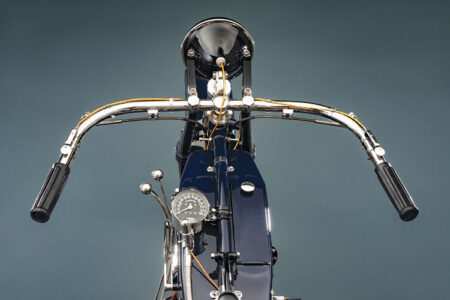
The brochure further explains that the Sporting Solo was “built from hub to hub as a light, competent, swift, and easy-handling outfit, which will give the rider the utmost of that sense of freedom and power that is found in no other recreation.” Wider handlebars than those found on the standard Ace were also shorter and lower, in the style of an “English T.T.” or road race bar. As well, the sculpted saddle was created specifically for the Sporting Solo to “hold the rider securely in position for fast riding on the road.”

The Sporting Solo featured increased compression with the use of alloy pistons instead of the standard cast-iron pistons; it produced 22 horsepower. According to the brochure, by 1923, the capacity of all Ace fours had been taken to 78 cubic inches, or 1278cc, and the drop-forged I-beam connecting rods were drilled for lightness. Valves were 1-1/4-inches in diameter and had a 1/4-inch lift.
Before the new model could be launched, however, tragedy struck. On December 11, 1922, William’s life was cut short at the age of 39 when out on a test ride of the Ace Sporting Solo.
In the Motorcycling and Bicycling Illustrated article in Schultz’s book, a lengthy account of the accident with William at the controls of a Sporting Solo can be found. The author wrote, “Will Henderson riding the new Ace was accompanied by Walter Bradley and P.J. Bailey with a sidecar outfit. They left the Ace factory shortly after 11 a.m.”
The story continues, “The sidecar machine halted at a gasoline station, and Will rode along onto Castor Road at a moderate pace. Having designed the ultimate machine, which was yet another in a long string of developments since the first design in 1911, must have been a thrill. Why Will was accompanied by the two men in a sidecar isn’t recorded, but one can guess that the Sport Solo Ace was assembled quickly and liberties were taken to get it on the road. Having these two men with him gave them a chance to see its performance and also to help in case of mechanical trouble.”
Then, tragically, “As Will Henderson crossed Folkrod Street, an automobile, driven at a very high speed by a man named Elmer Pferisch, shot out of the side street and crashed into the motorcycle broadside. The automobile driver, it was said, seemed to have made no attempt to stop or swerve aside before the collision occurred, as the marks of the wheels on the pavement indicated that the brakes had not been applied until after the crash.”
The car skidded some 60 feet after impact, dragging the Ace Sporting Solo beneath it. William was transported to the hospital, but due to the severe trauma, shortly after his arrival, he succumbed to his critical injuries.

Although William was never able to establish his own financial success with four-cylinder motorcycle production, the Motorcycling and Bicycling Illustrated story quoted William’s father, Thomas Sr., who viewed his son’s success quite differently. “He has been successful,” Thomas Sr. said. “He has done what he set out to do. His death prevents him from enjoying the material rewards which the future held for his long efforts, but it cannot rob him of the credit of establishing the four-cylinder principle and accomplishing the great purpose which had been his guiding motive throughout the years. His was the task of blazing the trail.”
But success still eluded Ace Motor Corp. It was under the auspices of the Michigan Motors Co. of Detroit, Michigan, in 1924, and that same year, the company entered liquidation. Production was then moved to Blossburg, Pennsylvania, and it seems no machines were built in 1925. All Aces for 1926 were constructed in Blossburg before the company was finally purchased by Indian, and, for 1927, the machines were referred to as the Indian-Ace Four Cylinder Motorcycle.
Under Indian, the four-cylinder engine gained force-feed oiling with a drilled crankshaft to provide 40 pounds of pressure to the bearings. Indian improved the front fork, too, with small changes to increase stability. Indian dropped the Ace name in 1928 and relaunched the four-cylinder motorcycle as the 441. Production of the 441 carried through to 1942.
Throttlestop’s Sporting Solo
According to Mecum Auctions, this 1923 Ace Sporting Solo was first sold in Norway to Kjell David Anderson. It then found its way to Sweden, but any stories about the intervening years are lost to time. At some point, it was purchased by Leiff Jönson, who restored the machine in its correct cobalt blue with cream-yellow wheels and pinstripes. It was then sold in 2007 to the MC Collection of Stockholm, which enlisted Mecum in 2018 to sell many of its motorcycles. Auction catalog copy states this Ace Sporting Solo, “was restored to use.”
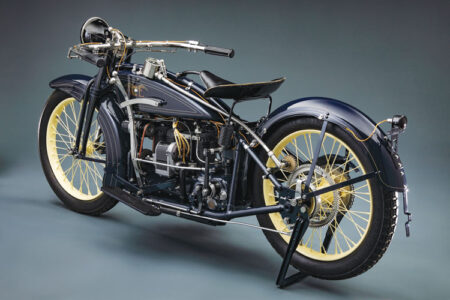
“The restoration is stunning,” says Throttlestop’s Jim about the Sporting Solo. “Some restorations are done almost too well; they’re overkill. Others can be the opposite, though, and are underkill. This thing is just right, and it knocks your socks off. I mean, it was originally made in America, but this, to me, is just a proper restoration that channels European craftsmanship. It puts you right back in the time it would have been sold new off a showroom floor, and it’s got class.”
Jim owns this 1923 Ace Sporting Solo together with a 1927 Indian-Ace. “I love these fours,” he says. “There’s the whole story about FN really being the first with an inline four, and then through Henderson and that split up to arrive at the Ace and the death of Will Henderson and Indian taking over Ace — that gave Indian a ready-made four-cylinder motorcycle they could immediately market. Eventually, the Ace was Indian-ized, as I like to say.”
In Jim’s collection, the ’23 Ace Sporting Solo and the ’27 Indian-Ace are appropriate bookends as a testament to William Henderson and his four-cylinder machines. Of all his motorcycles, Jim favors these two perhaps the most. He concludes, “The ’23 is the centerpiece of any room it’s ever been in, but both it and the ’27 are my pride and joy.” MC