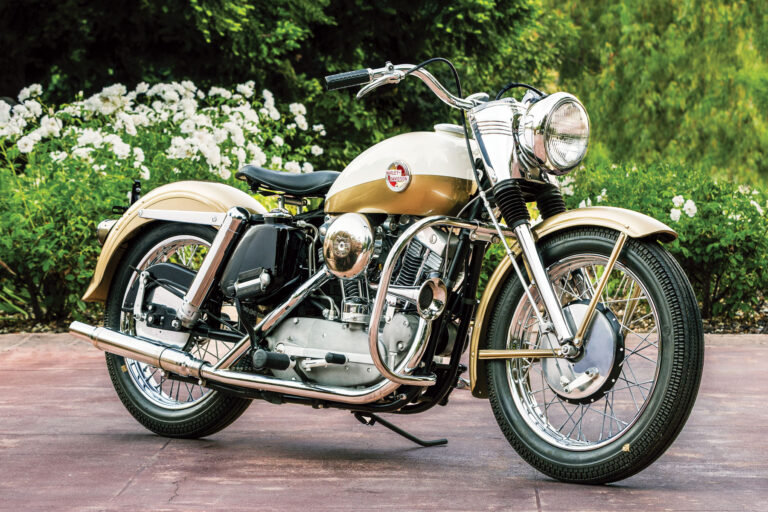
1957 Harley-Davidson Sportster
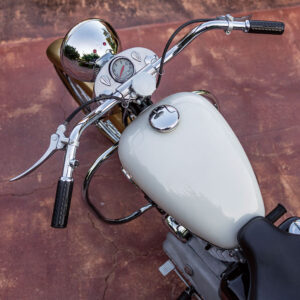
- Engine: 883cc (53.9ci) air-cooled OHV V-twin, 3 x 3.8in (76mm x 97mm) bore and stroke, 7.5:1 compression ratio, 42hp @ 5,500rpm
- Carburetion: Short barrel Linkert DC1, oil-coated paper air filter
- Transmission: 4-speed, right footshift, triplex chain primary
- Clutch: Seven-plate dry clutch
- Electrics: 6v battery and coil ignition, generator
- Frame/wheelbase: Dual downtube cradle with swingarm, 56.5in (1,434mm)
- Suspension: Telescopic forks front, swingarm and dual rear shocks
- Brakes: 8in SLS drum front and rear
- Tires: 3.50 x 18in front and rear
- Weight (dry): 495lb (224.5kg)
- Fuel capacity: 4.4gal (16.7ltr)
- Oil capacity: 3 U.S. quarts
- Top speed: 100mph (factory claim)
- Price then/now: $1,103/$24,000-$32,000
Glenn was the youngest of five brothers who grew up in the early 1960s in Southern California. From the beginning, he loved everything about motorcycles. His older brother had a Honda 305 Scrambler, and Glenn dreamed of the day that he would be able to buy his own motorcycle.
Money was tight in his blue-collar parents’ home, and Glenn could only ride what he could find, afford, and fix. He learned how to keep things running and gained an appreciation of and knowledge of the repair and restoration process. “My enjoyment is doing the work and bringing these old classics back to life,” he says.
When Glenn turned 21, he took off on a road trip on an old stripped-down 1971 Harley FLH Dresser. After four months on the road and just shy of 13,000 miles, he settled down in Jackson Hole, Wyoming, and started his own business called Custom Cycles and Sleds, working on motorcycles in the summer and snow machines in the winter. While living in Jackson Hole, he acquired a barn find 1957 Harley-Davidson Sportster and rode it regularly through Yellowstone Park. Eventually, Glenn decided to tear it down and restore it to its full glory.
In 1992, Glenn, then living in Palm Springs, California, had to sell his first Sportster and entered it in an auction. Otis Chandler, a well-known collector, was looking for a 1957 Sportster to add to his newly forming motorcycle collection. After buying the Sportster, Otis offered Bator a job managing his collection and restoring new acquisitions. After a ten-year run with Chandler, Glenn and his wife Deni started Bator International, working as a high-end motorcycle broker and an auctioneer while continuing to restore motorcycles. That first Sportster is now on permanent display at the Barber Motorsports Museum in Birmingham, Alabama.
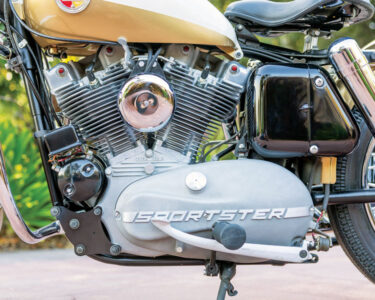
Glenn claims our featured Nugget Gold and Birch White Sportster will be the last Sportster he ever restores. “A couple of months ago, I ran it through the judging process at the Antique Motorcycle Club of America meet at Dixon, where she scored a 100-point Junior First award. It has been a good run, and after restoring close to a dozen or more early XLs, it’s time for me to turn my attention to other challenges.”
Chasing the Brits
In 1951, Harley was selling Hydra-Glides in 61- and 74-cubic-inch displacements, 45-cubic-inch WL V-twins, and a 125cc two-stroke single-cylinder lightweight, all with no rear suspension. The WL used a sidevalve engine, developed about 21 horsepower, had a hand shifter, and girder forks. The contemporary 500cc Triumph then being imported used an overhead valve engine that developed 28 horsepower, had a sprung rear hub and telescopic forks, hand clutch and a four-speed footshift, and was good for 85-90mph. Harley only sold 1,044 WLs that year.
Meanwhile, Harley engineers were working on a more contemporary motorcycle to compete with the increasing number of European bikes imported to the U.S. The K Model, unveiled in 1952, was still a 45 cubic inch (750cc) flathead. It had a hand clutch, four-speed footshift, telescopic forks, and rear suspension. By design, it was a unit-construction engine and transmission. It was a good-looking motorcycle, but not especially fast. The contemporary OHV 650cc Triumph Thunderbird weighed about the same but was considerably faster. In 1954, Harley lengthened the K Model’s stroke to 4.5625 inches to produce a displacement of 883cc (54 cubic inches). The KH was still a sidevalve, but a hot sidevalve. It was clocked at a top speed of 95mph, but customers still weren’t interested. It sold in even fewer numbers than the K model. The next evolution was the KHK, with hotter cams, polished ports, and larger valves. Harley only sold 714 KHKs in 1956. For the record, Harley was selling considerably more 125cc lightweights.
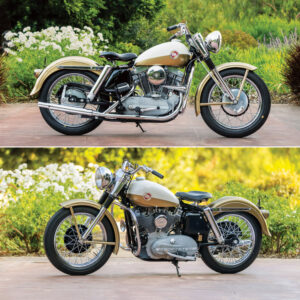
Finally, in 1957, Harley-Davidson came out with the 883cc XL Sportster. The Sportster looked very much like the KHK and had the same displacement, but it had overhead valves and a 7.5:1 compression ratio. Since an OHV motor of the same displacement and state of tune as a flathead motor will usually make considerably more horsepower, this midweight Harley was fast enough to challenge the British bikes.
The new Sportsters quickly became popular, especially after the factory bumped up the compression ratio to 9:1 in 1958. The California dealers convinced the factory to produce a stripped-down clubman racing machine the same year, which was designated the XLCH. A little over 200 of the 1958 XLCH models were built, and as uncrated, had no lighting and an abbreviated rear fender. For 1959, the XLCH was factory-equipped with lights. The factory sold 1,983 Sportsters in 1957, increasing to 2,765 by 1960. Harley-Davidson has continued to make Sportsters until the present, although the Sportster S, debuting in 2021, has a completely different DOHC engine that meets European emission standards.
The original 1957 Sportster was designed as a smaller, more nimble version of the big twins Harley was then producing. Standard colors throughout the lineup were Pepper Red with Black tank panels, Skyline Blue with Birch White, Birch White with Black, and Black with Pepper Red. An extra charge color was Metallic Midnight Blue with Birch White. A Nugget Gold with Birch White option became available as a spring special.
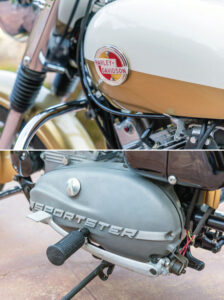
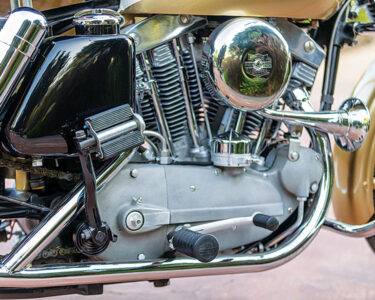
Actual displacement was 53.9 cubic inches, or 883cc. The Sportster had a four-speed transmission, unit-construction motor cases, and shifted on the right to match British rivals. Interestingly, the big twins are equipped with footshift on the left. The electrical system used a six-volt battery, typical for 1950s electrics, with a generator. While the XLCH used a magneto for ignition, other XLs were points and coil. Like the prior KHK, front suspension was via telescopic forks and rear suspension was dual shocks. Dry weight was 495lb for the XL models, and the factory stated horsepower was 42hp @ 5,500rpm, a bit higher for the XLCH, which also weighed a bit less, especially sans lighting electrics in its 1958 introductory year. For comparison, the contemporary Triumph 650cc TR6 Trophy turned out between 34hp and 46hp @ 6500rpm, depending on state of tune, and weighed 365 pounds dry.
With new unit sales sparse, the factory encouraged dealers to push optional equipment and accessories. A prospective Sportster purchaser had a choice of two different handlebars, all sorts of extra chrome, a two-up seat or a solo saddle, different windshields, and even a cigarette lighter. This lengthy option list allowed owners to customize their bikes in many different ways.
Finding the unfindable
Glenn Bator found this 1957 Sportster for sale in Pennsylvania. Someone had attempted to make a chopper out of it. Luckily, the aspiring customizer had not altered the frame. It is common to find motorcycles from this era with heavily altered frames, which means the bike is likely good for nothing but parts. At this time, there were no serial numbers on frames, but Harley did date-code frames with an alphanumeric code, which placed the date of the frame construction, not necessarily the motorcycle’s assembly. On the frame, the code is on the right side of the seat casting where the rear of the gas tank bolts to the frame. If a bike is to be judged by the Antique Motorcycle Club of America, frame date codes should be within an acceptable range, and the frame must be in the correct configuration, with no parts cut off or altered. For example, an early 1957 Sportster has to have a proper date-coded frame, and an engine with a low serial number and engine “belly numbers.” When looking at a potential Harley restoration project, it is of course also possible that the frame and the engine did not meet each other at the factory, and a later model engine was stuffed into an earlier frame at some point, or vice versa. Checking the frame date code, engine serial numbers, and belly numbers is critically important if you want to make sure your Sportster is factory original.
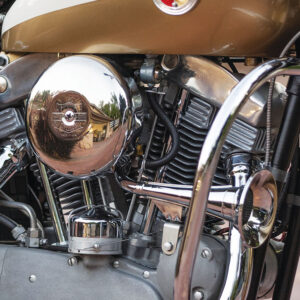
The first thing Bator does with a restoration project is to disassemble the motorcycle to the last nut and bolt. For a near 100-point restoration, all visible bolt heads have to be correctly marked and finished. Glenn knows several early Sportster enthusiasts and has his own stash of parts, but if something is not in Glenn’s or friends’ stashes, it has to be found. Finding parts is usually the major part of a restoration effort. Bator says that prospective owners should know that finding correct parts for these bikes is very difficult. “You have to know what you are looking for. Find a knowledgeable person — pay them if necessary — to go over the bike.” Glenn and some of his friends have spent years searching for the correct parts to complete a restoration. “If you are going to restore a bike, make sure you have the majority of the hard-to-find parts on the motorcycle,” he warns. “You may never find them.”
Checking over the disassembled parts of his Sportster project, Glenn decided that the lower fork legs and the wheel rims were rusted beyond hope. He found rims, but then needed correct spokes. Glenn sent a sample spoke to Buchanan Wheel, a well-known spoke manufacturer, who matched the size and shape to the original. Michael Barrett of Camarillo, California, laced the wheels.
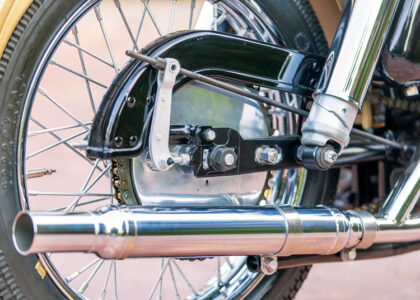
The brake drums were worth restoring, and the coil cover and toolbox, both hard-to-find items, were in good shape. The tank was too far gone to restore, and the hunt was on for a new correct tank. Glenn found one that needed some repair, but given that 1957 Sportster tanks and their special plastic badges are few and far between, Glenn bought the tank and repaired it. The forks were easier — Bator had a set in his parts stash that were in good condition, simply needing refinishing. He cautions that Harley made a design change in the mid-Sixties, and it is important to check that the forks are correct for your year.
It is also important to correctly match the factory finishes, paint, and plating. In the 1950s, many parts were Parkerized, a chemical phosphate conversion finish that is often used for gun components. The process involves heating clean parts in a solution for a specific amount of time, with a dark gray to black result. Many people chrome or cadmium plate parts that should be Parkerized, a common way to lose judging points.
Meanwhile, Bator was looking for a list of hard-to-find parts. The rear shocks, the key switch, and all the bodywork were eventually located, purchased, and refurbished. The fenders are unique to early Sportsters, for example. The correct seat could not be found, but Corbin makes an acceptable replica seat, so that is what was installed on the bike. David Sarafan, who is known for pulling rabbits and unobtainable parts out of hats, was the source for the authentic-looking cloth-covered wiring. Dave Carleton, another Sportster enthusiast, produced the correct white faced speedometer, and John Bordas put it in working order.
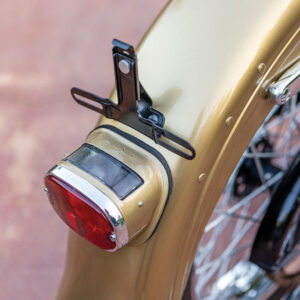
Dave Carleton also found a Nugget Gold fender at a swap meet with good paint: “the only Nugget Gold piece I had seen in over 40 years of swap meets and travels throughout the country.” Glenn Bator decided that, since his date codes and serial numbers were right for the mid-year Spring Special color, he would paint the bike Nugget Gold and Birch White. “I haven’t seen any other 1957 Harley restorations with that color.” With all parts ready for final assembly, including a balanced crank and flywheels, Bator put the engine back together, assembled all the rolling chassis parts, tested the electrical system, and fired up the bike.
Art of the start
Starting an early Sportster is an art. In the 1960s, some people considered a Sportster a “girl’s bike,” a slur at the time, of course. The rejoinder from Sportster owners was, “Try to start one.” Unless you follow the exact starting drill, the bike will either not start or kick back, injuring your leg and causing much pain. Dave Carleton says he used to ride an early Sportster and never bothered to lock the bike, since no thief had a chance of starting it. The starting drill is: With the ignition key in “off,” turn the gas on. Set the choke to the third notch (full choke) and kick 2-3 times. Turn the choke completely off, then re-set to the first notch. Crack the throttle a little, retard the timing with the left grip manual advance all the way forward, turn the key to on, and kick. “Sportsters are notorious for being hard to start,” says Bator. “If the bike is tuned and you know the sequence, there is no problem, although the kickstarter is notorious for the ratchet slipping. When that happens, your foot goes straight down, and boy, does that hurt! After a period of time, you will know what it wants, and the bike will start for you.”
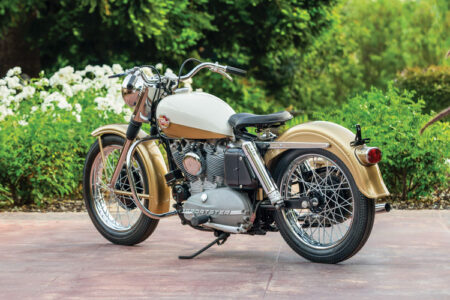
Once started, a ’57 Sportster will cruise at 65mph all day long. The frame has geometry similar to the dirt track racing frame that Joe Leonard and Brad Andres were then racing to the National Number One plate. The bike does handle well for its era. “It’s fine in corners. The tires on this bike are NOS Goodyear Super Eagles, 3.50 x 18 front and rear, so care is required. If the tires were replaced with modern tires, this Sportster would be fine on the road, but then it wouldn’t be a bone stock 100 pointer. The brakes are user-friendly at stops.”
The vertically split crankcase will leak oil, and there is nothing you can do to stop the leaking, so the rider has to check the oil in the oil tank every time they fill up with gas. Even in the absence of outright leaks, the bike will consume about a quart of oil every 500 miles.
Motorcycles bring joy to different people in different ways. Glenn is now working on a Knucklehead for a customer. “After I finish with one motorcycle, I go on to the next bike. I am semi-retired, doing what I like to do.” Meanwhile, one more first-year Harley-Davidson Sportster has been very authentically brought back to life. MC