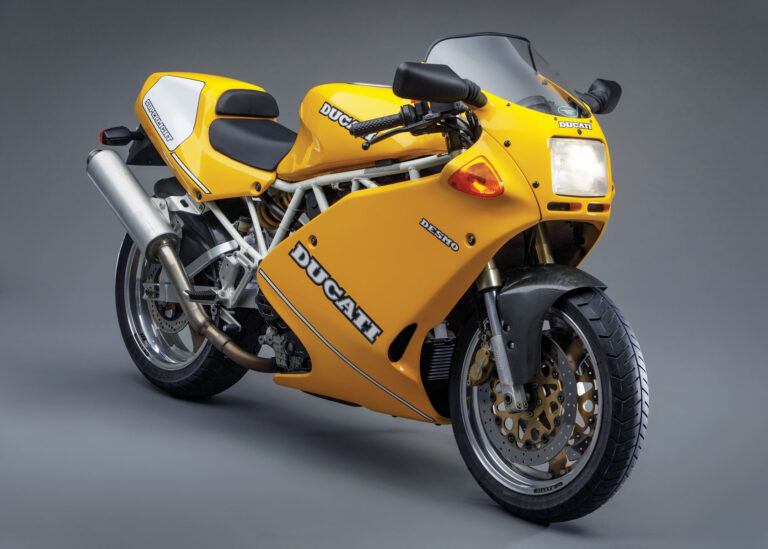
1993 Ducati 900SL Superlight
- Engine: 904cc Desmodromic SOHC air-and-oil-cooled 90° L-twin, 92mm x 68mm bore/stroke. Two valves/cylinder, 9.2:1 compression ratio. 76hp @ 6750rpm (Cycle World dyno 8/92)
- Top Speed: 130mph (209 km/h), 1/4-mile: 11.74 sec. @ 113mph*
- Carburetion: two 38mm Mikuni BDST 38-B67 constant-velocity carburetors
- Electrics: 12V Kokusan electronic inductive-discharge ignition
- Transmission: 6-speed, gear primary, chain final drive ratio: 2.466:1
- Frame: Welded CroMo steel trellis-type tubular spaceframe. Wheelbase: 55.5in (1410mm)
- Suspension: Showa 41mm adjustable inverted fork; Showa fully adjustable GD monoshock rear
- Seat height: 30.7in (780mm)
- Brakes: Dual Brembo Goldline 320mm stainless-steel disc front, single Brembo 245mm SS disc rear
- Wheels: Marvic/Akront magnesium-aluminum or Brembo cast aluminum
- Tires: Michelin A89/M89X 120/70-17 front, 170/60-17 Rear
- Fuel capacity: 4.6gal (17.5ltr)
- Weight: 409lb (185.5kg) dry
*Cycle World test, Aug. 1992
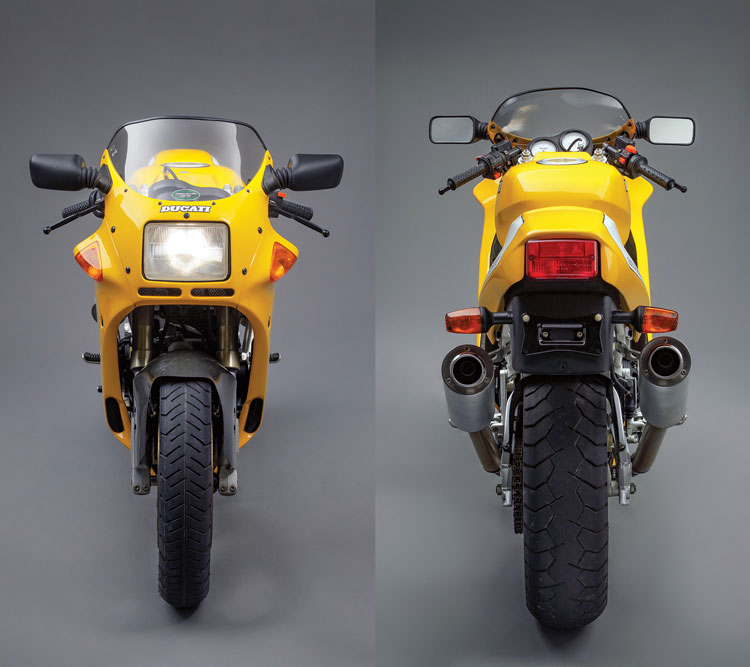
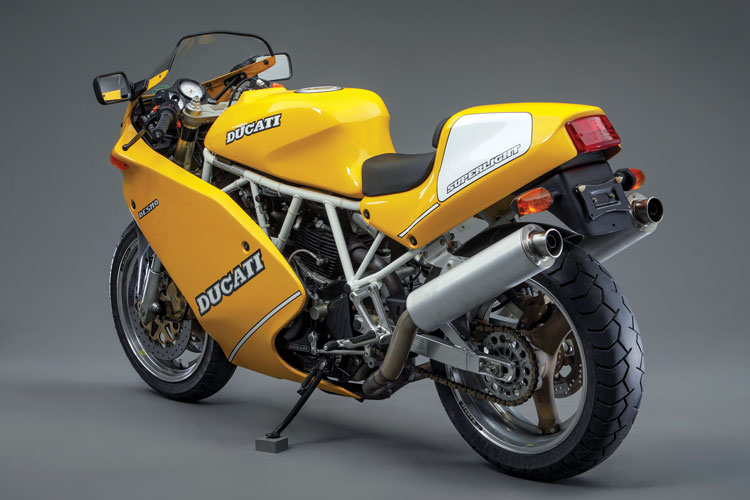
As motorcycling grand entrances go, there are few better than rolling into a Saturday morning coffee stop or a weekly bike night aboard a booming, brilliant yellow Ducati sport bike. Especially one with a white frame, super-trick Marvic wheels, and factory “Superlight” decals adorning its monoposto tailpiece. The limited-edition Duck, in a blazing paint color Ducati dubbed “Giallo,” is incapable of slipping unnoticed into a parking area, anywhere.
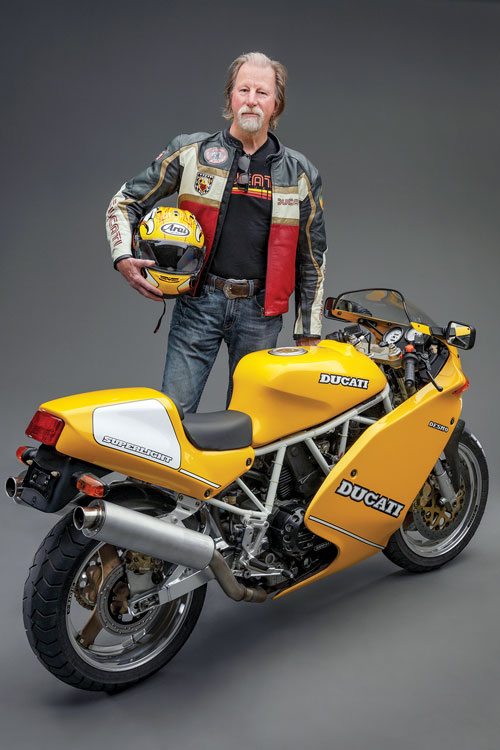
“Every time I stopped on the Superlight, even getting gas, the bike drew a crowd,” noted Gary Heinitz, the most recent custodian of the 1993 900SL featured here. “And it didn’t matter if there were any motorcyclists in the crowd.”
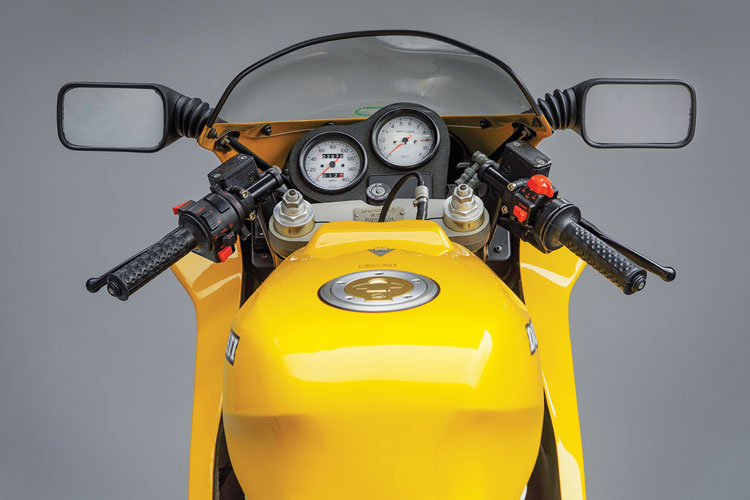
A serial Ducatisti, Heinitz admits to an addiction that has, at its peak, included 30 of Borgo Panigale’s most desirable models, each waiting in his Wisconsin garage to give him a serious adrenaline kick. “I’ve had F1s, 900SPSs, race bikes, bevel 900 Super Sports, and a Paul Smart Ducati 1000LE to name a few,” he said. “The Superlight was one of the coolest.” Without remorse, Heinitz decided to consign the 900SL for sale late last year, for entirely rational reasons.
“I’m getting older and so have been thinning the herd,” he reported. “I’m now down to only five Ducatis.” Heinitz purchased the 900SL with 1,800 miles on it from the original owner in Louisiana. He proceeded to put about 1,000 miles on the bike over the next 20 years. Chalk that up to Wisconsin’s short riding season and the lure of other machines in his then-extensive Ducati stable.
When the Superlight became available in the U.S. in 1992 (as a ’93 model), a year after the model’s debut in Europe, its buyers “tended to be riders who owned a number of motorcycles. They didn’t rack up big mileage on the 900SL,” explained arch-Ducatista Vicki Smith, who co-owned Action Sport Cycles, the Ducati dealership in Fort Lauderdale, Florida, during the 1990s. By comparison, “owners of the standard 900SS rode the heck out of those bikes,” she said.
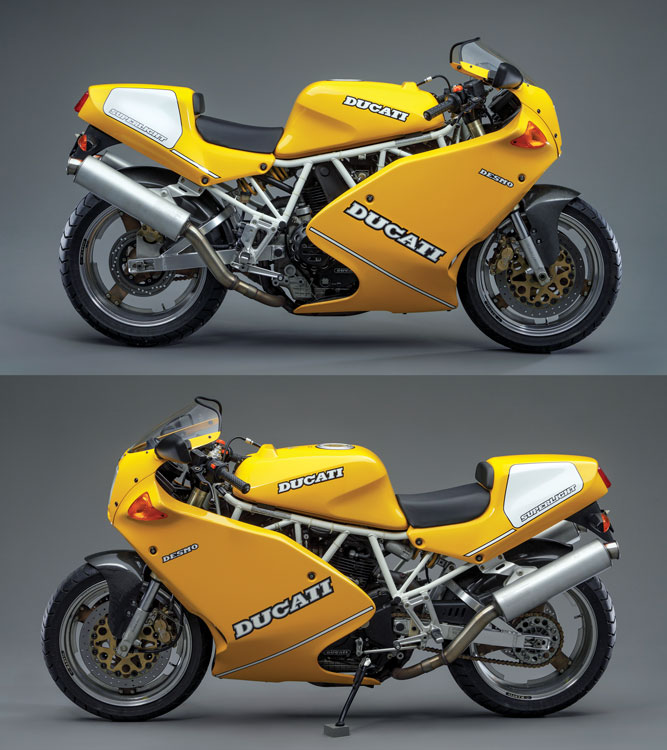
Indeed, in developing the 900SL Ducati created a collector bike right out of the crate. It was based on the solid, well-regarded 900SS platform, which was helping to revitalize the ailing company. By replacing the Supersport’s dual seat with a solo perch and adding a bit of tech bling (carbon-fiber fenders and the Marvic wheels), Ducati was able to reduce the base 900SS’s weight, giving the marketing guys a low-volume, premium-price model to affix the special Superlight decal. The actual mass savings, however, was only five pounds (2.26kg). The SL tipped the scale in Cycle World‘s shop at 409 pounds (dry), versus 414 pounds for a regular 900SS, according to the magazine’s August 1992 “Super Twins” comparison test. In that shoot-out, the 900SL prevailed over a Buell RSS1200 and a Two Brothers-kitted Honda Hawk GT, RC31.
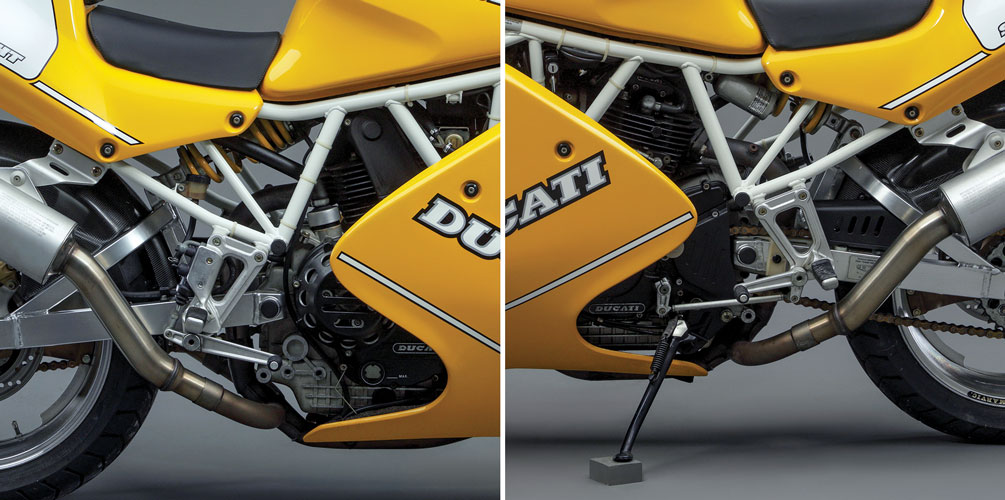
Early Europe-only Mk 1 examples were fitted with cast-iron brake rotors. All were in classic Ducati blood Red. Mk 2 versions arrived in ’92 with stainless Brembo Goldline rotors and the optional Giallo livery. But aside from the flashbike paint, carbon-fiber jewelry, and a numbered plaque on the top triple clamp, was the $9,800 Superlight worth $1,300 more than a plain-Jane Supersport?
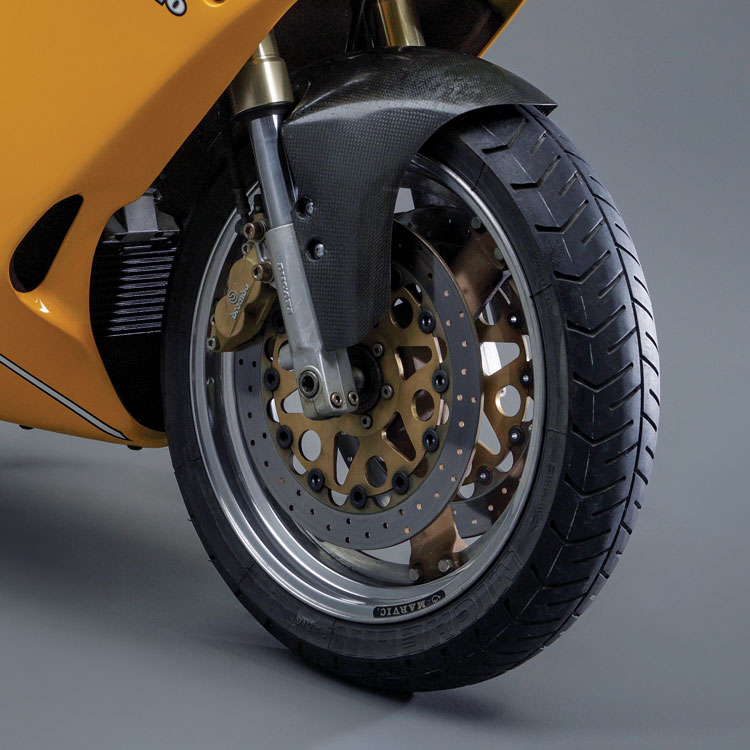
“For us dealers, yes,” Smith asserted. “Its exclusivity made it very desirable. It was simply the coolest of the belt-drive 900s that came before the 916.” She concedes, however, that it was easy and cheaper to build a Superlight out of a standard 900SS using the Gio.Ca.Moto USA (predecessor to Ducati Performance and owned by the late racer Jimmy Adamo) catalog. Smith was among many enthusiasts who did that, upgrading her belt-drive 750 Sport.
The 900 Supersports of the early 1990s “were like having beers with an old buddy — reliable and pretty comfortable for a serious sport bike,” she said. “They were actually a very good motorcycle. They were a lot of things that Ducati had not given customers until then.”
Superlight building blocks
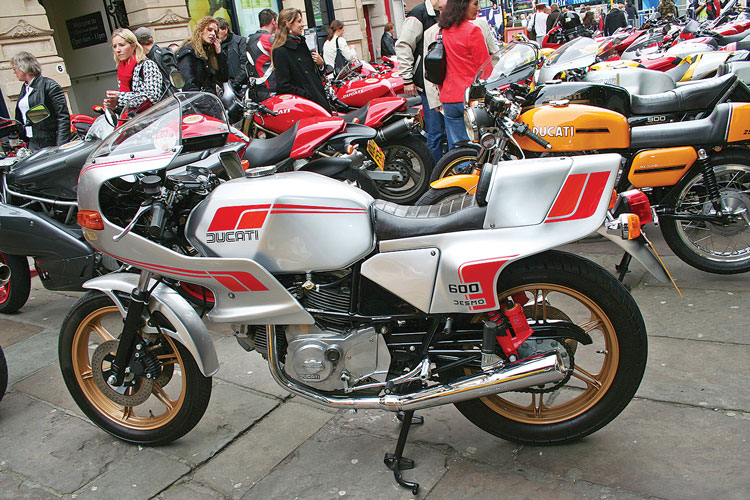
1979 marked the dawn of a transformative product era at Ducati, with the introduction of the Pantah. The all-new 500cc sports Twin, soon enlarged to 600cc, brought a fresh new approach to chassis engineering. The Pantah used the engine as a stressed member within a welded trellis-style frame consisting of short, straight, small-diameter steel tubes. The heavily triangulated structure achieved a useful balance between stiffness and flexibility. Tubular space frames had been used by other motorcycle constructors, including the John Player Norton team (for its 1974 F750 race bike). Italian racecar fans would recall the 1959 Maserati Tipo 60 “Birdcage” multi-tube chassis.
Perhaps more pivotal was the Pantah’s engine architecture. At the time of the new L-twin’s introduction, Ducati was winding down production of its classic SOHC 860cc and 1000cc twins, culminating in the 900S2 and Mike Hailwood Replica 1000 Mille. Those engines, famous for their towershaft-and-bevel-gears camshaft drives, were expensive and time-consuming to produce. Full of shims requiring careful assembly, the “bevel” engines were notoriously fiddly when it came time to adjust the Desmo valve gear. The old saying among vintage Porsche buffs — “a mechanic should come standard with every 911” — also could have applied to Ducati bevel twins.
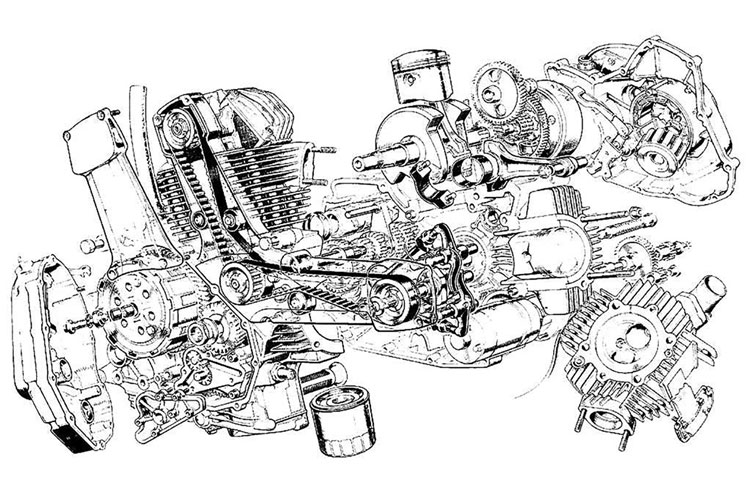
Ducati design maestro Dr. Fabio Taglioni recognized that his bevel-drive twins needed a replacement. His Pantah engines boasted modern plain-bearing con rods and a toothed reinforced-rubber belt and cogged pulleys to drive the single overhead camshafts. The belt-drive cams followed Moto Morini’s pioneering use of a Gilmer rubber belt to spin the cam on its pushrod V-twins. The result was a Ducati L-twin that ran quieter, was lighter, easier and cheaper to produce, and simpler to maintain, while delivering stout performance across a broad rev range. “Dr. T” also anticipated expanding the Pantah’s design bandwidth to incorporate larger and smaller displacements for future applications.
Ducati’s new owners, the Cagiva Group, entered the scene in 1983, first purchasing Pantah-based engines for use in Cagiva-badged motorcycles, notably the Allazzura with its cartoon elephant tank emblem. Two years later, Cagiva acquired Ducati outright from the Italian government. By then, Taglioni’s Pantah was evolving as a “platform.” The L-twin powertrain and chassis spun company profits while serving as building blocks for a string of new production models. Pantah-based race bikes included the beautiful, four-time world champion 600 TT2.
Ducati’s new-generation portfolio expanded into more sophisticated L-twins. The 1988 Desmoquattro 851 brought twin-cam four-valve heads, liquid cooling and electronic fuel injection, along with multiple World Superbike championships. Meanwhile, reviving forebear’s names, the 750 Sport debuted, followed by the 900 Supersport. The latter was probably the bike Dr. T had in mind when he laid out the Pantah a decade earlier. An air-and-oil-cooled 904cc 90-degree L-twin, with two Desmo-actuated valves atop each 92mm cylinder, the “Desmodue” shared the 851’s six-speed crankcases. The engine’s cams and valve gear were carried over from the factory Cagiva/Ducati Elefant Dakar rally engines. Its cylinder bore of 92mm, the stroke of 68mm, and 9.2:1 compression ratio had proven practical on the 902 Paso.
For fuel/air delivery, Ducati engineers opted for Mikuni 38mm constant-velocity carburetors. They rejected the fuel injection and Weber carb that had given wanky behavior on the liquid-cooled motors and the 750 Sport, respectively.
A strengthened version of the 750 Sport’s trellis frame was given a steeper (25-degree) head angle and 104mm trail, and the swinging arm bushings were replaced by needle bearings. The reborn 900SS was “very much a product of parts-bin engineering,” observed Cycle World in its July 1991 cover story. Frames were fabricated by supplier Verlicchi. Suspension came from Marzocchi — then Showa, then back to Marzocchi. Brakes were sourced from Brembo and cast wheels from Marchesini (now owned by Brembo). The Marelli Digiplex ignition fitted at launch was replaced for 1992 models by a Japanese Kokusan system.
All were assembled by Ducati into gleaming new motorcycles, most of them painted in properly Italian blood red. The resulting machines were impressive. At 414 pounds dry, the 1991 900SS was 15 pounds lighter than a Honda CBR600F2. Magazine testers rated the steering to be delightfully neutral. Changing lines mid-corner was easy, and the Duck offered a feeling of security. Cornering clearance was abundant, they reported. And while it could not match period Japanese four-cylinder sport bikes at the dragstrip and in peak velocity, the Supersport was widely praised for its deep mid-range grunt, overall rideability, and, of course, the basso profundo exhaust note.
And “wonder of wonders — the thing was comfortable,” reflected Cycle World editor Peter Egan about the early 1992 model 900SS he tested in 1991. “The moderately high clip-ons, good seat, and dropped rearsets made this a Ducati you could ride all day.” Egan was sufficiently smitten to purchase a ’92 900SS — red, with a white frame — followed by an upgraded 900SP.
From 1991 through 1997, Ducati wisely iterated the 900SS “family” to include the half-fairing 900CR, the higher-spec 900SS/SP, the collector-focused Superlight, and the all-silver 1997 Final Edition (FE). In total, the company sold nearly 28,000 units. And tangentially, the 900SS engine was also paired with the 851/888 series spaceframe to create the “naked” 1993 Monster — a model that became a Ducati blockbuster and almost a brand unto itself.
In 1998, the 900SS was given a major facelift under the direction of new Ducati design chief Pierre Terblanche. Fuel injection was added, and the bike’s audaciously curved bodywork was influenced by the radical Supermono racing single. The resulting 1999 model’s styling was politely deemed “controversial” by the media and by the Ducatisti. Disappointing sales reflected a polarizing product.
900SL on the road
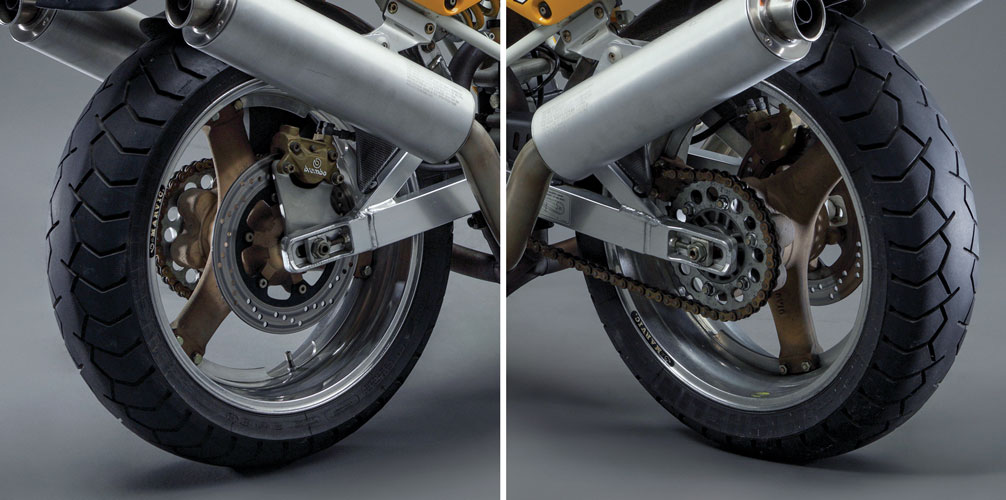
“Essentially a 900 Supersport” was Cycle World‘s take on the ’93 Superlight. The subject bike, in head-turning Giallo, was tested in the August 1992 issue. The SL parts manifest listed a solo saddle, slightly more upswept exhaust (reportedly with larger diameter silencers taken from the 888 SP4), the aforementioned carbon-fiber fenders, and Marvic wheels as stock equipment. The latter was an innovative composite design featuring a cast-magnesium center hub made by Marvic in Italy, bolted to a flanged aluminum wheel rim made by Akront in Spain.
“Given its specification, you would expect the Superlight to work like the standard Supersport. And you’d be right,” the testers stated, referring to the SS engine’s torque-rich power curve and lack of annoying vibration that make the big Ducatis so enjoyable in everyday riding. They also praised the “seemingly unlimited” cornering clearance and “roomy” ergonomics. The test SL posted near-identical performance numbers to the SS tested in 1991, recording an 11.74-second/113-mph quarter-mile and a 130mph top speed.
“Top-gear roll-ons show just how strong this Twin is,” CW had said of the ’91 Supersport. “It outguns all of the sporting 600s and 750s, and even a few liter-class bikes, in an impressive display of real-world horsepower.”
Testers’ praise for the 900SL’s slick-shifting six-speed gearbox was offset by their loathing for the “horrible, squawking” hydraulically-actuated dry clutch. The bane of all Ducatis during that era, the clutch chattered loudly through the unique-to-Superlight ventilated cover. “Loud clutches save lives” was already being adopted as a T-shirt declaration among the Ducati faithful. The Showa rear shock was also described as being slightly over-sprung, but not enough to affect the magazine’s verdict.
“Light, nimble, and secure, the Superlight is simply one of the best handling motorcycles in the world,” the Cycle World testers concluded.
Buyers should check these areas
Ducati’s 900 platform from 1991-98 has proven quite robust for owners, which is good news for restorers and collectors. The predominant issues affecting the SS, CR, SP, SL, and Monster are well known and have been tackled over the years. According to Vicki Smith, the Supersport line had three problems emanating from the factory. Cracks appeared in the frame headstock on early machines — “mostly on white-frame SS bikes, not SLs,” she recalls, prompting a factory recall. Ducati issued replacement frames to some owners.
On Superlights, the mounting holes on Marvic magnesium wheel hubs would become elongated, creating a loose assembly and a potential safety issue. (900SLs exported to Germany were fitted with standard SS cast-aluminum wheels because the country’s vehicle safety agency, the TUV, did not approve the Marvic wheels.) Ducati 900s during the early-to-mid-1990s, including 900SLs, also famously suffered from cylinder head stud failure. The practiced fix is to replace the studs, as many owners have done. Service intervals for the OHC cam belts should be heeded.
Online Ducati forums have also discussed the short life of the chattery clutch’s hydraulic slave cylinder, an easily replaced item.
Anyone who has owned or lusted after a Ducati 900 Superlight agrees on two things: The bikes were, and continue to be, extremely desirable. And they’re beautiful, whether in Ducati red or screamin’-yellow Giallo.
“They’re just really, really pretty,” Smith enthused. “It’s the one bike that many motorcyclists would say, ‘I shouldn’t have sold mine’ or ‘I should have bought one.'”
Related factoid: On Facebook, the Ducati Superlight & 900 Final Edition owners group claims 3,200 members. MC
Limited edition by the numbers
While Ducati does not officially release its annual production numbers, the company did provide them to noted Ducati historian Ian Falloon, who included the data in two of his essential reference books, Standard Catalog of Ducati Motorcycles, 1946-2005, and Ducati Belt-Drive Two-Valve Twins (Authentic Restoration Guide). The latter book’s appendix lists the 900SL production figures, including the factory codes reflecting year and country of destination.
900SL Mk 1, 1992
- code:00190171AA = 522 units, Europe
- code:00190172AB = 200 USA
- code:00190173AB = 100 California
- code:00190175AA = 30 Australia
- code:00190177AA = 100 Germany
Total production for the 1992 900 Mk 1 Superlight = 952 units. Falloon’s appendix also notes that 325 Mk 2 Superlights were produced in 1992, and 250 units in 1993. By comparison, Ducati built 401 examples of the iconic 1974 750 Super Sport.
All Mk 1 900SLs had white frames and full-floating rear brakes. Those exported to markets outside the U.S. were red and designated 1992 models. Mk 1s for the U.S. were yellow, according to Vicki Smith; all were 1993 models. The Marks 2 through 5 were not sold in the U.S.
Falloon reports that Mk 2 models replaced the Mk 1s’ Marvic wheels and cast-iron brake rotors with bronze-painted cast-aluminum wheels and Brembo stainless-steel brake rotors. The Mk 1s’ vented carbon-fiber clutch cover was also swapped out for a standard non-vented SS aluminum piece. Cast-iron brake rotors reappeared on 1994 Mk 3 models, along with a few other upgrades.