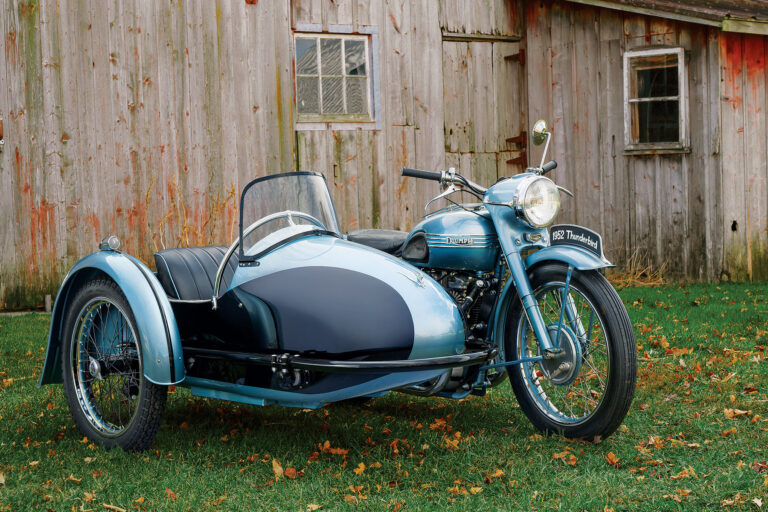
1952 Triumph 6T Thunderbird
- Engine: 649cc OHV parallel twin, air-cooled, 71mm x 82mm bore and stroke, two valves/cylinder, 7.0:1 compression ratio. Cast-iron head and barrel.
- Carburetion: Single SU MC2, vacuum type
- Power: 34hp @ 6300rpm
- Transmission: 4-speed, single-row chain primary drive
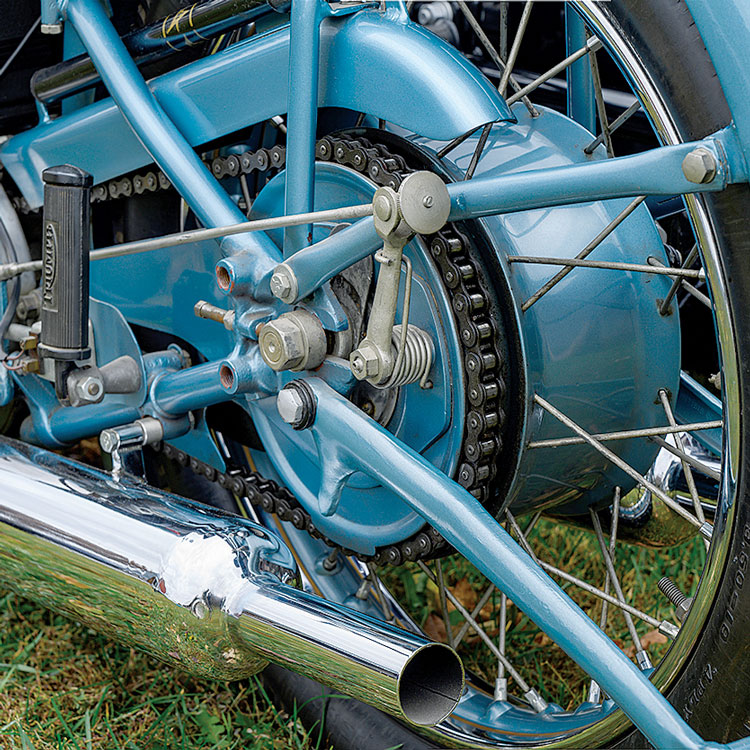
- Final Drive: Roller chain, ratios: 4.57:1 solo; 5.24:1 sidecar (optional)
- Electrics: 6V, BTH KC2 magneto, auto advance
- Chassis: Steel, full cradle, furnace-brazed, lug-and-tube
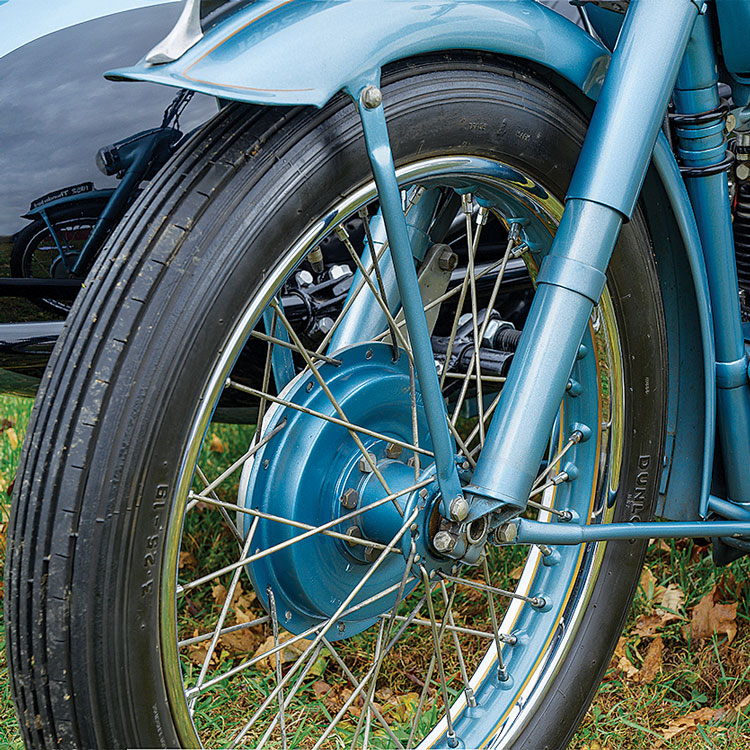
- Suspension: Triumph telescopic fork with internal springs; rear, Triumph Spring Wheel (a.k.a. Sprung Hub)
- Seat height: 29.5in (749mm)
- Brakes: 7×1-inch cable-operated drum front, 8×1-inch drum rear (on sprung hub models)
- Tires: Dunlop, 3.25 x 19 ribbed front, 3.50 x 19 rear
- Wheels: WM2 x 19 steel rims, front and rear
- Wheelbase: 55in (1397mm)
- Weight: 384lb (174.6kg) dry
- Fuel capacity: 4.8gal U.S. (18.1L)
- Fuel consumption: 72mpg @ 50mph*
- Top Speed (solo): 100mph (161km/h)* *Motorcycling test, November 30, 1950
Sidecarists, by their own description, are a unique bunch. Perhaps even a bit eccentric. “Mastering a motorcycle takes practice; mastering a sidecar takes wisdom,” noted one enthusiast on the United Sidecar Association’s online forum. Another pearl heard among the faithful: “Sidecar riding is motorcycle riding… for advanced riders.”
Skill, determination, and muscle are indeed required to manage the physics of the three-wheeled beast. A motorcycle doesn’t take kindly to having its single-track dynamics upset by that third wheel, plus the extra mass that’s bolted to the bike’s side. Steer right when braking; steer left under throttle to keep the rig on course. And countersteering? It doesn’t exist with a sidecar rig.
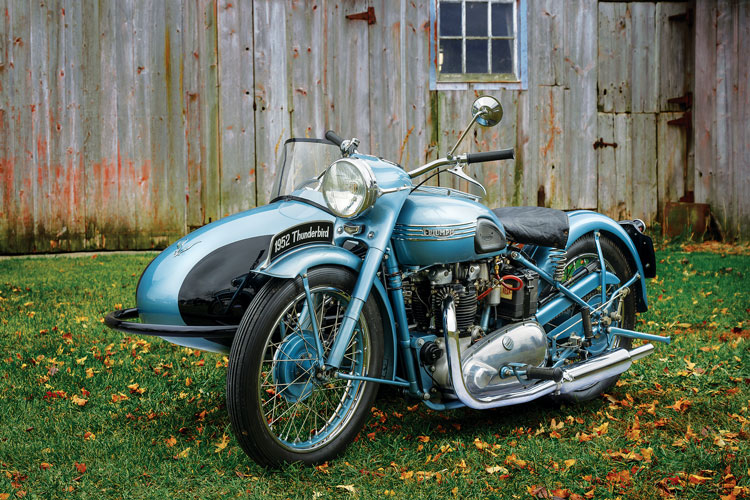
“That third wheel is in charge!” exclaimed Tim Smith, whose gorgeous classic rig is featured here. He chuckles when recalling his first sidecar jaunt as a passenger: The rider, an old pal, surprised him by lifting the wheel mid-corner. “I thought we were tipping over. It scared the snot out of me!”
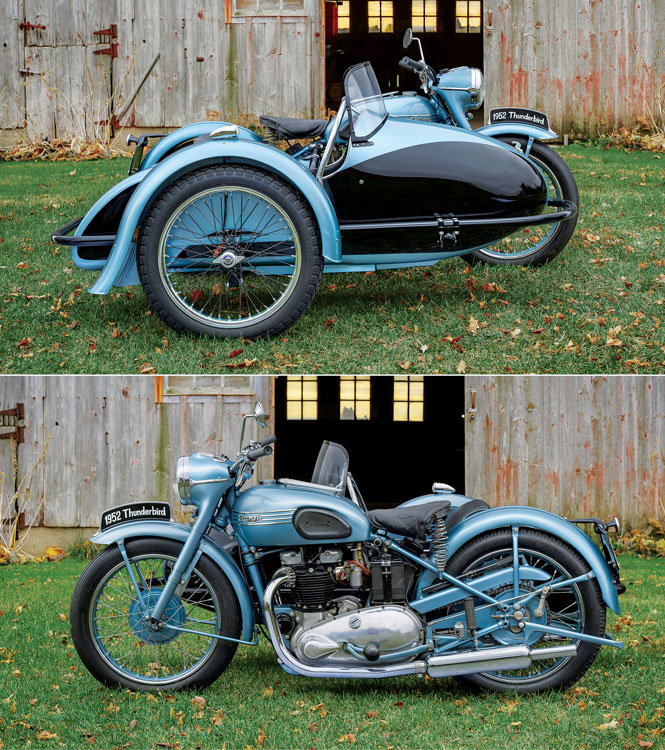
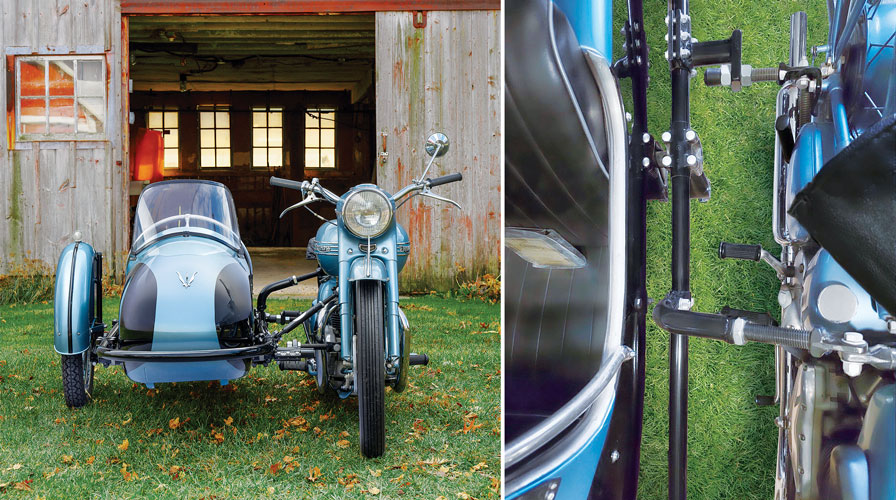
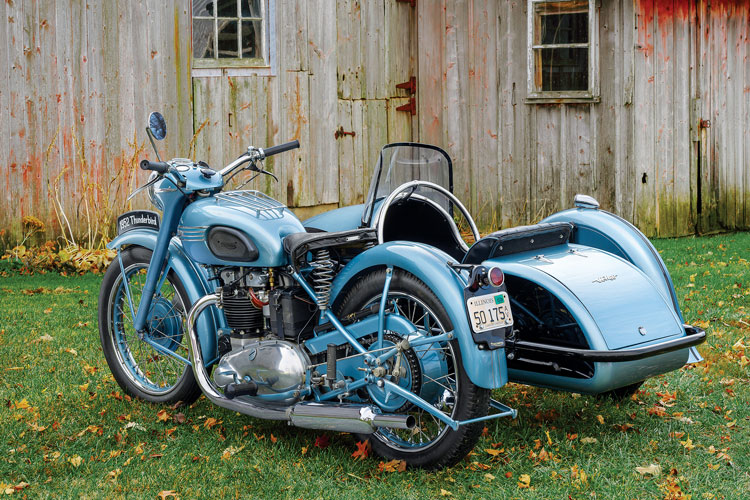
For his own “combination,” as the British call them, Smith has paired a 1952 Triumph 6T Thunderbird with a period Swallow Jet 80, the U.K. sidecar maker’s sports model. The 650cc parallel twin isn’t often mentioned with the archetypal sidecar tugs: Harley’s Electra Glides, /2 BMWs, Moto Guzzi T3s, Urals, the Ariel Square Four, and vintage British big singles like Panther’s 600cc Model 100. But from its 1949 debut as a 1950 model, Triumph’s torquey T-bird was factory-kitted for “hack” duty and proved popular in the role. The stock frame was lugged for sidecar fitment, and the bike could be ordered with heavy-duty suspension springs and lower final-drive gearing.
Thus equipped, the Thunderbird was deemed an ideal partner for the Zeppelin-shaped Steib and trad-British Swallow sidecars then being imported by Triumph’s U.S. eastern- and western-states distributors. The market then was as much a niche as it is today.
In Britain, by comparison, motorcycle sidecars were popular for passenger and utility use until the advent of the BMC Mini compact car in 1959. Some, like the Busmar Double Adult, Canterbury Carmobile, and Watsonian Oxford, wore fully enclosed sedan bodies capable of hauling a small family. Pity the poor bike…
Inspired by a photo
Third-wheel motoring was on Tim Smith’s mind in 1994 when he spotted the dusty Swallow in a corner of a friend’s shop near his Illinois home. The friend, a local fabricator, had taken the old hack in on trade for one of his scratch-built sidecars. The Jet 80 and its connective hardware were mostly intact. The interior leather was dry-rotted, the body dented, and the windscreen was missing, but Smith was undaunted. With a garage full of Triumph, MG, and Austin-Healey sports cars and a small fleet of Norton singles and twins, Tim is well versed on the care and fettling of British classics. He dragged the Swallow home. Now he needed a suitable horse to pull it.
“A calendar photo of a restored Triumph Thunderbird sidecar rig in a field was my inspiration; I thought a similar rig would be cool to have,” he explained. Smith had long admired the early T-bird’s handsome lines, which, along with the grunty 650cc motor, helped make it an instant hit for Triumph. Five years passed. Then along came a classified ad in Walneck’s Cycle Trader: 1952 Triumph Thunderbird for sale. In Maine.
In pre-digital times, it just took a little more time to buy old motorcycles at a distance. Smith’s hunt included telephone calls to the seller and patience waiting for print photos of the blue ‘bird to arrive in the mail. The pics looked promising. He and his wife, Miriam, then headed east in the autumn of 1999 on a New England vacation. They took Tim’s pickup “just in case” the Triumph would be coming back to Illinois with them.
“The bike was sitting in a room in the owner’s farmhouse in rural Maine,” Smith said. “Seeing it in person matched the picture of the Triumph and sidecar on the calendar I’d hung on the wall.” The Thunderbird, nicely refinished in a close match to the original Polychromatic Blue, barely ran. It sputtered in the way that only a thorough going-over could cure. A deal was struck, and the Smiths and Triumph were soon Midwest-bound. Making the bike roadworthy required only minor mechanical attention and new tires, Smith noted. It then served a solo role while the Swallow restoration began.
The T-bird flies
The 6T Thunderbird was the first motorcycle model made by a foreign manufacturer specifically for the American market. Since the end of World War II, Triumph’s 500cc Speed Twin and sporty Tiger 100 had drawn a new generation of riders wanting lighter, quicker, and better handling machines than the ponderous, hand-shift Harley and Indian V-twins. But the Yanks who were now “riding Limey” naturally wanted more. Specifically, they asked Triumph dealers for bikes with increased power and torque, delivered at lower rpm, for more effortless cruising. And please make them faster, of course. West Coast distributor Bill Johnson and the U.S. dealer body pressed Triumph boss Edward Turner for “more cubes” during Turner’s regular Stateside visits.
As a designer, Turner was a master at getting the most out of the minimum. In late 1947, he tasked the experimental department chief, Frank Baker, to begin development of a bored-and-stroked version of the Speed Twin. They settled on a 650cc displacement by adding 2mm to the stroke and 9mm to the bore. The final 71mm x 82mm dimensions enabled the Speed Twin’s crankshaft to be used in combination with a new, beefier cylinder barrel and cylinder head. The extra 150cc gave Americans what they wanted: a new “forty incher” (40 cubic inches) that delivered 34 horsepower, seven more than the 500, and a fatter torque curve.
Importantly, Triumph’s new 650 shared the 500cc twins’ chassis and cycle parts. This helped moderate production costs while allowing dealers to earn a higher profit per bike. It also boosted the new bike’s power-to-weight ratio. The 650 generated the same horsepower at 4,000rpm as the 500cc twins did at 6,000rpm. The increased torque enabled the use of higher gearing, which gave higher cruising speeds with less engine stress and vibration.
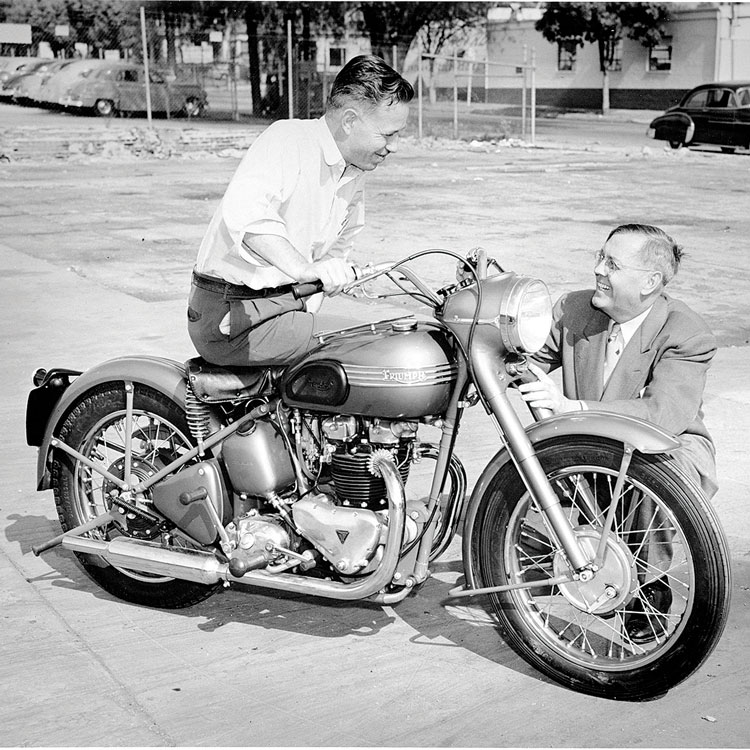
The new motorcycle needed a name. It was conceived during Turner’s February 1949 visit to the U.S. He’d come to attend the Foreign Car and Motorcycle Show in New York City and lay the groundwork for Triumph’s Eastern states distributor in Baltimore. Accompanying Turner were Rod Coates, a keen racer and bike dealer who would soon become The Triumph Corporation’s (TriCor) service manager, and Coates’ wife, Marge. The trio aimed to drive south to Florida for the Daytona Beach races after the New York show concluded.
As their southbound journey passed through South Carolina, Turner noticed the Thunderbird Motel, fronted by a giant bird figure on a totem pole. In Native American lore, the eagle-like thunderbird is capable of unleashing thunder, lightning, and rain. Turner was particularly struck by the towering statue, according to Marge Coates in a 1991 interview with the author and David Gaylin for the book Triumph Motorcycles in America. Coates stated that the motel’s imagery sparked lively discussion about how appropriate “Thunderbird” would be for Triumph’s upcoming 650. As it turns out, the name was perfect.
Four years later, the Ford Motor Co. adopted the name for its 1955 sporty car, after making a legal agreement with Triumph. “The deal was, Ford wouldn’t make a Thunderbird motorcycle, and Triumph wouldn’t make a Thunderbird car,” a Ford patent attorney told the author. Both T-birds lived on, the Triumph until 1966. It was briefly reprised in 1982.
The new 650’s arrival in the U.S. did not go smoothly at first. When the first machine was uncrated at Johnson Motors in Pasadena, California, JoMo service and racing manager E.W. “Pete” Colman couldn’t wait to wring its neck on the local roads. But his first ride ended in disappointment.
“The original Thunderbird was a cast-iron snail,” the strident Colman declared to the author during a 1991 interview. He soon traced the bike’s lethargy to the undersized one-inch bore of the Amal 276 carburetor. Colman quickly fired off a telegram to the factory requesting they fit a mixing unit more capable of feeding the 650’s larger combustion chambers.
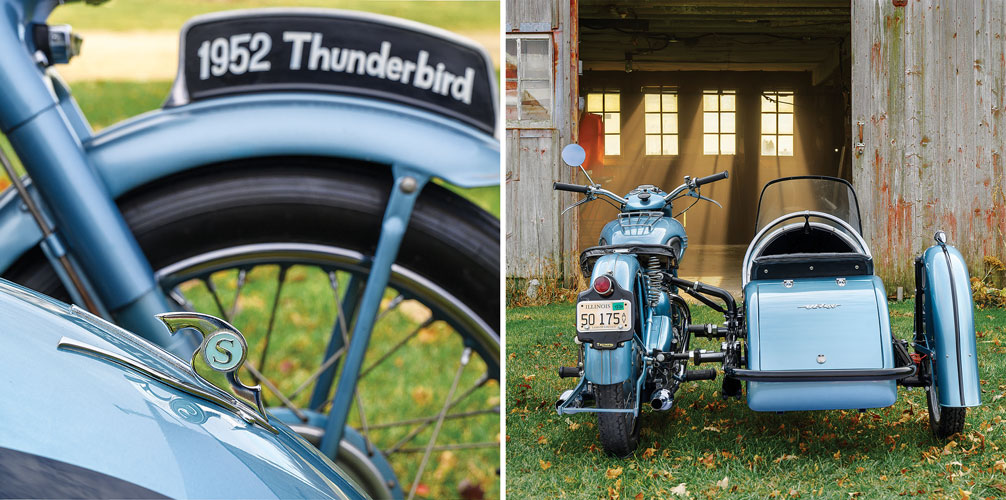
Meriden responded with a larger Amal as part of a mid-year upgrade. The additional 1/16-inch larger bore woke up the sleepy ‘bird. It so impressed Colman that he had the JoMo service shop build a special sidecar around a stock 6T, to serve as a mobile camera platform to film the Catalina Grand Prix off-road races. And Cycle magazine tested the Triumph in its inaugural April 1950 issue. Editor Harry Steele praised every aspect of the T-bird except its somber grayish-blue livery, which proved to be a snoozer in the showroom. The paint was so unloved by Americans that Triumph changed the color during 1951 to a fetching metallic shade called “Polychromatic Blue.” Customers loved it.
Steele finished his Cycle road test by reporting: “The riding characteristics leave nothing to be desired, and if it’s acceleration you crave, there are very few stock, fully equipped machines that could ‘jerk your cork’ if you’re on a Triumph Thunderbird.”
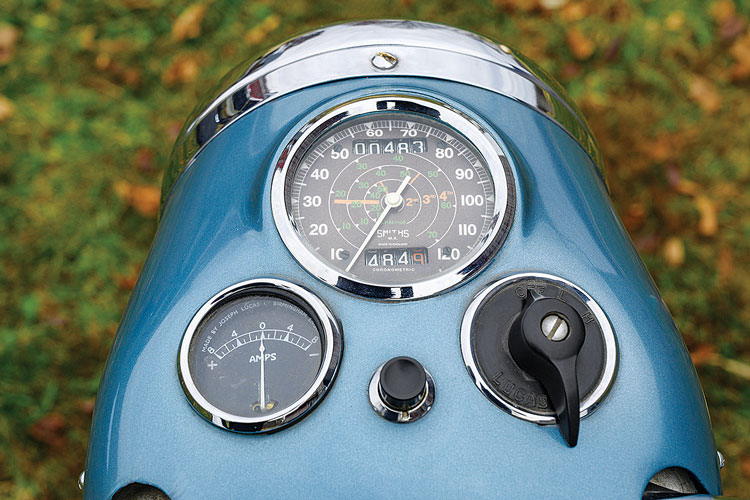
A new Triumph 6T was priced at $712 in early 1951, but a year later, the T-bird listed in the U.S. for $837. Post-World War II inflation had prompted Triumph to increase the retail prices of its entire model range by more than $100. Fortunately, many changes and improvements arrived for the 1952 Thunderbird. Night riding was made safer by a bigger Lucas seven-inch, pre-focus headlamp enclosed in a larger-diameter headlamp nacelle. The six-volt electrical system was changed from negative to positive ground to conform to similar changes in the British auto industry. The wiring harness was color-coded. Frames were modified to accommodate a connecting tube to a Vokes D-shaped air cleaner, specifically aimed at U.S. riding conditions.
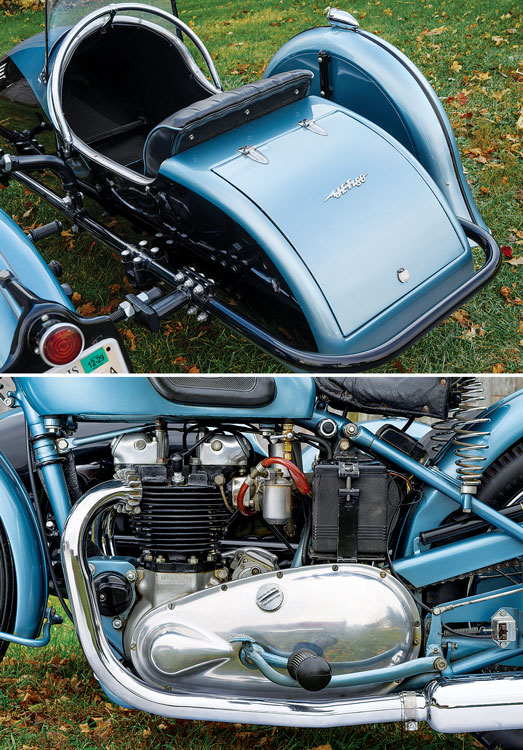
Nickel rationing due to the Korean War forced Triumph to reduce the number of chrome-plated components across its model range. On the ’52 Thunderbird, this meant wheel rims and handlebars were stove enameled in the Polychromatic Blue. Smith’s machine today is fitted with a chrome handlebar, likely changed by a previous owner. Other items that were normally chromed but changed by the factory to cadmium plating included the pushrod tubes, rocker feed spindle dome nuts, and the gearchange and kickstart levers. Per request from JoMo and TriCor, the high-rise chrome handlebar (part number H0787) developed by California handlebar specialist Earl Flanders became a popular dealer-installed option. 1952 models also offered an optional folding kickstart lever, which became standard in 1954.
The biggest technical change on the ’52 6T was an automotive-type SU carburetor replacing the Amal 276. The SU was attractive to Triumph due to its relative simplicity (no multiple jets) and ease of adjustment. In an SU, the vacuum created by the engine’s intake stroke pulls the fuel/air mixture into the combustion chamber. A piston rather than a traditional slide or butterfly valve controls airflow, making it theoretically more responsive and efficient.
No other sidecar-toting motorcycle can claim a performance history that matches that of Triumph’s pre-unit Thunderbird and its 650cc power unit. In July 1949, Triumph brought three prototype 6Ts to the Montlhéry high-speed autodrome in France to prove the new bike’s speed and endurance in front of Auto Cycle Union observers. Ridden by Triumph factory personnel, the machines were stock except for Dunlop racing tires. Each completed a 500-mile workout at over 90mph, with numerous laps over 100mph.
In the U.S., the same Thunderbird that Pete Colman cursed as a “cast-iron snail” was transformed by JoMo into a speed-record machine dubbed “Wonder Bird.” With Bobby Turner (no relation to Edward) aboard, the bike ran 135.84mph on a California dry lake in 1950. A year later, at the Bonneville Salt Flats, the hot-rodded ‘bird ran over 132mph. It was the fastest gasoline AMA Class C record for any engine size and stood for seven years.
In 1951, Walt Fulton won the inaugural Catalina Grand Prix off-road race aboard a 1950 Thunderbird. The bike, built by a California dealer, was mostly stock except for upswept exhaust and raised handlebar. And most famously, a Thunderbird engine powered the Texas-built “Devil’s Arrow” streamliner piloted by Johnny Allen to 192.3mph at Bonneville in 1955, then went 214mph for the new motorcycle ultimate speed record in 1956. Cast-iron snail indeed!
The rig completed
Tim Smith restored his Swallow Jet 80 by changing its paint scheme from silver/maroon to the ice blue/black colors that he felt better matched the Thunderbird. A fellow member of the Chicago Norton Owners Club and professional upholsterer, Jon Revilla, handled the complete restoration of the Jet 80’s interior. Dents in the chair’s steel body panels were repaired, and the Swallow’s unique Silentbloc rubber-bushing suspension amended. Another friend, the late Kurt Liebhaber, fabricated some missing attachment links.
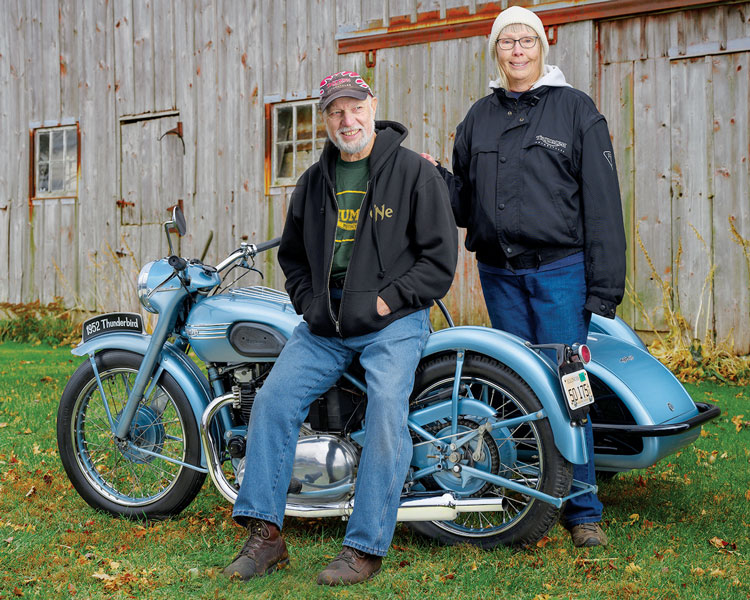
Smith feels that the steel-intensive sidecar is “a little bit too heavy” for the 384-pound Thunderbird, with its 34 ponies and minimal suspension travel. “It’s a handful,” he reports. He installed sidecar springs in the forks, but the fork legs, as seen in the photos, remain almost statically compressed.
Tim actually prefers the Triumph as a solo mount. “It’s really sweet to ride,” he reports, having put over 1,000 miles on the old ‘bird since he put it back into service. The classy rig spends most of its time sitting in the Smiths’ family room, admired by all who visit. MC
The notorious Spring Wheel
When Velocette rolled out a trio of new race bikes at the 1936 Ulster GP, it unveiled the future of motorcycle rear suspension. The Velos pioneered the hydraulically-damped, swinging-arm rear suspension that we know today. Edward Turner, who was about to join Triumph as managing director and design head, thought he had a better idea: the Sprung Hub, also known by the factory as the Spring Wheel, a patented design.
Turner’s rear hub design was influenced by the Dowty landing gear wheel hubs on Gloster Gladiator aircraft. Short springs providing two inches of suspension travel were housed above and below the axle in a spring box within the hub itself. This enabled it to be slotted into Triumph’s existing “hardtail” frame lugs. No need to invest in new frames and tooling!
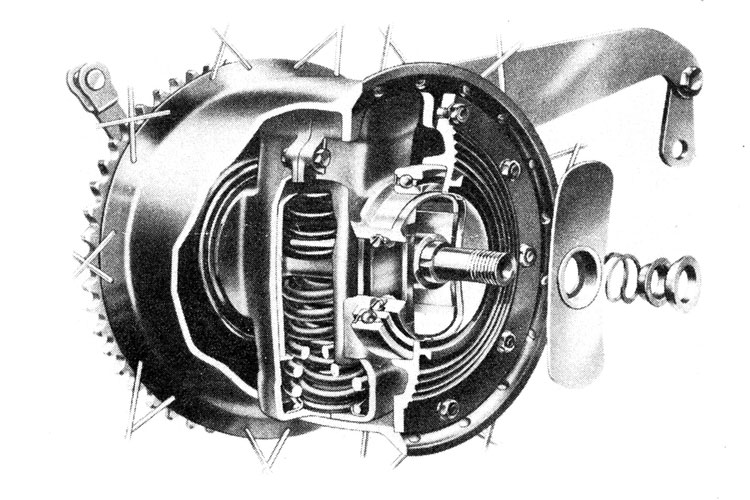
The Spring Wheel added nearly 15lb (7kg) to the bike’s mass, but it did incorporate an eight-inch brake drum. And to the untrained, it could be hazardous to strip for servicing due to the internal springs under high compression. Because of that, Triumph cast a safety warning into the housing!
Triumph unveiled the first production hub at the Manx Grand Prix in 1946. The design was mildly updated in Mk.II form and remained in production until Triumph’s first swinging-arm models debuted, comparatively late, in 1954.