
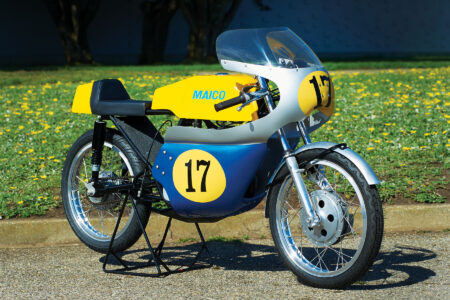
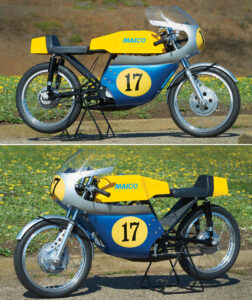
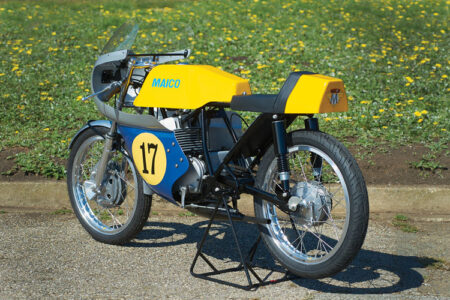
1972 Maico RS125
- Engine: 124cc air-cooled two-stroke, single cylinder, 54mm x 54mm bore and stroke, 10:1 compression ratio, 25hp @ 11,000rpm (claimed by factory)
- Top speed: 125mph (period estimate)
- Port arrangement: Rotary valve induction, two piston controlled ports, one bridge port
- Carburetion: 32mm Bing
“Let’s say I was going to put this bike on the track,” says restorer Steve Poggi. Steve raced flat track on and off through the early 2000s, and race track prep is second nature to him. “I couldn’t race it myself because I am well over 6 feet, and this bike is built for small people. I would have to get a little guy or girl to race it. Back in the ’60s and ’70s, when the 125cc racing class was really popular, most of the racers were young Italians.”
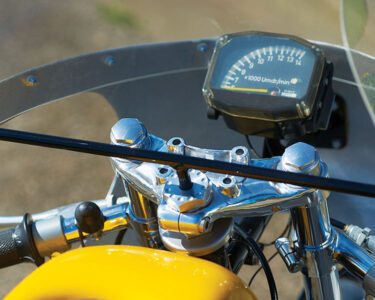
The Maico, a two-stroke, runs on race gas, pre-mixed with oil 40:1. Steve likes Golden Spectro. There is no battery (which saves weight), and, though in the 1970s, bump starting was the rule, now rollers are needed to start the bike. Steve made his own roller starter, drawing on his racing experience, so he could start the bike at home and at vintage motorcycle events. If Steve was part of a race team, he would back the Maico onto the rollers as the announcer gave the 10-minute warning, put the transmission in second gear, clutch in, and push the button to activate the roller starter. When the rear wheel starts spinning strongly, he would pop the clutch. If all goes well, the Maico starts, and its two-stroke howl fills the race team’s pop-up tent. Clutch in, find neutral, push the bike off the rollers, and hand it over to the rider, fully suited up and ready to go. The little yellow race bike heads off to the starting line, leaving behind a faint haze of blue smoke.
This little racer has not been on a track since the restoration was finished, but Steve has taken the bike to more than a few shows and started it up with his roller starter. It’s a real crowd pleaser, in part because it is so rare. Out of the 146 built, this is one of the few that now runs.
Small makers in global competition
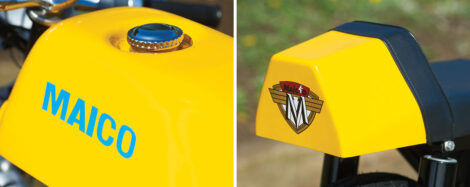
The 1960s and 1970s were a time when it was possible for comparatively small motorcycle manufacturers to do well in international competition, especially in offroad events. Jawa, Bultaco, Mondial, and Ossa all made names for themselves in motocross, enduro, and trials. A German company, Maicowerk, was one of these contenders. A family corporation, Maico did well until the combination of increased competition from the better-funded Japanese manufacturers and family feuding led to the company’s demise. Maico has been revived several times, and at present is building bikes on a very limited basis.
Although Tragatsch’s The Complete Illustrated Encyclopedia of the World’s Motorcycles says that the company started in 1926 making ILO engines, the company’s own history, published in 1981, says that the company started by making bicycle frames in 1931 and commenced buying engines from Sachs and ILO to produce small motorcycles in 1934. Motorcycle production stopped during World War II when the Nazi government ordered that Maico produce war materiel instead. There was a difficult period right after the war, but by 1948, Maico was building small economical two-wheelers to fill the overwhelming demand for basic transportation. Europe’s transportation system was in ruins, and people were desperate for an inexpensive way to get from place to place. The first Maicos were small unit construction two-strokes intended for commuting.
Increasing prosperity in the 1950s led to increased participation in motorcycle sport, especially offroad competition. Maico started building offroad motorcycles in the 1950s and fielded a factory team soon afterwards. Powerful, well-built Maico racers notched many top-three finishes in World Motocross racing and won the Trans-AMA series in 1970, 1972, and 1973. The Whizzer Corp. started importing Maicos to the U.S. in 1955, where they were eagerly bought by aspiring American motocross and enduro contenders.
Road racing detour years
Between 1969 and 1974, the Maico company detoured from its usual pursuit of offroad trophies to make a splash in 125cc Grand Prix road racing. The Maico road racer was developed from a street machine of the same displacement in 1969. Some of these bikes, especially the factory racers, were water-cooled. The Maico company fielded a factory team that won three races in 1969 and usually ended up among the first five across the finish line. Many of the 146 road racers built during this period were sold to privateers.
This road racer romped in the German national championship. Several were imported to the United States and were seen competing in regional events. Börje Jansson, racing for Maico, came in third in points in 125cc Grand Prix racing in 1970 and 1971, and fourth in 1972 and 1973. Maico backed out of road racing in 1974 for unknown reasons, probably due to a combination of the expense and the distraction from the main business of building offroad competition machines.
The rotary valve two-stroke engine that powers this RS125 road racer was originally designed in 1968, replacing an earlier piston port 125cc single, the first of which was produced by Maico in 1939. The first of this new iteration of the 125 had five speeds, while later ones had six. Bore and stroke were a square 54mm x 54mm, with a Mahle racing piston. The cylinder was square in appearance, maximizing cooling fin area. Ignition was via magneto, and the tiny carburetor, situated behind the right outer case, is by Bing.
Maico used the basic engine and frame for its 125cc road racer, enduro machine, and motocross racer, changing compression ratio, transmission ratios, suspension, brakes, wheels, and electrics to suit each model. On the five-speed version, all three were powered by a coil, points, and a magneto. The enduro model had lights and the wiring to activate them. Maico used the same magneto for the other models, but cut off the wires. Later RS125s had six speeds and a different ignition setup.
The most interesting part of the engine was a rotary valve, which was set directly in front of the carburetor intake. This thin fiber disc was keyed to the crankshaft, and a cutout in the disc metered and timed the fuel/air mix supplied to the crankcase. The disc cutout could be altered in many different ways to tune the engine. There were three piston ports in the cylinder, the third of which acts as a bridge port. This feature trapped additional fuel charge and passed it through a hole in the back of the piston, thus adding additional fuel to the combustion chamber. This innovative design made the RS125 one of the fastest motorcycles in its class. It produced more horsepower than nearly any other 125 on the grid in the early 1970s. The road racing version of the RS125 had 10:1 compression and produced a maximum of 25hp at 14,000rpm.
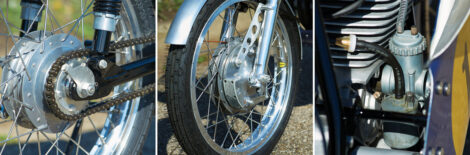
The Maico’s frame was rigid and strong, and contributed to the bike’s good handling. A big double leading shoe drum brake on the front wheel and single leading shoe brake on the rear slowed the bike for corners. Like most purpose built racers, the 125’s powertrain was delicate, finicky, and required proper tuning to do well, but the Achilles heel of the little Maico was the shift linkage. For the first several years of production, the linkage was placed outside the inner case on the right side. Getting it properly adjusted was not easy, and the transmission tended to go out of adjustment regularly, leading to missed shifts, lost races, and bad language. More than one Maico road racer traded his bike for a slower, but relatively trouble-free Japanese machine. Despite the challenges, teams that could make the Maico work could run away from the opposition.
Steve Poggi says that the 1974 road racers had the gearshift linkage moved inside the cases, standard practice for most motorcycles. The company decided to discontinue the road racer that year, about the same time that Maico offroad teams started forward mounting the rear shocks on their racers, increasing travel and leaping above the competition. 1981 was the high point — Motocross Action called the 1981 Maico Mega 2 (490cc) the greatest open-class motocross bike of all time. Shortly afterwards, a falling out between the owners of the family-owned company led to a decline and a filing for bankruptcy in 1983.
Maicowerk AG continued to produce a few motocross and enduro machines. The company was then sold to a succession of owners who continued to build a few motocross and enduro machines. Since 1999, the company has been owned by Koestler. Maico has announced it will build 10 motorcycles in 2026.
Maicos remain a very popular ride in vintage and amateur enduro and motocross racing, and Maico riders regularly line up in American Historic Racing Motorcycle Association offroad competitions. For several years, Eric Bley and his son Sven raced RS125s in AHRMA’s road racing class. Aside from these vintage racers, the road racing RS125s are seldom seen on this side of the Atlantic. This Maico was purchased by Steve Poggi and Jaclyn Lucas as a basket case in 2014. The rebuild was finished several years later.
Steve Poggi’s restoration work
After Steve retired from vintage flat track racing, he took up restoring vintage European offroad bikes, mostly Bultacos, but sometimes other European machinery. At present, he is working on an Airhead BMW for jaunts in the nearby countryside. Steve’s wife, Jaclyn Lucas, helps with the restorations, takes photos, and provides moral support.
The Maico restoration was something of a fluke. “I saw some photos,” says Steve. “I never knew that Maico made a road racer. I got most of the bike from a guy in Germany. The rest was located through word of mouth. The Bing carburetor came from England, and a guy in Washington State had English Girling shocks and the right Ceriani forks.” Little by little, rust was scrubbed off and parts were reconditioned and replated. “When it arrived at our house, it was in a box of rusty parts,” says Jaclyn. “I watched the metamorphosis from rusty parts to shiny yellow racer. It transformed like a Monarch butterfly in a chrysalis.”
Steve claims that there were no issues with the engine that came with the basket case and that the rebuild was simple and straightforward. That is, it was simple and straightforward to an ex-racer who was used to 2 a.m. rebuilds the night before a race. He says he bead blasted the parts, bought new bearings and seals from a supply house (both were generic items used on a variety of machines), and reassembled the engine to specification. Proper tolerances were obtained with shims. He also rebuilt the brakes, which were the original Maico brakes with new brake shoes.
Besides problems associated with finding parts for a motorcycle of which only 146 examples were made, Steve had to fabricate the fairing mount and the front fender bracket. After an intense search, he found a good reproduction fairing in England and had it painted by a person who worked at a body shop that is now closed. He cleaned and reassembled the magneto. There is only one wire on the racer — from the stator to the coil — so rewiring the bike was the least of Steve’s problems. Rebuilding the wheels was much more difficult. “The spokes need to be custom cut to the right offset for the rear wheel. I went to Buchanan’s, which specializes in custom spokes, and had them install them in the Akront wheels.”
“I love looking at it,” says Steve. The RS125 can’t be ridden anywhere except for a racetrack, but Steve and Jaclyn enjoy taking the yellow Maico to shows. “I really love the attention and questions. People come over who used to ride Maicos and gawk. ‘I didn’t know they made road race bikes,’ they tell us.” And when Steve starts it up, people come running for a taste of what Grand Prix racing sounded like in the early 1970s. It is a true time machine. MC


