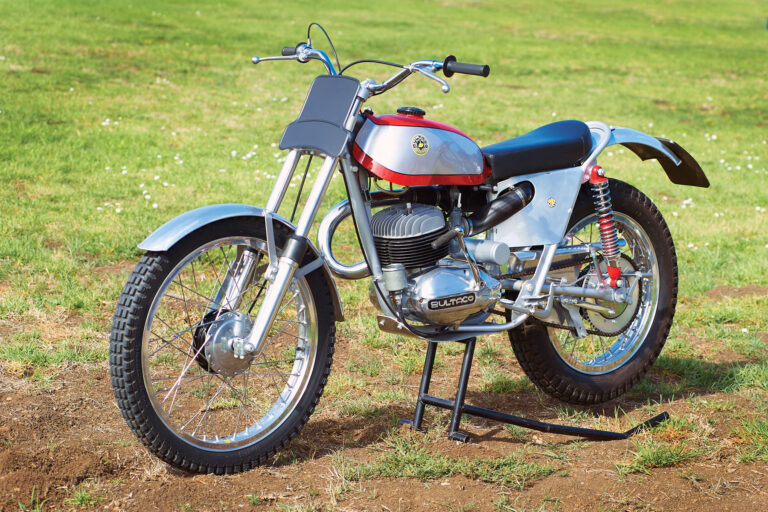
1967 Bultaco Sherpa T Model 27
- Engine: 244cc unit construction single, air-cooled, piston port two-stroke, 72mm x 60mm, 9:1 compression ratio, 18hp @ 8000rpm
- Carburetion: 24mm IRZ carburetor, nylon air filter
- Ignition: Flywheel magneto
After we were married, Steve started building a motorcycle for the Pikes Peak Hillclimb competition. He was in the garage. I heard the bike start up, and it sounded horrible. My heart broke for him — he would be so disappointed. Then he came in with a big smile on his face. The bike had straight pipes, and that was the way it was supposed to sound.”
—Jaclyn Lucas, Steve Poggi’s spouse, assistant, and cheerleader
Steve Poggi and Jaclyn Lucas have been married for a few years. Now retired, both have interests that the other supports. Jaclyn paints watercolors, and Steve cheers her on, appreciates her efforts, and frames her paintings. Steve restores European off-road and race bikes, and Jaclyn helps when needed, videotapes his builds, and cheers him on. Steve used to race Bultacos, and a lot of his restorations are of bikes from this innovative Spanish company.
The beginning of Bultaco
Many motorcycle companies have been started by enthusiasts. This was especially true in the early days, when it was possible to build motorcycles on a shoestring budget. But enthusiasts also started quite a few motorcycle companies in the chaotic period after World War II, when half of Europe was bombed into the Dark Ages and people cried for inexpensive personal transportation. One of these startups was the Spanish firm, Montesa, the first big motorcycle factory in Spain. One of the investors in Montesa was Señor Francisco Xavier Bulto, familiarly known as Paco. Señor Bulto was very interested in competition and attracted technical staff to the new company who also had a need for speed. Montesa was quickly successful, in part due to performance on the racetrack, then one of the best ways to create positive publicity. Bulto, an offroad enthusiast, rode in the International Six Days Trial, ISDT, for the company, and earned a bronze medal.
In 1958, government restrictions and other factors led to Montesa deciding to retire the competition department. Bulto was outraged. He left the company, only to find out a few days later that a lot of the technical staff had also resigned when they heard the news. A group of now-former Montesa employees invited Bulto to dinner and proposed starting a new motorcycle company that would celebrate competition in all its forms. Bulto agreed.
The new Bultaco company (the name stems from Bulto plus Paco) started up on a farm owned by Bulto, then moved to another farm. The muddy track leading from the main road to the factory was often used to test prototypes. The first product was the 125cc two-stroke Tralla, a road machine that quickly morphed into a lightweight road racer. Shortly after production started, Bultaco won seven of the first ten places in its class in the Spanish Grand Prix.
In 1960, Bultaco produced its first offroad model, the 155cc Sherpa N, marketed as an enduro bike. In 1964, the Model 3 Sherpa S motocrosser appeared, in 125cc, 175cc, and 200cc sizes. Bultaco two-strokes were very different from the majority of motorcycles that had appeared in off-road competition to this point. The mainstay of motocross, enduro, and trials events before 1965 were four-stroke BSA, Matchless, and Triumph singles, as well as some twins. They were powerful and handled well, but they were heavy and had limited suspension travel, which limited their usefulness in trials, enduro, and motocross events. Greeves, a British firm, made well-regarded lightweight competition machines, but they were hobbled by their general-purpose engine, made by Villiers. The Bultaco motocrossers became very popular in the U.S., and U.S. imports shot up. The benchmark year 1965 continues to be important for vintage trials competitors, since classes are divided into pre-1965 and 1965 and later machinery.
Trials was a major competition event in Europe and many other countries after WWII, and the Spanish company felt a need to develop a winning trials machine. Bultaco hired Sammy Miller, then the reigning trials champ, at the end of 1964 to help the company achieve this goal. Miller was contracted to Ariel at the time, but the contract was about to run out, and Miller secretly started working with Bultaco. Photos have survived of Miller testing a Bultaco on Señor Bulto’s ranch before the end of the Ariel contract — and also before he was officially hired by Bultaco in October 1964. The 250cc Sherpa T trials bike was unveiled shortly afterwards.
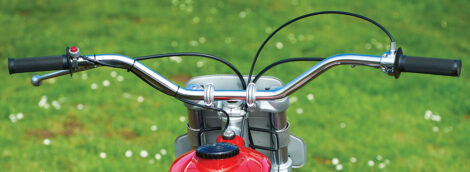
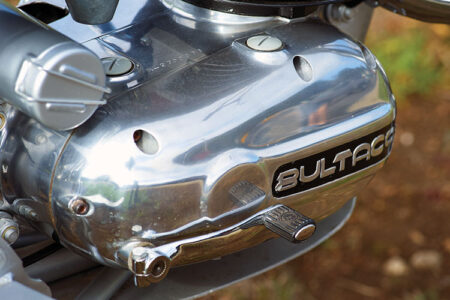
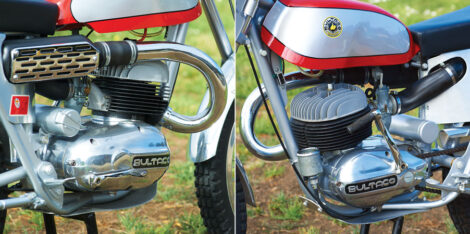
Trials bikes alternate between a walking pace over an obstacle course and fast off-roading between “sections,” areas where the bike has to navigate up, down, and over a hilly course, often strewn with rocks and mud. The Sherpa T, purpose- built to do well in these difficult conditions, had a light, stiff frame and a two-stroke engine with cooling fins designed to dissipate heat in slow going. Lead-filled flywheels located in the primary case increased inertia, and a small IRZ carburetor and exhaust chamber combined with a wide-ratio 4-speed gearbox, featuring a stump-puller low gear, to give maximum torque at low RPM.
In a 1967 ride evaluation, Cycle World praised the Spanish Betor front forks and the five-way adjustable rear shocks as “some of the best going,” and the standing riding position as “excellent.” Trials competitors spend most of their time standing on the pegs and only use the seat when they have to push around an obstacle. The compression ratio was 8:1. Sammy Miller won the very difficult Scottish Six Days Trial in 1965 on a Sherpa T, the first win in this event on either a non-British bike or a two-stroke.
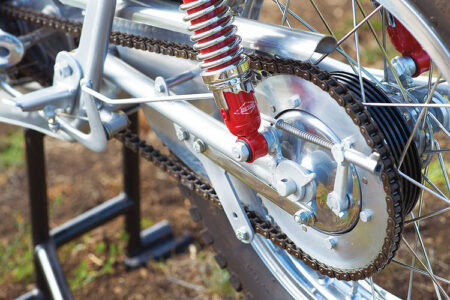
After the initial launch, Bultaco continued to work on and improve the Sherpa T. Changes included in the 1967 Model 27 Sherpa T included a five-speed gearbox and alloy wheels. Curb weight, with a full tank of gas, was 219 pounds. Sammy Miller, riding a Sherpa T, won the Scottish Six Days Trial in 1967 and 1968. In 1972, a 326cc version of the Sherpa T was added. In the U.S., Bultaco trials bikes were so popular in the 1970s that the Bultaco factory named both an east coast and a west coast importer. Bultaco-mounted, the late Lane Leavitt was a three-time AMA Trials champion.
As the 1970s wore on, Bultaco began to run into headwinds. The much better-financed Japanese factories were challenging Bultaco’s offroad dominance. Bultaco was starting to have cash flow problems. The Franco dictatorship, which had allowed workers few rights, ended after Franco’s death in 1975, and pent-up rage led to strikes and demands for increased wages. Señor Bulto retired in 1980, and the company became a workers’ co-op. Unfortunately, the workers had no experience in managing a company, and production ended in 1983.
The Bultaco name continues to have cachet, and two different companies have bought rights to the trademarks. In 1998, Sherco started manufacturing a line of off-road competition motorcycles as “Bultaco by Sherco.” The Sherco company is still in business, but dropped the Bultaco name in 2001. In2015, a Spanish company started building electric motorcycles and e-bikes under the Bultaco name.
The Bultacos of the 1960s and ’70s have not stopped being fun to ride and are now a mainstay of American Historic Racing Motorcycle Association off-road competition and local vintage events. Racing wears out motorcycle parts in a hurry, and racer demand has resulted in several companies now manufacturing new parts for these bikes. The availability of parts not only makes it feasible to go racing, but eases the task of the restorer. Steve Poggi’s interest in Bultaco restoration stemmed from his long history of racing Bultacos.
Poggi brings it back
Poggi started out on minibikes at age 13 and went on to racing flat track on a 1971 Bultaco Pursang, Model 68. He quit racing to raise a family. This first marriage did not work out, and he spent the 1990s racing vintage flat track — on Bultacos. He met Jaclyn in 1999. “Our first date was on a motorcycle.” Jaclyn was supportive of Poggi’s racing, but as the years went by, racing ceased to be fun. Poggi had become more interested in restoring bikes like those he had raced in years past, and his work began to win concours prizes. Most of the machinery he has brought back to factory condition has been offroad, with an emphasis on Bultaco motorcycles, but he does have a 1968 BSA A65 twin. “It’s my only street bike.”
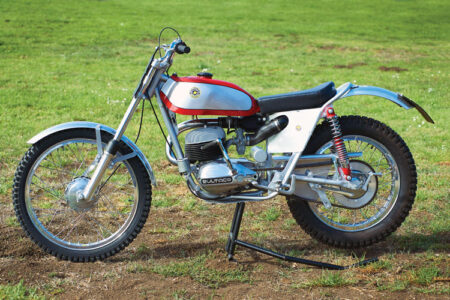
Steve was not looking for a trials bike, saying, “I never raced trials. Being tall, it’s hard to ride a trials bike. You have to lean over.” But he lucked into this Sherpa T through a friendly conversation with a neighbor. The neighbor had the Bultaco in a shed, and Poggi wandered over to look at it. Eventually, the neighbor concluded he was never going to get the bike running and gave it to Steve in 2008. Be nice to your neighbors — you never know what they have in the back of their garages!
At first, Poggi was going to part the bike out, but a little research showed that he had a rarity. This 1967 model was the first Sherpa T with a five-speed transmission. Only 700 were made, and Señor Bulto did the testing himself, on his San Antonio (Spain) ranch. “I decided to bring it back to original.” By this time, Poggi had restored several Bultacos and knew where to get parts. He had also located a couple of painters who did good work and had the special tools he needed to rebuild the drive train. A shop manual, parts book, and the owner’s manual were available. With Jaclyn providing moral support and a third hand when one was needed, the bike went up on the lift and the restoration was underway. Both Poggi and Jaclyn have work clothes for the garage and wear disposable gloves while working on bikes, which keeps the cleanup to a minimum and Jaclyn’s hands looking nice.
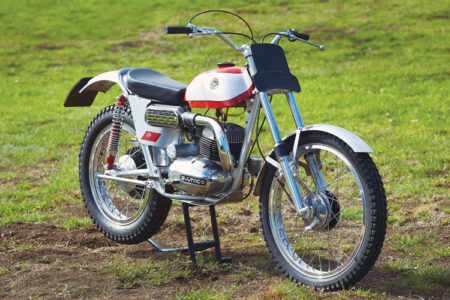
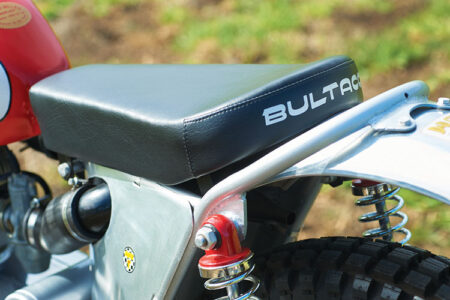
The mild steel frame was in good condition, but someone had painted it yellow, and they had painted a yellow stripe on the seat. Poggi took the motorcycle apart and stripped the yellow paint off the frame. The seat was not fixable, but a NOS seat was for sale in Spain. The front and rear suspension are rebuildable, so Steve rebuilt them with the new seals that are currently available. Front fork travel is six-and-a-half inches, and rear shock travel is four inches, not bad for 1967. He also rebuilt the engine, “making creative use of available parts.” Someone is importing new sand cast heads for several Bultaco models, and there are piston and rod kits for sale.
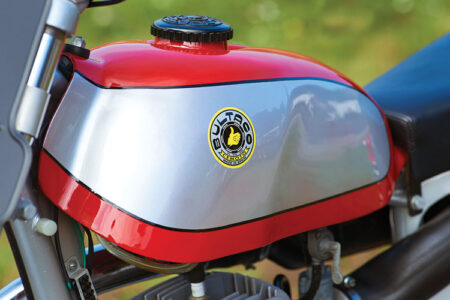
The fuel tank is fiberglass. Modern ethanol gasoline turns 1970s fiberglass into jelly, and also deteriorates rubber parts. Poggi has coped by coating the interior with epoxy and only using the non-ethanol fuel that is sold in gallon containers by Home Depot for home generators and lawnmowers. “It’s 92 octane. Sometimes I use 100-110 octane race gas.” He sends the tank painting out, and matches the original color either by locating a spot of unfaded original paint or by matching to the Bultaco color card he located a few years ago.
The small drum brakes are all that is needed to stop a bike that is going at a walking pace over rocks and logs. Poggi rebuilt them and polished the hubs and backing plates. The Spanish IRZ carburetor is not a common item, but rebuild kits are available, and Poggi knows where to find them.
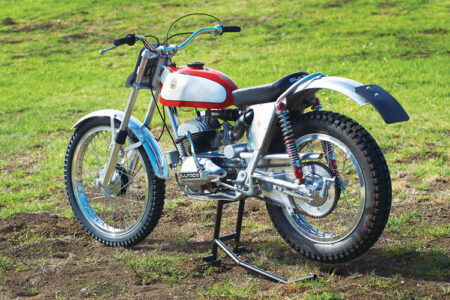
The engine back together, and the magneto was tested and found to produce good spark, Poggi mixed Golden Spectro two-stroke oil and non-ethanol fuel at a 40:1 ratio, opened the petcock, and jumped on the kickstarter. “It fired right up.”
Now that Poggi’s AHRMA days are over, his restorations get ridden around the bike show grounds and up onto the podium for the award ceremony. Poggi is a careful restorer who does his research, and, as a result, his bikes earn a lot of awards. He says that he works on his restorations because he finds restoring motorcycles pleasurable. “I see a bike all patinaed and beat up — the typical bike in the back of the garage. I want to bring it back. I want to see what it looked like when the first owner purchased it.”
Jaclyn chimes in. “When Steve brings out the beautiful bikes he builds, they get noticed and appreciated. Memories come flooding back. Beautiful restorations help people relive their glory days.” MC