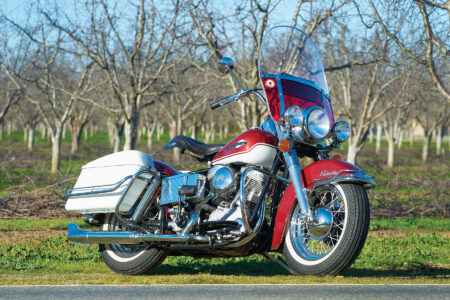
1965 Harley-Davidson Electra Glide
- Engine: Air-cooled OHV four-stroke, 45-degree V-twin, 73.73 cubic inches (1,208.19cc), 3.44in x 3.97in (87mm x 101mm) bore and stroke, 8:1 compression ratio, two overhead valves per cylinder, 60hp @ 5,400rpm
- Top speed: 98mph (factory claim)
- Carburetion: Linkert, Model M74B
- Transmission: 4-speed, left foot shift
Dave Kafton is an expert mechanic who specializes in Harley-Davidsons. In the last 20 years, he has become increasingly interested in classic Harleys and is now known as an engine builder. In addition to numerous pre-1984 twins, Dave has built 19 engines for bikes that ran in the Motorcycle Cannonball coast-to-coast events.
“This is the 11th 1965 Panhead I have owned. I kind of regretted selling the last one,” Dave says. He found this Harley in a storage unit, with an original condition frame. It was complete except for the sheet metal, all of which was missing. The gentleman who owned it had died, and his widow, who was selling the bike, had no idea what had happened to the tank and fenders. Dave conjectures that the owner had sent the bodywork out to be painted, but there were no receipts and no indication of who the painter might have been. Dave is a swap meet expert and bought the bike as it was, figuring that replacements could be found. He was also getting on a bit in age, and figured a bike with an electric start might be a nice retirement project.
Postwar boom and buildup
Panheads were in many ways a product of the economic conditions after World War II. In 1948, Harley-Davidson was sitting pretty. Coming off four years of wartime production, the company invested in surplus machinery and was able to upgrade the factory at bargain rates. Newly demobilized GIs had money and were more than willing to spend it. The company sold 20,115 slightly upgraded versions of the prewar lineup in 1947.
An upgrade of Harley’s 61- and 74-cubic-inch overhead valve twins had been in the works since the shooting stopped in 1945. The new versions of the V-twin, basically a top end revamp from the OHV Harleys built between 1936 to 1947 (now referred to as Knuckleheads) debuted at the end of 1947 as 1948 models. The Motor Co. referred to them by the same letter designation as the prior machines: “E” for the 61-cubic-inch motors and “F” for the 74-inch jobs. Riders eventually nicknamed the new bikes “Panheads” from the shape of the rocker box covers. The 61s were smoother, while the 74s were more powerful.
The Panhead was a mix of new and old. Although many motorcycles of the time had rear suspension, the Pan was a hardtail, with rider comfort seen to via a sprung seat post. Velocette introduced the first commercially viable foot shift in 1929, while BMW announced oil damped telescopic forks in 1935. The first Panheads, for 1948 only, used the same springer front end and hand shift transmission that the company had been using since the early 1930s.
Like earlier Harley Big Twins, the Panhead was motivated by a 45-degree V-twin with “knife and fork” connecting rods operating off a single crankpin set between two flywheels. One camshaft with four lobes operated the pushrods. The camshaft and oil pump were connected to the crank assembly by a series of beefy gears. A Linkert carburetor fed fuel mix and single leading shoe brakes stopped the beast.
What was new was increased top end oil containment, cast aluminum heads (aluminum was suddenly cheap, due to hundreds of decommissioned fighters and bombers being melted down), and hydraulic valve lifters. The hydraulic lifters gave trouble at first, but did better after they were moved from the cylinder heads to the timing case in the early 1950s. The new engine ran cooler and leaked less.
Everything about the cycle parts and the motor was solid, built to take a lot of abuse — America had a lot of gravel roads at this time, and a major market for Harley was police departments. The new iteration of Harley’s Big Twin sold well, so the next year the factory added another improvement: telescopic forks. These were as big and beefy as the rest of the bike. 1949 was another good year for Harley, but not quite as good as 1948.
Imports disrupt the market
At this point, problems arose. Harley’s rival Indian was floundering and had agreed to a last-gasp restructuring funded by a British company. Part of the agreement was that British motorcycles were to be sold in Indian dealerships. British factories were being pushed to export in order to pay off war debts, and the 1949 devaluation of the pound made English brands a bargain. Small numbers of German BMWs were coming into America. American riders now had a choice between lighter and more technologically advanced imports and the traditional American bike, and many chose the imports. To make matters worse, the veterans who had rushed to buy motorcycles in the 1940s were getting married, having children, and trading the motorcycle for a washing machine. Sales dropped, and motorcycle riding acquired a bad image.
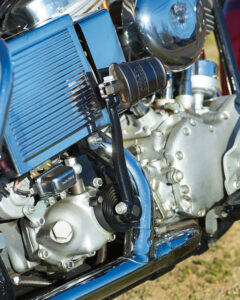
Harley-Davidson’s first effort to counter what the company saw as a tidal wave of imports was to demand Congress impose an increased tariff and possibly a quota. Congress refused to go along, but in the meantime, the engineers were working on the K Model, a middleweight that would be competitive with the British bikes, and on upgrades to the Panhead twins. An optional foot shift appeared on the Panhead in 1952, which was also the last year for the 61-cubic-inch EL motor. In 1955, the Big Twin received a heftier bottom end and more horsepower. Rear suspension and hydraulic brakes appeared in 1958.
Harley sold very few bikes between 1953 and 1963, and often made ends meet by doing subcontract work for General Motors. As a result, progress slowed. Sales started to rise in the early 1960s — the Baby Boom generation were becoming teenagers and the better image of motorcycles promoted by Honda filtered to Harley-Davidson. With more sales came more money to improve the product. The company sold stock and spent the money on plant and product upgrades. Superseding the Duo-Glide, 12-volt electrics, an electric starter, and the “Electra-Glide” name were added to the venerable Panhead in 1965. The next year, the factory put a new top end on the Big Twin, which riders referred to as the Shovelhead. Shortly afterwards, Harley-Davidson sold itself to AMF, and about 15 years later bought itself back again and launched a new line of Evolution motors.
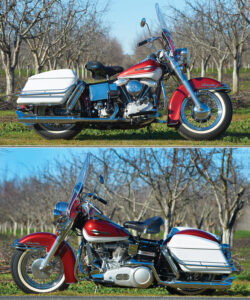
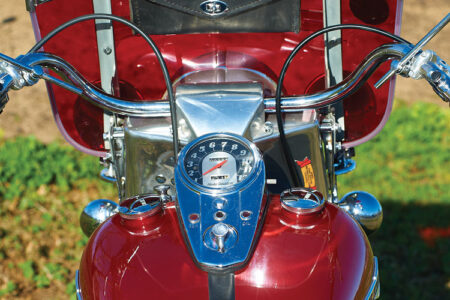
Much of the styling of the 1949 Hydra-Glide was the work of industrial designer Brooks Stevens (including the streamlined headlight nacelle, the fenders, and dash). Harley Big Twins have echoed the same look since. The Panhead “look” is iconic American: heavy, rugged, and solid. It’s an aura that appeals to a lot of people. Finding a Panhead to restore to original can be problematic, since many were turned into choppers in the 1960s and 1970s, when they were just old bikes that could be bought cheap. Finding one with an original frame with nothing altered or cut off is an event.
First start and new life
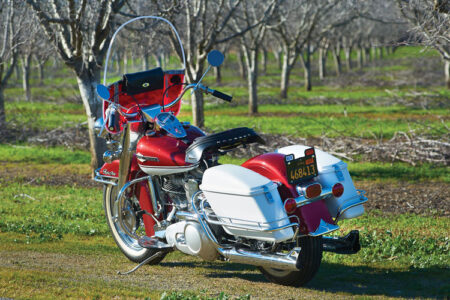
Dave started taking this Panhead apart and found the engine had been rebuilt at some point, with the cylinders bored .030 inch over. He punched them out to the next oversize, .040 inch oversize, put the engine back together with mostly stock parts, and started working on the chassis. At first, he thought about customizing this Pan, but then decided to build it to stock specs. He located the sheet metal, repaired it, coated it with primer, and gave it to a friend to paint. The red is very close to the Hi-Fi Red Harley offered as an optional color for 1965.
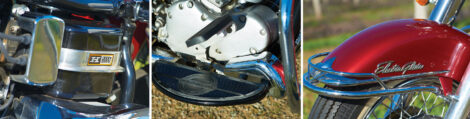
There are a lot of one-year-only parts on 1965 Electra-Glides. Difficult-to-find parts include the 5-gallon tank, the header pipes, and the star hubs on the wheels. The distributor is also one year only. This Panhead is almost stock. Non-stock items include the chrome plating on the neck bearing cups, (they should be cadmium plated), the spotlights, the exhaust mounting, the chrome cover on the exhaust, and the wheel rims. “It was too much trouble to change,” Dave explains.
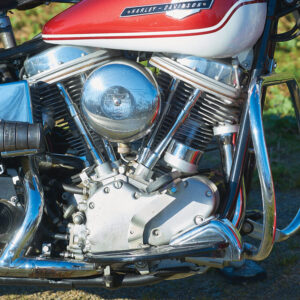
At this point, with the bike complete and ready to add gas to the tank and fire up, Dave started experiencing medical issues. He decided to start it when he felt better. Three years came and went, and Dave’s medical problems did not go away. A friend of his saw the Electra-Glide and talked about buying it, but never came up with any money.
A few months ago, Mike Laird, a member of the Antique Motorcycle Club of America (as is Dave Kafton), called Dave to see if he had a distributor for a Panhead Mike owned. Dave did, so Mike stopped by to pick up his part. While in Dave’s shop, he saw this ’65 under a blanket and asked to see the rest of it. Mike admired the bike, asked if it was for sale, paid for his part, and left.
As Dave tells it, “Mike called the next day. He said he couldn’t sleep, that he wanted that Panhead. Mike said he had talked to his wife and had the cash in hand. I talked to my friend who had been interested, and he said the asking price was a lot of money, and if Mike wanted it, to let it go. Mike came and picked up the Panhead the next day.”
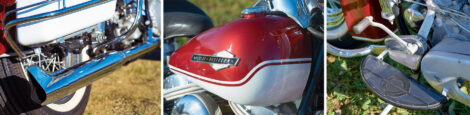
Dave, an affable guy, has a lot of friends, and another friend had been looking for a hardtail Panhead (pre-1958) for some time. Two weeks after Dave sold the Electra-Glide, he saw an ad for a 1951 Harley, collected his friend, and went to see it. It turned out that the seller was Mike Laird. The Electra-Glide was there, still not started, although Mike had cleaned it up and installed a new battery. Although Dave was not feeling well and wanted to go home, he agreed to stay long enough for Mike to start the Electra-Glide. Mike put a gallon of gas in the tank, opened the petcocks, gave it full choke and hit the starter button. The bike — which had not been started since the rebuild — started right up and went into that Harley-Davidson potato-potato cadence. Mike was very impressed — the carburetor tuning was almost perfect and everything worked as it should. “Dave knows what he’s doing,” Mike says. Dave was being modest. “I was pretty impressed myself.”
Mike has now had the bike for four months and has added a NOS windshield with reproduction red-tinted lowers. He has ridden it 288 miles in the four months and is apologetic about this mileage — he wants to ride it more.
Custodian of a classic
This Electra-Glide is the fourth or fifth Panhead Mike has owned. He has worked on and loved Panheads for a long time. He learned to ride early and competed in local motocross and other offroad events. He also had a succession of street bikes. Mike learned to work on motors from his father, a car mechanic, and does most of the work on his machines.
Mike Laird’s first Panhead, the one that started his long-term love affair with these Harley-Davidson V-twins, was bought partially completed. It belonged to a friend who was terminally ill. The friend had started to put it together, never finished it, and had finally decided to sell it. Mike went to look at the machine. “I had to have it. It was beautiful,” Mike says.
Mike had never worked on a dry sump motor before, but with help from friends, the bike came together and ran. “I learned a lot of things the hard way,” he says. “I learned about oil scavenging systems and ignition timing for early V-twin motors. I also learned to rebuild carburetors.” Along the way, Mike found he had an aptitude for carburetor rebuilding and tuning. He now sells rebuilt Keihin, Linkert, S&S and Mikuni carburetors on eBay, and also offers rebuilding services. “People often need coaching — what is an air leak, what is that popping noise, why won’t the bike run without the choke on. I try to help.”
Mike is also knowledgeable on how to keep a Panhead off the lift and on the road. Maintenance consists of carburetor tuning, chasing oil leaks, and making sure the heads are torqued to specification. Clutch adjustment is critical. “When I put a clutch together, I hone the holes the dowels fit into just enough so everything moves smoothly. I check the clutch housing for wear and set up the ‘mousetrap’ booster that assists with clutch pull. A two-finger clutch pull is achievable with a properly setup mousetrap.” Oil should be changed every 5,000 miles. Mike recommends 50 or 60 single weight oil for any Panhead that is run when the outside temperature is between 50 and 85 degrees Fahrenheit. Mike does not think a Panhead should be ridden when the temperature is over 85 degrees, due to the danger of overheating.
Oil flow is important with a motor as old as this one. After a rebuild, Mike undoes the return line and puts it on a fill spout. He makes sure oil circulates, is scavenged, and returns to the oil tank before reassembling the oil line. Panheads often “wet sump” where oil drains to the bottom of the motor, often increasing drag to the point where the bike will not start. Prism Motorcycle Supply sells an oil turnoff kit that wires to the ignition to keep the bike from starting unless the valve is opened. This problem can also be avoided by careful assembly. “This ’65 does not wet sump — that shows how meticulous an engine builder Dave is.”
Mike is an ex-racer, but does not push on this Panhead. He has other bikes to indulge his need for speed. First gear is walking speed. Second is up to 30-35 mph. “I spend a lot of time in third gear.” The best roads for this bike are well-paved country roads with gentle curves that can be ridden between 40 and 55mph. He says that one of the benefits of riding this Panhead is that the bike is noticeable. “I have a better chance of being seen.”
“This bike is majestic. This bike is one of the nicest examples of a ’65 I have ever seen. I am so thrilled to be the custodian.” MC