
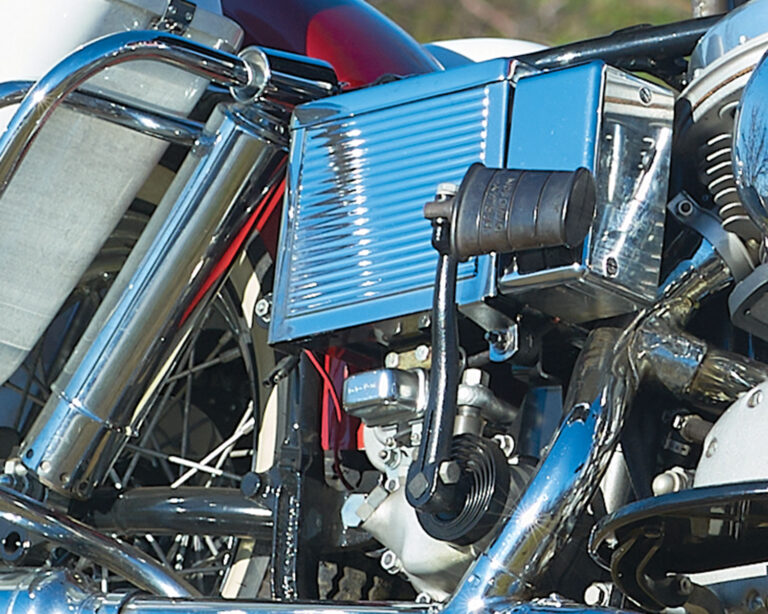
This issue’s story, “Big Twin Continuous Improvement,” where the 18-year-old Harley Panhead gets an electric starter, calls up a few experiences and resultant opinions. Improving motorcycles and making them better seems like a good idea, but then who is defining better, and at what cost does it come?
When I attended AMA Board of Directors meetings in the 1980s and 1990s, there was corporate representation from the big motorcycle companies, and six members elected from the AMA membership. I recall meeting the new Harley-Davidson representative one day and getting his card; he was Harley-Davidson Vice President, Continuous Improvement. Being firmly entrenched in the highest tech and design of the sport bike world at the time, I held my chuckle for later.
But looking at the Motor Company’s approach to always working to make better bikes can be judged as on target; coming off the AMF era brought many challenges. Triumph, Norton, BSA, and the other British and typically Italian and German makers worked in similar fashion. Unlike the Japanese manufacturers who historically toss everything and start over every other year for motocrossers, and rarely keep a street bike catalogued more than four to six years, you take feedback and tweak your design — you don’t start from scratch. With the Japanese manufacturers’ approach, parts are obsoleted, aftermarket fitment is stymied, mechanics need more training, and bugs almost always need to be worked out. Not always is that new machine better than the one you’re sitting on, to say nothing of paying for reworks with every change.
So, in 1909, Harley-Davidson made its core design a 45-degree V-twin displacing 61 cubic inches, though adding cubic inches, it has stayed around that basic formula for over a century. Engineering inlet over exhaust engines, flatheads, then releasing overheads in 1936, they retained a lot with each model change. With the Duo-Glide, they finally worked in rear suspension for 1958, and for 1965, electric starting appeared on the last Panhead. Sure, decoration and paint colors, frame details, sheet metal, and speedo faces were changed, and the 1948 Hydra-Glide was a big shift, but little was outright obsoleted from the EL and FL that had arrived in 1936. If you take a look at Harley’s racing program, it’s very logical and helpful to tuners and racers. Up until 1980, when the last complete XR750 dirt tracker was made, with good credentials, Harley would sell you a production racer; WRs, KRs, and XRs. In the 1950s and 1960s, you could select components from a pretty large catalog and buy the bike at your local dealer. Improvement was brought as factory riders were testing components in the racing season, privateers could buy what the factory developed in the following racing season.
For Harley-Davidson and the British makers, improvement came slowly, but at a safe pace. Your familiarity and your parts stash from previous street or race bikes still applied. To the contrary, improvement with Japanese bikes usually meant it was obvious you were riding an obsolete design as the Honda in-line four CB750F Super Sport was replaced by the VF750F Interceptor, a liquid-cooled V-Four. Continuous improvement involved more radical changeups and usually lower trade-in and resale value.


