
Where were you in ’72? If you were in the motorcycle marketplace looking for your new ride and you had an affinity for two-stroke power, you were in a very good place in time. There were some remarkable bikes with top-line performance available — but the writing was on the wall. Two-strokes weren’t going to be around for much longer.
The Air Pollution Control Act, initially enacted in 1955 and later referred to as the Clean Air Act, codified as 42 U.S.C. 7401, was updated or reauthorized nearly 30 times since. Revisions in 1965 and 1970 affected regulation of motor vehicle emissions, with the 1970 amendments requiring 90% reduction by 1975 — but federal action extended the deadline in 1977. Getting emissions by two-stroke engines down far enough to meet the standards was not considered feasible by most manufacturers — except one.
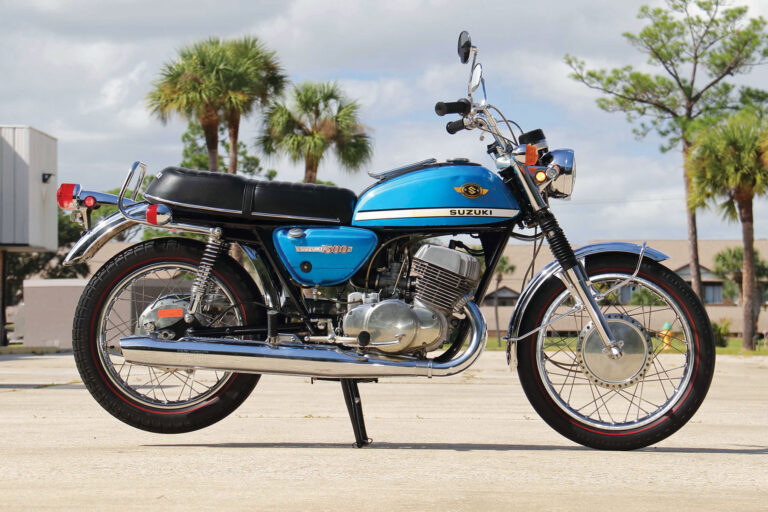
The liquid-cooled Suzuki GT750 LeMans triple came out in 1972 and lasted until 1977. The popular Suzuki T500 air-cooled twin was shown at the Tokyo Motor Show in 1967 as the 500/Five. It was launched in 1968 as the T500 Cobra, was renamed the Titan in 1969, was renamed again as the GT500A in 1976, and was offered until 1977 when it was named the GT500B. The Kawasaki H2 Mach IV 750 came out in 1972, simultaneously with the S1 Mach I 250 and S2 Mach II 350 triples, and joined the H1 Mach III 500 triple, on the market since 1969. By 1976, the Mach IV was gone, in 1977, the Mach III was gone, and by 1979, the 250 and 350 (by then KH400) triples were gone.
Yamaha R5-C
Yamaha’s 347cc air-cooled twin-cylinder engine became one of the most successful two-stroke motorcycle powerplants in history. It originated in 1969 with the basic R3. Over the years, the engine was refined for both more power and lower emissions with things like reed valves, capacitive discharge ignition, liquid cooling, YPVS (Yamaha Power Valve System) variable height exhaust port, and a switch from five- to six-speed unit transmissions. It was bumped up to 399cc, becoming the RD400C, went back to the 347cc displacement in the RD350LC in 1981, became the RZ350 twin in 1984, with the yellow and black Kenny Roberts edition in 1985, and ended in 1989 as the liquid-cooled RD350F2 when the displacement went back to 347cc. Racing success informed the bike’s development and improvement over the years.
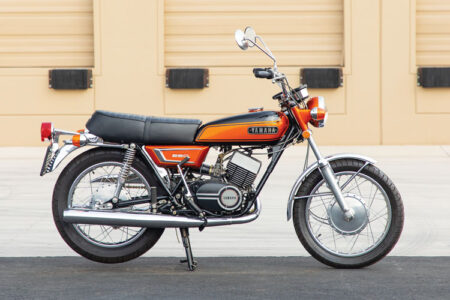
The Yamaha 350 twin became a part of motorcycle racing legend when Don Emde rode the racing version (TR3) to victory in the 1972 Daytona 200, outrunning and outlasting three- and four-cylinder 500cc and 750cc two-stroke and four-stroke competition! Don Emde’s victory set off a chain of Yamaha Daytona 200 victories that lasted for 12 more consecutive years! It was also the first time Daytona was won by a two-stroke powered machine, by a Yamaha — and one displacing only 350cc. In a sense, the engine concept actually survived in another form when the Yamaha TZ700 road racer emerged. Its engine was essentially two liquid-cooled 350 twins, complete with separate crankshafts joined side-by-side!
The R5 was embraced by the press and public alike for its light weight — only about 311 pounds — low purchase price, only a smidge over $800, good brakes, great handling, sleek, purposeful appearance, and, as stated at the time, “Harley humbling” performance.
The willowy little Yamaha twin in the right hands could achieve some impressive elapsed times at the drag strip. Cycle World test riders turned a best quarter-mile E.T. of 14.3 seconds with a terminal speed of 89.82mph in their road test. Measured top speed was 99mph. Indeed, the Cycle World reviewers called the bike a “race-bred motorcycle in a street machine’s clothing.”
Suzuki GT750J LeMans
Of the bike, Cycle World reviewers said, “…the GT750 is the most refined, and yet most awesome, two-stroke ever.”
Those hoping the GT750 would be a “Kawasaki killer” able to turn overwhelming liquid-cooled horsepower loose on the H2 would be disappointed. Suzuki wanted and needed its biggest two-stroke road bike to be a true all-around performer with broad market appeal, not a stoplight-to-stoplight drag bike. After all, there were plenty of bikes after that segment of the market already. Still, inquiring minds needed to know: how do the two compare?
In its January 1972 issue, Motorcyclist magazine pitted the GT750 against the Kawasaki H2 Mach IV in a head-to-head test. In that review, Suzuki’s Willie Hardin said, “Everyone expected the bike to perform like an H1 or H2, but it was clear they’d made the GT more of a sport touring bike. The GT was heavy and didn’t handle particularly well, but it was comfortable and smooth and very torquey.” The engine’s smoothness was augmented by rubber mounting and earned high praise from Cycle magazine testers, who said, “The water-cooled Suzuki is one of the smoothest motorcycles available anywhere.”
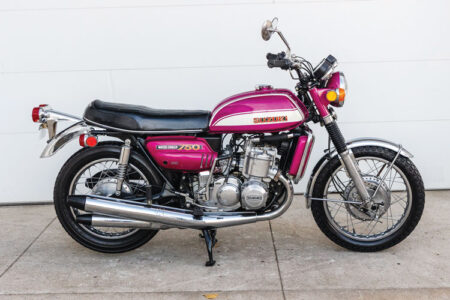
Stacked up against the H2 Kawasaki, the GT750’s quarter-mile ET was respectable, though not necessarily competitive. The H2 could cover the quarter in 12.72 seconds with a terminal speed of 103.80mph; the GT750 did it in 13.87 seconds with a terminal speed of 93.55mph, according to period tests by Cycle World. According to numbers achieved by Cycle Guide, the GT750 would even follow the 500cc Mach III down the strip. The Mach III was able to cover the quarter in their test in 12.80 seconds at 102mph at the finish line. Those numbers illustrate the differences not only in the power curves and vehicle weights (the GT750 being about 102 pounds heavier than the H2) but in the design philosophies.
While the H2 Mach IV was designed with the intention of it being a high-performance hot rod — and that objective was realized — the GT750 was designed to be a comfortable, competent sport touring bike with sufficient punch to handle being loaded up with touring gear for long-range or sporting cruises around town.
Kawasaki H2 Mach IV 750
“The quickest road machine Cycle World has ever tested.” That is how they summed up the March 1972 road test of the Kawasaki H2 Mach IV 750 triple. Full stop.
Unlike the 500cc Mach III, the Mach IV did surprisingly well in the period road tests in the handling department. The Mach III had barbs thrown at it in regard to its handling, such as calling the bike “the Widowmaker” and “Norton has the Featherbed frame; Kawasaki has the Deathbed frame.” Those comments stemmed from its suspension being viewed as unsatisfactory and the frame being too weak and flexible to handle the speed and power the 500cc triple could produce.
The Mach III came out in 1969, and it’s evident that Kawasaki paid attention to the negative press about the bike’s handling. It beefed up the chassis for the Mach IV using larger diameter thick-wall tubing and gusseting at the steering head and cross-bracing of the duplex frame and swingarm, which lessened frame flex problems.
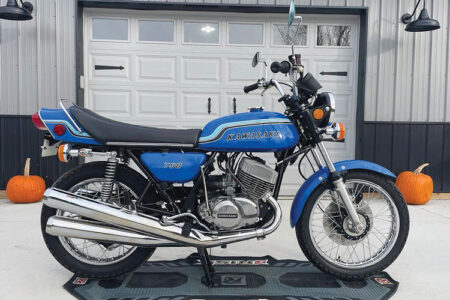
The Mach IV was an unapologetic speed machine with few creature comforts. The ride provided by its suspension and seating position didn’t get panned in the press, but the saddle was found by some to be too hard and too short, particularly for the pillion, as well as the passenger pegs being set too high for comfort. Engine vibration was a surprising bright spot, being minimal at all speeds except at about 80mph in top cog and then primarily emanating from the rigid-mounted footpegs. Fuel economy, as one might expect, was a weak point, even when ridden conservatively, only averaging about 30 miles per gallon. That leaves the rider running on fumes after only about 135 miles with the bike’s 4.5-gallon tank.
But nobody bought a Mach IV for fuel economy or posh touring. It could deliver zero to 60mph in 5 seconds flat with actual period test top speed of 119.72mph. That is why most Mach IV buyers wrote the check.
Suzuki TS500J Titan
Among the titan two-strokes of ’72, there was only one that was a Titan literally in name and deed. In 1972, the Titan was officially designated TS500J. Longest-lived in its original air-cooled form of the ones we look back on here, it was perhaps the one that was an underrated workhorse. While it was nowhere near as successful in road racing as the 350cc Yamaha, it was, nevertheless, able to notch a number of racing successes.
In September 1969, Art Bauman rode the racing version to victory in the 125-mile AMA National championship at Sears Point — the first time a two-stroke engine powered a rider to such a victory. Ron Grant later won the 125-mile AMA National at Kent, Washington.
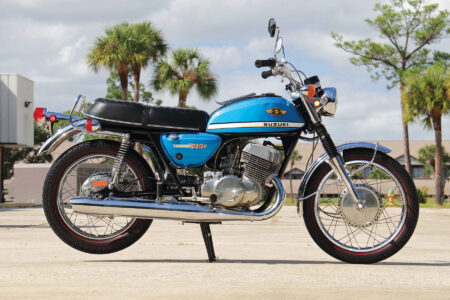
Thanks to advancements in alloy metallurgy and engine architecture, it was one of the earliest two-strokes that stepped above the 350cc ceiling so common when the 500/Five emerged in 1967. The largest displacement two-stroke road bikes for each of the other major Japanese manufacturers in 1967 were Kawasaki’s A7 Avenger at 338cc, Yamaha’s YM2C at 305cc, and Bridgestone’s DT175.
Among the air-cooled two-strokes of the day, the Titan was the one that was regarded as having both high performance cred, as well as the comfort, handling, and reliability to be a viable touring machine. Its powerband was broad enough to allow it to pull steadily in a wide rpm range, avoiding sudden power peaks. The engine was also smooth, quiet, and could average about 50 miles per gallon. Handling and ergonomics earned praise, as well.


