We hear a lot about tariffs these days. Mostly, the discussion is about whether they are good or bad for this group or that, and what they do to consumer prices. And whether they bring any protective benefits to U.S. product manufacturers who must compete with foreign manufacturers in the same product lines.
The mechanism is simple: by adding a tariff, which is basically a tax on competitors’ imported products, those products, which may start with a lower manufacturer’s suggested retail price (MSRP) than competing domestic products, may be brought up to a comparable or even higher price when it reaches the consumer. This is one way the government can “level the playing field” when imported products appear to be taking market share from domestic manufacturers — particularly if the imported product pricing is believed to benefit from the home country giving subsidies, having low or no taxes on the manufacturer, lower material and labor costs, and so on. Other factors that may justify government implementation of tariffs include evidence of “dumping,” which involves selling the product below cost or other anti-competitive strategies.
In the early 1980s, Harley-Davidson found itself in a tough situation. Thirteen Harley-Davidson employees had just succeeded in buying out the motorcycle manufacturing portion of the company owned by American Machine and Foundry (AMF), which brought control of company operations closer to home, but also removed the operating capital that had been flowing into the company from AMF. It also made the company — its new owners — solely responsible for servicing its substantial debt.
At the same time, manufacturers like Honda, Yamaha, Kawasaki, and Suzuki were hitting the U.S. market with multi-cylinder superbikes, cruisers, and touring bikes that were fast, reliable, and surprisingly affordable. But in some cases, too many units were being shipped to America, and MSRPs were reduced to promote sales. This was driven by the practice of Japanese manufacturers to reduce unsold inventory at discount prices, or that “dumping” described earlier. Harley-Davidson believed it had cause for regulatory action, and it sought it.
In September 1982, Harley-Davidson CEO Vaughn Beals petitioned the International Trade Commission (ITC) for relief. He asserted foreign motorcycle manufacturers — particularly Japanese companies — engaged in unfair competition. The petition sought protection in the form of a tariff on heavyweight (700cc and up) motorcycles and powertrain subassemblies.
In January 1983, the ITC agreed that importation of heavyweight motorcycles did threaten the domestic motorcycle industry and recommended that President Reagan act to raise the then-current import tariff of 4.4% to 49.4% and keep it there for a year; lower the rate to 39.4% in the second year, to 24.4% in the third year, to 19.4% in the fourth year, and to 14.4% in the fifth year with the tariff returning to 4.4% after the fifth year. In April 1983, Reagan signed into law a revised version of the tariff plan that did not include powertrain subassemblies and focused almost entirely on Japanese manufacturers.
The Japanese manufacturers responded the following year; they rolled out bikes with displacements of 694 to 699cc. Honda introduced four such models in 1984, Yamaha introduced one such model for 1984, and Kawasaki moved the manufacture of some models that would have been impacted by the tariff to the U.S.
The Motor Company had seen its market share in heavyweight motorcycles fall to only 12.5% in 1983 and was posting very poor financial results, as Willie G. Davidson described in his 2023 memoir, Ride Free: “After losing around $25 million in 1981 and $32 million the next year, Harley-Davidson climbed back into the black. In 1984, we had $2.9 million in profits on $294 million in sales.”
Davidson gives substantial credit for the turnaround to the release of the Evolution V2 engine, which replaced the aging Shovelhead in about half the product line in the 1984 model year, and the new models that went with it, but there can be little doubt that the 1983 tariff law would have had some effect.
Fortunately, he goes on to relate that the company’s turnaround came on strong — so strong, in fact, that it advocated for the end of the tariff plan by 1987, a year earlier than it had been authorized for.
One technical effect of the tariff from the Japanese manufacturers was to trim some of their 750cc models down to under 700cc to slip under the tariff displacement limit. Here’s a look at four such examples: the 1985 Honda VF700C (V40 Magna), Suzuki GS700ES, Suzuki GV700GL Madura, and Yamaha XJ700X Maxim.
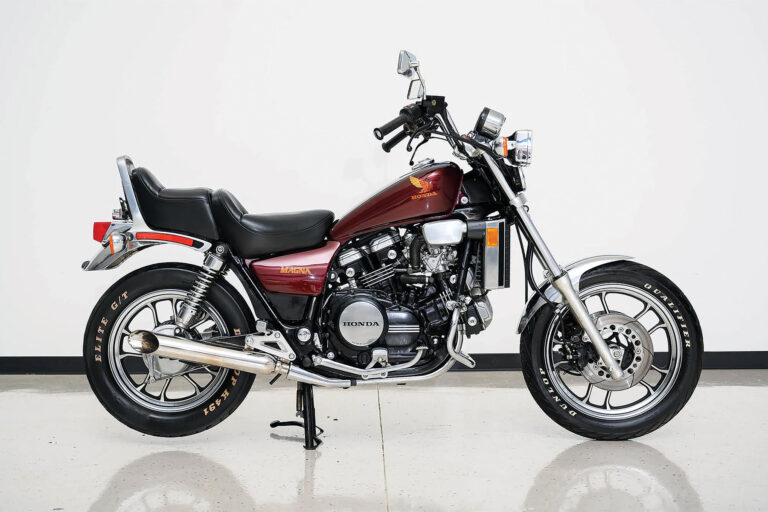
1985 Honda VF700C (V40 or V42 Magna)
The Honda VF700C Magna was perhaps the most radical of the tariff bikes of the 1980s. It’s liquid-cooled, 90° included angle, V-four, double-overhead cam, four-stroke engine with four valves per cylinder, four carburetors, six-speed transmission, and shaft drive set it apart from the other bikes in its class — except for the Suzuki GV700GL Madura, which also boasted a liquid-cooled V-four engine (see detail below). The Honda V-four mill was a race-bred powerplant with a 10,500rpm redline and the ability to reach it with ease.
The engine spun out 82bhp at 9,500rpm — which was three bhp more than its 750cc version — and it did so with nearly undetectable vibration, even without a counterbalancer. The 90° included angle of the cylinder banks provided near-perfect primary balance, and rubber mounts of the engine accounted for the sewing-machine-smooth operation.
To create the nominal 700, which had an actual displacement of 699cc, Honda shortened the stroke of the VF750 engine from 48.6mm to 45.4mm. With a shortened stroke, Honda also raised the redline from 10,000rpm on the VF700F Interceptor model to 10,500rpm for the V40 Magna.
Complementing the Magna’s smooth power was the chromed four-into-two exhaust system, which kept the exhaust note civil even as it helped the engine breathe easy as the revs rose.
Styling was something of a mashup of looks. Moderate-rise pullback bars, a wide, sleek gas tank up top, which sloped down to a two-piece stepped saddle with integral sissy-bar, long-legged forks, and that wide-angle V of the engine that gave the Magna a very distinctive vibe. Custom? Well, that is in the eye of the beholder.
The Magna’s ride and handling were enhanced by an advanced suspension system up front. It consisted of air-adjustable, oil-damped telescopic forks equipped with Honda’s unique TRAC (Torque Reactive Anti-dive Control) system. The forks had a kicked-out look in the spirit of one of the first of a generation of factory custom cruisers. The rear suspension consisted of preload-adjustable dual shock absorbers working on a swingarm that combined with a wide, stepped saddle that included a padded backrest.
While the ride quality earned some praise in period reviews, the ergonomics did not. In its April 1984 review, Cycle magazine said, “The seating position, while not as radical as the Shadow’s, places the pegs far out in front of the rider’s spine, almost under his hands. The pullback bar makes a six-foot rider lean just barely forward, enough to put a curve in his lower back, but not enough to rest any weight on the bar itself. Shorter riders don’t fare much better. In either case, a 50mph headwind tires out arms both long and short.”
Cycle magazine’s article headline summed up the VF700C’s raison d’être: “The marketing people said custom. The government said 700cc. The owners said V-four, water-cooling, shaft-drive. Honda listened to everyone and then said one word: Magna.”
1985 Suzuki GS700ES
The Suzuki GS700ES retained the in-line transverse air-cooled four-stroke, four-cylinder, double overhead cam platform of its 750cc predecessor, which was introduced in 1983. Externally, the 700 was largely indistinguishable from the 750. Only a very astute observer might notice the rear sprocket was enlarged from a 43-tooth to a 45-tooth item. The internal changes that mattered included the reduction in the stroke length from 53mm to 49.6mm to get the displacement down to the tariff-evading 699cc, increasing cam lift on the intake and exhaust valves, increasing exhaust valve duration, and fettling the exhaust system’s dimensions.
The steps to improve the engine’s breathing and power delivery worked to keep it competitive with other 700cc bikes of the day, with 80 claimed crankshaft horsepower at 9,300rpm and 46.5lb/ft torque at 8,500rpm.
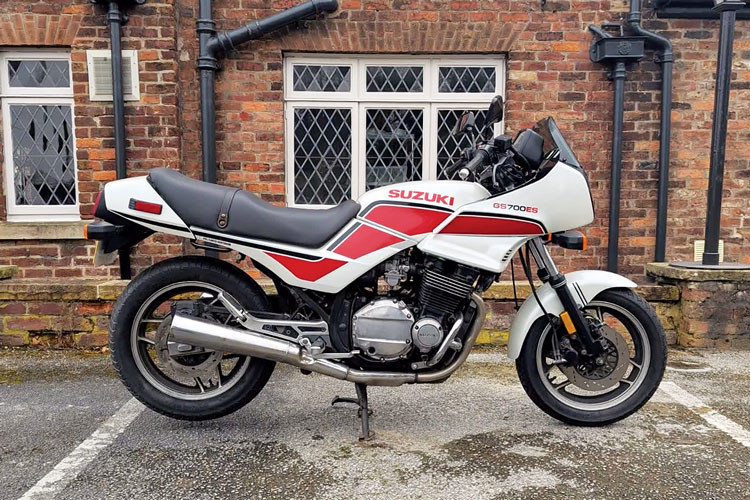
In most respects, period road tests tended to assess the GS700ES as unremarkable but comparable in performance, ride comfort, handling, and braking to the competition in its class.
For example, in its March 1985 review, Cycle World said, “Even engine vibration fails to spoil the Suzuki’s hospitable nature. Some light tingles do manage to creep into the handgrips and rubber-mounted footpegs, particularly at cruising rpm, but they are never strong enough to be debilitating.” Faint praise on that count.
In the area of acceleration, the GS did a little better, “The 700 carburates cleanly at low revs and doesn’t fall flat on its face anywhere, but the acceleration below 4,000 or 4,500rpm won’t peg the needle on your thrill-o-meter, either. Instead, the low-end and midrange roll-on is about like that of an above-average 550-class sportbike; steady, but not likely to give even the most pencil-necked rider a case of whiplash.”
1985 Suzuki GV700GL Madura
Produced in the 698cc configuration for only the 1985 model year, Suzuki’s Madura is a rather uncommon machine to find these days. The only other V-configuration bike Suzuki built to beat the bottom limit of the tariff was the 699cc VS700GLF and LEF Intruder V-twin.
At a glance, the Madura and Magna look very similar, with each featuring sweeping lines, sculpted fuel tanks, low stepped saddles, and built-in sissy bars. The engine of the Madura makes the difference with the coolant jackets, making no pretense of air-cooling fins, as is the case with the Magna. The Madura has panels on the cylinders with lines that run parallel rather than perpendicular to the line of the cylinders.
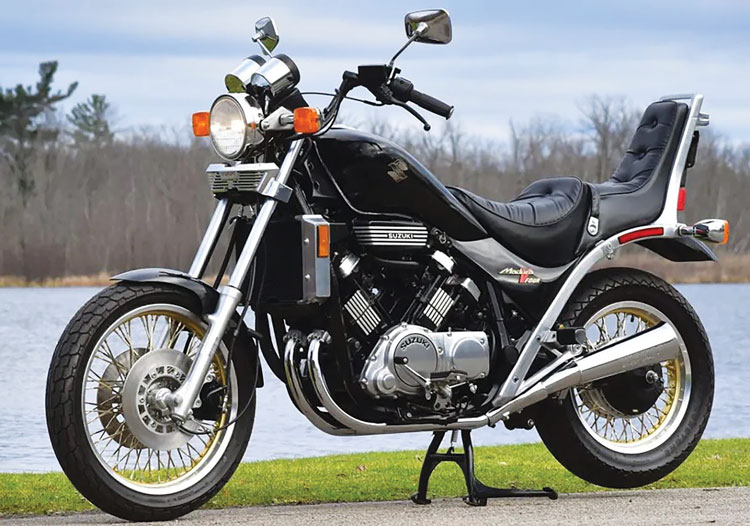
At 82°, the included angle of the Madura’s V-four engine is slightly narrower than the 90° of the Magna, but the difference doesn’t upset the engine’s primary balance enough to warrant a counterbalancer. Despite very similar engine specifications, the Madura’s claimed bhp is 72, ten fewer than the Honda Magna.
If that difference appears notable on paper, it doesn’t appear to have been notable on the road, as Cycle Guide magazine’s testers found: “The 700 starts eagerly and warms readily in the morning, with a trace of CV hesitation the only carburetion glitch. The small Madura’s engine has a flexible, easy-to-use nature, with a broad power spread, and this makes rides on this Suzuki friendly, enjoyable affairs rather than frenzied mini-races. Suzuki’s engineers effectively controlled engine vibration, making the powerplant all the more delightful to use, and if you need to squeeze maximum performance out of the 700, it winds smartly and willingly up and through the 10,750rpm redline.”
1985 Yamaha XJ700X Maxim-X
Yamaha’s XJ700X Maxim-X not only had sub-tariff target group displacement at 697cc, but unique engine performance features that put it at the top of claimed horsepower and torque for the class. Unlike most transverse, in-line DOHC four-cylinder power plants of the time, the Maxim-X’s engine is liquid-cooled and has five valves per cylinder, giving it a sophisticated 20-valve system.
The Maxim is in the cruiser class, as was its predecessor, the 650 Maxim, but Yamaha departed from the most common approaches for styling and ergonomics. Handlebars, footpeg positioning, wider, plush seat, even the chassis configuration were revised from the 650 Maxim to provide more comfortable leg room, more natural hand and arm position with lower, flatter handlebars, and longer, heftier braced forks for better handling.
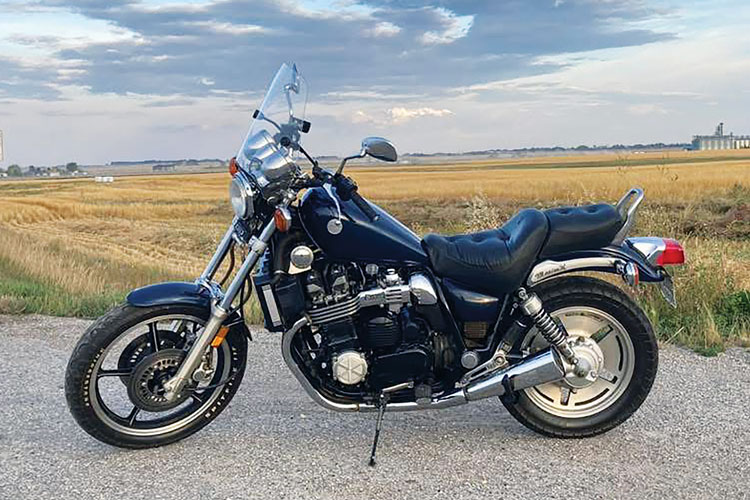
Where the Yamaha parts company with the other machines in its class is the five-valve engine, sister to the Yamaha FZ750 sport bike powerplant. It comes equipped with three 21mm intake valves and two 23mm exhaust valves breathing for each cylinder. That may sound counterintuitive, but since exhaust gas volume is only about 70% of intake volume, it works out efficiently. Of course, this also takes the Maxim-X’s mill to a new level of complexity where the valve train is concerned, but the results may have been well worth it.
In its 1985 review, Cycle magazine said of the Maxim-X’s engine, “Down low, the X is aggressive enough to let you zip past freeway traffic without touching the shift lever, but at 7,500rpm, an impressive disappearing act occurs. The X kicks so hard above seven five its midrange feels wimpy by comparison. From 7,500, it will rev quickly past its 10,000rpm redline — quickly enough to lighten its front-end exiting corners and trigger its 12,000rpm electronic rev limiter if you’re not careful. Those who aren’t careful may find reason to be — the Maxim-X continues to make serious power deep into the red zone and will pull to redline in top gear at 129mph.”