It had to happen. In the arms race of motorcycle horsepower and performance that swept the industry after the launch of new three- and four-cylinder street bikes at the end of the 1960s and early 1970s, the trajectory of the one-upmanship in engine design could only go one way: six-cylinder superbikes — at least for some.
Three of the contenders for bragging rights in the super-six category were manufacturers that had extensive experience with multi-cylinder race bikes, the research and development for which transferred in many respects to their road-going descendants.
Benelli was among the first to launch a six-cylinder street bike, releasing its Sei 750 in 1974. Two Asian competitors, normally with an obsession with being the first to roll out radical new models, didn’t join the six-cylinder fray until 1979; Honda with its 1,047cc CBX Super Sport, Kawasaki with its 1,286cc KZ1300A1.
Benelli offered the 750 Sei from 1974 to 1984, but also added the Sei 900 to the lineup in 1979 and offered the 908cc six until 1989. With at least one six-cylinder model in the product line for 15 years, Benelli had the longest six-cylinder model presence in the market of the three manufacturers.
Kawasaki’s KZ1300 Sports basic model was in showrooms from 1979 to 1982, but was refocused on the long-range touring bike market in 1983 as the ZN1300 Voyager, which was carried in the line until 1989.
Honda’s 1,047cc CBX Super Sport was the shortest-lived of the sixes, having come out in 1979 and disappearing by 1982, though the bike was shifted from the Sport category to Sport Touring in 1981 as the CBX-B with a slightly detuned engine, touring bags, a fairing, a strengthened chassis, and Pro-link monoshock rear suspension.
1974 Benelli Sei 750
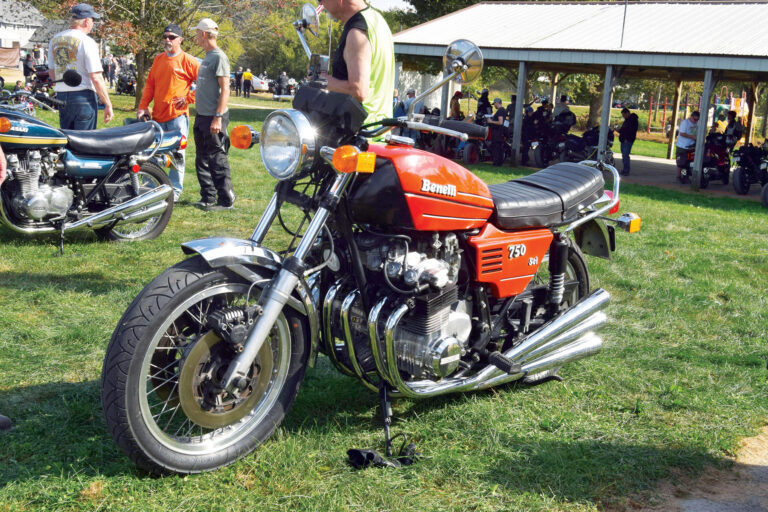
In 1974, the Honda CB750 was still a sight to see out on the road, with its four upswept exhaust pipes issuing its unique howl out the back. So, when the Benelli Sei 750 emerged with its six upswept pipes issuing an even more compelling sound, people would be likely to do a double-take.
But if would-be owners of the Sei assumed that if four cylinders are fast, six must be much faster, they would be disappointed. While the bike earned high praise for smooth operation, Italian styling flair, and technical sophistication, it didn’t possess world-beating speed.
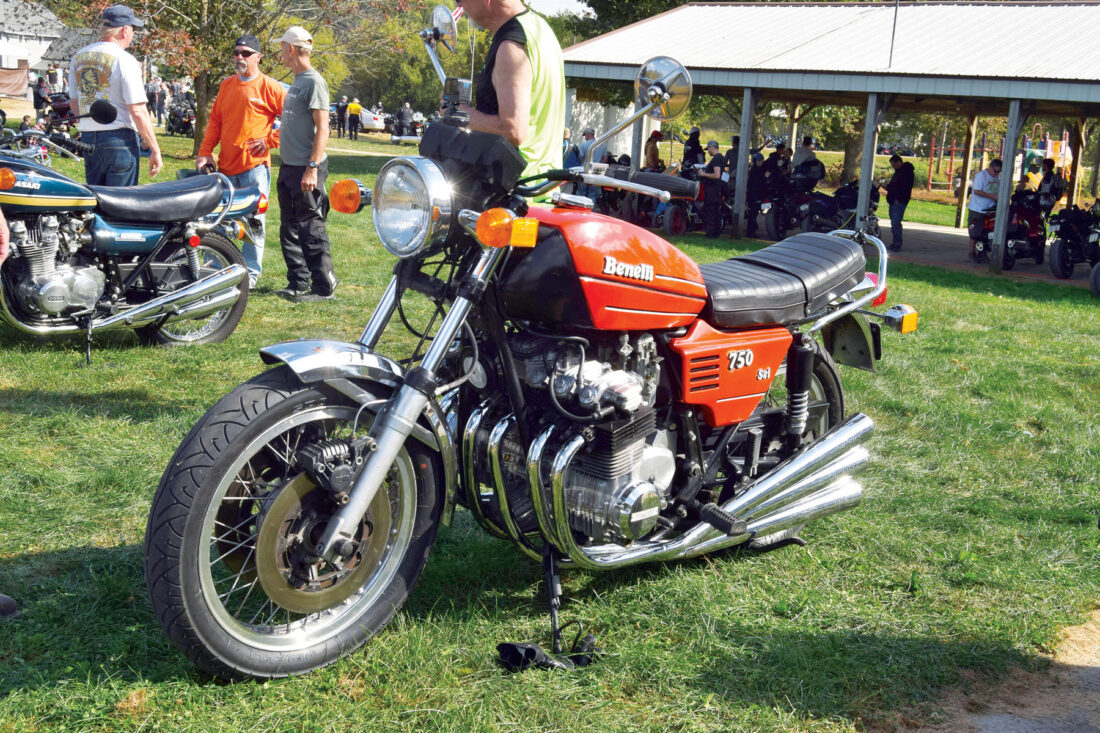
Roland Brown, in his review of the 750 Sei, noted, “The motor was tuned for mid-range performance and was impressively tractable, producing usable torque everywhere above 2,000rpm in top gear. Carburetion was crisp, and there was barely a step in the power delivery as revs rose through the range. This meant that although the Benelli’s top speed of about 115mph was unexceptional, the bike impressed with its effortless high speed cruising ability.”
Despite the unique appearance of the single overhead cam six-cylinder air-cooled mill, the design of the engine really was not all that exotic or original. Closely patterned on the Honda CB500 Four, the bore and stroke and other physical specifications matched the Honda, but with two extra cylinders. While the Sei made a bold statement with its six mufflers out back, Benelli did seek simplicity on the intake side, using three 24mm Dell’Orto VHB24 carburetors mounted on three Y-shaped manifolds to fuel the engine instead of six carbs.
Despite its visual appeal, praise-worthy handling, and brakes, the Sei models didn’t achieve sustained high sales volume. Brown summed it up, saying, “Potential owners were worried about reliability and high running costs, as well as the bike’s considerable purchase price.”
1979 Honda CBX Super Sport
Perhaps no other production model in Honda’s street bike line ever appeared to be more of a direct descendant of Honda’s world championship-winning in-line six-cylinder 250cc and 350cc GP racing bikes of the sixties than the CBX.
The engine was not only physically imposing with its six cylinders, an expansion of the then-new replacement for the SOHC CB750, the 1979 DOHC CB750F; it was also technically sophisticated beyond any other air-cooled superbike, with its dual overhead cams and 24 valves. It was fueled by six 28mm Keihin CV carburetors and had electronic ignition. Unlike the Benelli, with its thought-provoking six mufflers, Honda opted to go with a lighter six-into-two exhaust system. Even with that and other weight-saving approaches, the CBX weighs 600 pounds ready-to-ride.
It is that bulk and the triple-digit brake horsepower that framed the overall target market, which is composed of experienced riders. In its February 1978 in-depth review of the CBX, Cycle magazine’s riders flogged the CBX at the Willow Springs road race course, Orange County International Raceway drag strip, and on a Webco dynamometer.
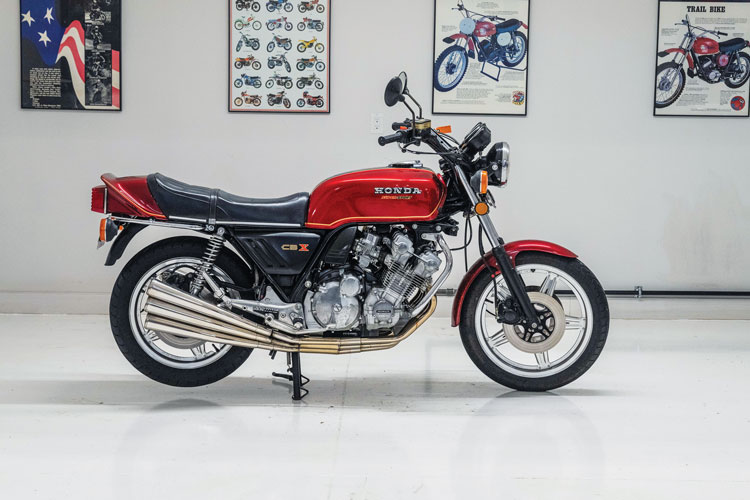
On the race track at Willow Springs, the CBX acquitted itself well. Not perfectly, but well enough to earn praise for its brakes, handling, and acceleration. The numbers were impressive: on that track, it was stated by those in the know that a 1:45 lap would be “about as fast as any stocker had ever gone.” The CBX was ridden to a 1:43!
At the drag strip, the CBX made a statement. Cycle‘s reviewers laid out some jaw-dropping numbers: “The bike’s 11.55 second ET was by almost two-tenths the quickest quarter mile ever turned by a standard production motorcycle tested by any magazine, its top end blast of 117.49 was more than two miles per hour up on the [Yamaha] XS Eleven’s fastest. There is no doubt: the CBX six is the hardest-accelerating production vehicle ever built.”
Having proven its dominant performance credentials, but unable to achieve dominance in the sport motorcycle segment, by 1981, Honda repositioned the bike as a long-range touring bike, the CBX-B. It didn’t rule the showroom in that form, either, and was discontinued after 1982 as Honda unleashed its first wave of liquid-cooled, DOHC V-4 VF series bikes that same year. In an interesting part of its legacy, about 600 CBX examples were donated to schools as teaching aids for technical education classes in 1981, remembered now as “school bikes!”
1979 Kawasaki KZ (later ZN) 1300
Of these three manufacturers offering models with six-cylinder engines by 1979, Kawasaki’s KZ1300 was the biggest, heaviest, and brawniest. Tipping the scales at over 700lb, the big Kawasaki needed all of its claimed 120bhp to achieve competitive performance.
But Kawasaki brought forth a product with some important differences apart from being the heaviest. Its transverse DOHC four-stroke engine was liquid-cooled, and its six cylinders were fed by three two-barrel carburetors mounted on curved, paired manifolds and a low-maintenance, high-strength shaft final drive was fitted instead of roller chain. In addition to the inherent balance and smoothness of an inline six, the 1300 also had a harmonic damper to absorb torsional vibration in the crankshaft.
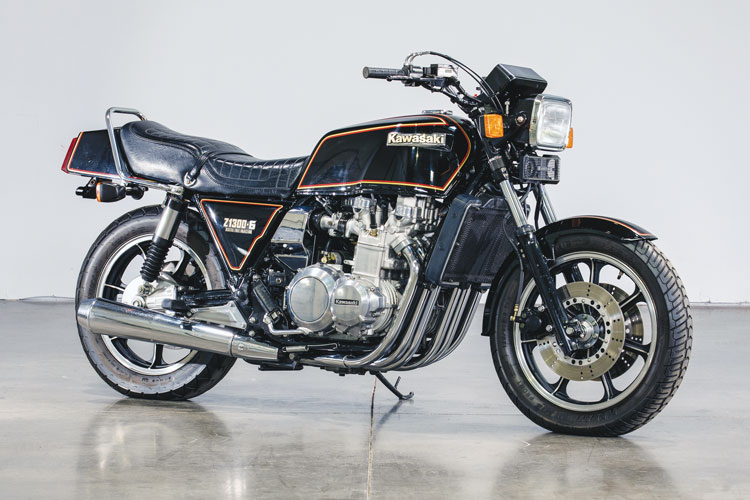
After all the technical derring-do and advanced engineering, to many riders, performance numbers still mattered. Despite its formidable weight and size, the 1300 managed impressive numbers, according to the March 1979 review by Cycle magazine. It covered the standing start quarter mile in 11.96 seconds with a terminal speed of 114.35mph. The calculated top speed in fifth gear at 8,000rpm was 135mph, but extended top-speed testing showed a white-knuckle 141 indicated mph at 8,400rpm. Those numbers compare favorably with the benchmark performance machine from Kawasaki, the 903cc Z1. In its March 1973 review, Cycle World test riders covered the quarter mile in 12.61 seconds with a terminal speed of 105.63mph; what was wicked fast had become history.
Suspension, brakes, and handling were good according to the Cycle testers, but the bike’s engine configuration did lead to limitations in cornering clearance lean angle. That said, the bike is a big-bore sport touring machine, not a road racer. It was the engine that stole the show in the road test summary: “The 1300’s engine is its message — and that message is far from a telegram edged in black. In terms of vibration control, throttle response, serene production of power, and easy, peaceful running, the 1300 engine is absolutely in a class by itself.”
By the end of its run in 1989, about 20,000 KZ1300s and 4,500 Voyagers were built.
The six we never saw — Harley-Davidson’s Project Nova 1500cc V6
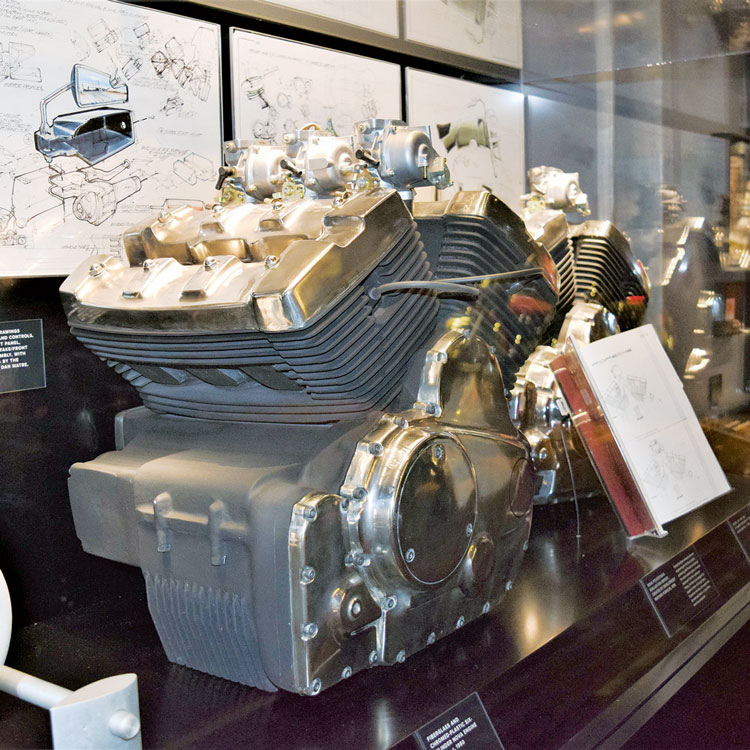
In the mid-seventies, Harley-Davidson began development of an all-new series of machines that would have included double overhead cam liquid-cooled V-twins, V-fours, and, at the top of the line, compact V-sixes. The series was code-named Project Nova. Though the bikes would not have reached mass production until the 1980s, had that happened, Harley-Davidson would have been the only manufacturer offering a compact V6 power plant for the road — notwithstanding the 996cc Laverda V6 factory endurance racer of 1978. Porsche was H-D’s partner in the development of the Nova bikes, handling the engine and transmission development. Financial circumstances prevented the completion of the development of the Project Nova bikes. For more on this, see our coverage in On the Radar — “The Classics that Never Were.”