The year 1969 was nothing if not the ignition point for the motorcycling world’s voracious appetite for three- and four-cylinder engines. Two models spring to mind as the instigators — the Honda CB750 and the Kawasaki H1 Mach III 500. The Honda made its mark for smooth, reliable rideability; the Kawasaki for ferocious, 750-humbling acceleration. But in 1969, BSA and Triumph were there with new 750 triples as well.
It wasn’t long before Honda, Kawasaki, and other manufacturers began developing models to spread multi-cylinder fever to smaller displacement categories and lighter weight versions with more affordable price tags. Although it’s likely they had preliminary work done on a range of variants before those landmark models were ever brought to production.
Honda clearly was already moving to add other multi-cylinder models, even as the CB750 was being rolled out. In 1971, the CB500 Four was added, and in 1972, the CB350F four joined the line. Honda had considered adding a 250cc four as well, but decided to forego a quarter-liter version because the frictional losses would overpower any gains possible with four cylinders. As a result, the 350 was the smallest of Honda’s mass-produced in-line four-cylinder street bike engines.
Kawasaki, meanwhile, was moving quickly to expand its two-stroke triple line with three new variants in 1972. The H2 Mach IV 750, S2 Mach II 350, and S1 Mach I 250 were all unleashed at the same time.
Of course, all this multi-cylinder mania in the U.S. market being generated by the Japanese manufacturers was not lost on the European contenders for U.S. sales.
In Italy, Moto Guzzi and Benelli had recently been combined as a result of the purchase by the De Tomaso Group. De Tomaso had purchased Benelli in 1971 and Moto Guzzi in 1972. It was under De Tomaso that important development resources ultimately moved from Moto Guzzi’s V-twins to inline multi-cylinder models.
That led to the release of the first model, the Moto Guzzi 350 GTS in 1974, which carried an inline SOHC 350cc four-stroke four-cylinder. That bike was also badged as the Benelli 350RS starting in 1977. By 1976, a 250cc SOHC four-cylinder badged as the Benelli Quattro was introduced, with the more radically styled Moto Guzzi 254 version coming out in 1977, though the tiny 250 was primarily for the European market, not the U.S.
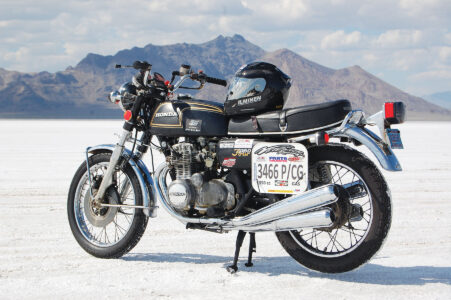
In terms of all-out performance in their respective displacement classes, none of these micro-multis came with a factory claim of world-beating top speed or pavement-wrinkling acceleration. That said, a bone-stock 1974 Honda CB350F, which was reported to be smooth, if not all that fast in period road tests, is the current American Motorcyclist Association national land speed record-holder in the 350cc P/PC (Production engine/Production frame/Classic age) class — a record which has stood since 2014.
If there is a notable distinction among these diminutive bikes, it may well be that they are — well, diminutive — and powered by the smallest versions ever mass-produced of the three- and four-cylinder engines that powered their bigger brethren.
Honda CB350F (1972-74)
According to a retrospective press release on in-line four-cylinder powered bikes published by Honda, company founder Soichiro Honda once said the CB350F was his personal favorite. That’s not unlikely; he would have found a lot to like in that small package. The little 347cc SOHC four-stroke inline four that powers it is a descendant of Honda’s spectacular four, five, and six-cylinder Grand Prix race bikes that contributed to Mr. Honda’s company winning 18 class Manufacturer’s World Championships in the 1960s. It is the smallest of the four-stroke inline four models Honda ever mass produced.
Despite being on the lowest end of the Honda four-cylinder displacement and price range, Honda did not cut corners on technical aspects or aesthetics. It was equipped with four carburetors and four brightly chromed upswept exhaust pipes that gave the bike the same kind of sweet, high-pitched howl in four-part harmony of the bigger fours, especially when it’s on the boil up near its dizzying 10,000rpm redline.
Sadly, examples of the CB350F found these days with the original pipes in place most often have severe rust-through problems, or some sort of four-into-two or four-into-one aftermarket replacement pipes. Fortunately, in recent years, the company that manufactured the original items produces limited quantities of OEM specification four-into-four pipe sets, part number HM333P, occasionally available from David Silver Spares.
Period road tests found that the CB350 twin, which was still in production alongside the four, was a tad quicker in the quarter mile, but if given enough time, the four could reach a little higher top speed; that being around 98mph — depending on the rider and test conditions. But top speed was not the bike’s top billing; while the CB350 twin could leave a rider’s hands and feet tingling from its vibration, the four was much smoother and had only minor vibration between 5,500 and 6,000rpm.
Despite being a direct descendant of Honda’s vaunted CB750, even sharing some of its components, the 350F was a disappointment in some areas. In its review of a 1974 CB350F, Cycle News said the bike’s weak suspension made it feel like “a pogo stick with handlebars.” Cornering was characterized as “wobbly.” Cycle News reviewers also panned the Honda’s front disc brake, saying it gave “little braking torque for a whole lot of lever effort,” and felt that the fork would “twist” under hard front wheel braking, making corner entry feel unsteady.
Failings aside, Honda must have been generally satisfied with the 350F as originally brought to market. In its three-year production run, about the only thing that changed was the color options. In the 1972 and ’73 model years, Candy Bacchus Olive and Flake Matador Red were the options, and for 1974, Glory Blue Black Metallic was the only color available. Over the course of the bike’s three-year production run, about 70,000 were built.
Benelli 250 Quattro (1976-84) and Moto Guzzi 254 (1977-1981)
Both Benelli and Moto Guzzi had long been established names in the European motorcycle scene by the 1970s and 1980s; Benelli in business since 1917, and Moto Guzzi since 1921. The acquisition of both by Alejandro de Tomaso in the early 1970s improved the financial outlook for both brands and led to dual-branded models, including inline four- and six-cylinder bikes.
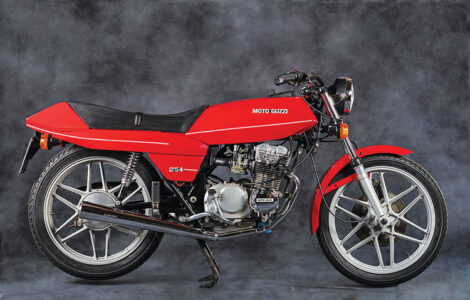
At the top were the 750 and 900cc inline six-cylinder Sei models. But the product line also included the novel Lino Tonti-designed Benelli 250 Quattro (1976-84) and Moto Guzzi 254 (1977-1981). While the two versions shared the same 231cc single overhead cam four-stroke four-cylinder air-cooled engine and five-speed transmission, steel backbone frame with the engine as a stressed member and running gear, the two did vary in styling. That styling included significant use of thermoplastic panel bodywork, which some period reviews characterized as “slab-sided.” Creation of each model was encouraged by the special Italian tax advantages offered for motorcycles of 250cc or less displacement.
In some ways, the effort to lean into clean lines may have gone a little too far. For example, in an effort to unclutter the handlebars, the Moto Guzzi 254 had the speedometer, tachometer, and front brake hydraulic fluid reservoir set down into the top of the fuel tank. While it did provide a sleek appearance, it also resulted in the fuel tank capacity being restricted to only 2.2 U.S. gallons (8.5 liters). With the engine’s fuel economy averaging only about 35mpg when pushed, that put the full-tank range at only about 77 miles (124 kilometers). With the bike’s peak 27 horsepower coming on at 10,500rpm and the red line up at a buzzy 12,000rpm, the sporting rider could easily be tempted to run the little 254 well up in the thirsty range.
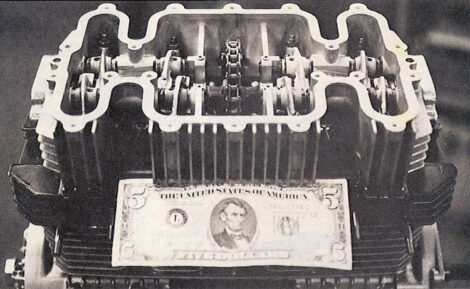
The U.K.’s Motorcycle News editor/writer Brian Tarbox traveled to Italy to do a first ride report on the 254 in 1977 and said that the tiny fuel tank was a problem: “As a result, the U.K. importers decided against bringing it to this country. However, it was a great little bike and I have great memories of riding it through the countryside of Northern Italy.” That was likely a factor against North American importation as well, as examples are very hard to find in the U.S. The little Guzzi is rare anywhere — reportedly, fewer than 1,000 of the Moto Guzzi version were produced.
Kawasaki Mach 1 S1/A/B/C, 1972-1975, KH (Kawasaki Highway) A5/B1-B5) 1976-1980
Kawasaki’s H1 Mach III 500 really fired up interest in the concept of an air-cooled two-stroke triple and what kind of tire-spinning performance it could produce. By extension, the kind of class-leading performance the Mach III delivered might be proportionally produced by smaller versions. At least, that may have been the assumption of buyers considering Kawasaki’s smallest triple, the Mach I S1 250. After all, the little 250 had the same 120° crankshaft that provided three power strokes per crankshaft revolution as the Mach III.
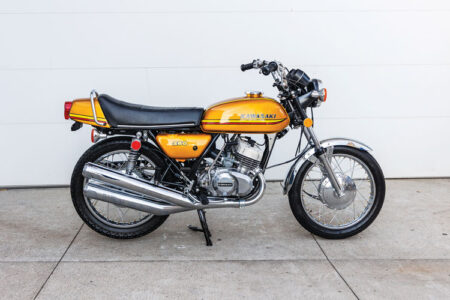
In fact, the state of tune and overall weight of the first-year version were designed to come as close as possible to creating that outcome. For example, the 1972 S1 put out a claimed 30 crankshaft horsepower and had a dry weight of 330lb. In 1973, claimed BHP was down to 28, and by 1977, it had been reduced still further to 26, and dry weight increased to 341lb. Of course, some part of these changes may have been the result of efforts to comply with more stringent tailpipe emissions standards in both Japan and the U.S.
Despite what would seem to be a powerplant with great performance credentials, Classic Motorbikes found the bike’s launch capabilities lacking, saying: “There is no power to be had or used in anger, below 6,000rpm, and even then, things are a little slow in developing, the engine starting to show some interest around the peak of the torque before running out of puff less than a grand later.”
The S1/KH series bikes had a unique aesthetic with their asymmetric exhaust system layout. With two mufflers on the right and one on the left, the look could be quirky, cool, or a non-starter. Still, in many period reviews, the overall appearance of the smallest triple earned praise similar to the initial impressions of the original Mach III. But, after eight years, the look may have become too familiar, and with performance becoming less and less exciting, by 1980, it was the end of the line for the 250 triple.