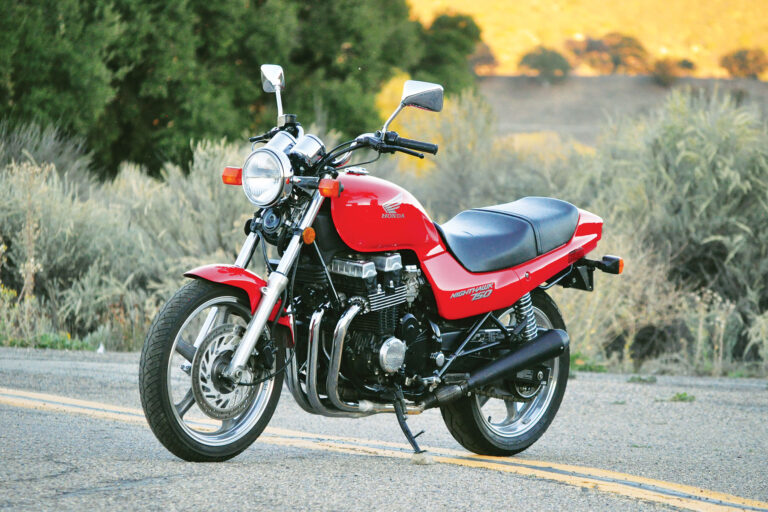
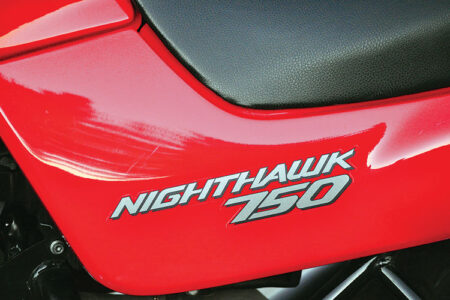
2003 Honda CB750 Nighthawk
- Engine: Air-cooled, DOHC inline four, 747cc, four-valves per cylinder, 67mm x 53mm, 75hp, wet sump lubrication, 9.2:1 compression ratio
- Top Speed: 122mph / Quarter-mile: 109mph, 12.26 seconds (Cycle World)
- Carburetion: Four 34mm Keihin CV carbs
- Electrics: CDI, 12v, three-phrase AC generator, 320 watts
- Transmission: 5-speed, constant mesh
- Clutch: Wet clutch
- Final Drive: Chain
- Frame/wheelbase: Double down tube, mild steel, 56.2in wheelbase
- Suspension: Showa 41mm fork, two non-adjustable coil/over shocks
- Brakes: Single hydraulic disc, single-leading shoe drum
- Tires: front, 110/80 x 19, rear, 140/70 x 17
- Fuel capacity: 4.8gal.
- Oil capacity: 3 quarts
- Weight: 472lb
- Price then/now: $3,998/$3,998
Stop and think about this for a moment: Motorcycles built and sold during the first few days, weeks, months, and years of the 21st century form the vanguard for an all-new gene pool of soon-to-be classic motorcycles. And many of those new-millennium bikes are still on the road today! Dig deeper into this classic-bikes rabbit hole, and, as Alice said during her trip through Wonderland, “things get curiouser and curiouser.”
In short, many of today’s future classics are closing in on the 30-year mark, the accepted criteria for classic status. What’s even more mind-bending, though, is the further down this classic-motorcycle rabbit hole we go, the deeper into the 21st century that we find ourselves. Clearly, this new generation of 21st-century motorcycles serves as the feeding ground for classic bikes in the coming years of this millennium and beyond.
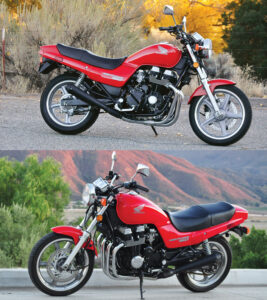
But I’m getting ahead of myself and Father Time, so let’s focus on today, not tomorrow. And today we’re going to look closer at one of the new millennium classic candidates — a bright red 2003 Honda CB750 Nighthawk. At this point things could get even more curiouser, so hold on; this bike is my bike, one that I purchased early last summer; a bike that I dubbed “Read October” — the name “Read” chosen for a little word play with the bike’s paint color because, well, I’m a writer, and writers like to play with words. The Honda’s Read/Red double entendre also phonetically salutes the late author, Tom Clancy, and his all-time great novel, The Hunt for Red October.
My hunt for Read October (the bike) has its origins back in the 20th century, when, as a motorcycle magazine staffer, I failed to invest in and retain at least one street bike from that golden era for my personal use at some point in the future. Simply, back in those days, most of my road riding took place while testing manufacturer-supplied loaner road bikes for various motorcycle magazines; time spent in the saddle was usually time spent testing new-model motorcycles. Life was good, so there really was no need for me to own a bike, although I did possess a few through the years. They were primarily road race bikes, off-road bikes, and a first-year Ninja that I put too few miles on because, like I said, I was busy road testing manufacturers’ test bikes. So, I sold the Ninja, and time marched on until eventually there were fewer and fewer motorcycle magazines conducting new-model road tests. Consequently, I reluctantly relinquished my keys to the “candy store” because the candy was no more. I was left without a ride, so to speak.
But the itch to ride — and write — prevailed, and I ended up contributing articles and feature-bike photography to this and a few other surviving publications. I also bought a clean, low-mileage 2007 Kawasaki Vulcan 900 to ride. The itching stopped, but I soon realized there was something lacking in that Vulcan 900. Mainly, its steering geometry was a little off target, prompting front fork flop, requiring some countersteering when entering turns. I had read all the Vulcan 900 road tests conducted by the remaining magazines, but nobody mentioned fork flop in their reports. I soon realized that those road tests fell short of revealing the bike’s counter-steer shortcoming, not to mention a few items related to service and maintenance. I sold the bike, then began looking for something more suitable and user-friendly. That’s when I recalled a conversation I once had with Jerry Smith, a former staffer with me back in the 1980s at Cycle Guide magazine. Our phone conversation was sometime during the early 2000s, and it focused on his black 1992 Honda Nighthawk. Jerry pointed out the bike’s strong points, foremost, how the Honda offered easy, predictable turn-in for cornering. He also praised its powerful, smooth-running engine, fuel economy that generally resided between 48-50mpg, and more.
But most of all, Jerry praised the bike’s reliability, nay, its sheer bulletproof stamina! That’s when Jerry told me about a pair of long-distance riders from the Iron Butt Association who traversed the long and lonely stretches of Siberia aboard Honda CB750 Nighthawks during the summer of 2004. Iron Butt President Mike Kneebone and long-haul rider and author Bob Higdon rode their 2003 Nighthawks across the newly opened trans-Siberia highway, stretching nearly 5,000 miles from Vladivostok on Russia’s east coast, to the country’s more cosmopolitan western sphere that includes real cities, unlike those in Siberia, that essentially constitutes Mother Russia’s eastern frontier with a sparse population and smaller cities and towns with names like Savintsk, Chita, Cbluche, with motels that, as Higdon described, “you won’t confuse with a Motel 6.” Interestingly, though, Kneebone and Higdon had originally started their trans-Siberian adventure on two adventure-touring bikes, heading east. But before they even reached Moscow, Higdon’s BMW R80GS — as he described — “came apart at the seams.” That prompted them to regroup in Washington state, of all places, where they curiously opted for a pair of identical Honda CB750 Nighthawks, which Higdon described in his article “Slogging Through Siberia” for Rider magazine, as a bike that is “so maintenance free that they oil themselves at night while you’re in the bar knocking back a vodka gimlet.”
By summer 2004, they had regrouped to start from the east at Vladivostok. They were joined by two more experienced Iron Butt members — John Sartorius for his mechanical skills, and Iron Butt Ironman, Steve Attwood, known for his stamina and riding skills. Both were on Adventure Touring bikes, not stock Honda Nighthawks. Higdon described the condition of Russia’s “new highway” as a combination of “Bad dirt, worse pavement, washouts, rocks, gravel, mud, sand, dust, and road works that you really won’t believe.” In short, not your dad’s Interstate. Even so, none of those shortcomings, not to mention extreme temperature swings, horrific winds, and of course the road itself, could inflict enough damage to sideline any of the bikes, although, as the journey unfolded, the Hondas in particular required some weld patching to keep going.
All four bikes and riders survived and finished that brutal ride, proving just how rugged that “new” Honda 750 was, and still is. Furthermore, as you’ll learn, the Nighthawk’s initial retail price remained under $4,000 from its 1991 debut to 2003, its final year on the market. It’s a bike that is so rugged, so reliable, and so affordable that it often defies logic and explanation. Truly, Honda engineers conceived a bike for the ages, one that took advantage of all that Honda’s engineers, stylists, developers, even assembly-line workers had learned since the company was formed back in 1948. In short, the Nighthawk’s quality represents more a matter of selective engineering rather than expensive and extensive R&D. Here’s how it came to be:
The Nighthawk takes flight
Honda Motors conceived the Nighthawk during the late 1980s, assigning Mr. Hara as chief engineer for the project. On the surface, the venture appeared to be a way for Honda Motors to regain the glory the company had enjoyed with the original CB750 back in 1969. That bike played a leading role in Honda’s dominance of the worldwide motorcycle market, starting in 1969, soon to be joined by Yamaha, Suzuki, and Kawasaki, and all with their own in-line four-cylinder models. By the mid-’70s, Cycle magazine coined the phrase UJM, short for Universal Japanese Motorcycle, which might have been another word for bikes powered by inline-four-cylinder engines, sitting transverse in the frame.
But another UJM model wasn’t what Honda aimed for with the CB750 Nighthawk. Rather, Honda’s goal was to create a bike that, in many ways, would surpass the UJM factor for the 1990s (and beyond). It was a bike that not only performed beyond the original 1969 CB750. It was superior in every aspect, while boasting a sticker price under $4,000, well below most other bikes that offered comparable rides, features, and performance.
To achieve that goal, Honda embarked on an extensive fact-finding mission, interviewing and surveying countless customers and enthusiasts worldwide. As Cycle World reported in their January 1991 review, Honda undertook “the largest body of marketing information ever compiled for one new model.” It helped, too, that Honda had previously offered the CB700SC during the early 1980s. However, that model had a driveshaft, not chain drive, and, interestingly, hydraulic valves. In addition, the CB700SC was essentially conceived as a “tariff fighter,” commissioned to circumvent the 1984 tax on Japanese bikes with engines displacing more than 700cc.
Armed with their extensive marketing data, the new non-UJM CB750 was gaining traction towards its 1990 target date. It helped, too, that Honda already had a domestic and International (Europe and Australia, etc.) model that pretty much served as a place to begin tacking on
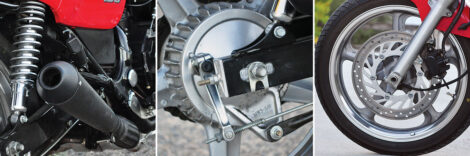
various other “seasoned” components that Honda engineers freely helped themselves to for the Nighthawk project. For instance, the CB750’s front fork was based on a similar design for the CBR600F2’s hydraulic performance fork; a minor redesign helped center the fork’s metering rod for more precise and consistent damping. In addition, Honda’s customer surveys revealed that many price-conscious customers preferred twin rear shock absorbers that were easier to change and more affordable compared to most mono-shocks that were gaining popularity at the time.
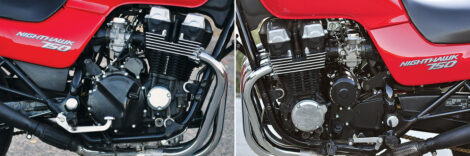
Upgrades were found in the double-overhead camshaft engine, too. That was, perhaps, the most significant piece of hardware that Honda’s engineers plucked out of parts bins filled with existing components originally developed for previous models. Those included Japan’s domestic market CBX750, a favorite in Japan. By 1990, the new U.S.-bound CB750 Nighthawk’s 747cc engine boasted four valves per cylinder, reshaped intake and exhaust port tracts to enhance low- and mid-range performance, and that worked as efficiently as possible with the Nighthawk’s mild 9.3:1 compression ratio. The Hawk’s camshafts sported reconfigured cam lobes, too, again for a smoother, more user-friendly, linear power curve. For comparison, the original U.S.-market CB700SC had a screaming redline of 10,700rpm; the new CB750 engine was milder at 8,300rpm. That allowed for more mid-range torque, resulting in a “trouble-free” ride, mainly because throttle response was more predictable thanks to the wider power band for a more relaxing ride on the road. The gaggle of refinements easily appeases the four 34mm Keihin constant velocity carburetors to deliver their smooth and steady power. As a bonus, the CBX-based engine brought self-adjusting hydraulic valve lifters to the game (plus a cam chain adjuster), which means no periodic valve adjustments as required with the original CB750 Four, and most other motorcycles.
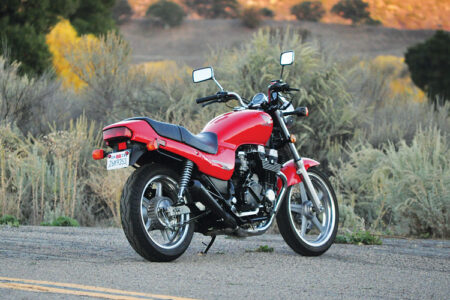
Refugee parts continued migrating from various parts bins, too, but for the most part, the CB750 Nighthawk was its own model, planned and built for a specific yet broad-range market. By the time the bike was ready for its debut in 1991, it could — and did — show off its contoured and padded seat, which many magazine editors agreed was comfortable, spacious, and stylish, blending in with the Hawk’s sculpted fuel tank and its 4.9-gallon capacity.
The bike’s overall performance was impressive, too. Even its single hydraulic disc front brake (by 1991, most bikes used double-discs up front) produced smooth, progressive stopping power, although the rear single leading-shoe drum was marginal by comparison. In short, paint, polish, and performance have been typical Honda qualities, and the CB750 Nighthawk was no exception.
The Nighthawk’s suggested retail price for 1991
Was… drum roll, please… $3,998! Below Honda’s price target! Clearly, Mr. Hara and his crew were right on target in every aspect. The bike was affordable, spunky in performance, yet docile so that anybody could straddle the saddle with confidence. And for the traditionalists among us, there was no radiator and electric fan to contend with, no hard-to-reach single shock absorber to adjust, no seriously complex electrics to babysit.
Will the Honda Nighthawk go down as a landmark model in Honda’s family? Probably not, but for Nighthawk owners, our bikes behave with the obedience of a well-trained Labrador retriever. Hmm, maybe I should have nicknamed my bike Big Red or Hawkeye, or… nah. MC
Hunt for Read October
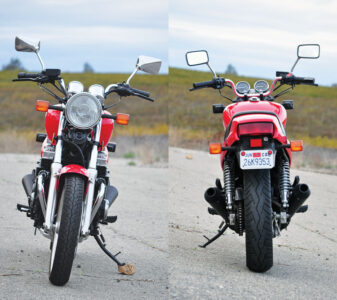
After reading magazine road tests of the Nighthawk and quizzing my friend Jerry Smith about his 1994 model (see main text), I took my search to the next level. I called my vintage Honda guru and friend Bill Silver (a.k.a., Mr. Honda) to get his opinion. He echoed what Jerry told me. Ditto for what the magazine reports stated. Shortly after Bill and I talked, he called me back, reporting there was a Nighthawk for sale near him. I contacted the owner, and the bike sounded promising. It was a survivor, and it was only about 50 miles from my home in Temecula, California, so I wasted no time. I drove out to see for myself. With the exception of its black aftermarket mufflers, plus a few other non-OE parts such as hand levers, etc., the bike appeared stock. The Honda was surprisingly fresh and clean.
The owner, Steve Gussa, had originally found and bought the bike in Las Vegas, Nevada. But shortly after his purchase, and by the time he reached his home in La Mesa, California, Steve realized that his ailing neck and back muscles were starting to wave the checkered flag. “I realized that I shouldn’t be riding anymore,” he reluctantly told me. No doubt, life and its physical annoyances have a way of creeping up on all of us. Steve was today’s target. As the saying goes, “one man’s loss is another man’s gain,” and the moment I first saw Steve’s Nighthawk, I realized it was too clean to pass up. So, we struck a deal, shook hands, and then, and with due respect to Arnold Schwarzenegger, I repeated his famous line in the movie The Terminator — I told Steve, “I’ll be back!” A week later, my brother and I fetched the bike and brought it home.
Steve had previously commissioned the crew at Poway Motorcycle to service the entire drivetrain, making sure that all was fresh and new, from new air filters to sparkling new spark plugs, plus rebuilt and synchronized Keihin CV carbs, and plenty more. When the service was completed, Bill and Bud spooned fresh Bridgestone BT-series Battlaxx rubber onto the front and rear cast aluminum wheels. When I arrived at Steve’s to seal the deal, the bike was easily ready for its close-ups… and for me.
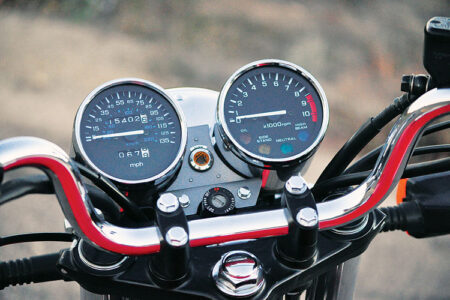
Now that the bike is mine, my older son frequently joins me with his late-model Harley Dyna Street Bob (!) for day rides throughout the winding and rhythmic roads in the Temecula area. The bike is a pleasure to ride, and I’ve taken it to a couple of events, among them the Vintage Japanese Motorcycle Club’s 13th Annual West Coast Rally at Big Bear Lake. My 0-three Nighthawk’s odometer showed 13,912 original miles at the time of my purchase this past summer. By the time you read this, I’m guessing those numbers could roll over to somewhere between 17,000-19,000 miles.
But most of all, Read October is fun to ride. I’ve road tested plenty of landmark motorcycles, but, curiously, whenever I set out on the Nighthawk, I experience the same eager, stimulating sensation that gripped me when I learned to ride my first bike, a 1965 Honda Super 90, and, later, my 1967 Super Hawk. The Nighthawk goes wherever I point it, its eager DOHC engine revving freely and willingly, chased only by a hint of vibration throughout the speed range. As for those black aftermarket mufflers? Well, I got used to them, and I actually enjoy their baritone burble when tracking the backroads where I can blip the throttle on downshifts without drama and then race to redline where the decibel factor vaporizes silently into the still air.