From the end of the 1960s and through the 1970s, motorcycle competition for buyers’ attention boiled down to one key factor: power. At first, the horsepower race involved engine designs with more cylinders, starting with the Honda CB750 Four and Kawasaki Mach III 500 triple, and many others, and ranging up to six-cylinder bikes like the Honda CBX, Benelli Sei, and Kawasaki KZ 1300.
By the late ’70s, the manufacturers concluded that adding still more cylinders would only add more weight for marginal gains in performance with offsetting disadvantages in more cumbersome handling, poorer operating economy, and higher purchase price. Manufacturers realized the next front in the power war was improving operational technology, sophistication, and reliability.
In addition to advancements that enhanced reliability, such as electronic ignition, the next frontier would involve improving intake and exhaust efficiency. This led to efforts to address multiple objectives, including compliance with tailpipe exhaust emission limits, noise abatement, and fuel economy, all while increasing horsepower and torque — preferably without designing an all-new engine, as well. Forced induction of the fuel/air mixture using supercharging or turbocharging promised major increases in horsepower without adding cylinders, increasing displacement, or adding substantial weight.
This approach was not really new; in 1937, BMW rolled out its supercharged 500cc Type 255 Kompressor race bikes, one of which carried factory BMW rider, Georg Meier, to victory in the Isle of Man Senior TT in 1939. Another factory BMW rider, Ernst Henne, rode a Kompressor to an FIM world land speed record at 173.68mph in 1937. Gilera and DKW also utilized superchargers on race bikes in the 1930s.
With BMW having proven the capability of supercharging in motorcycle applications, you may wonder why turbocharging, which used the pressure created by exhaust gases, was the technology of choice instead.
Author and turbocharged motorcycle expert, Randall Washington (aka Randakk), explains it in his book, Boosted! A Tribute to the Honda CX500 and CX650 Turbos, (available on the MCC Store), based on Honda’s CX500TC development experience: “Honda initially thought an engine-driven supercharger was the logical path, but blowers proved to be quite vexing for various reasons. The main challenges were packaging issues, parasitic efficiency losses on a small V-twin, and difficult carburetion. After disappointing R&D testing, Honda switched to exhaust-driven turbochargers. Turbos presented their own daunting engineering problems, but Honda found a way to overcome them.” Other manufacturers evidently encountered the same challenges and came to the same conclusion.
Technically, the first turbocharged street bike of the era was the 1978 Kawasaki Z1R-TC. But, in fact, the Z1R-TC was not built in the Kawasaki factory and did not leave Japan turbo-equipped.
The Z1R-TC was created in the U.S. with bolt-on equipment by Turbo Cycle, a company that was the brainchild of a former Kawasaki executive, Alan Masek. His plan was to fit Kawasaki Z1R bikes with American Turbo Pak gear, then sell them back into the market to existing Kawasaki dealers. This is somewhat similar to the way the first Harley-Davidson Tri Glides were brought out. From 2008 to 2012, the Tri Glide was a Harley-Davidson factory assembly of an aftermarket-developed conversion kit for the two-wheel Ultra Classic.
So, since it was not produced with turbocharging by Kawasaki, it really wasn’t the first turbocharged production motorcycle built as a turbocharged model. Nevertheless, we mention it here as a harbinger of things to come from Japanese manufacturers.
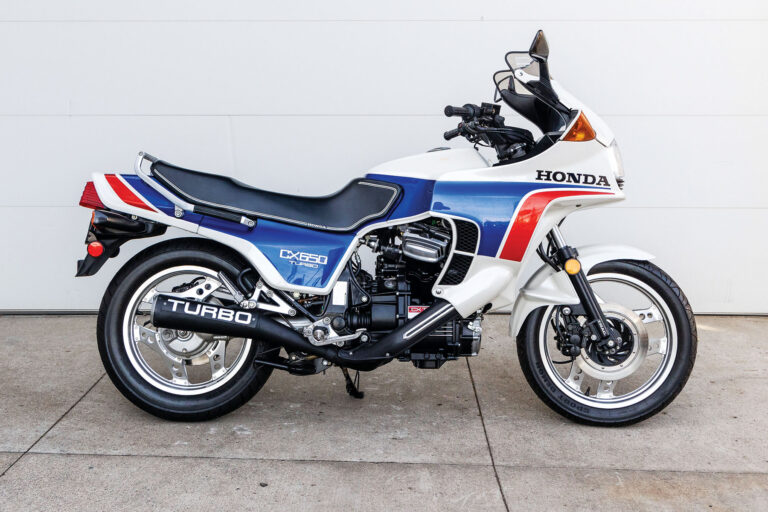
Honda was the first manufacturer out of the gate in the turbo-bike business, having introduced its first turbocharged production motorcycle in 1982. That was the CX500TC, which was replaced in the lineup in 1983 by the CX650T. By 1984, Honda was out of the turbocharged motorcycle business. Washington says actual shipments to North America of the CX650 Turbo totaled only about 1,126 units, of which about 600 were donated to educational institutions, with the caveat that these “school bikes” should never be sold or registered for use on the road.
Washington covers these bikes in detail in his book, as well as the other notable mass-produced turbo bikes. He was also kind enough to be a great technical resource for the development of this article.
Yamaha was close on Honda’s heels, entering the turbo market only a few months later in 1982 with its XJ650L Seca model, which lasted into the 1983 model year. Washington indicates a total of about 8,000 units were built over the two-year production run.
Suzuki rolled out its entry into the turbocharged fray in 1983 with the 673cc XN85 Four. Only 1,153 were manufactured, so this is something of a rare machine — probably even rarer than that number suggests. Washington’s book reveals that the actual number is only 1,053. Moreover, the number sold out of that quantity was only 600, 305 of which were shipped to the U.S., and of that, only 150 actually were sold. Only 20 were sold in Canada. The bikes that were not sold were ultimately returned to Japan, where they were destroyed. The XN85 proved to be a one-year technological wonder.
Kawasaki entered the turbo bike market in 1983 with its ZX750-E1/2 (or GPz 750), which stayed in the line-up until 1985, making it the longest-lasting in a manufacturer’s product line of turbo bikes. Washington estimates total production at about 3,500 units.
1982 Honda CX500TC/1983 CX650T
Honda had its unique CX500 in the product line going back to 1978 as a normally aspirated, 80-degree in-line, liquid-cooled, pushrod V-twin with four valves per cylinder. At the time, it was a rather odd combination of features. Unspoken at the time was that the design anticipated potential addition of some form of forced induction.
Washington reveals that as early as September 1980, Honda teased the concept of a street-going turbo, briefly displaying an early prototype of the CX500 Turbo at the Honda Dealer’s Convention. Only days later, the prototype was rolled out at the International Motorcycle Show in Cologne, Germany, and Honda had thrown down the gauntlet; the race was on to be the first manufacturer to get turbocharged motorcycles on the showroom floor.
Before that could happen, there was a set of complex technical problems that had to be solved. Early on, testing proved use of carburetors with superchargers as well as turbochargers was not satisfactory. That led Honda to a major design change: forget carburetors and supercharging and go with industry-leading computerized electronic fuel injection paired with what was then the world’s smallest turbocharger.
That decision introduced a new set of design challenges, which Washington details in his book. Among them:
- Finalizing the volume of the surge tank, and developing the specifications of the exhaust turbine, compressor unit, and related housings.
- Developing placement and specifications of the resonance chamber.
- Sustaining consistent head pressure above the throttle plates to improve throttle response at low RPM.
- Preventing pressure decreases at high RPM.
- Reducing stagnation in the intake tract and reducing lag at all engine speeds.
- Minimizing the uneven cylinder pulses caused by the irregular firing of the 80-degree V-twin.
Eleven sensors feed data to the EFI control module, including a pair of piston position sensors and a tilt sensor that shuts off the fuel flow in the event the bike is laid down.
Even the bike’s fairing and bodywork were the subject of intensive development, but not just for the usual reasons of aesthetics and aerodynamics. Since the turbocharger and adjacent exhaust components literally reach red-hot temperatures, the bodywork was carefully designed to prevent any fuel spillage from reaching those parts during refueling.
Exhaustive as the design and development were for the CX500 Turbo, Washington describes a number of areas for improvement that Honda addressed before the release of the CX650 Turbo or that can be addressed with modern upgrades.
Among those were the bike’s total weight and high center of gravity, potential for turbo “lag,” potential for over-revving the engine, which led to addition of a rev limiter on the 650, certain high-priority maintenance points such as the speed sensors, manifold absolute pressure (MAP) sensor, air valve failure (over time), OEM diode-style voltage regulator, which can be addressed with a modern upgrade to a MOSFET replacement. Other areas include handling improvements, such as modern upgrades to front and rear suspension units, and the 2-inch increase in handlebar width on the CX650 over the CX500 unit.
1982 Yamaha XJ650L Seca Turbo
While Randall Washington’s book primarily focuses on the Honda CX Turbos, it also delves into the primary competition. Yamaha managed to nearly steal Honda’s thunder, bringing its XJ650L Seca Turbo to dealer showrooms only a few months after the CX500T came out.
The Seca Turbo was distinctive among the turbo bikes of the day in that Yamaha opted to sort out the problems associated with making turbocharging work with carburetors instead of switching to computerized electronic fuel injection. Instead, Yamaha utilized innovative approaches such as a slick reed valve in the intake tract, essentially bypassing the turbocharger at low RPMs to prevent off-boost performance problems.
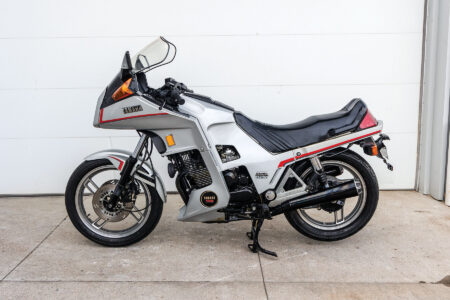
Yamaha opted to go with four Mikuni 30mm CV carburetors and, based on period road tests, achieved surprisingly good results.
For example, in its June 1982 road test, Cycle World said, “The only difficulty in riding the Turbo fast is adjusting to the use of boost coming off corners. But once you become accustomed to keeping the revs up and using the turbo when you want it, the application of power becomes sheer entertainment, and it’s almost a letdown to climb back on a normally carbureted 650 with normal, linear acceleration. Use of the turbocharger, like other thrills, is addictive.”
Another unusual design approach placed the 39mm Mitsubishi turbocharger behind and below the engine, just in front of the rear tire. This location mitigates the high center of gravity problem presented by the high turbo gear location in the Honda CX Turbos. The Yamaha is also one of only two of the turbo bikes of the period that came with low-maintenance shaft drive like the Honda CX models.
Clever adaptations notwithstanding, Washington summed up his view of the Yamaha XJ saying, “The Yamaha is an interesting effort, but not as refined or sophisticated as the Honda Turbos.”
1983 Suzuki XN85 Turbo
Suzuki didn’t enter the turbo market until 1983, but not in a rushed reaction to the Honda and Yamaha turbos.
Suzuki had its own turbo in development for several years and stayed the course in its development plan, bringing its XN85 Turbo into the product line when it was judged to be ready for prime time.
The bike’s moniker refers to the claimed 85bhp the 673cc transverse, DOHC air/oil cooled, inline four-cylinder engine was claimed to produce.
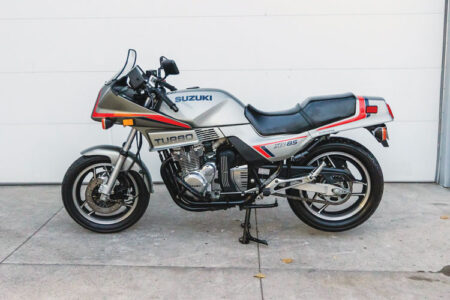
The XN had some unusual and not necessarily favorable design approaches. For example, the turbocharger sat above the transmission behind the air/oil-cooled cylinders, cramped just ahead of the outgoing portions of the exhaust system. This arrangement increased the heat load the turbo would have to endure, potentially adversely affecting service life.
The seating position was biased toward the “sport” aspect of “sport touring.” The bars were relatively low and far forward, pulling the average rider into something of a speed tuck; the footpegs were high and somewhat back. Cycle World, in its April 1983 road test, said, “Mostly the Suzuki has a riding position that is extreme. You either love or hate it, but you don’t get on this motorcycle without becoming immediately aware of its purpose in life. That is, to go fast. Maybe not quickly, but fast.”
1983 Kawasaki ZX750 E1/2 (or GPz 750)
Kawasaki didn’t unleash its ZX750E1 until late 1983 and into 1984, and the E2 model in 1985, giving it time to sort the model’s features and specifications carefully in the context of the plusses and minuses revealed by the competition’s earlier efforts.
To deal with the common problem of “turbo lag,” Kawasaki kept the distance from the exhaust valves to the drive vanes of the turbocharger as short as possible, positioning the turbo just below the outlet point of the exhaust headers in front of the engine crankcase.
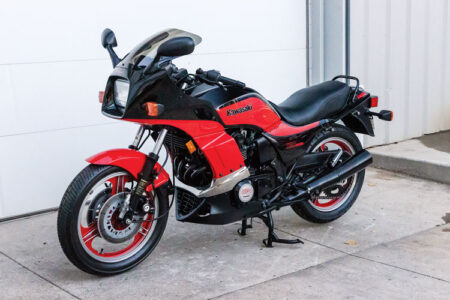
With the largest displacement of the turbo crop, one would expect the Kawasaki to deliver the highest horsepower output and impressive performance, which period road tests confirmed. Cycle World magazine stated, in its March 1984 review, “No normally aspirated 750 — and few normally aspirated anythings — can best the Kawasaki’s turbo-pressurized acceleration, its headlong rush, its willingness to leap from 60 to 120mph in what seems like less time than it takes to read this line.”
As was the case with the Suzuki XN85, the ergonomics of the Kawasaki proved to be an acquired taste, with some reviewers of the day finding the seating position either too “aggressive” or “cramped.”
Overall, the Kawasaki earned high praise in the motorcycle press of the day, with Cycle magazine testers concluding in November 1983, “In sum, Kawasaki’s ZX750 is the fastest, quickest, most stable, and most sporting turbocharged motorcycle available. Some riders will prefer the softer, more compliant suspension of other turbos and the upright ergonomics of the CX650T, for example. Fundamentally, however, the Kawasaki’s central appeal as a turbo lies in the quality of its power, for which simple executions and refinement rather than dazzling technical complexity seem responsible. The ZX’s power is closer to that of normally aspirated, big-displacement motorcycles than to any of its heavy-breathing turbo brethren. In our view, that’s the way turbocharged motorcycles should be.”
Despite this heady praise, even the Kawasaki ZX750 Turbo became a part of motorcycling’s past-tense by 1985 — along with all the others.