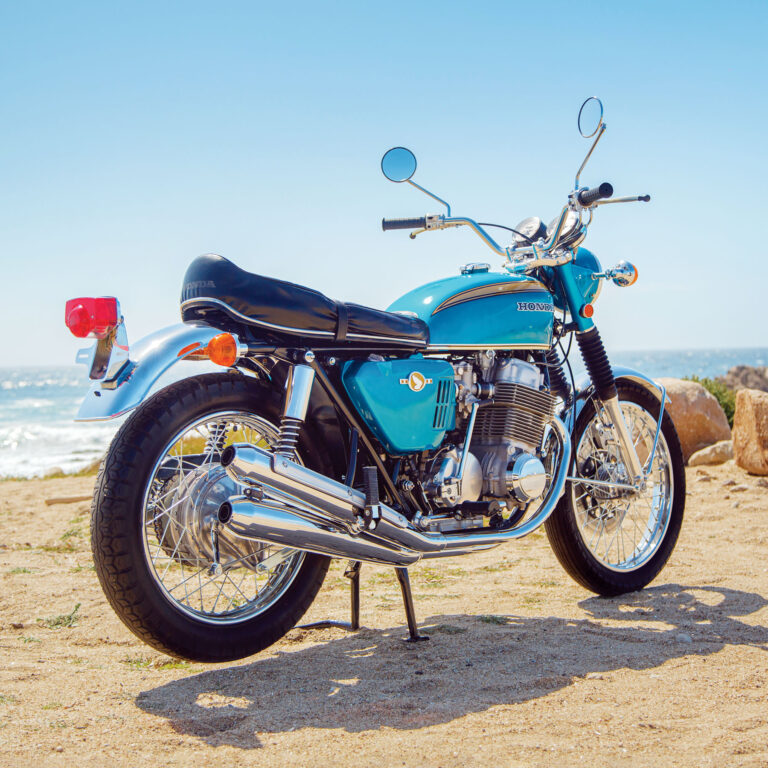
1968 Honda CB750 Prototype
- Engine: 736cc SOHC, 4-stroke, air-cooled, 4-cylinder, 61 x 63 mm bore/stroke, 9:1 compression ratio, 67hp @ 8,000rpm
- Top Speed: 125mph
- Carburetion: 4 one-off, sand cast 28mm Keihin
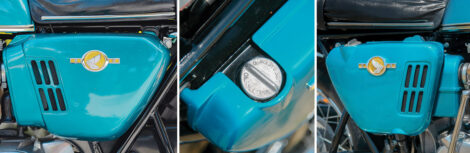
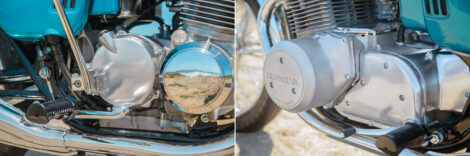
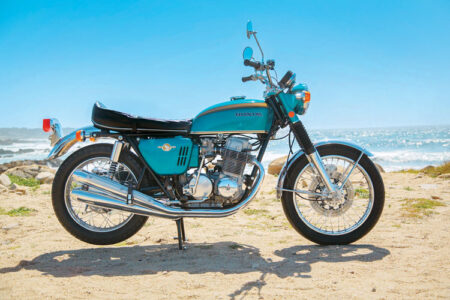
Four days before rolling his freshly restored candy blue-green Prototype Honda CB750 onto the manicured lawns of The Quail Motorcycle Gathering in 2024, Vic World had been anxiously awaiting the delivery of a set of one-off, lost wax-cast brass side cover emblems. Unique to this machine, the emblems were reproduced by a San Francisco-based jeweler working solely from photographs. Then, they were polished, chrome plated, and finally hand-painted in gold metallic and white.
These left and right winged Honda emblems are unique to this bike — no other Honda has ever had any the same — and were the final touches on a project that began some 30 years prior to The Quail. They are just one small, yet highly significant example of the efforts Vic took to bring this one-of-one machine back to life. In recognition of his labor, time, and the rarity of the motorcycle, the Prototype CB750 deservedly earned not only First Place Japanese, but the highest honor, Best of Show at The Quail Motorcycle Gathering, 2024.
Mr. CB750
It’s a tale that started when Vic’s phone rang, and that’s not uncommon as he’s almost always been searching for early Honda CB750s. In the mid-1990s, he answered a call that led to this machine, in pieces, in a Los Angeles-area backyard. After talking to the seller and receiving a set of Polaroid snapshots in the mail, Vic realized he was looking at the remains of the one and only Prototype Honda CB750 that, in the fall of 1968, landed stateside. To say he’d uncovered a rare and important motorcycle is an understatement.
But it was all in a day’s work for Vic, who eats, sleeps, and breathes early sandcast CB750s. His fascination dates back to when he was 17 and he had his first exposure to motorcycles, and Hondas in particular. “An older friend spent a day teaching me how to ride a Honda 175 Scrambler, and I was immediately hooked,” Vic says, “and I bought that bike from him.”
Not long after, Vic was offered a ride on a friend’s first-year CB750. “It was probably a sandcast, but we didn’t know what those were back then,” Vic explains. “He let me borrow his bike once when mine was in the shop, and I’ll never forget, at 17, climbing on top of that 750 — it felt like sitting on top of a locomotive. First gear just kept on pulling and pulling.”
Vic quickly upgraded from the 175 Scrambler to a brand-new Honda 450 Scrambler with money earned assembling and setting up 3-speed and 10-speed Raleigh and Gitane 10-speed bicycles in a San Francisco bike shop. “I couldn’t afford to buy a 750, and I think they were flying off the shelf at the time,” he recalls. Tinkering with the 450, Vic modified it, turning it into a street racer that he took with him when he moved east in the mid-1970s. The first winter he was there, however, he had to buy a car due to the shortened riding season.
“I found myself in Cincinnati having expanded my business,” Vic explains. “I was sitting in my car at a red light at a big intersection, and across from me, a perfect example of a candy blue-green ’69 or ’70 CB750 went right across me, and I stared at that thing. I said, ‘Oh, my God!’ and it all just came back to me, and I immediately went looking for one.”
He found a fine example of a candy blue-green CB750, bought it, and rode it everywhere. As he researched CB750s, Vic learned about the early sandcast models and how rare they were. “I decided to start looking for them,” he says, “not only from a collection standpoint, but further in the back of my mind I thought one day they’d command a premium and so I started advertising for them in magazines like Old Bike Journal and Walneck’s Cycle Trader. In the mid-to-late 1980s, almost no one knew what a sandcast was, because to most people, it was just an old CB750.”
Vic located and purchased several sandcast Hondas, but soon realized he’d also need parts to restore them. Working by mail, phone, and classified ads, he scoured the U.S. and Canada for dealer inventories. He knew what he was looking for, and he eventually became known as Mr. CB750, establishing a business dealing solely with the restoration and sale of sandcast 750s, operating as World Motorcycles. That’s why his telephone would often ring, and that’s what led him to the Prototype.
Honda sends the Prototype
In October 1968, a never-before-seen Honda 4-cylinder 750 arrived in the U.S. According to Vic, whose website is dedicated to the bike, there were three main reasons this occurred. As he says, the first was, “To excite the U.S. and world market.” Second, “To conduct a two day test in the Nevada desert (no speed limit in Nevada then!).” And third, “For one magazine (Cycle Guide) to do an in-depth exposé. Theirs was the only magazine exposure of this rare motorcycle.”
The Cycle Guide story ran in the March 1969 issue with only a few black and white photographs. Meanwhile, in January of ’69, Honda had already moved on from the Prototype CB750 and sent to the States four pre-production machines. These, Vic says, were completely different from the Prototype, but rather were very close to what dealers and the public would expect to see when full production models shipped just two short months later, in March of 1969.
“Honda must have asked Cycle Guide to hold back from printing their story,” Vic says, “and the actual article is just a very simple piece about what, to them, was a brand-new motorcycle — they didn’t know it was a Prototype model.”
As it was the only Prototype CB750 to ever reach America, Vic negotiated a deal to buy it and hauled what remained of it back to his San Bruno, California, headquarters. While many of its components were extant, there were several pieces that he knew would be difficult to replicate, including alternator, transmission and clutch covers, and the side cover badges.
“It was always in the back of mind, and I knew this one was going to take a lot of work,” he says of contemplating the project. “I knew I was going to have to make patterns for the covers that were missing — basically by taking measurements and by looking at the few photographs of this bike that there were in the Cycle Guide magazine. That’s very daunting, because there’s more to sand casting engine covers than just sand casting engine covers. Everything must fit, and it has to look right as well.”
Significant differences
When asked what the differences are between the Prototype and what Vic refers to as “street bikes,” or production Honda CB750s that were sold off showroom floors, he laughs. “Basically, every piece except for the rubber handgrips. They were testing their own waters, and the best way I can describe it is like a baker making a cake from scratch and experimenting with the recipe. Is this enough sugar? Is this too much flour?”
What really sets the Prototype apart are the engine dimensions. It’s very compact, and when compared to a street bike powerplant, much narrower. Vic suggests this is because Honda was concerned about rider comfort, as it was the company’s first, “4-cylinder wide, transverse-mounted engine going to market for everyday use. It was really their big bang.”
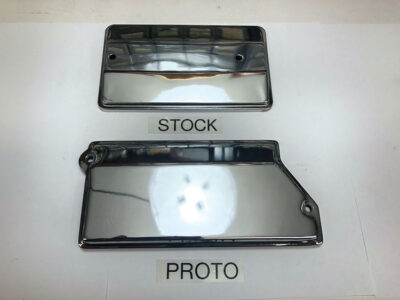
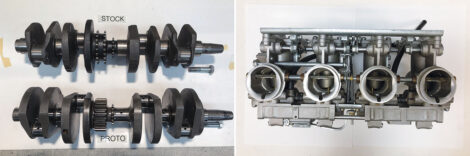
These dimensional differences are readily noticeable when examining the internal engine components. Knowing that the engine wouldn’t be apart again any time soon after he finished the restoration, Vic documented Honda’s “recipe” changes with side-by-side images of the Prototype and street bike components.
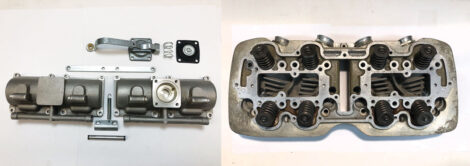
“The cylinder spacing is closer together, and the cylinder block is narrower,” Vic says. “And, the head is completely different. It is the only 750 head that has a big wide-open space under the cam towers. The cam towers, and the rockers are also completely different. The crankshaft is billet, with smaller journals, and it’s one-of-one, of course.” Meanwhile, the transmission mainshaft and countershaft assemblies are narrower, as are all the gears.
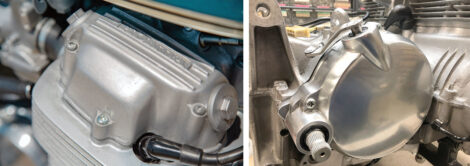
Uniquely, the Prototype valve cover has the word “Honda” cast into it, rather than “OHC 750” as on the street bikes. Additionally, there are two threaded bosses in the Prototype camshaft cover that Vic says Honda cast in, thinking to use them to bolt the top end of the engine to the frame to stabilize it. “But they realized they didn’t need to, and those bosses are never seen on any other cover.”
Honda also experimented with the starter motor well, which is cast into the back of the upper engine case, and the stamped-steel chrome panel that covers the starter. Instead of it simply being rectangular, as on street bikes, it has an added “ear,” with the cover shaped to match. Also, there is a hole through the upper and lower engine cases for all the wiring, including the starter motor wire. That does not exist on any other CB750 motor.
The Prototype’s connecting rods are rather slender, with much smaller plain bearings for the rods and crankshaft (30mm diameter crank main and rod journals versus 36mm for the production, street bike units). “I think they realized this was their first venture into a plain bearing engine design, so typical of Honda’s highly detailed engineering, they went with bigger and much beefier rods and bearings to start street bike production.”
Significantly, the carburetors are one-off sand cast components made by Keihin and are unique to the Prototype, with one shared float bowl between two carbs, instead of individual bowls for each carb. “These are the most bizarre carbs I’ve ever seen in my life,” Vic says. “If you want to get to a float, you have to take off all the carbs, turn them over, and there are 35 screws to take out just to get to one float. This was trial and error, and obviously they realized the carbs would have to be made differently for the street bikes.” On production 750s, there is one throttle cable per carb, but on the Prototype, there’s a push-pull linkage arrangement with two cables that Vic says is also rather complicated, and somewhat similar in design to the K1 through K5 CB750s sold from 1971 to 1976.
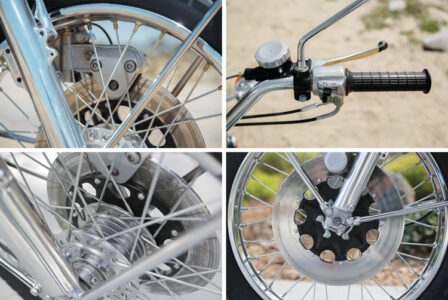
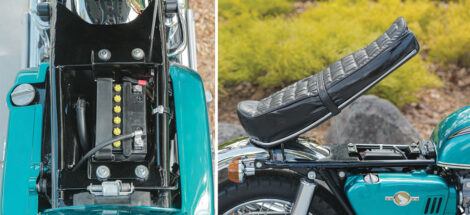
Beyond the engine, it’s the only CB750 to feature a saddle hinged at the rear, rather than the side. Parts from other models were used, too. For example, the bottom triple clamp was sourced from a 450 Scrambler with a longer stem added, and featured a welded, drilled, and tapped tab to locate the front disc brake line junction. The top clamp is polished aluminum, while the disc brake parts themselves are all one-off handmade sand cast pieces that differ significantly from the street bike components.
Also from a 450 are the fork ears, as they include the wire clamps to hold the speedometer and tachometer cables. Those don’t appear on a production 750. He also points to the airbox side covers. Asymmetric, the right side doesn’t feature the molded leading edge of the left side, which covers almost the entire airbox.
“The Prototype really only had to be something that was demonstrated and to show, and the 450 parts existed and were accessible,” Vic says of the parts-bin engineering, which helped put the Prototype together, “These were easily used parts to get them to where they needed to be at that point. Everything was rush, rush, rush to get this model out. Honda was under a lot of pressure and the industry knew other manufacturers were going to come out with big bikes, because word just gets around.”
Sand cast vs die cast
The Prototype and the first 7,414 CB750s were all built featuring sand cast engines. Vic says, “Because they had so much sand casting experience with all of their GP racing bikes, Honda was best off producing the engines that way, it was easier and much less expensive than making up die cast tooling just to roll the dice. They wanted to see how it would go, especially in America, as that was their main market. A few engineers at Honda couldn’t comprehend a motorcycle selling for $1,300 when their N600 car cost the same amount to the public. But, when the CB750 hit the market, it sold like hot cakes.”
As Vic says, making a part using the sand cast method is quicker, easier, and cheaper. In this process, a “pattern” of the desired shape is made of wood and pressed into sand to compact it and create a mold. To cast features such as fins or other details, “cores” made of sand and a glue-like binding material are used. Molten metal is then poured into the mold, cooled, and removed. If cores are present, these need to be chipped away while any loose sand is dusted off before final machining for contact surfaces and threaded fasteners.
Die casting, on the other hand, requires a steel mold instead of a sand mold. Creating the metal mold is time consuming, and up-front costs are expensive, as specialized machinery is required to inject molten metal, such as aluminum for an engine case, under high pressure into the mold. Once made, however, the steel dies and tooling can be used repeatedly to produce smooth, uniform, and very consistent components. When Honda realized they had a winner on their hands with the CB750, the decision to invest in die cast technology became much simpler.
Dedication to the machine
While Vic acquired the Prototype in the mid-1990s, he started picking away at work on the project around 2002. He collaborated with many experts to pull it off. For example, Vic had one of the less complicated engine covers made first by having a wooden pattern carved by a craftsman in Europe before it was cast.
Later, with the advent of computer aided programming, he had the engine cases scanned to ascertain the correct position of bolt holes in the remaining engine covers. With a digital file of the hole locations, a friend working with CAD/CAM developed a digital pattern for each cover. These were then sent to a rapid prototyping company to create 3D printed plastic parts, which were sent to Vic to evaluate shape and fit. After making any adjustments, patterns could be made to pour aluminum via sand casting.
“I think I waited about a year for just a couple of covers because the guy I’d found to cast them was really busy,” Vic says. “I didn’t want to bug him, but I’d call every couple of months and ask, ‘How’re we looking?'”
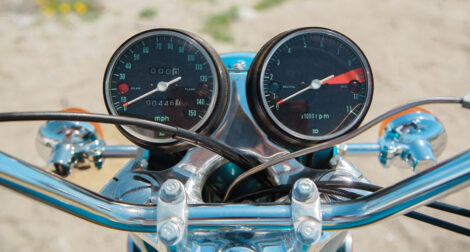
The gauges are unique to the Prototype, with the indicator lights for beam, flash, neutral, and oil at the 9 o’clock and 3 o’clock positions. “These are the only 750 gauges like that. On every other 750, those indicator lights are at 7 o’clock and 5 o’clock,” Vic says. “The faces on these instruments were in really rough shape, but I found a guy who does silk screening in the Netherlands. Working from one of the black and white Cycle Guide photographs, he produced those new faces, and that was another four months.”
Other pieces only required cleaning up for use, such as the fork legs, brake caliper, disc, and hubs. Spokes were treated to fresh zinc plating. Vic worked to ensure the candy blue-green paint is “exactly the correct color.” In photographs, the paint appears to be blue, but Vic says, “The candy blue-green paint really doesn’t photograph well, but it’s the right color.”
Does it run? Indeed, it does. Vic test fired the Prototype two or three weeks prior to The Quail 2024 while waiting for the side cover emblems. “Everything I build has to be running,” he explains. “It ran well, but I discovered the tach cable was sticking. That cable is the same as a street bike, so there you go, there is another piece the same, and I had one to replace it. After it was installed, the tach calmed down.”
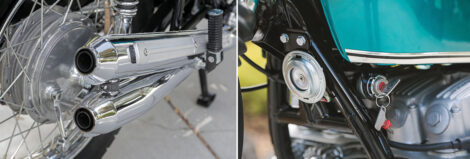
Vic always likes to test ride a bike to ensure it shifts into all gears and operates as it should. “I typically test ride them for about a mile, and with this one, I thought about it. But, I also thought, what if something does happen? I think I’ll just run it in the shop, and I’m not going to run it often.”
Locating something as rare as the Prototype Honda CB750, Vic says, “Is kind of like finding the Mona Lisa, had it ever been missing. It was very exciting to find it, but at the same time, it was daunting. But I had a purpose and couldn’t stop, kind of like a long-distance runner.”
Daunting, but well worth the effort. “Winning Best of Show at The Quail really surprised me,” he says. “I consider myself blessed at how many early and rare sandcast Hondas I’ve found and have been able to restore, and especially this Prototype. It’s going to long outlive me now that it’s back together.” MC