Over the years, so many brands tended to offer their middleweight models in the 250cc and 350cc displacement categories. To many, those displacement categories seemed to be somewhat “standard.” Maybe it was that tendency that led to the frequent use of those categories as class designations for racing. So, the manufacture of motorcycles with engine displacements that didn’t match those categories seemed a little odd.
Given a closer look, some of the models offered in those less common displacement categories were surprising in other ways — and many good ways — as well. Why did this phenomenon take place? Cycle World explained it this way in its September 1979 review of the Suzuki GS425E: “Like all the other Japanese motorcycle manufacturers, Suzuki has found the formula for the NLB [Nice Little Bike]: four-stroke, overhead cam, approximately 400cc Twin. To provide some measure of novelty, all the companies make their 400cc Twins slightly different from all the other 400cc Twins.”
Novelty? Well, that may be one factor, but economy is a natural feature of most bikes in these engine sizes; lower purchase price, generally lower cost to insure, lower costs for maintenance, better fuel economy and so on. Lighter weight means easier manhandling when that is required, lighter feel on the road, and less likelihood of the engine overpowering new or physically small riders. But some of these bikes came with unexpected advanced features as well. All these things considered, we thought it might be worthwhile to have a look at a few examples of somewhat oddball bikes that are often overlooked when thinking of classic motorcycles.
1981 Honda CM400A Hondamatic
After extolling the virtues of the Nice Little Bikes for their low purchase price and light weight, the first one we throw into the mix actually offered neither. The 1981 Honda CM400A Hondamatic is neither lightweight at 411lb — the heaviest among the bikes we’re considering here — nor inexpensive with an original purchase price of $1,998, by far the most expensive of them.
What it did offer was smooth, quiet, simple operation. The CM400A utilized a clutchless two-speed fluidic torque converter instead of the five- or six-speed constant mesh manual shift transmission that was typical of the day. It’s important to note that, while the Hondamatic does not have a typical multiplate clutch, it is not truly “automatic.” That is, it doesn’t upshift or downshift on its own. The transmission eliminated the need for a clutch, but did not eliminate the need for manual shifting, so perhaps “semi-automatic” is the more accurate term. There are only three choices the rider needs to consider; neutral, low, and high gear. Moving from neutral into low or high still requires the rider to use a foot shifter, but not using a clutch lever to make gear changes. Indeed, it’s really not even necessary to use low or neutral for that matter; the thing can handle most riding chores, including moving from a stop in high gear alone, and it can idle in either gear with just light brake application without using neutral. Low gear helps, however, when brisk acceleration is necessary.
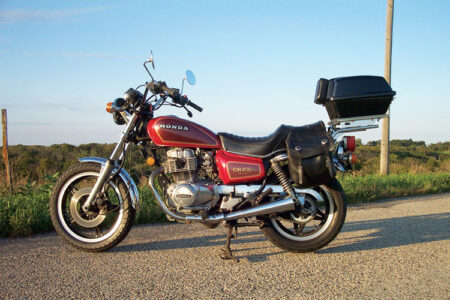
While the torque converter eliminated the clutch, there is still a lever on the left handlebar; because of another oddity. The Hondamatic has a parking brake, which is operated by a lever on the left handlebar, where a clutch lever is usually located, for setting the rear brake, because even if left in gear for parking, the bike can roll freely. It also has a push-button lock-out button that must be depressed at the same time as the parking brake lever is pulled, requiring two-hand operation to set the parking brake. That is to prevent the accidental application of the parking brake while underway.
The engine also was a bit odd for the times, as it had three valves per cylinder, two intake and one exhaust, as well as dual counter-rotating, chain-driven balance shafts. The original equipment mufflers are remarkably effective, even to this day. Based on my experience riding and owning a CM400A, I would describe the bike’s manners of smooth, nearly vibration-free, quiet, twist-and-go operation as being the closest thing to an electric motorcycle as any internal combustion powered bike will probably ever get. But I can also agree with the July 1981 road test by Cycle magazine where the bike’s road performance is concerned.
Cycle found the CM400A’s acceleration docile, saying, “Performance as judged by the numbers is not the CM’s long suit, but if you could grade simplicity of operation and put that on a spec page, then you’d have to admit the Hondamatic offers something tangible for your money.” The numbers they refer to are the standing start quarter mile time of 17.8 seconds with a terminal speed of only 73.95mph. Of those numbers, they said, “The CM400A takes longer to reach the far end of the quarter mile strip than any motorcycle we’ve tested recently.” Among those other bikes referred to was a bike displacing only 250cc. But, put in context, Honda already had a long list of bikes for riders in search of thrills at the drag strip — that, of course, was not the target market for the Hondamatic.
The Honda CM400A was not the only clutchless or “automatic” bike on the market in its day. Honda also offered a similarly equipped semi-automatic CB750A, Moto Guzzi had the V1000 I-Convert (introduced in 1975, the “I” standing for Idro-Convert), Suzuki had its GS450GA, and Husqvarna offered the 420AE and 420 AXC, which were true self-shifting automatics.
1976 Suzuki GT380
In 1972, when Suzuki introduced the GT380 two-stroke triple, Kawasaki was coincidentally rolling out its new three-cylinder two-stroke S2 Mach II 350, and Honda released its CB350F four-stroke four-cylinder. So, at that point, a more-than-twin cylinder 350 was no longer an oddity in the market. But, by 1976, the Honda four had been bumped up to 400cc and the Kawasaki S2 was no more. That made the GT380 something of an oddity, as did its odd displacement.
Why the 371cc displacement was used I had thought may be the product of economy in terms of utilization of existing engine parts, such as pistons. So, I looked at what other existing Suzuki two-stroke models where a single cylinder’s displacement would equal 123cc, such as the TS125. That didn’t work; the TS125 single has an actual displacement of 123cc, but used a larger bore at 56mm and shorter stroke than the GT380 with its 54mm bore and stroke. So, exactly why the 371cc displacement was used isn’t clear on that basis.
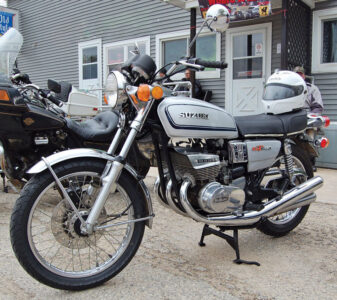
But the GT380 had a couple more odd features. The most obvious is the Ram Air scoop over the top of the one-piece head and wedge-shaped cooling fins under it. The Ram Air feature originated in Suzuki air-cooled racing bikes. It is designed to concentrate laminar air flow over the head to optimize cooling.
It also had a puzzling three-into-four exhaust system. In a displacement class where eliminating excess weight is a general rule, that seems like an odd decision, particularly when early road tests panned the exhaust system for limited cornering clearance on both sides. Odd though it may have been, the GT380 had enough sales appeal to remain in the Suzuki line-up for seven years.
1976 Honda CJ360T
Prior to the introduction of the CB and CL variants of the 356cc 360s in 1974, Honda had six — yep, six — variants of the long-popular 325cc nominally 350cc parallel twin, which had been popular in the product line since 1968. Oddly, the 31cc increase in displacement resulted in a decrease in horsepower; the 1973 Honda CB350G claimed 36bhp @ 10,500rpm, while the 1976 360 put out only a claimed 34bhp @ 9,000rpm!
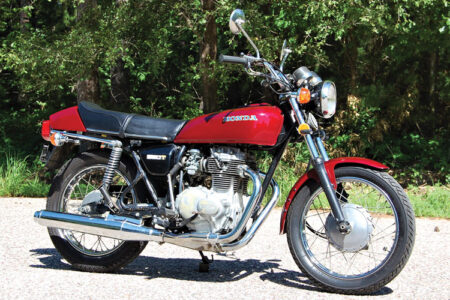
The 360 models writ large really seemed to offer a few distinctions without much of a difference. For instance, they had an all-tubular steel frame leaving the 350’s pressed steel backbone unit behind. They had a six-speed transmission instead of a five speed. They had some other internal engine and transmission changes and a modest aesthetic make-over. At the time the 360 models were rolled out, Honda already had the four-cylinder CB350F and the single cylinder XL350 in the line.
If all that wasn’t a bit odd on its own, then in 1976 Honda did the exact opposite of the usual new model progression, where the base models get more features in subsequent years. Instead, Honda then rolled out what amounts to an econo-model 360 where a number of originally standard features disappeared. The CJ360T had the same engine, but not the six speed. Other standard features disappeared, too. The CJ had no centerstand, no dual exhausts, no pinstriping, no disc brake, very little chrome and decals instead of 3D badges, and very important to most riders, no electric starter. That’s a little odd, but it was low-cost.
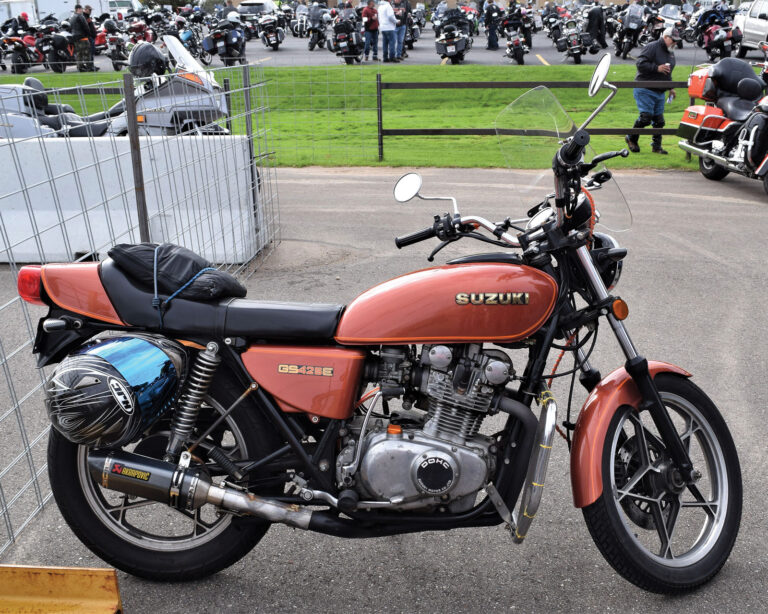
1979 Suzuki GS425E
As I prowled the 1,000-plus bikes at the Slimey Crud Motorcycle Gang Café Racer Run a couple years ago, I almost walked right past a rather standard looking Suzuki twin. Then I noticed something odd on its side cover. It said it was a GS425E. That, I thought, is odd.
So, I did a little research and found that the 423cc four-stroke twin-cylinder Suzuki GS425E was only on the market in 1979. The closest thing to it from Suzuki in 1978 was the 398cc GS400C, a twin-cylinder four-stroke, which survived it beyond 1979 as the 1980 GSX400 and which saw its parallel twin four-stroke engine get a four-valves per cylinder head. The same year, the GS450 appeared with displacement bumped up to 448cc and name changed to the GS450 (ET, LT, or ST).
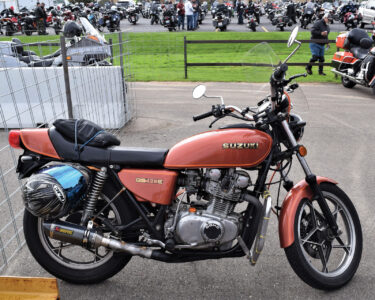
Such incremental change by itself seems to be an odd thing to do when the cost of tooling and manufacturing changes for the 25cc increase in displacement would only be spread over one year’s production. Cycle World, in its 1979 review of the GS425, pondered the possible economic reasons for the odd displacement, including parts interchangeability. They found multiple-bike use of pistons was not a factor, but was for other parts saying, “Being patterned after the larger Suzuki fours, at least in the top end, many parts like the cam chain tensioner, piston wrist pins, cam followers, adjusting shims and numerous bits and pieces are interchangeable even if the piston size is different this year.” That referred to the preceding model using the same 65mm pistons as the GS750, but that the 425 uses 67mm pistons.
The engine did offer top-tier features, such as double overhead cams and a gear-driven counterbalancer. It offered a six-speed transmission and both electric and kick starting. Cycle World said that above 3,000rpm, the counterbalancer made for “no more vibration than most fours have.”
The GS425 also had some uncommon features for bikes in its category, such as a digital gear position indicator, automatic cam chain tensioner, storage space in a rear cowling, and locking lid over the fuel cap similar to the CJ360.