1983 Honda CX650 Turbo

- Engine: 674cc liquid-cooled OHV 80-degree V-twin, turbocharged, 82.5mm x 63mm bore x stroke, 4 valves/cylinder, 7.8:1 compression ratio, 100hp @ 8,000rpm, 76.7 lb-ft @ 5,000rpm
- Top speed: 139mph*
- Carburetion/Fueling: Computerized Fuel Injection (CFI), 35mm throttle body
- Transmission: 5-speed constant mesh, shaft final drive
- Electrics: Digital electronic ignition, 12V/340W charging system
- Frame/wheelbase: Steel diamond frame with engine as stressed member, aluminum swingarm/58.9in (1,496mm)
- Suspension: 37mm Showa telescopic fork with adjustable TRAC anti-dive; Honda Pro-Link monoshock rear
- Brakes: Dual 10.9in (276mm) front discs, single 10.9in (276mm) rear disc
- Tires: 100/90V18 front, 120/90V17 rear
- Weight: 518lb (235kg) dry; 564lb (256kg) wet
- Seat height: 31.1in (790mm)
- Fuel capacity: 5.3gal U.S. (20.1L)
- Quarter-mile: 11.75 sec. @ 112.21mph*
*Cycle test, October 1983.
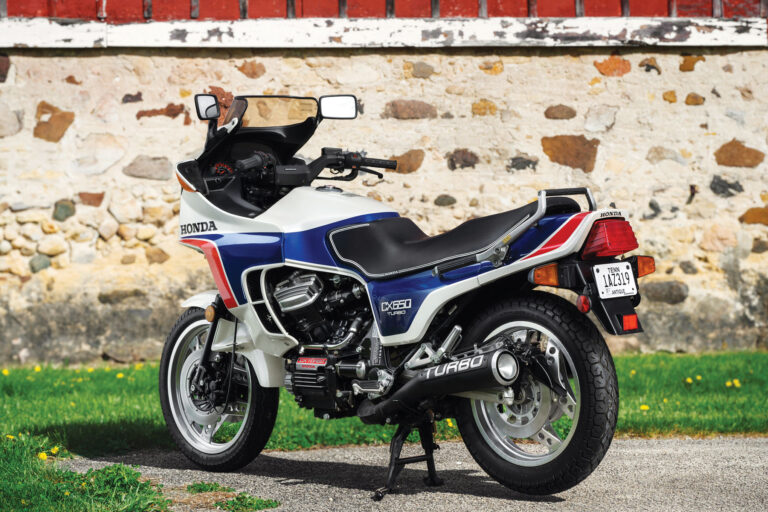
Matt Jonas of West Chicago, Illinois, is a lucky man. Not only does he have a wonderful collection of interesting motorcycles, but the Honda CX650 Turbo shown here was actually a surprise gift from his wife Bonnie. Matt took ownership in the early nineties. Incredibly, the odometer shows only two actual miles from new.
Matt started his two-wheel journey at age 13 on a 1958 Cushman Eagle sporting an impressive 4.8 horsepower. His first real motorcycle was a 1970 Honda CL450. As his riding expertise grew, he began racking up prodigious mileage on frequent cross-country riding trips, often attending AHRMA race events on the West Coast. Many of these miles were accumulated on his trusty 1984 Yamaha SECA 900. He owns two such SECAs. One is pristine and low-mileage. The “workhorse” shows 142,812 miles on the odometer.

Matt’s current collection includes a ’90 Honda RC-30, a ’79 Honda CBX, an ’86 Ducati 750 F1 Montjuich, and a ’70 Norton Commando. Even in such company, Matt’s CX650 Turbo is a standout.
According to Matt, “The CX650 Turbo is one of my favorite motorcycles. The innovative technology is fascinating and way ahead of its time. The design is visually stunning and still looks totally modern. The riding position is ideal for a taller rider like me. It’s one of Honda’s best achievements. Given the Turbo’s scarcity, unique design, breakthrough engineering, function and beauty, they’re underappreciated and undervalued in the current market. I love it!” That’s high praise considering the impressive machines in Matt’s collection.
Development and history
The one-year-only 1983 Honda CX650 Turbo improved on its groundbreaking predecessor, the CX500 Turbo. The original Honda Turbo was the first production motorcycle to feature both turbocharging and electronic fuel injection. Honda was at the vanguard of a surge in market interest for innovation, sophistication, efficiency, low emissions, and social responsibility. Turbocharging was the perfect answer!
The CX500 Turbo, predecessor of the CX650 Turbo, was a grand achievement and collectible in its own right. But even the most ardent enthusiasts (like me) agree that it did fall somewhat short of perfection. Notably, it does have very abrupt and addictive power delivery that delights and rewards a skilled rider.

The improved CX650 Turbo was first exhibited at the 1982 IFMA Exposition in Germany and corrected most of the “shortcomings” of Honda’s original Turbo. When launched, the original manufacturer’s suggested retail price (MSRP) was generally $4,998, depending on dealership destination. Overlooking the homologation-special Honda CB1100R, this was the most expensive Honda available at the time. It cost more than a fully loaded GL1100 Aspencade or a CBX. Unfortunately, the CX650 Turbo landed during a global recession. In addition to normal economic difficulties, such as high unemployment and high interest rates for consumer loans, Japanese motorcycle companies faced political headwinds beyond pure market forces. Harley-Davidson suffered significant market share erosion to the Japanese companies. Never mind that Harley sold virtually unchanged motorcycles while the “Big Four” Japanese
companies offered innovative, reliable machines bristling with new technology at compelling prices. Rather than improve their products and compete in the marketplace, Harley got relief from friendly politicians in Congress: a targeted tariff on heavyweight motorcycles (over 700cc) from Japan. The politicians who delivered this gift for Harley also made stump speeches extolling the virtues of free market capitalism. Ironic.

The tariff lasted five years and started at 45%, scaling down each year. By 1988, the tariff was only 10% and ended. Along the way, Harley turned down offers of technical assistance for product improvement from the Japanese companies. Harley was eventually embarrassed by the whole affair and lobbied to end it. Ronald Reagan signed the bill that terminated the program on October 9, 1987.
Harley mostly squandered the relief period. They made no significant product improvements beyond minor quality control measures to clean up a bit after the prior owners, AMF. Yes, that’s AMF as in bowling balls. Harley did begin one crucial initiative. They embarked on a campaign to transform Harley into a “lifestyle” brand. To some, clothing and other items emblazoned with the Harley logo became more important than the machines. This merch sold like crazy and enhanced dealer profitability. The move saved Harley-Davidson from oblivion, so it’s hard to criticize.
Meanwhile, Japanese companies unleashed a few 700cc “tariff specials” in reaction to the new tariff. The Honda CB700SC Nighthawk S was an excellent example. But the improved CX650 Turbo was not such a response. The development of the CX650 Turbo was underway long before Harley cooked up the tariff program. However, the new Turbo was well positioned (by displacement alone) to compete in the tariff era. Alas, this did not pan out well for Honda.

Many potential buyers were also apprehensive about the “complexity” issue of a fuel-injected, turbocharged motorcycle. How difficult and expensive would maintenance be? No one knew for sure, but many good prospects got cold feet in the showrooms. The result was a lot of unsold CX650 Turbos. One creative solution was the so-called “School Bike” program. According to VoTech Administrator Dan Clarke, American Honda gave away 2,500 motorcycles and ATVs circa 1982-83. This program was crafted as part of Honda’s 25-year celebration in the United States. Per Dan: “The VoTech program at American Honda provided Honda Training to public school instructors that had motorcycle, small engine, and automotive programs. Instructors were invited to participate at Honda Training Centers around the U.S. No charge! The summer VoTech program provided special training courses designed to provide both Honda Technical Training and training resources to instructors to be used in their home schools. Participating instructors were also given priority for donations. Honda’s goal was to help satisfy the need for motorcycle technicians at the dealership level.”
Of the 2,500 units donated, Honda gifted about 1,200 1981 CBXs and around 600 1983 CX 650 Turbos.

Each school bike had a sticker indicating they were not to be sold or registered for road use. According to Dan, “When these bikes were donated to schools, the binding agreement with Honda and the recipient school stated that the bikes and parts would not be sold or put into use, ever… The parts could be scrapped and the proceeds used by the recipient school for other supplies and/or educational materials to benefit students.” Over time, many clever “workarounds” were used to defeat the sticker and binding agreement. Many “school bikes” were eventually sold, registered, and put into service.
So, Honda shipped only 1,126 CX650 Turbos to North America and soon felt compelled to give away 600 of them after it halted production. Why? This is a complex issue, and no principals are left to interview. My analysis is partly based on known facts. The rest is informed conjecture.

The changes Honda implemented for moving from the CX500 Turbo to the CX650 Turbo were extensive. In fact, I’ve documented over seven dozen changes! And this would be just the “approved” changes that made it into production. No one knows how many other changes might have been requested by the engineering, production, and marketing teams. Given the low production total, this was a costly proposition for Honda. Unverified rumors have circulated that Honda lost as much as $5,000 per Turbo! Due to the passage of time, such figures can’t be verified or disputed now. I tend to believe that number.
In some ways, Honda felt stubbornly compelled to resolve the niggling criticisms leveled at the original CX500 Turbo and dramatically improve the new CX650 Turbo. Since Honda’s engineering prowess had been challenged by quibbles from a small contingent of vocal magazine reviewers, there was motivation to improve the product regardless of cost. Eventually, senior management (and accountants) prevailed over the project team.

At first glance, the two Honda Turbos look about the same beyond the paint and graphics schemes. The timeless design created by Chief Designer/Stylist Minoru Morioka seems unchanged. However, the surprising reality is that very few parts actually interchange between the two models. From a product view, the changes were a resounding success. Unfortunately, the economics for Honda were not good.
The essence of the comprehensive CX650 Turbo makeover is more displacement, a compression bump, lower max boost, simplified EFI hardware, revised gearing, and lighter overall weight. Most of the weight reduction came from upgrading bodywork from fiberglass to lighter acrylonitrile butadiene styrene (ABS) thermoplastic. The result is a more powerful, faster bike with further reduced “lag” and snappier performance off-boost. Peter Egan assessed the improvements in his 2011 retrospective on the Honda, Yamaha, Kawasaki, and Suzuki Turbo bikes for Cycle World: “The Honda feels refined, solid and integrated. Bottom end seems at least as strong as on any naturally aspirated 650 Twin; but, around 4000rpm, the turbo starts to work its magic and speed builds with a satisfying, heady surge to its 9000-rpm redline. If you keep it on boil at around 5000 rpm, it’s ready when you are. To sense any turbo lag, you have to hit the throttle hard when it’s bumbling along below 4000.

“The verdict: very rideable and civilized, with the turbo serving to boost the fun factor and make the best of short passing zones on the highway. Still looks good, too, and the styling hasn’t aged as much as it has on some of the others. I ended the day thinking this is a bike I’d love to own.”
I have mixed emotions when contemplating the CX650 Turbo and what might have been. It’s a stunning technical accomplishment viewed as an engineering and production marvel. From a business perspective, it’s hard not to imagine that Honda’s management viewed it as something of a failure. The R&D expenditures and marketing investments were enormous. Honda naturally continued to develop fuel injection as a logical improvement over carburetion. But what if Honda had continued development and evolution of turbocharging? What amazing machines would have emerged in the last 40+ years? We might have an answer on the horizon. Honda has shown renewed interest in the possibilities of forced induction for motorcycles. At the November 2025 EICMA industry show in Milan, Honda unveiled the radical V3R 900 E-Compressor prototype, equipped with a V3 engine featuring an electric motor driven compressor. Unlike conventional engine-driven superchargers or exhaust-driven turbochargers, this new system decouples boost pressure from rpm and engine load, opening up a treasure trove of tuning possibilities. This development is definitely worth watching.
Riding impressions
Morioka created sleek bodywork that was tested and refined at the Pininfarina Wind Tunnel in Italy. He lamented that his beautifully integrated mirrors and turn signals added vital wind protection but cost the Turbo the performance equivalent of 10 horsepower. No matter, the fairing is non-obtrusive and highly effective. The Turbo handles crosswinds with aplomb.
Morioka’s team also delivered many small but important CX650 Turbo-specific ergonomic refinements. Three important ones: a modified seat with an elongated rider section, raised and wider handlebars, and a 10mm taller windscreen. The result is an “all-day” riding position that’s surprisingly inviting for a high-performance machine.

I’ve been fortunate to own a very nice 1983 Honda CB1100F — the apex predator of inline four-cylinder air-cooled Hondas. I’ve also owned a Honda Turbo. I have considerable seat time on both. Both machines were in Honda showrooms during the same model year. If you compare the specifications for the CB1100F to the CX650 Turbo, you’ll find that the horsepower, weight, acceleration, and top speed are similar. Both are refined, handle well, and represent Honda at its best. Each is a terrific collectible bike that’s a joy to own. However, the riding experience and power delivery could not be more different. I like them both, but I prefer the overall smoothness, wind protection, and refinement of the Turbo. If I had to choose a vintage bike for a cross-country trip, the CX650 Turbo would be my weapon of choice.
The CX650 Turbo retains all the excellent DNA of the earlier CX500 but is easier to live with than the higher-strung CX500 Turbo. Most riders prefer it over Honda’s first Turbo. Max boost is lower, but 16.4 psi is still not trivial. The CX650 Turbo has prodigious roll-on capabilities in the higher gears. On full boost, it performs like a serious liter bike. Gear changing seems almost unnecessary.

At rest, the bike seems slightly top-heavy and somewhat ponderous. Once underway, weight sensations disappear. At lower speeds, the CX650 Turbo feels like a docile and pleasant middleweight. On boost, it has a fierce personality. Once acclimated, the rider is not really aware of the turbocharger. Power delivery is seamless, linear, and right now. EFI calibration is spot-on — on par with the best modern bikes. For a fast bike, it’s surprisingly quiet and smooth. What about dreaded “turbo lag”? Glad you asked.
I cover this topic extensively in my book. Here’s the gist. Simply put, “turbo lag” on Honda Turbo motorcycles is a myth. There is no appreciable “lag.” Honda spent five years with a team of 50 engineers to harness and civilize power delivery. Hundreds of new patents were the by-product of their diligence. They were wildly successful. Once rider education is accomplished and you learn to keep the revs above 4,000rpm (as Honda intended), boost is right now!

Power delivery characteristics make the CX650 Turbo the King of Roll-On Competitions. Under full-throttle roll-ons from 5,000rpm in 5th gear, it can beat almost any machine of the era — not even close, really. Top speeds are also fairly impressive. Aided by good aerodynamics, top speeds are limited more by the available gearing than by a lack of power.
The CX650 Turbo is likely the most agreeable vintage machine to ride fast without fuss. Competent suspension and brakes inspire confidence. The robust powerplant provides gobs of linear power without thrashing on the throttle or gearbox. Since there’s ample cornering clearance, aggressive cornering is a “no sparks” activity. “Twisties” are a snap — brake hard for conservative cornering, then calmly apply throttle for warp-speed acceleration to the next braking point. Stay alert, because the next corner will be here soon!

Finally, the CX650 Turbo offers an unmatched owner’s experience on the issue of “fussiness,” specifically the lack thereof. Most vintage bikes require a heavy regimen of maintenance to keep them roadworthy. If you’re reading this magazine, you already know something about finicky carburetors, poor synchronization, stale ethanol-diluted gasoline, and storage entropy issues. In addition to Honda’s normal engineering excellence and high build quality, you also get EFI. The result is a vintage machine that’s nearly an appliance. It digests “gasahol” without complaint. You can leave a Turbo for weeks, and it will fire up instantly, ready for a spirited ride. Well done Honda! Yamaha, Kawasaki, and Suzuki eventually offered compelling Turbos of their own. Each has loyal and dedicated enthusiast support. However, most knowledgeable owners consider Honda’s CX650 Turbo the “best” overall machine of the Japanese Turbo era. That’s my strongly held viewpoint and I’m not alone. Brad Beers of Zionsville, Pennsylvania, owns the finest collection of all five Japanese Turbos in the world. Each is as “perfect” as humanly possible. Brad’s informed assessment: “The Kawasaki was the fastest, the Suzuki was the best handling, the Yamaha was rushed into production (the cause of many problems), and the Honda CX500 Turbo was the first production fuel-injected turbocharged motorcycle sold to the public.

I like all the Turbos for reasons specific to each, but Honda was the only manufacturer to build a second, more refined turbocharged model specifically targeting feedback from the original CX500 Turbo. With the CX650 Turbo, Honda did a great job building something very special!
The Honda CX650 Turbo is a great-handling, very comfortable, powerful bike. The most impressive feature of the CX650 Turbo is the smooth transition from “off boost” to “boosted” as rpm rises rapidly. The resulting wide powerband is entertaining and easy to manage. The design has aged well. It’s not only functional; it still looks advanced and futuristic. It’s the best overall of all the Turbos.” MC