
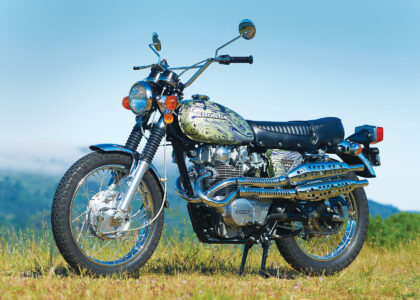
1972 “Flying Dragon” Honda CL450
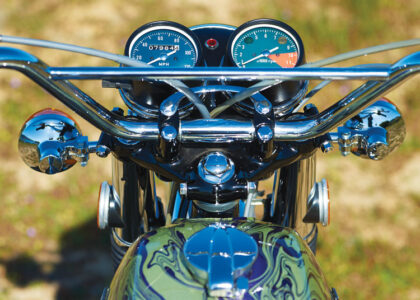
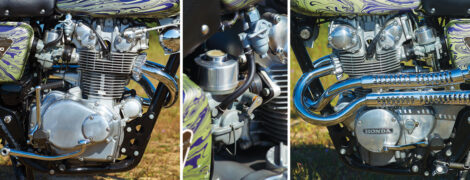
- Engine: 444cc air-cooled four-stroke twin cylinder 70 mm x 57.8 mm, 9.0:1 compression ratio, chain-driven double overhead camshafts, two valves/cylinder, 43hp @ 9000rpm
- Top speed: 92mph (period test)
- Carburetion: 2 Keihin 32mm CV carburetors
“I first saw this bike at the Antique Motorcycle Club of America meet at Dixon, California, where the previous owner was having it judged. I was fascinated by the bike.” –Owner Clay Baker
Honda’s experiment with factory custom paint
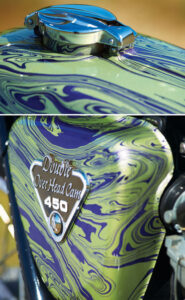
In the late 1960s and early 1970s, Honda concentrated on engineering and reliability, not on art. But at one point, the company stepped outside of its comfort zone and experimented with hydro-dipping tanks and side covers to produce tie-dyed effects for some of its motorcycles. End papers used in classic bookbinding often have a similar treatment, called marbling. Why Honda did this is unknown. It is known that the factory, flush with cash from export sales, was experimenting with different possibilities. These experiments were carried out by small special project teams in different departments.
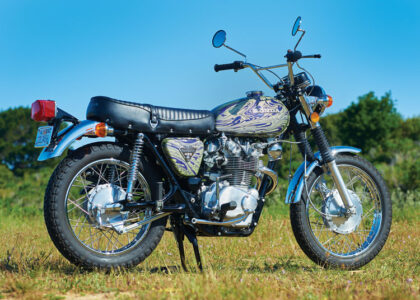
Bob Kelly, Honda historian, has learned that these special project teams, often composed of only a few people, were not announced within the company, and most employees, even those within the same department, would have been unaware of them. It is likely that a special project team in the paint department came up with a very special paint scheme for the 350 and 450cc motorcycles Honda was then producing, but no specific information has surfaced.
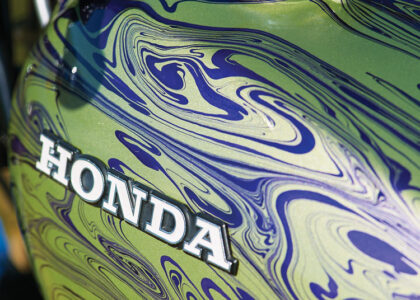
There are many other unanswered questions about these tanks and side covers, and Kelly and other Honda historians who have tried to locate answers have come up with very little. This paint process probably involved dipping the part in a vat of water with paint floating on the surface. No one is exactly sure how the swirls were achieved, and no two paint sets are the same. In recent years, only one company (Hydrodypz in Georgia) has been able to come close to the Honda factory look, but even what they produce does not come out the same as the Honda factory paint.
The tank and side covers were sold as a set to dealers; they were not factory-installed. The American Honda headquarters, then in Gardena, California, announced the availability of the paint sets in a dealer bulletin and provided a special order form for American dealers to fill out to order them. Several retired employees have reported seeing the bulletin in 1972, but none of the bulletins have been located. One special order form has surfaced. A few of these tank and sidecover kits have survived, often stored in the original box from Honda Motor Company, Japan, and the ones that have surfaced are now very valuable.
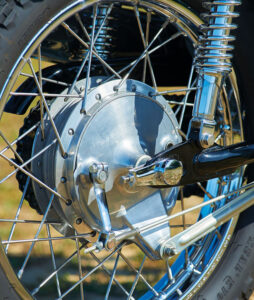
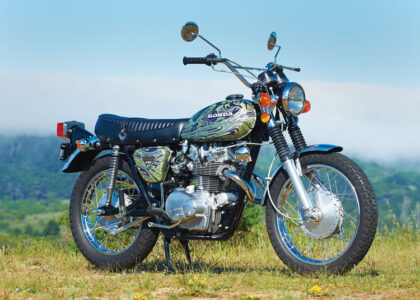
The paint sets were available in Japan for CB250s (not available in the U.S.) and CB350s, the street version of the twins. Also for the Japanese market, a red/gold paint set was made for the SL350 Motosport, a dual sport machine more slanted to trail riding. All of these bikes’ kits came with a matching open face helmet. Bob Kelly has found a Japanese advertisement for the paint sets — in English! Jack Smith in Canada has been searching for the CB paint sets in Japan and has recently discovered a helmet. In the U.S., the paint sets were only available for the CL series 350 and 450 street scramblers: bikes with high pipes, double leading shoe drum brakes on the front wheel, and tires with more aggressive universal tread.
Once ordered, paint sets were sent from Honda Japan to one of Honda’s 10 distribution centers, then located around the U.S., and from there to the local dealer. Paint colors available in the U.S. for the CL450s were metal flake gold with purple swirls, metal flake silver with purple swirls, a green base with purple swirls (as on Clay Baker’s bike), and light blue with dark blue swirls. The light blue with dark blue was the most popular option back in the day, and, possibly for that reason, blue/blue sets are now very rare. Historians have located Honda factory part numbers for all four paint set colors. Paint sets have been found in the original packaging, with delivery labels addressed to a distribution center, and at this point, all Honda experts are certain that all four options are authentic.
The special paint option was not very popular at the time, possibly because of the cost of $42.66 in 1972, which equals over $322 today, and tank and side cover sets moldered in the back rooms of dealerships. Honda stopped producing the paint sets after the 1973 model year and filed the project under “ideas that did not work.” Although Honda literature refers to the special paint as “custom paint sets,” in the U.S., the paint sets are universally known as Flying Dragons. No one has been able to determine where the name came from.
Honda 450 development history
The Flying Dragon paint sets were not the first time that Honda had come up with a cosmetic fix for its middleweight twins. The first Honda 450s appeared in 1965. Some were in Honda Scarlet red with silver, but most were black, later nicknamed “Black Bombers.” The CB450 was technologically advanced, and as Honda’s biggest bike, it was supposed to be a showcase heralding Honda’s entry into the middleweight motorcycle market. Unlike most street bikes in 1965, the CB450 had double overhead cams, an electric starter, and valve closure controlled by torsion bars, not springs. But unfortunately, the advanced features did not overcome issues that compromised rideability, including excessive weight, lubrication, and carburetor problems. Many contemporary riders thought the bike was ugly. The Bomber did sell, but not in the numbers Honda had hoped for, and bikes piled up in warehouses.
Honda engineers developed a new version of the CB450 to fix many of the Bomber’s problems and gave the machine a five-speed gearbox. It was scheduled to be sold to the public in 1968. In 1967, in an effort to clear the warehouses of the earlier bikes, Honda shipped kits to dealers to turn what was thought of as an ugly duckling into a more attractive dual sport machine, then known as a scrambler. Motorcycle Classics published an article on the 450D, as the Bomber with the kit was known, in “1967 Honda CB450D Super Sport.” The 450D was the prototype for the CL450 that appeared the next year.
The first CL scramblers appeared as 1968 models, both in 350 and 450cc versions. The first CL450 was designated the CL450K1. Before 1968, there was only one version of Honda’s 450, but now there were two separate models: the CB450, intended for on road use, and the CL450, advertised as an offroad machine but, in reality, limited to groomed trails and dirt roads due to its weight, ground clearance, and suspension. In its May, 1968 road test, Cycle World said the CL was, “in reality, the CB in sports casual.” The high pipes and offroad tires did make it easier to ride dirt roads. In 1968, there were a lot of dirt roads to explore, and a motorcycle with limited offroad capability made a lot of sense. People who were serious about going out into untracked wilderness in the late 1960s and early ’70s usually bought a lightweight two-stroke.
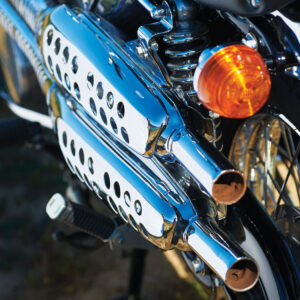
In its 1968 road test, Cycle World found that the CL was a little quicker off the line, and the CB had a slightly higher top speed, mostly due to the different exhaust systems on the two models. Both bikes displaced 444cc and had double overhead cams. Both sported a well-designed five-speed transmission, dual adjustable rear shocks, 9:1 compression, dual constant velocity Keihin carburetors that delivered smoothly, and a double leading shoe front brake. In the years that followed, the CB got a front disc brake, while the CL soldiered on with the double leading shoe drum. The CL went through six different versions, mostly differentiated by cosmetic changes to the lights, tank, sidecovers, muffler cover, and seat, before being retired in 1975.
Ugly duckling becomes sought-after swan
The beginning of fame and fortune for the Flying Dragon paint set started in 2012, when Bob Kelly wrote an article for the Vintage Japanese Motorcycle Club magazine about what he had been able to discover to date about the paint sets. At the time, very little was known about them. Don Stockett, owner of the Vintage Motorcycle Rescue restoration facility, saw the article, started his own investigations, and became interested in acquiring a Flying Dragon motorcycle. He located a paint set (in the original box) for a 350cc machine and two CL350 motorcycles to provide parts for one 100-point bike. The author of this article saw Don Stockett’s Flying Dragon at The Quail and wrote an article about it, which was published in the September/October 2014 issue of Motorcycle Classics.
Don Stockett eventually decided to sell the bike and brought it to the yearly Las Vegas Mecum auction. The Barber Museum read the VJMC and the Motorcycle Classics articles and decided to buy it. It is now on display, with a placard, “The Rarest Honda in the World.”
At this point, the buzz started, and prices for an authenticated and properly restored CL350 or CL450 sporting a Flying Dragon paint set went through the stratosphere. Auction prices currently range from $31,000 for an unrestored motorcycle to $71,000 for a CL in concours condition with a properly authenticated paint set.
Bob Kelly has continued to research the paint sets. He has found that the sets were always sent out strapped to pallets, with 10 sets on one pallet. At least one of the pallets was sent to the warehouse in Baton Rouge and one to the New Jersey facility. He also found an original order form and has been kind enough to share it with Motorcycle Classics.
Clay Baker adopts a Dragon
Clay Baker bought his CL450 before the auction frenzy really got going. “After I saw the bike at Dixon, I made contact with the owner. He decided to sell it during the COVID pandemic, and we came to a price. I was interested because I like CL Hondas and because it was a 450. Although I have ridden it a few times with the Flying Dragon paint set on, I am careful about taking it out. I am minutes from quiet roads. I have a stock tank and side covers, which I put on if I am just going for a ride. The bike does need to be used.”
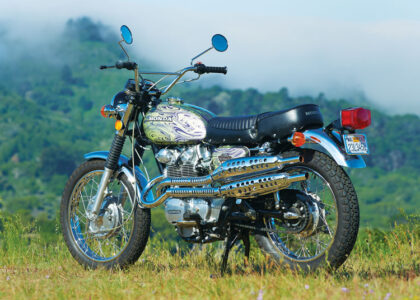
A CL450 that has the Flying Dragon tank and side covers is a rare collector’s item. A CL450 that has the stock tank and side covers is one of the more common classic bikes. It is a sturdy machine that was used by many people during the 1970s as a commuter during the week and for fun on dirt roads on weekends. Although Honda has never published sales figures, some knowledgeable people at the Vintage Honda Twins website (www.VintageHondaTwins.com) estimate that from model year 1965 to 1974, about 200,000 were built. Quite a few have survived, parts are available, and a CL450 in good mechanical condition is a good choice for a motorcycle enthusiast who wants to own a vintage machine.
“CL450s are a good middleweight. I go on club rides with mine (mostly with the stock tank and side covers) and keep up with everyone,” says Clay. “It’s not a crotch rocket. I don’t have problems with braking. It handles reasonably well, and it’s OK on dirt roads. It has decent ground clearance.”
Care and feeding of a Dragon
Maintenance is a little more involved than a modern bike. “I change oil at the beginning of the year or every 3,000 miles. Yearly maintenance starts with the cam chain. You set the cam chain, set the valves, and set the timing. I bought a Digisync (an electronic device that measures vacuum pressure in each carburetor), which isn’t cheap, but makes it much easier to set multiple carburetors.”
The tank and side covers that make an ordinary motorcycle into something rare and valuable need to be maintained as well. Anything that sits will eventually start to look a little dusty. Clay uses the 3M system with 3M 06068 “Perfect buffing” ultrafine machine polish, and he carefully polishes by hand, with a microfiber cloth used to buff. “The clear coat is super thin to begin with.”
Clay enjoys riding the Dragon, maintaining the Dragon, and just looking at the Dragon. “I look for rare bikes for my collection,” says Clay Baker. “This is the kind of bike I like.” MC
A thank you and tip of the helmet to Bob Kelly and Don Stockett for all the assistance with this article —Margie Siegal


