1990 Honda VFR750R/RC30
- Engine: 748cc liquid-cooled DOHC 16-valve 90-degree V4, 70mm x 48.6mm bore and stroke, 11:1 compression ratio, 86hp @ 11,500rpm at rear wheel (period test)
- Top speed: 153mph (period test)
- Carburetion: Four 38mm CV Keihin
- Transmission: 6-speed, chain final drive
- Electrics: 12v, electronic ignition
- Frame/wheelbase: Twin-spar aluminum frame/55.4in (1,407mm)
- Suspension: 43mm Showa telescopic fork w/adjustable compression and rebound front, single-sided “Pro-Arm” swingarm w/single Showa shock w/adjustable preload, compression and rebound rear
- Brakes: Dual 12.2in (310mm) discs w/4-piston calipers front, single 8.7in (221mm) disc w/2-piston caliper rear
- Tires: 120/70V x 17in front, 170/60VR x 18in rear
- Weight (wet): 475lb (216kg)
- Seat height: 30in (762mm)
- Fuel capacity/MPG: 3.6gal (13.6ltr)/37mpg (period test)
- Price then/now: $14,998 (1990)/$25,000-$50,000 (ridden examples)
It’s a well-worn cliché, but “race on Sunday, sell on Monday” has been a solid philosophy in motorcycling for over a century. Racing has been a showcase for the technology likely to be seen in future street bikes. Features like disc brakes, monoshock suspension systems and multi-valve cylinder heads all debuted on Grand Prix race bikes before finding their way to the street.

But in the 1980s, Grand Prix racing, which was then dominated by 2-strokes, ran into an identity crisis. The major makers were pouring money into 2-stroke engine development to stay ahead of their racing competition, but with the phasing out of 2-stroke street bikes, the expertise gained would no longer translate to production machines. In the U.S., Formula 750, also dominated by 2-strokes, was facing a similar issue. And as race bikes became less and less like the sport bikes in dealer showrooms, race fans lost interest, leading to a deeper disconnect between the sport and the street. A resolution would emerge, and it helps to review some of motorcycle racing’s history to put the outcome in context.
One of the most popular – and dangerous – races on the Grand Prix circuit was the Isle of Man TT. Riders generally accepted the extreme hazards as part of racing, but when his friend Gilberto Parlotti was killed in the 1972 TT, then World Champion Giacomo Agostini vowed he would never again race on the Island. Other top riders joined Agostini’s boycott, leading to the TT being dropped from the World GP calendar in 1976.
Britain’s motorcycle sport organizing body, the Auto Cycle Union, proposed an alternative formula to include the Manx TT, a new racing series for modified street bikes pitting 1,000cc 4-strokes against 2-strokes up to 500cc. The first Formula TT race was run under the FIM stewardship in 1977, and the formula quickly proved popular, especially after Mike Hailwood’s comeback win on the Isle of Man in 1978 and Joey Dunlop’s run of five championships from 1982-1986. By that year, there were eight Formula TT rounds on tracks all across the globe. In the U.S., the American Motorcyclist Association (AMA) initiated a new race series in 1976 also based on production machines: AMA Superbike.

Formula TT and AMA Superbike were so successful that they invited competition. This arrived in 1988 in the form of a startup rival, World Superbike racing. Also based on street bikes, World Superbike, or WSBK, pitted 1,000cc 4-stroke twins against 750cc fours. By 1990 it had eclipsed Formula TT, which held its last race that year.
And while Formula TT entrants (at least in the early years) were mainly supported by dealers and private sponsors, WSBK quickly attracted factory backing, setting the stage for the legendary battles of the 1990s between thundering Ducati V-twins and howling Honda V4s.
Under the skin
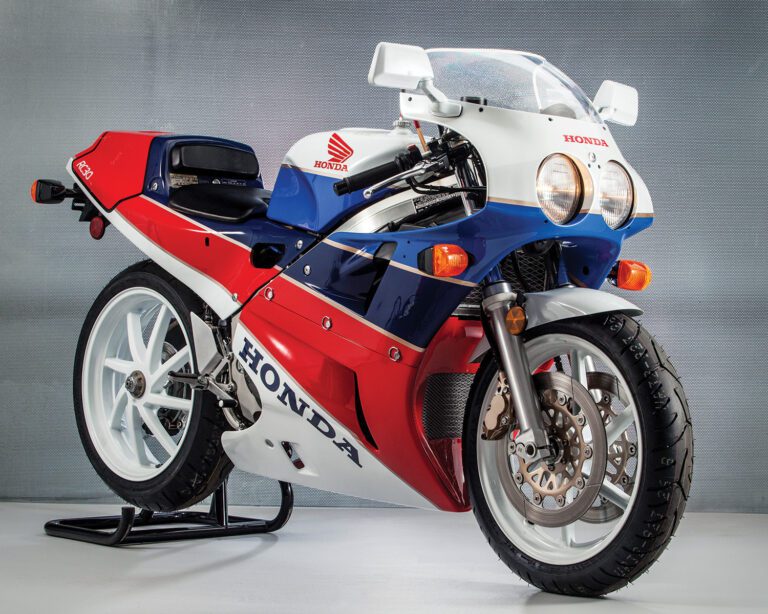
Honda’s entry into WSBK was with the VFR750R, otherwise known by its factory designation, RC30. Though superficially similar to the VFR750F Interceptor of 1986, the RC30 shared almost no parts with it, and the design started pretty much from a clean sheet of paper. And while the Interceptor was produced and sold in large numbers, the RC30 was a homologation special. That is, it was produced in just enough numbers to satisfy FIM rules for the minimum number of street-legal units offered for sale, and no more than 3,000 RC30s were built.

The differences between the VFR750F and VFR750R stem from their origins. The F was a development of the VF750F Interceptor, itself derived from the VF750C Magna and VF750S Sabre. The VF750F used the 16-valve V4 engine from the C and S, but with the cylinders at 45 degrees to the horizontal, and chain final drive replacing the shaft drive. Oddly, as a result of this change the transmission went from 6- to 5-speed – the chain drive took up more space in the gear case. But the VF750 engine was also starting to gain a reputation for camshaft wear issues. Not every bike was affected, which made the cause even more elusive. Recalls and production changes helped, but the Interceptor’s reputation was tarnished. Honda was committed to the V4 format, so a bold move was needed.
The new VFR750F Interceptor of 1986 borrowed the “cassette” gear-driven valvetrain from the VF1000R, which was known to be durable and reliable. The sixth transmission gear was reinstated, bucket tappets were used in the valvetrain, and the revised power unit went into a new perimeter alloy beam frame replacing the VF’s steel tube item, with a “Pro-Arm” cast alloy, single-sided swingarm controlling the rear wheel. It was updated for 1990, and stayed in production until 1997.
Made in Japan
For the RC30, Honda’s engineers worked backwards from a race bike, rather than forward from a street bike.
It’s said the impetus for the RC30 program came less from World Superbike but more for a machine that could successfully compete in the prestigious Suzuka eight-hour endurance race, and the World Endurance series. From its debut in 1978, the Suzuka was run under TT Formula One rules, meaning it was open to street-based 1,000cc motorcycles. A rule change in 1984 limited capacity to 750cc, and the requirement for entrants’ bikes to be street-based was strictly enforced. After the rule change, Honda won the Suzuka for the next three years with its RS750R and RVF750, both based on the 1983 Honda VF750F Superbike engine. Regardless of its endurance intentions, the RC30 proved to be particularly suitable for World Superbike racing, and won the championship in its first two years, 1988 and 1989, with Fred Merkel riding. However, WSBK’s 750cc four/1,000cc twin formula proved advantageous for the Ducatis, and the RC30’s successes waned after 1990. Honda responded with one more development of the V4: The RVF750R (RC45) replaced the RC30 as Honda’s premier racer in WSBK and endurance racing from 1994. It featured PGM-FI fuel injection and moved the camshaft drive from the center of the crankshaft to the end.

Inside the RC30
The RC30 used a liquid-cooled 90-degree V4 with 16 valves and four overhead camshafts, the same basic layout as all Honda V4s. Drive to the camshafts was by a cassette gear set closer in origin to their race bikes than the Interceptor, with roller bearings supporting the camshafts, nixing the VF750’s camshaft wear issues. The cams also drove the valves directly via shim-and-bucket.
The RC30 shared the VFR750F’s 70mm x 48.6mm bore and stroke, but used titanium connecting rods and two-ring pistons to reduce friction and piston weight. Like all Honda V4 race bikes, the RC30’s crankpins were set at 360 degrees, a bit like two Ducati engines side by side; the VFR750F stuck with a 180-degree angle. This configuration gave the RC30 its signature thrumming exhaust note.
Drive to the slipper clutch was by gear, then to a new 6-speed close-ratio gearbox. The RC30 featured a heat exchanger to dissipate heat from engine oil to the coolant radiator rather than a separate oil cooler. Many other ancillaries, like the oil pump, water pump, starter and aluminum gas tank were also unique to the RC.
Forming an integral part of the chassis, the powertrain bolted to a twin-spar light alloy beam frame carrying a cast aluminum swingarm with eccentric adjustment of the rear axle for chain tension. The swingarm was controlled by a single Showa shock with adjustment for spring preload and compression and rebound damping. At the front went a Showa 43mm conventional cartridge fork with compression and rebound adjustment. The single-sided swingarm and front fork with quick-release axle clamps were both intended to facilitate quick wheel changes in endurance racing, as was the 4-into-2-into-1 exhaust mounted on the left side, leaving the rear wheel clear for easy removal and replacement. Triple Nissin disc brakes provided impressive stopping, while the bike rolled on 120/70 x 17-inch bias-ply front and 170/60 x 18-inch radial rear tires.

Cycle magazine tested an RC30 in 1990 and enjoyed the flat torque curve, which made it “exceptionally easy to ride fast — dial the throttle on in a corner at 6-7,000rpm, and perfect thrust reaches the rear wheel, building smoothly as you exit … The RC30 is a fast motorcycle that never feels as if it’s working hard.” They found the handling limited only by the tires: “… maybe only slicks would match the RC’s capabilities.” Switching from the RC to the VFR750F was “like stepping out of a music-and-smoke-filled rock-and-roll bar and finding yourself in a plush living room with the stereo playing. The song may be the same, but the ambiance …”
Roman Brotz’s RC30
Roman Brotz bought his RC30 new from a dealer in Manitowoc, Wisconsin. “I wanted to get a motorcycle that had up-to-date race features on it, like having the engine totally covered by a cowling. I wanted to have something that looked a little bit more fast so I could race it, and I thought that this bike was just the ticket.”
Brotz never did race the RC30, but he did compete at Blackhawk Farms and Indianapolis on a Suzuki RGV250 Gamma. It was the timeless looks of the RC30 that appealed to him. “If you look at the bike today, I mean, it looks like a race bike. That bike still has some good looks to it.”
Its current good looks are courtesy of motorcycle restorers Retrospeed in Belgium, Wisconsin. Many years ago, Brotz let his girlfriend’s brother ride the RC30. He hit a patch of gravel and dropped the bike. Though the damage was minimal, Brotz decided to park the RC30. “I had a cover over it, but mice got in and kind of made a mess of it.”
And it was only recently that he considered restoring it, at the suggestion of a nephew. “I didn’t ride it for a number of years. Certain parts like the front fork were starting to oxidize. The windshield was cloudy and, yeah, I thought, ‘Well what the heck.’ I was thinking that the bike was a person or something. It’s something I wanted to make healthy again. Retrospeed gave me a quote for the job. I saw examples of their work in a motorcycle magazine. It wasn’t cheap to do it.”
Brotz’s reaction to the restoration? “Oh, it’s unbelievable. He [Retrospeed owner Brady Ingelse] does absolutely miraculous work. I couldn’t believe how well he was able to restore the original parts.” Brotz plans to keep the RC30 for the time being. “I don’t have any plans to sell it, at least for now,” he says.
Given the RC30’s rising value — a 1990 with 14 push miles from new sold for a record $92,000 at Bonhams’ 2018 Las Vegas auction — he’ll likely come out ahead when he does sell, whatever the restoration cost. MC

The RC30 in context
Between 1984 and 1996, Honda Racing Corporation (HRC) used bewilderingly similar designations for its 750cc road/race V4s. How can you tell them apart?
The RS750R endurance racer of 1984 was based on the 1983 U.S. VF750F Superbike. A new designation, RVF750 was adopted for 1985, though the bikes were similar in specification. For 1986, the RVF750 gained the single-sided swingarm, licensed from ELF Racing, that would appear later on the RC30. That year also marked Honda’s third successive World Endurance and AMA Superbike titles for the RVF. The street VFR750F was adapted from the RVF750.
1988 saw the introduction of the all-new VFR750R/RC30 and the first of two successive World Superbike wins, plus victories at Daytona in 1989 and 1991. From 1991-1993 the RC30 concentrated on the Superbike class, with the RVF750 continued in endurance racing.
The new RC45 of 1994 (also known as RVF750 and RVF750R) was aimed at both Superbike and World Endurance, and duly won the WSBK title in 1997 and the World Endurance title in 1995 and 1998. It also scored wins at Suzuka (1994 and 1999) and Daytona (1996 and 1998).
All RC-designated Hondas were built at Honda Racing Corporation’s separate facility, not on a regular production line.