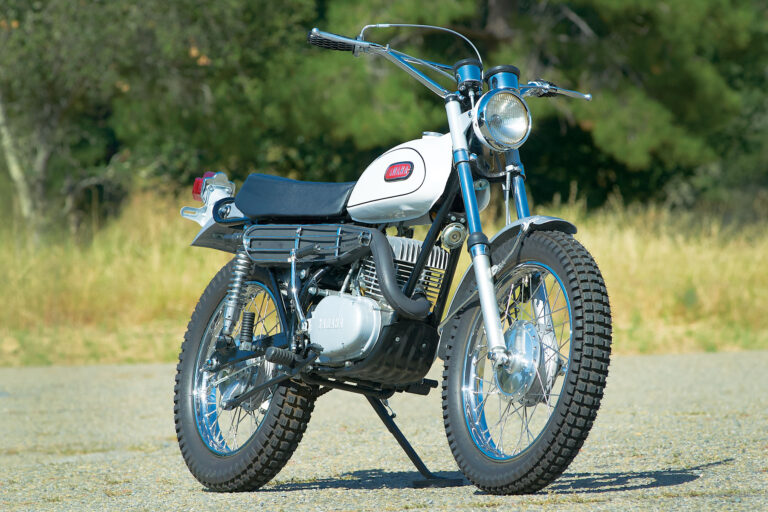
1968 Yamaha DT-1
- Engine: 246cc air-cooled piston port two-stroke single, 70mm x 64mm, compression ratio: 6.4:1, 21hp @ 7000rpm
- Carburetor: Mikuni VM26SC 26mm, foam filter
- Ignition: Flywheel magneto, coil, 6v battery for lights.
- Lubrication: Autolube oil injection
- Transmission: 5-speed, left-foot shift, chain final drive
- Clutch: Multiplate wet clutch
- Starting: Kick
- Frame/wheelbase: Duplex tubular steel cradle, swingarm, wheelbase: 54.7in (1389.3mm)
- Suspension: telescopic fork, swingarm, dual shocks
- Brakes: SLS drum front and rear, 149.3mm diameter x 25mm
- Wheels/tires: Steel rims, 3.25in x 19 front, 4.00in x 18 rear
- Weight: 247lb dry
- Fuel capacity: 2.5gal
- Top speed: 55mph+ (owner est.)
- Price then/now: $580/$7,000-$10,000
Rob Fontes has a cabin in the Sierra Nevada foothills and spends a lot of his weekends there, which is how he met Neil Fergus. As he explains: “There was a group of guys who would meet at a Starbucks and go for a ride. One of them was Neil Fergus. He would ride to breakfast and lunch every day. I started riding with him and found that he knew every back road in the area. Neil was at least in his late 80s at the time and was a very competent rider.”

The two became friends. Neil started telling Rob stories about his life and giving him clippings. He won the #1 plate in District 37’s 250 motocross class in 1965 on a 250cc Honda CL72 Scrambler — and was possibly the first person anywhere to earn a #1 plate in organized off-road competition on a Honda. Neil had studied frame geometry and suspension and modified his bike into a worthy off-road competitor. He became known as an off-road tuner and frame and suspension expert, and his expertise led Yamaha to hire him to help develop what became the Yamaha DT-1: an affordable, user-friendly dual-sport machine that sparked development of a whole new category of motorcycles. Intrigued and inspired by conversations with Neil, Rob decided to get a first-year DT-1 and restore it. “Once I heard the story and remembered the bike from my childhood — my brother had the later 360cc model — I wanted to get one. At this point in my life, I had a small motorcycle collection made up of bikes I wanted, not made up of bikes based on what they were worth. I started looking to buy a 1968 DT-1.”
What Americans wanted
Honda started exporting motorcycles to the U.S. in 1959 and quickly learned that what Americans wanted in a motorcycle was very different from what Japanese wanted in a motorcycle. In 1960s America, there were miles and miles of dirt roads and wide open country to explore, and the main problem was getting out into the countryside. Desert racing was huge on the West Coast, and Triumph was selling large numbers of the TR6 and other bikes that could be modified into “desert sleds.” Other popular makes were Matchless and Greeves. Riders in other parts of the country were competing in flat track races and enduros. Despite the popularity of off-road, no one was making lightweight bikes that could be pushed out of a dealership and taken out into the wilderness. Depending on the bike, a certain amount of customization was required. In the early 1960s, several European manufacturers, including Jawa, CZ, Husqvarna, and Bultaco, started making light, powerful two-strokes that were purpose-built for the dirt. These bikes were exported to the U.S., but their total output was much smaller than demand, and some were relatively expensive. Few were street legal, and a pickup truck was required to get from garage to the trail.

Yamaha started exporting two-strokes to the U.S. in the early 1960s. After an initial period of feeling out the U.S. market, the company found success in the YDS-3, with decent horsepower for the period, a five-speed transmission, and Autolube automatic oil/gas mixing technology. However, like Honda, Yamaha did not make motorcycles that were worthy off-roaders “out of the box.” The factory made “scramblers,” bikes with high pipes and knobby tires that were rideable on graded dirt roads but fell short on anything more challenging.
In the late 1960s, U.S. motorcycle sales were down, but Yamaha’s product research showed that a market existed for a purpose-built street-legal off-road machine, a bike that could be ridden from the owner’s home to good off-roading areas. American Yamaha dealers weighed in on what they wanted: a 250cc machine with great torque, a narrow profile to fit on tight trails, and as light in weight as possible.
Yamaha’s Japanese engineers traveled to the U.S. so they could have a better idea of what the new model should be capable of. They decided to use their single-cylinder factory motocross machine, the YX26, as a basis, and started sending prototypes to the U.S. for testing. The Yamaha importer hired Neil Fergus on the recommendation of Jack Hoel, head of New Product Development for the Yamaha USA subsidiary, and Dave Holeman, a photographer and technical writer for Yamaha. Neil was involved in the testing from start to finish and made numerous recommendations to Yamaha engineering. He finally OK’d the last prototype, only to find that Yamaha, in a hurry to bring the bike to market, had incorporated his prior suggestions on the final model and was not going to change the bike any further.

Yamaha wanted to enter its new model in desert races, and Neil suggested Mike Patrick, a top desert racer as a factory rider. Mike asked Phil Bowers to be the second member of his team in the 1968 Mint 400 (see sidebar for Mike and Phil’s adventures on the DT-1). After his work on the DT-1, Neil went on to do product development for a company that made aftermarket parts for Yamahas.
Bore and stroke on the DT-1 were 70mm × 64mm, the same as on the YX26. This two-stroke’s cylinders had five ports, including a scavenge port. The scavenge passage and auxiliary scavenge passage were separate. Disc or rotary intake valve design was considered and rejected. That design would have added additional complexity, width, and weight to the engine. The motor produced 21 horsepower and 17.5 foot-pounds of torque through five gears. The frame, of high-tensile steel, was made to be as light as possible and still not break on challenging trails. Wide bars helped with steering. The long travel forks were specifically designed to take on gravel, dirt, sand, and small rocks. A skid plate, high pipes with guards, and wide knobby tires completed a package that an average rider would not have to modify in the slightest before heading to a nearby cow trail. The GYT (“Genuine Yamaha Tuning”) parts kit that Patrick and Bowers campaigned with went on sale to the general public and made the DT-1 competitive for advanced trail riding and racing. Some DT-1s were converted for motocross.

The advent of an affordable entry to the wonderful world of off-road riding hit a nerve with the general public. 12,000 DT-1s flew out the doors of Yamaha dealers after the bike was introduced to the public in late 1967. Yamaha started making the DT-1 in a series of displacements. In 1970, the RT1 360 Enduro was announced, basically a bigger DT-1 with some upgrades. The RT1 was rebranded in 1974 as the DT360A Enduro, which sported reed valve induction, a CDI ignition, and a sportier chassis. A monoshock came in 1977. More restrictive emissions restrictions spelled the end of the line for some two-strokes, and Yamaha discontinued the last variant of the DT-1 in 1979.
Yamaha’s first motocross bike, the YX26, precursor to the DT-1
Motorcycle racing was a popular spectator sport in post-war Japan. In 1967, the two leading Japanese sanctioning bodies sponsored or sanctioned 300 races, about half of which were motocross or scrambles events. At the time, Yamaha was a relative newcomer to motorcycle manufacturing, having produced its first bikes in 1955. The company made a name for itself by winning the Mount Fuji hillclimb and was seriously invested in racing from the start. Racing was how Yamaha distinguished itself from the other Japanese motorcycle manufacturers and was a major selling point.
By the mid-1960s, the engine design that had begun to win motocross races was a two-stroke single. At the time, Yamaha was entering Japanese races with a twin-cylinder machine that could be configured for either road racing or off-road events. Disappointing off-road results convinced management that the development of a dedicated motocross machine was a necessity. Work on the YX26 factory racer began in November 1965. As raced, the bike had a duplex frame, a long-travel front end, a long and spindly swingarm, a small tank, and no chain guard or other amenities. The YX26’s first outing was at the All-Japan Motocross Grand Prix race on May 14, 1967. Yamaha factory rider Tadao “Chu-san” Suzuki won this race and the next race he entered a week later. This YX26 motocrosser was definitely a winner, but also definitely a factory racer, meant to be torn down and rebuilt after every race. In order to translate this machine into something that could be sold to the public, it had to be made much more durable and reliable, without materially increasing weight or expense.
Bore and stroke were 70 mm × 64mm, the same dimensions used on the DT-1. The DT-1 also benefited from experiments in the porting for the YX26. Induction, via piston ports, was the same on both bikes. Although the two motorcycles were very different in many ways, Yamaha was able to bring the DT-1 from concept to prototype in 15 months, due to the development work done on the YX26.
The right bike
With thousands of these little bikes out there, many have survived, despite over-enthusiastic owners, treacherous gullies, and outraged moose. These survivors, especially the first-year models, have become collector’s items and are selling for collectible prices. When Robert Fontes decided to buy one, finding a DT-1 in his price range was a struggle. “The 1968 DT-1 being first-year production made it extremely expensive.” After losing out on several eBay auctions, Rob found a bike listed in the wrong category and with a vague listing title; it was listed in regular eBay, not eBay Motors.

“I bid on the bike and won the auction. After I won the bike, I wanted to pay for it, but the seller had no instructions in his ad on how to do this. I emailed the seller and got no response. eBay has a rule that you have to pay for the item within seven days of close of auction. On the seventh day, I figured that the seller must have felt the bike was worth more money than it sold for, so he would just not respond and could then relist at a higher amount. At that point, my phone rang from an out-of-state phone number that I did not recognize, and when I answered, an elderly gentleman spoke and said: “Hi, I think you bid on a bike I’m selling.” He explained that he could not figure out eBay and was struggling with the sale. I said, ‘No problem; let’s get eBay on the phone to walk us through.’ I added a three-way call with eBay customer service, and while waiting on the line, I told him about Neil Fergus and how he had inspired me to buy the bike. eBay got on the line and explained that because the bike was not listed through eBay Motors, we could not use eBay’s escrow process for purchase, and we would have to figure out our own agreement. We worked out an agreement, and I wired him money.
“Two days go by, and the old gentleman calls me and says that he researched Neil and proceeded to tell me about how impressed he was by Neil. He then explained that his brother’s bike I purchased did not have the original taillight due to his brother breaking it in the early ’70s. He told me that his brother bought the bike after riding the old man’s DT-1 and that he was going to switch taillights so that I could have an original taillight.” The bike showed up at Rob’s house in a truck. “Once I received the bike, I could tell the bike was a survivor bike. Everything was original and aged, but original. I had fun restoring cars in my youth, but then life started, and time was not available. I finally found myself with the time to try to restore a small project. This would be my first project in 30 years. It was great fun.”

As bought, the bike was complete but had a broken and badly welded clutch lever perch, a worn seat cover, deceased seat foam padding, deteriorated electrical components, and a dead battery. It also needed a thorough cleaning. Rob joined the Classic Japanese Motorcycle Club (CJMC) and got encouragement, advice, and the names of parts suppliers. Speed and Sport in Bloomsburg, Pennsylvania, has a wide variety of NOS parts for vintage Yamahas and was able to come up with a seat cover and new seat foam, new seals for the forks, a clutch lever assembly, and brake shoes. Steve Gibson of GP Racing in Auburn, California, rebuilt the top end, bored out the cylinder to the first oversize, and located a new piston. The Mikuni VM26SC 26mm round slide was in working order, just needing the float bowl emptied and cleaned.
Rob was able to locate a NOS clutch lever perch. He rechromed the wheel rims and respoked the wheels with stainless steel spokes. “I learned to spoke wheels on bicycle rims. It takes a while. I do it slow.” He found a painter through the CJMC. The painter, now retired, was able to match the paint from an unfaded area on the tank. “I built my own little polishing room,” for polishing dingy components. He asked Neil Fergus to help assemble the forks and tune the rear suspension, so he turned up at Rob’s garage one weekend. “I have no idea how many years it has been since Neil put one of these together, but he remembered every step. I should have taken pictures!”

Finally, all together and running, Rob rode the bike to the weekly gathering at Starbucks and found Neil. He took him to the parking lot and started the bike up. “As soon as I started it, Neil turned his hearing aids off and yelled, ‘You’re missing your silencer!'” Neil explained that, as sold, the DT-1 had a small device at the end of the tailpipe that served as a spark arrestor and reduced the decibels. “He knew it was missing right away! I asked him if he wanted to ride it, and Neil said, ‘Why not!’ He took it to the end of the block, brought it back, and suggested Rob do some adjustments on the clutch. Since then, Rob has replaced the spark arrestor and fixed the clutch. He rides his bike on nearby trails.
Rob uses aviation gas for the DT-1 and other bikes in his small collection. “It doesn’t go bad.” Blendzall Ultra two-stroke oil goes in the oil injection tank. “It’s the old smell I grew up with. It works with oil injection engines.” The starting ritual is gas on, half choke, give the throttle a quarter turn, and kick. “It’s snappy — starts first or second kick. I have let two or three people ride it, and they were surprised how much power it has.” Rob’s cabin is a half mile from an easy set of trails. “I’m in third gear until I hit the dirt, then first or second gear. It’s good on an easy single-track trail. I don’t want to push it.”

Maintenance has mostly consisted of cleaning the bike after rides, especially the drive chain. “I haven’t even fouled a plug. I haven’t had to adjust the chain.”
Neil Fergus died in August 2025 at the age of 95, two weeks after his last ride on his Suzuki DR 650, leaving behind a host of friends and family. Rob brought the DT-1 to the memorial ride and keeps the DT-1 as a memory of Neil Fergus. “Besides, it’s a neat bike. Gas mileage is a million smiles per gallon.” MC
Thanks and a tip of the helmet to Neil’s son Doug Fergus, who went above and beyond to help with this piece.
Patrick and Bowers race the 1968 DT-1 Yamaha
Neil Fergus was heavily involved with the early development of the DT-1 prior to its introduction to the U.S. market. He indicated to Yamaha that Mike Patrick would be a good choice to ride the bike in the local California AMA District 37 desert events. Yamaha approached Mike, and the DT-1 was entered in the 1968 Mint 400, a 400-mile off-road race that took place in the hills near Las Vegas.

The Mint 400 was a “team” race, and Mike asked me to partner with him. Mike Patrick and I first saw the DT-1 when we tested it on the way to Las Vegas. It was completely stock with a GYT kit (Yamaha’s accessory racing kit), and headlight. We couldn’t find any issues to concern us, except it needed a few tweaks.
The first Mint 400 ran in 1968 and started in South Las Vegas, went to Ash Meadows, to Tonopah, and back to Vegas. We changed riders at Ash Meadows. We were running third, but I stalled the engine in a tight sand wash 20 miles from Tonopah and couldn’t restart it. We were disappointed, but Yamaha seemed satisfied with the first attempt. Mike and I shared this bike for the next few months, doing well in local AMA District 37 Southern California desert races.

When I won the Southern Cal National Championship Hare and Hound overall, I soon got my very own bike, he-he! And I no longer shared a bike with Mike. We campaigned the DT-1s heavily in 1969, winning the Mint 400 overall and finishing third in the Mexican 1000. Mike dominated the desert racing season on the DT-1 and was the 250 class champion in 1969.
We continued into 1970 on the 250s, but by the Mint 400, Yamaha wanted to introduce a 360cc into the lineup. We were given a prototype 360cc engine built from DT-1 cases with a “works” cylinder, etc. Lots of welding and epoxy, but it was a rocket. We put the engine in a DT-1 desert bike, installed lights, and all our good, trick racing stuff we had developed, and headed to the Mint. We led from the first lap and never looked back. The same motorcycle was used in the Mexican 1000 in 1970. Yamaha tech Bill Stewart worked his magic on the lighting system, giving us a real advantage in the night sections, and the bike gave us the win.

Yamaha enjoyed great success with the DT-1 largely due to the talent of Mike Patrick. It was a well-designed motorcycle with a fair price. With a few modifications to the suspension, it could hold its own in any competition. I have been told the DT-1 set sales records for a make and model that exist to this day.
— Phil Bowers, edited by Margie Siegal