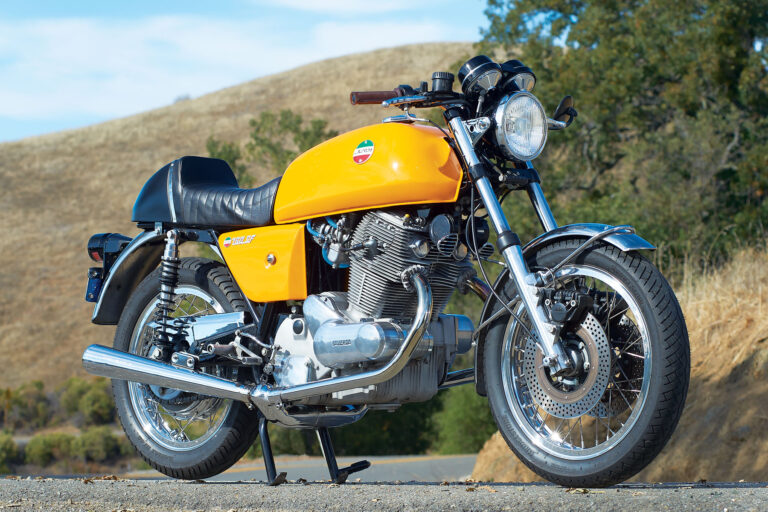
1974 Laverda 750 SF2
- Engine: 744cc air-cooled SOHC parallel twin, 80mm x 74mm bore and stroke, 8.9:1 compression ratio, 65hp @ 7,000rpm (approx.)
- Top speed: 118mph (period test)
- Carburetion: 2 x 36mm Dell’Orto PHF
- Transmission: 5-speed, chain final drive
In 42 years of riding, Steve Cakebread has owned his fair share of motorcycles. The list includes everything from a little Yamaha DT100 to a boisterous Triumph Thruxton 1200R, plus numerous Japanese and Italian sport bikes, among them three Kawasaki H1 and H2 two-stroke triples and three Ducatis, including an MH900e. These days he has just two bikes in his garage, a 1974 Laverda 750 SF2 and a 1975 Norton 850 Commando Mk3.
“I tend to gravitate to the Laverda,” Steve says of the two. “Due to my work travel commitments and family life, riding can be interrupted for months. You can leave the Laverda for six months and press the button, and it will start first time. The Norton always seems to have some issue, such as a stuck float valve or needing the crankcase drained of oil, even though it has an upgrade anti-drain valve and oil pump mods!”
That admission takes on added meaning when you learn that in 1958 Steve’s father, Bill Cakebread, began a five-year apprenticeship at Associated Motor Cycles Ltd., the parent company of AJS, Matchless, and Norton motorcycles. That apprenticeship led to him working with the design team for the stillborn double-overhead cam, 800cc Norton P10 of 1965, before he left the company in 1966. The connection goes deeper yet: Steve’s uncle, Bob Cakebread, was on the design team for the Norton Commando. By rights, Steve should be reaching for the Norton, not the Laverda. “The Laverda is oil tight and a lot easier to work on,” Steve explains. “The Norton has separate engine, primary drive and gearbox, which adds additional parts and extra leak paths. The Laverda has all the good practices of the then-emerging Japanese bikes — horizontal split cases, integral gearbox, starter motor designed from the beginning rather than being added later, and wet sump.”
SF beginnings — imitation is flattery
In 1964, 25-year-old Massimo Laverda, newly minted general manager of Moto Laverda, the company founded by his father, Francesco Laverda, in Breganze, Italy, in 1949, traveled to the U.S. to take a closer look at the all-important U.S. market. He’d gone to the States once before, in 1959, when he met up with motorcycle enthusiast and Cycle World publisher Joe Parkhurst, and the 1964 trip galvanized his ideas of what Moto Laverda needed to succeed on the international stage: a big-bore motorcycle.
Up to that point, Laverda’s biggest motorcycle had been a 200cc overhead-valve parallel twin. Before that, Laverda had made its name with a series of rugged overhead-valve 75cc and 100cc single-cylinder machines that had proven highly successful in Italian road racing, dominating their class in events such as the Milan-Taranto and the Motogiro d’Italia. In the 75cc class in 1953, Laverdas took the first six places in the Motogiro and the first 14 in the Milan-Taranto.
Inspired by Honda’s robust parallel twin, Massimo bought a 305cc Honda CB77, which he and chief engineer Luciano Zen subsequently disassembled and analyzed, assessing its design and potential as a significantly larger engine. It’s said that imitation is the sincerest form of flattery. If true, then Zen’s final design was the ultimate flattery, looking — albeit significantly larger — every bit like the Honda engine it was modeled after. Originally a 654cc 180-degree twin, the new engine was first produced in 1968 as the 360-degree Laverda 650. Likely fewer than 200 were manufactured before the engine was enlarged to 744cc.
Buyers in the U.S. were first introduced to the big Laverda as the American Eagle, brand-engineered by serial entrepreneur Jack McCormack, who was famous for helping shape American Honda’s 1962 “You meet the nicest people on a Honda” marketing campaign and was the first importer for Suzuki motorcycles in the U.S., in 1963. Jack saw promise in Laverda’s new big twin, and working closely with Massimo, Jack secured production from Laverda for his “Classic” American Eagle before the 750 became available anywhere else.
The relationship continued for 1969 and 1970, with Jack the sole U.S. importer of the Laverda 750 for American Eagle. Ever the marketer, Jack arranged to have famous daredevil Evel Knievel use a Laverda twin for his jumps, and it was during this time that Knievel adopted his signature stars and stripes design that adorned the Laverda and his riding gear. By 1970, however, Jack’s American Eagle Corp. was floundering, and it was liquidated in 1971.
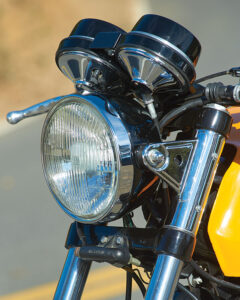
Meanwhile, Laverda continued developing the 750, in 1969 introducing the 750GT, followed by the first sport version of the bike, the 750S, which featured more aggressive camshafts and a higher 9.65:1 compression ratio against the GT’s 8.9:1. The 750S was dropped in 1970 with the introduction of the 750SF, the new designation standing for “Super Freni” — Super Brakes in Italian. The patented Laverda-manufactured drum brakes were designed by Massimo’s father, Francesco, and replaced the Grimeca units previously used. The Laverda-designed brakes were considered vastly superior to the Grimecas, providing strong, consistent, drama-free braking. The frame was revised, including, among other changes, a lower center of gravity and added thickness at the rear engine mounts to address stress cracking.
The 750 proved itself in endurance racing, its successes inspiring Laverda in 1971 to introduce the 750SFC (Super Freni Competizione), a factory production racer with hand-assembled engines and numerous modifications to make the bikes lighter and faster. Production of the 750SFC continued through 1976, with 549 of the model built.
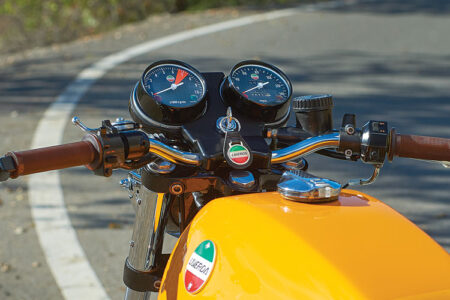
The SF continuously evolved, including engine and chassis upgrades and changes to cycle gear. A Nippon Denso speedometer and tachometer replaced the previous British Smiths units starting with the second series 750SF in 1972, and Lucas switchgear replaced the previous German Bosch gear. From the beginning, Laverda equipped the 750 with components sourced from England, Germany, and Japan, including a Nippon Denso starter and Bosch electrics for charging duties.
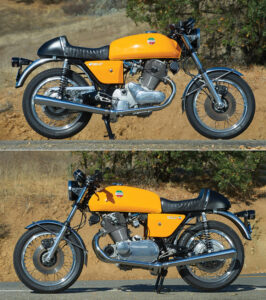
The 1973 SF1 saw larger 36mm Dell’Orto PHF 36 carbs replace the previous 30mm VHB units. Intake and exhaust valves grew from 38mm and 34mm, respectively, to 41.5mm and 35.5mm. Compression was lowered to 8.9:1, but claimed output was boosted from 60HP to 65HP. Other changes included second-series Laverda drum brakes.
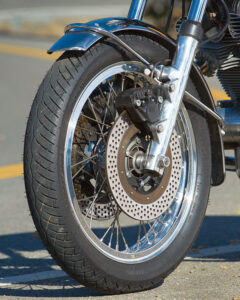
More changes came in 1974 with the introduction of the SF2, the bike featured here. Up front, 280mm Brembo disc brakes in both single and dual-disc configuration (U.S. bikes were apparently fitted with dual discs only) replaced the Laverda drum, and the Lucas switchgear was replaced with Nippon Denso switches identical to those used on various Suzukis. The final iteration of the SF2 came in 1975-1976, with left-side gear shifting and right-side rear brake pedal for U.S. versions.
With Laverda’s 1,000cc triples taking center stage, the 750 twin was fading from the limelight. The 1976-1977 SF3 was the last of the 750 line, distinguishable by FLAM alloy wheels, a 280mm Brembo rear disc, a revised gas tank, and a fiberglass tail section. From 1968 to 1977, Moto Laverda produced just under 19,000 twins, 5,030 of them in 1972, its highest production year. By comparison, Honda built an estimated 63,500 CB750s in 1972 alone, and more than 400,000 total between 1969 and 1977.
Steve Cakebread’s 1974 SF2
Proving the apple doesn’t fall far from the tree, Steve Cakebread, like his father before him, has spent a career in engineering, likewise starting in the motorcycle industry, as an apprentice draftsman in 1983 with Weslake & Co., Ltd., the company responsible for the 8-valve heads introduced in 1982 on the last gasp Triumph TSS. “My father had always been mechanically driven, even before he started his apprenticeship,” Steve says. “I started making scale models at a young age, and I sort of followed in his footsteps. I worked within the motorcycle group and reported directly to Ron Valentine, the designer of the Hesketh V1000 engine. Unfortunately, the company folded six months later.” From there, Steve went to work with Jaguar specialist Lynx Cars and then Warrior Automotive, which developed a 16-valve conversion for the Ford Pinto OHC engine, before returning to Weslake following its reorganization.
In 1994, after completing his master’s degree, Steve was hired by engineering company Ricardo in England. “The intent was for me to go into the motorcycle group. Ricardo at this time was relatively small, and I was pulled into a new high-speed direct injection diesel engine program for Ford, codenamed Puma,” Steve recalls. Shortly thereafter, GM contracted Ricardo for work on its new global 3.6-liter V6 engine, and Steve moved to Detroit to work on the program, eventually finding his way to San Jose, California, and he is now project director within Ricardo’s automotive and industrial group.
Motorcycling has been at the center of Steve’s interests, acquiring his first at the age of 16. “My passion for motorcycles and engine design stems from my grandfather, who rode Panthers and ex-military Indians fitted with his own homemade sidecar outfits, and my father and uncle,” Steve says. His father owned numerous motorcycles over his life, including Vincent Rapides, Broughs, a Manx Norton, and an Excelsior. And following his work at Norton, his uncle Bob Cakebread joined up with Colin Seeley, where he designed the Seeley-Suzuki monocoque chassis. A love of motorcycles runs deep in the Cakebread family.
Which brings us to Steve’s ’74 Laverda 750 SF2. “I’ve always thought the canted over forward engine added a bit of quirkiness to it,” Steve opines, “so very much like the Honda CB77, of course. I hadn’t ridden one before I bought mine, so it was a bit of a leap of faith. But I liked the clean lines of the bike, it has a certain level of symmetry, and I really took to it. It was a classic, it was Italian. I’d seen one before that needed quite a bit of restoration, but when I saw this Laverda was for sale, the advertisement photos showing the California sun shining on the beautiful orange paintwork and chrome, I think the deal was done. I put a bid on it and ended up with it,” Steve says.
“It was in very good condition as described, and I knew about the non-standard parts like the pod air filters, rear sets and rear shocks,” Steve says. “It also had the wrong Fiamm horns (Steve fitted the correct ones shortly after buying it) and it also has drilled discs, which are quite nice, so I’ve kept them.” Steve’s left a few other modifications in place, as well. “When I purchased it, I realized that some of it wasn’t standard, so I ended up buying the correct footrests, rear shocks, and air box with the intent of returning it to standard. But then I just liked the look of it, the aesthetics. The pod filters and the period rear sets look the part, and they are very comfortable, surprisingly, and the rear shocks (Works) just seemed to look right, so I ended up keeping it as it was.”
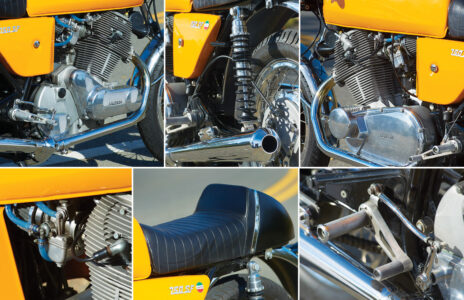
According to the previous owner, the engine was rebuilt by well-known Laverda expert Scott Potter. “The engine has been excellent. It’s very mechanically quiet for an air-cooled engine. The only thing I did when I first got it was to change the oil, which I religiously change every 1,000 miles due to the filter being a rock catcher compared to modern oil filters,” Steve says. But it wasn’t all roses. “One of the ears was broken off the 4-bolt retention plate for the oil filter, so I bought one that has a drain plug fitted in the bottom. There were a lot of electrical gremlins I had to deal with as well, mostly rerouting of wires. Some of the cycle parts I had challenges with, like the throttle cable, which was probably half a yard too long and wrapped under the tank, and the headlamp rim spring retainer was broken, and the swingarm bronze bushes were totally shot. That was probably the worst job I’ve ever done on a motorcycle, carefully sawing out the bronze bushes to then punch them out. They’re about 5mm thick and it took an age to punch them out. It probably took me a week in the garage over the evenings, gradually sawing away. I fitted it with needle roller bearings, which are the common replacement, which I got from Wolfgang (Wolfgang Haerter at Columbia Car & Cycle). I rebuilt the brakes using aluminum caliper pistons and new seals. I’m trying to get the rear brake to work as efficient as possible. Setting up a twin-leading shoe brake is a real challenge, but I’m getting there.”
Perhaps as an internal response to his work in high-tech engineering, Steve has found himself gravitating away from newer machines to the classics. “I had a Triumph Thruxton 1200R, and it was beautiful. It was such a nice bike and it would handle well and the performance was phenomenal, way above my capability. But being an engineer, I like adjusting and maintaining, and there’s really nothing much you need to do with them. It’s all electronic, it’s fuel injected, there are no carburetors to play around with, there’s nothing to adjust. I sold it to buy a Norton that I knew would be dripping oil and that I’d have to work on, but I find that more enjoyable than having something that’s a showpiece. I like something I can react to on a mechanical level, something I can work on,” Steve says, adding that he does all his own work on both bikes.
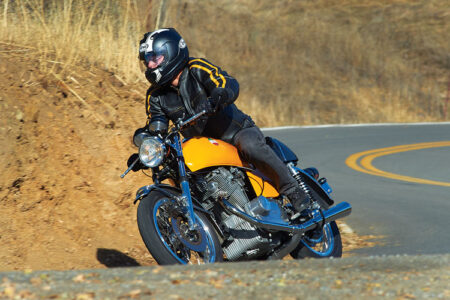
Unlike the Norton, which Steve says can be challenging to get rolling after it’s been sitting for any length of time, the Laverda has proven easy to awaken from a slumber. “I’ve had these long periods where I didn’t ride it for six months and didn’t do anything to prep it, and it started first press of the button. It really is reliable. I’ve had modern bikes that take longer to start. I think that’s what’s made me keep it all this time, it’s such a reliable bike, I can just go out and ride it. It hardly drinks any oil, consumption is non-existent, really. I’m a great believer these bikes need to be ridden. My father rode up to the pandemic, when he started to slow down, and he was a great believer in the value of the bikes, he respected them, but he didn’t mind getting them dirty and using them.”
Now showing 26,000 miles, Steve’s SF2 had 19,000 on the clock when he bought it some nine years ago, and in that time, it has proven exceptionally reliable. “It’s never let me down,” he says. And while he finds the SF2 less “flickable” in tight corners compared to his Commando, he loves the SF2’s long wheelbase, which provides excellent stability at speed and on long, sweeping curves, adding that it’s “a joy to ride over the Santa Cruz mountains and along Pacific Highway 1.” Not only a joy to ride, but Steve’s SF2 is also a joy to view, as substantiated at the 2025 Scotts Valley (California) Motorcycle Show, where judges awarded it first place in the Italian Class, a fitting confirmation of this SF2’s place in motorcycling history.
In 2008, Veloce Publishing released Motorcycle Apprentice: Matchless in Name and Reputation, Bill Cakebread’s vivid memories of his apprenticeship and work at Associated Motor Cycles Ltd. A thoroughly engaging look inside the British motorcycling industry of the 1960s, it’s a must-read for any student of motorcycling history. Last reprinted in 2016, copies can still be found online. Sadly, Bill Cakebread passed away last year. MC