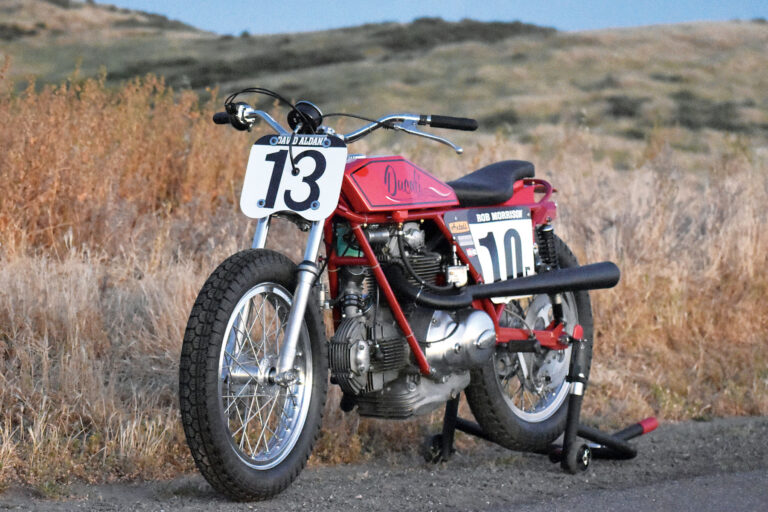
1972 Ducati 750GT Ron Wood Flat Tracker
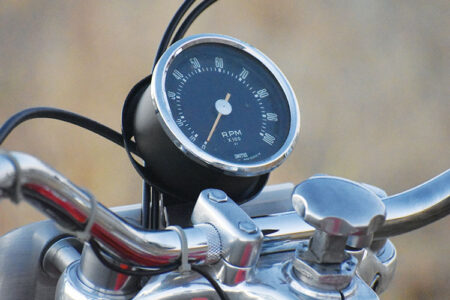
- Engine: 748cc air-cooled 4-stroke 90-degree SOHC L-twin, 80mm x 74.4mm bore & stroke, 62hp @ 8200rpm, 9.3:1 compression ratio
- Carburetion: Two Amal GP-2 with matchbox remote floats
- Transmission: 5-speed, right foot shift, gear primary, wet multiplate clutch, chain drive
Call it blind luck, if you will, or perhaps it was happenstance that led to Clyde Williams’ acquisition of what turned out to be a rare race bike. No matter, because at the end of the day, blind luck, as well as being at the right place at the right moment, was the final, and perhaps determining, factor that led vintage race bike collector Clyde to purchase the remains of what he suspected was a rather historic and very unique — even rare — classic AMA Class C flat track racer.
The bike was clearly in need of a major restoration, and Clyde decided that he and his good friend Sal Peluso should be the ones to return it to an honorable condition. But first Clyde had to make sure it was the bike he suspected it to be.
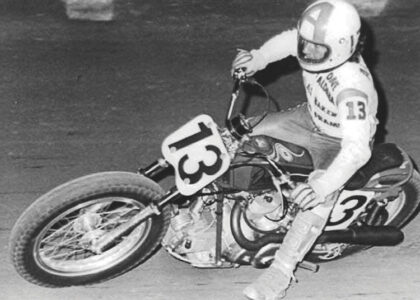
Historically speaking, the bike’s glory days had been short but sweet. Much like a Roman candle, the flat track race bike at one time might have shined strong and bright, only to fizzle and fade into obscurity practically overnight. But before that happened, the old war horse in question saw action on Southern California’s fabled oval dirt track. That would be J.C. Agajanian’s Ascot Half-Mile, a challenging dirt oval known for its tacky clay surface that often became slippery before the checkered flag waved. In fact, and at separate times, the old Ducati race bike actually had competed at Ascot, where AMA expert riders Rob Morrison (# 10E), Rex Barrett (# 21X), who had, at various times, alternated seat time with seasoned flat track veteran, David Aldana (#13). Aldana, one of the original members of “Team Burrito,” circa 1970, featuring feisty Don Castro, and the late, great Gene Romero. Aldana is, of course the rider that race fans from the 1970s will remember always — the ever-colorful “Bones,” a moniker given him after his various action-packed race crashes that he always managed to walk away from, using the long walk back to the pits to dust off his leathers, and himself, too, while waving at the crowd. In time, Aldana wore iconic and rather “colorful” black leathers, complete with full-body skeleton graphics stitched onto the front. Those leathers soon became his trademark. And through it all he never showed signs of slowing down! Moreover, it was his never-say-die attitude that eventually landed David into the Trailblazers Hall of Fame, and he was later presented with the Trailblazers’ Dick Hammer Award in 2024.
The man behind the machine
But for now, let’s get back to sorting out how this historic race bike found its way back into the light of day. Fittingly, as events unfolded, this flat track race bike’s original builder and tuner was famous, too. That would be team owner and bike builder, the late, great Ron Wood. His race team, Ron Wood Racing, was headquartered in Costa Mesa, California.
As you can imagine, Wood’s background was colorful and legendary, too. He initially hung out with other Ascot railbird race fans until he stepped into the lion’s den with his own bike entry. Turned out that one of his race fan friends had boldly commented in between heat races that he could go faster than some of the racers on the track that same day. So Ron Wood the spectator decided he could, and would, build a short-track bike for his friend to live up to his boast. That episode happened during the 1960s, and soon enough, Wood and his rider began competing at Ascot Raceway’s weekly program. They gained admirable success with each race they finished. Wood eventually built a short-track racer based on Dallas Baker’s frames that C&J Fabricators’ Jeff Cole and Steve Jentges produced for Wood’s racer that was powered by a Ducati 250 single-cylinder four-stroke engine. The combination soon enabled Wood’s rider to match, even beat, the two-stroke-powered bikes that had been the bike of choice among Ascot and other west coast competitors.
Wood’s bikes soon became known not only for their speed, handling, and reliability, but also for how they boasted excellent preparation, and in later years the bikes wore eye-catching red livery that was almost too good to be spent on any race bike! Wood’s on-track success with those 250cc Ducati engines eventually put him in close contact with Ducati’s chief engineer, Signor Fabio Taglioni, a man who created many powerful and well-crafted motorcycle engines that, for many years, propelled Ducati’s growing presence on the roads and race tracks in Europe and America… including some of America’s challenging dirt ovals, too. Wood’s success with Ducati 250cc singles proved to be a winning combination that led to an abundance of first-place trophies for the team’s trophy mantle.
Eventually Wood, in a sense, graduated to Half-Mile racing, and in doing so, switched to British-made Norton engines to power his entries for Ascot’s famous oval, where his Norton-powered bikes began dominating the weekly half-mile program. That combination also won Ascot’s 1978 AMA Grand National Half-Mile, which was part of the Camel Pro Series. Wood’s rider, Alex Jorgensen (and, at times, other riders), began dominating Ascot’s weekly half-mile racing program.
But all that was ancient history as far as vintage race bike collector Clyde Williams was concerned. Now retired from serving on San Diego, California’s, Harbor Police Department, he maintains a vintage race bike collection that keeps him busy at the height of his retirement years. But on this day, he was using his investigation skills to determine if the aging flat track racer he spotted was the same bike that he suspected it to be. Indeed, and at the very moment, his eyes became locked on the old bike — or what remained of the old bike — poised in front of him. Was it the flat-tracker that he suspected it to be?
Racers, start your engines!
The year was 2016 — Clyde had been surfing eBay’s vast market of vintage motorcycles for sale. As Clyde describes eBay, “it’s the world’s largest market place for [seeking] vintage motorcycles.” This particular day he was following up on a few bikes posted on eBay. The bike that initially caught his attention was propped against the wall behind a hillclimber. Clyde recalled, “It was the few bits and pieces of that motorcycle propped up behind the ‘climber that especially got my attention.” And what really grabbed his attention was the frame’s faded red paint — that is, what was left of its paint job, and the bike…
Clyde continues: “While looking at the hillclimber I noticed something interesting positioned behind it. It looked like an old flat tracker that was missing much of its racing hardware and various other components,” he recalled. “The engine was gone, the gas tank was gone, there was no seat, no front wheel, either,” and on and on it went as he recalled that day in Bisbee, Arizona, where the bike probably had been sitting for many years. As for the bike itself, its faded red frame was the only major component that showed any semblance to the bike’s former self — the big giveaway convincing Clyde to dig deeper. Clyde knew that Ron Wood had built a Ducati-powered flat-tracker, capable of AMA Mile Dirt track racing, possibly as early as 1973 or ’74. At the time, Harley-Davidson’s XR-750 was laying waste to the competition on America’s oval dirt tracks. So in 1972, when Ducati launched the 750 Sport with its “90-degree V-twin” as various magazine road test articles of the day referred to it, those reports also touted the new Italian engine as a savior that might relegate Harley’s XR-750 to second place on the half-mile and mile ovals in AMA’s Grand National Championship competition, which Harley-Davidson had dominated since the British contingent threw in the Royal towel regarding their factory support in AMA racing. So logic suggested during the mid-1970s that the Italians’ new Ducati “V” as the next Harley executioner. “Hmm,” agreed many of those Class C engine builders. Many were in agreement; the new Ducati “V-twin” engine might have potential to challenge the Harleys on America’s oval dirt tracks.
Now let’s get back to that special day in Bisbee, Arizona, with Clyde Williams. After processing the likelihood that this could be Ron Wood’s long-lost Ducati 750 flat-tracker, Clyde realized he was on to something special! Because, in an instant, when Clyde’s vision had momentarily blurred, it was enough that he could focus on one thing only — the #10E — Rob Morrison’s number…on the number plate that was still attached to the motorcycle. And Clyde reasoned that Morrison’s number plate had miraculously survived five decades intact and stuck firmly onto the aging flat-tracker’s plucked-over carcass and its fading red paint! Plus the old bike still had a rear tire, and that, too, served as a helpful clue that this was Wood’s’ Miler. Clyde had recently read a race article in a current issue of Cycle World magazine (December 2011, page 38), suggesting that Wood’s flat tracker had, at one time, been spotted drag racing in Arizona, of all things. But most of all, for Clyde, the discovery of Morrison’s number plate with the bike made it closer to certain that it was the bike Morrison had raced on occasion.
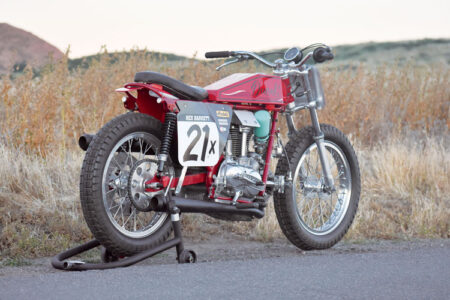
All those years, and the plate was still intact and attached to the old race bike, yet many of the bike’s original racing components and hardware were missing. But there were still enough clues prompting Clyde to dig deeper. He bought the carcass and returned home with it in tow, then placed it in his mini museum near San Diego to begin the old racer’s overdue restoration. Clyde was convinced that the number plate was the key, and the truth was found in the faded black numbers on a weathered white number plate that still displayed Morrison’s number! It was time to bring the late Ron Wood’s Ducati Flat-tack racer home for its just reward — a full restoration, which Clyde and his cohort and long-time friend, Sal Peluso readied for. It was time to put to rest all the years of neglect that the old bike had survived. Locating the bike was accomplished through diligent investigation of what showed in the background of a hillclimber listing — and a stroke of luck. Restoring the bike takes even more strokes… strokes of hard work, much research, parts searches, and careful and skillful shop habits. And Clyde and Sal were certainly up to the task.
Next stop… the shop!
Clyde and his “restoration buddy” Sal examined what Clyde had brought back, and both men were confident about restoring their new acquisition. Yet they knew it would be like any major restoration — a long and challenging process. Clyde immediately began searching for a “loose” Ducati 750 “90-degree V-twin engine,” but only after he promised that he would not take any engine from an existing bike. “I didn’t want to take another bike out of the game,” he promised himself, “so I kept the search only ‘for available’ engines,” which he eventually located.
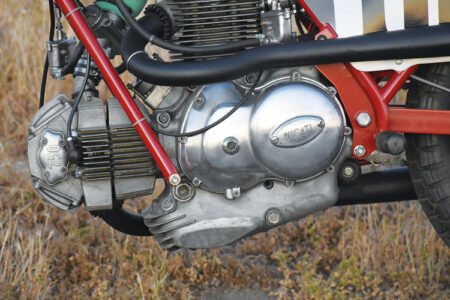
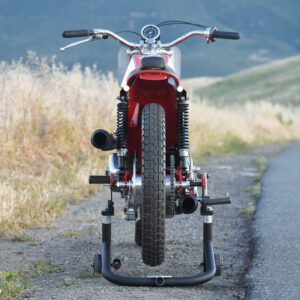
With a suitable engine in their possession they were able to confirm that the frame was, indeed, from Dallas Baker and C&J Frames (Jeff Cole & Steve Jentges, thus C&J). Meanwhile Sal went about modifying the lower left area of the clutch cover for proper cornering clearance. Using original photos taken by race photographers “back in the day,” Sal created templates to guide him as he formed a 45-degree beveled section (sharing the same dimensions as Wood originally applied to create needed cornering clearance). The beveled section is apparent on the lower left and in close proximity to the left side clutch adjustment access hole. Indeed, Sal’s fabrications looked as if Ron Wood himself had formed the crank case for increased cornering clearance! As luck had it, all mounting and access holes in the frame were intact, allowing Sal to match other corresponding mounting points, etc., when necessary. For instance, he measured the frame’s original holes’ spacing, which helped him determine the precise dimensions needed, based on what he studied in the photographs, so he could position the parts that he fabricated. Depending on the modification, he might TIG weld the piece in place before laying a bead for strength. Fortunately those vacant mounting holes remained, through the years, in the frame, which helped Sal position the replacement parts that he fabricated, and each one fit exactly where they were originally placed on the bike decades ago.
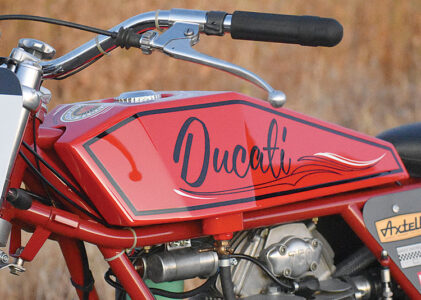
Another of Sal’s major contributions, of which practically all seasoned fabricators are known for, included fabricating the bike’s unique and stylish gas tank. Sal sectioned the corresponding pieces so when assembled and welded together they formed a single body. The tough part was heli-arcing each joint into position. When finished, the newly fabricated components match those that appeared in the original black and white photos Sal used as his guide. Those photographs were taken in period by some of motorcycle racing’s greatest photographers helping Sal recreate many details on the bike. “Once Sal began working on fabricating the new gas tank,” Clyde said, “I realized that we were, for sure, on our way to restoring the old bike.”
Sal is one of those specialists who can fabricate practically anything; give him a sheet of steel or aluminum alloy and watch as he transforms it into a familiar and usable piece for the project. And so Sal continued piecing together parts of the bike. First the seat, adapting an NOS Cobra seat that Clyde had sourced, and that matched the original seat, per available photos. It’s the same style seat created back in the 1970s by Fiberglass Works. The “new” seat was topped with Cobra’s solo seat, similar to what Morrison, Barrett, and Aldana must have used. Then there was the upswept exhaust system fabricated after the engine, seat, foot pegs, etc. were laid out and fitted into place.
Clyde maintained the hunt for suitable replacements of other components. The harvest included rounding up a pair of remote float Amal carburetors along with locating the Hurst Air Heart master cylinder linked to the NOS rear brake pedal that was originally fabricated by C&J. Again, blind luck?
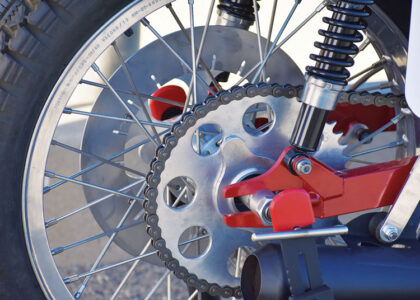
Buchanan Wheel laced the flanged Borrani (now that’s Italian!) wheels that Clyde located, and the rear hoop is fitted with a classic Barnes disc brake assembly and its familiar big-dish rotor, circa 1970s. Tires? That was an easy decision. Clyde and Sal went with a pair of NOS 19 inch Pirelli MT 53 tires that were then commonly used by riders, now by restorers.
Finally, it was time for paint, and the color was red, naturally, applied “By Romero” located in nearby San Diego. After it dried, “Pin striping By Rob Miller” got the call. Those period-correct decals on the bike were supplied by Tracee at DecalsbyFastDecals.com.
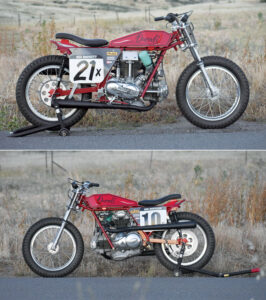
Perhaps the crowning touch is the three number plates, which use the same font styles that racers put on their number plates so many years ago. You’ll notice, too, that each plate bears its own rider’s name such as Morrison10E, Barrett 20X, and Aldana 13.
Epilogue
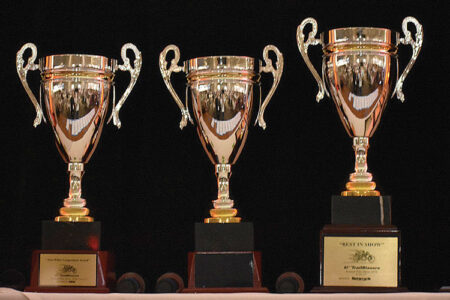
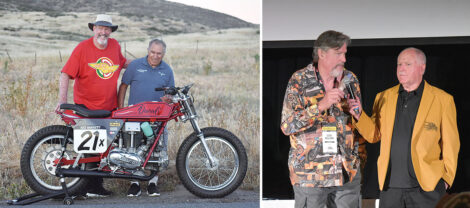
Clyde and Sal were able to finish the Ron Wood’s Roman Candle in time for the annual Trailblazers banquet, which includes a vintage motorcycle show prior to the banquet and the awards presentations. So Clyde and Sal entered the Ducati for display. And within those few hours that the bike celebrated its homecoming, the old war horse also reclaimed its historical and just place in the world of motorcycle racing, and the old gal didn’t even have to fire up her classic Ducati engine to do so. The bike had been in hibernation for half a century, and practically right out of the gate, the Trailblazers show judges determined that Clyde and Sal’s Ducati-powered flat tracker deserved the evening’s “Best of Show Award, Presented by Motorcycle Classics Magazine.” In effect, winning the award also served as a tribute to the late Ron Wood, along with all other trailblazer race-bike builders who had dabbled in putting Ducati-powered flat trackers onto America’s unforgiving mile ovals. Among them was Eddie “The Wizard of Odds,” Wilbanks, and perhaps most of all, Lloyd Brothers Motorsport’s Ducati entry that ultimately had put a Ducati in Victory Circle at an AMA Championship Mile with Joe Kopp in the saddle. No doubt, all the Ducati players deserve recognition for their efforts, each in their own way. Their efforts is what the Trailblazers are all about, celebrating the motorcycles and their riders who have emerged through the years. With every turn of the wheels, they move us closer to the finish line. MC