Change is here! As Motorcycle Classics has pointed out in recent issues, the classic motorcycling world is evolving and expanding daily. Many of the new “recruits” are from the pool of sporty Superbikes from the 1970s, ’80s, and ’90s. Even as you read this, those “aging” muscle bikes are settling into their golden years, and classic motorcycle enthusiasts are bound to preserve a newer batch of motorcycles, some of which will have powerful landmark engines capable of reaching 150 miles per hour and more.
Logic, mixed with a dose of common sense, suggests that those top speeds should be taken seriously; the faster the top speed attained by any motorcycle, the longer it takes to bring those speedy bikes to a safe stop.
An easy solution is to upgrade a classic motorcycle’s braking capacity, in this case, using a set of aftermarket replacement disc brake pads such as the DP Brakes pads featured here. DP’s replacement pads are based on a sinter-metal compound that offers improved braking performance in both dry and wet weather conditions. In addition, annoying disc-brake squeal is neutralized, and unsightly disc-brake dust is reduced.
Swapping to new pads generally includes a brief do-it-yourself session in the garage or at your local motorcycle shop. A more detailed DIY article about replacing disc brake pads was in How-To: Service Motorcycle Disc Brakes. In this story we’ll bring you expectations for this basic brake pad upgrade.
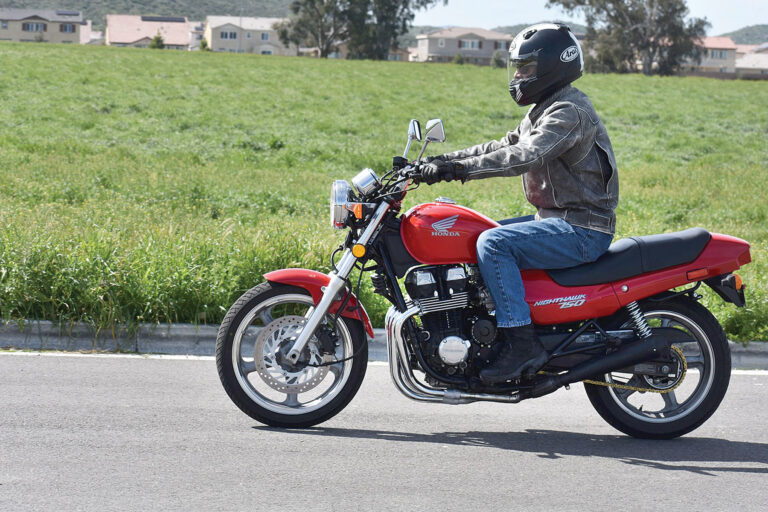
To expedite our testing, we arranged for Owen Bishop of Moto 41 Restorations in Santa Ana, California, to install DP Brakes pads on our test bike, a 2003 Honda CB750 Nighthawk. We chose DP Brakes’ “Standard” pads because they were engineered primarily for daily riding. The Nighthawk’s OEM braking system consists of a single front hydraulic disc brake and a tried-and-true mechanical drum rear brake. That combo allowed us to first measure stopping performance using both OEM brakes (front and rear), for a baseline stopping test. With that information, we could compare the resulting stopping distance. For our tests, we initiated braking at 30mph with and without the DP Brakes’ upgrade on the front brake, where most of a motorcycle’s braking force takes place. All initial braking speeds were the same — 30mph for each stop test. The front-brake-only stops (one with the OEM brake pads, the other with DP Brakes’ front pad) revealed how important the front brake can be. That was followed by a full-brake test; we included the Honda’s single mechanical rear drum brake for our follow-up comparison of the front brakes.

After Owen completed the brake pad swap, he checked the front brake reservoir’s fluid level, also taking time to make sure the brake fluid was fresh and clean. Owen recommends a brake fluid flush/replacement every couple of years, depending on how much you ride your bike. After topping up with Motul DOT 4 brake fluid — a quality product that Owen always turns to for his award-winning restorations — we were ready and raring to go, er, stop. And speaking of stopping, we were careful not to put excessive braking force to the new brake pads during an initial break-in period. So we kept speeds low for the first few miles. As brake feedback became more pronounced with each stop, we increased braking pressure until we were satisfied that the new pads had “bedded in.” Next stop? Motorcycle Classics’ elite Proving Ground, where I’d meet with my brother, Alan, who volunteered to help with the testing.
While we settle in for the brief ride to our “top secret” proving ground, let me share some interesting background about DP Brakes’ history. The company itself has roots that reach back to World War II when Dunlop Tyres supplied tires for England’s Royal Air Force (RAF) fighters and bombers. Wet weather and heavy combat loads were creating unsafe landing and stopping conditions for RAF fighters and bombers when they returned to their air bases after their combat missions. Something had to be done, and disc brakes, pretty much a novelty back in the early 1940s, were the answer. So Dunlop dedicated a new division to oversee disc brake development. By war’s end, and mission accomplished, Dunlop had success, and years later, an all-new company, DP Brakes, was formed in Buffalo, New York, where the company remains today, managed by Larry Mills. Today DP Brakes’ products are available from local dealers and shops, including Parts Unlimited dealers who offer overnight delivery for their customers.
Mills is also quick to point out that DP Brakes offers upgraded disc brake pads for competition, including road racing, off-road motorcycles, ATVs and side-by-side utility-vehicles, and plenty more. They also sponsor races and race teams! But for the time being, this magazine will concentrate on helping readers get those increasingly higher-performance classic sport bikes back on the road, and stopping well!
Testing 1-2-3
| Test 1 | Test 2 | Test 3 | Test 4 |
| OEM front disc brake and rear OEM drum brake | DP Brakes and OEM rear drum brake | OEM front disc only | DP Brakes front disc only |
| 30 feet | 24 feet | 34 feet | 27 feet |
We performed two baseline-stopping tests, leaving the Honda’s OEM Nissin front disc brake pads in place for Test #1. The Honda’s rear mechanical drum brake was not used for two of the four tests (Test #3 and #4), allowing us to compare the front disc brake’s performance in both stock and with DP Brakes pads. That helped determine the Honda’s absolute stopping performance with DP Brakes pads. Tests #3 and #4 make use of front and rear brakes for further comparison. All stops were initiated at 30mph.
We performed four tests — two with front disc brakes only, and two with front disc brakes and OEM rear drum brakes. Though results will vary with different brake systems, tires, and rider skills, our test results for the Honda Nighthawk show a significant 20% decrease in braking distance.