Trailblazers might be a peculiar name for a motorcycle club that focuses primarily on racers and key members of the motorcycle industry in Southern California. In truth, the Trailblazers’ dedicated membership constitutes more than 1,000 enthusiastic and energized members, the majority who are anchored in California, where Trailblazers originated more than 80 years ago. Despite the club’s roots running deep in Southern California’s active motorcycle market, out-of-town members are welcome, too, and many do join.
In a curious and roundabout way, the club’s original activities were fashioned by a gentleman named A. F. Van Order, who, while still in his early twenties, migrated from landlocked Illinois, ultimately settling in Los Angeles, California. Even as early as 1911, the City of Angels was a thriving metropolis that attracted people seeking Southern California’s golden sunshine. Van, as many of his new and sociable California friends nicknamed him, adjusted quickly to his new lifestyle in the Golden State. By the time he was 25 years of age in 1911, Van had been hired on as a member of the sales team at Passmore & Sayre Harley-Davidson, among the largest motorcycle dealerships in Los Angeles. Most of those L.A. dealerships were situated cheek-to-jowl along the boulevard, forming what unofficially became known by locals as “Motorcycle Row.”
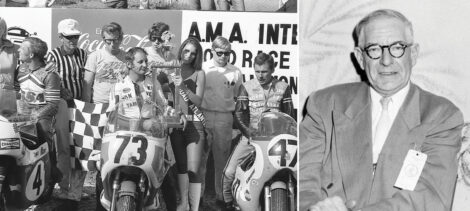
Van’s position in sales enabled him to enjoy casual, unplanned social opportunities that often led him to potential contacts within L.A.’s local motorcycling community itself. That, in turn, allowed him to easily interact with customers and motorcycle enthusiasts alike. Over time, Van Order’s social group grew to include motorcycle racers and other key figures within SoCal’s expanding motorcycle community. Many of his social and business contacts were part of the new and curious sport of motorcycle board track racing. Indeed, board track racing during the early 1900s through the 1920s was gaining stature as a legitimate professional sport. Looking back a century later, it’s strange to even think that, at one time, there were more than half a dozen board tracks throughout California, many more in large cities across America. Stranger yet, one of those California Motordromes was located in Beverly Hills!
Watching those and other motorcycle races must have made a strong impression on young A.F. Van Order, enough so that he purchased his own motorcycle. That set of wheels enabled him to participate in group rides, many of which delivered the road warriors to the local racetracks where they, and other groupies, filled the grandstands!
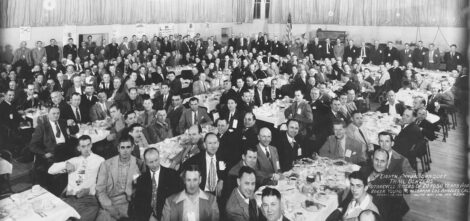
Van’s enthusiasm among hard-core motorcyclists, and the racers themselves, added credibility to his growing core of friends who appreciated his friendly demeanor, and ultimately, just after World War II, the Trailblazers club was formed. Eventually, he began reporting and contributing articles for his riding club’s newsletter. His newly acquired reporting skills, plus his many industry contacts, elevated his stature within L.A.’s growing motorcycling community. Most of all — and little did Van himself realize — his growing journalistic skills were setting his course toward a future editorial position with a relatively new motorcycle magazine — Motorcyclist, first published in 1912 in Los Angeles. Van’s contributions to Motorcyclist began to gain a following during the late 1930s and early 1940s. By the 1950s, his column was a fixture in every issue. His column, titled “30 Years Ago…” on events that happened, well, 30 years prior when Van was part of, and enraptured with, the early motorcycle racing scene. Van’s column also enabled him to write about his early-day luncheons and Trailblazer banquets. Moreover, those early banquets’ content and structure helped set the stage for today’s Trailblazers annual awards banquets format. But before that happened, Van helped fill each magazine issues’ 30-year void with his collection of early-day photography that he had acquired over the years. He also promoted what was best described as “Old-Timers Reunion Dinners” that served as the precursor for today’s popular Trailblazers banquets. In the beginning, Van had organized his early food fest concept more to gather his friends for casual get-togethers and mini-reunions than anything else. His casual concept continued into the latter 1900s and early 1920s, when The Great War, as World War I was originally labeled, began winding down, and better times awaited during the forthcoming Roaring Twenties. As motorcycle historian Harry V. Sucher, wrote in his book, American Motorcycle Association 1900-1990, “the war’s (World War I) effects on America’s economy soon were felt within the motorcycle industry as a whole during the late Teens. By then America’s economy had regained its former mojo, then came the Roaring Twenties, and America’s economy was at full throttle. Then, of course, the Stock Market Crash of 1929 led to the Great Depression, yet America survived to, once again, regain its footing; and then World War II had its say…” but only after Van Order and friends gathered one evening in 1940 for what became known as “The Trailblazers Banquet.”
According to former Trailblazers President Don Emde, “By the late 1930s, Van had actually been putting on reunion-style ‘Old Timers events’ for at least five or more years, but they were either Los Angeles Motorcycle Club events, or just productions by himself (Van Order).” Emde continued: “In 1939, Van first made use of the Trailblazers name and held a banquet in downtown Los Angeles.” Emde confirmed that Trailblazers still wasn’t a motorcycle club or organization. “This is why the current club lists its founding date as a year later, March 6, 1940,” he clarified. “That event included the election of popular racer Paul ‘Dare Devil’ Derkum for President and Van Order as club Secretary,” Emde concluded. From that date on, when Trailblazers was officially formed, the club has hosted an annual banquet, but with a few interruptions, chief among them World War II and the passing of Van Order in 1954, Emde pointed out.
Perhaps Van’s most memorable banquet was held in 1951 at the Rodger Young Auditorium. The guest list included several of the top racers from the board track era. Among the “chosen” were E.G. “Cannonball” Baker, Ralph DePalma, Don Johns, Fred Ludlow, Dave Kinnie, “Red” Parkhurst, and the renowned Ralph Hepburn. Truly an all-star lineup! The subsequent report in Motorcyclist opened with the following sentence: “The best Trailblazer dinner that Van has ever staged!” That landmark banquet also marked the Trailblazers’ “fifth annual reunion, dating back 11 years to 1940, but there were only five banquets on record in that time. Pause now for a moment; if you notice that those numbers don’t jibe it’s because World War II canceled about a half dozen would-be banquet dates due to the “War effort” that called for civilian conservation of food, gasoline, and other items needed for the war effort.
As welcome as those initial post-Depression banquets were, they failed to include one important feature; there were no women in the dining hall! Men only! That is, until ladies such as Lucile Flanders and others helped set the record straight! Today there are eight women members in the Hall of Fame, and that number is sure to grow as Trailblazers continue hosting banquets — that include women. To that we say, “thank you, Lucile Flanders, Mary McGee, and countless others.”
More change occurred in 1970 when Floyd Clymer, a former flat track racer and Hill Climb specialist, publisher, and president of Trailblazers, passed away. Fortunately, in subsequent years, the club’s leadership has included strong-willed racers and members of America’s motorcycle industry, such that Trailblazers has remained an integral part of the powersports market to this day and is an affiliate of the Motorcycle Industry Council (MIC). Names such as Bill Bagnall, Earl and Lucile Flanders, Max Bubeck, Walt Fulton III, Keith Mashburn, and Don Emde, who most recently passed the president’s gavel to Norm Bigelow. A host of others will surely continue to blaze the trail for years to come, or at least as long as we have motorcycles and motorcycle races.
Trailblazers Blazing Brightly in the Hall of Fame
As for members and their guests attending the annual Trailblazers’ awards banquet, a limited number of tickets are available to members and their guests (membership is just $10 annually). But wait, there’s more! Membership includes a monthly online newsletter edited by club and board member Bill Getty, who does a great job gathering classic racing photos originally photographed by some of the top photographers in the business. Best of all, the newsletter is available to non-members, too! To sign up for the newsletter, send an email with your email address to Trailblazers@gmail.com. Or visit the Trailblazers website.
Attending the Trailblazers’ annual awards banquet is actually somewhat of a challenge because tickets are sold exclusively to Trailblazers members, although members themselves can invite and reserve guest tickets at the standard price per seating. Trailblazers also supports its own Facebook page (Trailblazers Motorcycle Club), as well as hosting a website (www.TrailblazersMC.org). Anyone who fulfills annual dues of $10 automatically receives the online newsletter simply by providing an email address. Then settle back and wait for delivery! There is a link on the Trailblazers website to join.
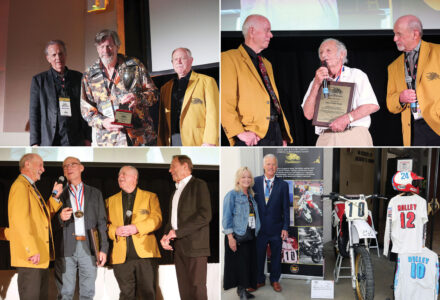
That monthly news feed is truly welcomed because it keeps you fired up for the remainder of the year. But the real show happens during the annual Springtime banquet, which includes a vintage motorcycle show that, oftentimes, includes the very bikes that were raced “back in the day.” Trailblazer Chris Carter, owner of specialty tool company Motion Pro, often shows up with a couple of bikes from his impressive collection, and dedicated classic race bike collector Mike Iannuccilli has displayed several of his immaculate historic bikes from his collection. Motorcycle Classics has featured many bike show entries in past issues. The magazine’s Best of Show winner was featured last year, and the 2026 Best of Show winner is featured in Bevel-Headed: 1974 Ducati 750 Sport.
Quotes and quips from the 2026 Hall of Fame inductees
Perhaps the real treasure behind the Trailblazers banquet is the awards presentations taking place after dinner, allowing us time to recognize and celebrate the very people who make, and made, a difference to the world and to the sport we all love — motorcycle racing. And to think that it all started with a friendly, soft-spoken guy from the Midwest and who had a passion for speed on two wheels.
The following 2026 Trailblazers Hall of Fame presentations give us our chance to reflect, in each of our own proud and magical ways, the love for the sport, and always looking forward. After all, we’re Trailblazers!
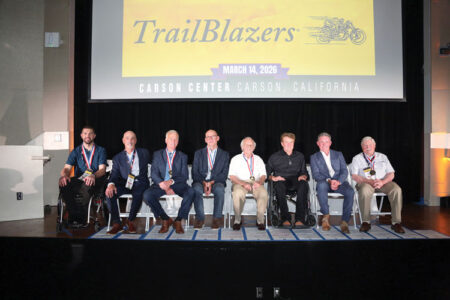
So, let’s tune in to the 2026 Trailblazers Banquet to hear some of the comments and insightful “war” stories as told by this year’s inductees.
Jim Holley — Motocross Hall of Fame, and Earl & Lucile Flanders Lifetime Achievement Award
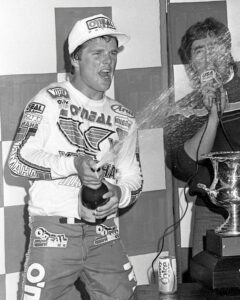
In the world of racing, Jim Holley’s success peaked when he won the 1985 Rodil Trophy World Supercross Championship. The audience also learned about Holley’s gift of connecting with people: during his acceptance speech at the awards presentations, he told how, shortly after joining Yamaha’s motocross team, he had shared a personal story with one of the motocross team engineers about how as a boy, Holley caught his hand between the sprocket and drive chain of his mini-bike. “Much damage!” He said to the engineer. Years later that same Japanese engineer recalled his original conversation with Holley, only this time he shared his own story. Turns out that he was lead engineer during the PW50’s development.
The engineer remembered Holley’s experience of getting his hand caught by the chain and sprocket, so the engineer told Holley that he integrated a less dangerous enclosed shaft-drive system; there would be no chance of a young rider injuring his or her hand this time! In addition, the Trailblazers Award program mentioned Holley’s ongoing support of his six-figure charity donations that he and his business partner Robert Hansen have continuously sent to City of Hope for its ongoing research to fight children’s cancer. Holley closed his speech with this question to everybody seated at the awards banquet: “Everything in the Trailblazers is good. My question to all racers is this: What did you give back to the sport?”
Dave Arnold — Motocross Hall of Fame
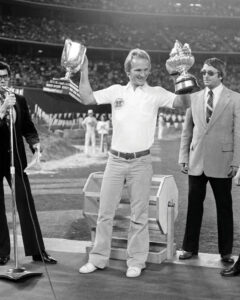
“The Man and The Man” might be a fitting caption to a photo that includes American Honda motocross team’s Dave Arnold and Roger De Coster together in the same frame. Because motocross fans know that it was the influence, hard work, and experience of both men that helped elevate motocross (and supercross) in America during the 1980s and ’90s. Due in large part to both men’s leadership, American Honda’s motocross programs enjoyed huge success during those years. So, it was only fitting that, by the time Dave Arnold stood before the microphone for his acceptance speech, “The Man,” would be standing right by his side. And so it was that Roger DeCoster (already a member of the Hall of Fame) appeared almost magically on stage alongside Arnold that evening. And it was during their early days as tuner and rider for Honda’s European MX squad that they, unknowingly at that time, set a future course for American Honda’s future MX and SX success. In case you forget either of their names, simply fall back on “The Man.” It’s a moniker that’s deserving of “Both Men.”
Brad Baker — Flat Track Hall of Fame
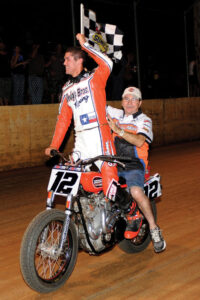
“A natural born racer” is a term you don’t hear with frequency, but those words easily apply to Brad Baker who, at 16 years old, turned pro. Within a few short years of racing, he scored the AMA Grand National Championship, becoming the third youngest AMA Grand National Champion, and doing so as a privateer, riding for the Dodge Brothers team. He later agreed to participate at the Superprestigio, a flat track race in Spain that included Moto GP legend Marc Marquez and other European racers. For this exhibition race that Brad Baker won, in the process beating fellow American Jared Mees (third place) behind Marquez! Fittingly, the Spanish and European fans went wild with excitement, prompting Baker to share some light-hearted joking with the Trailblazers: “I wasn’t sure if they (European fans) were going to throw me out.” In truth, Baker was loved by everybody there.
Baker’s brief career came to an end during a crash at the 2018 X Games, but his connection with flat track racing remains solid and strong, only this time he’s taking time to coach his younger cousin to get started in the sport. In closing, he shared with the Trailblazers about his race injuries that left him in a wheelchair: “I can either be miserable or positive and try to be happy,” he said, “and being positive seems like a better option.”
Randy Hall — Road Racing Hall of Fame
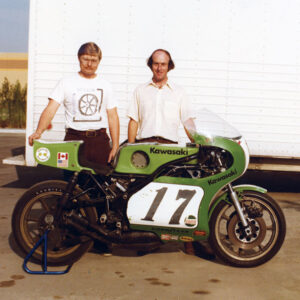
Ever wonder what goes on behind the scenes in the race pits during an AMA road race? The Trailblazers who share that commonality were given a little insight about one of the fastest road racers in AMA history. “When race practice got underway,” Hall began telling Trailblazers banquet attendees, “Yvon purposely slowed down in places where he was especially fast. As Kawasaki’s race team manager, Hall was certainly privy to Yvon’s ways! By slowing down, the other racers wouldn’t know his strong points on the track until the race got underway.” You can read about more war stories like this in Hall’s tell-all memoir Lean, Mean and Lime Green, which chronicles Team Kawasaki during that period, plus some dark, yet humorous, tales about Randy’s famous Ford van!
Mitch Payton — Motocross and Desert Racing Hall of Fame
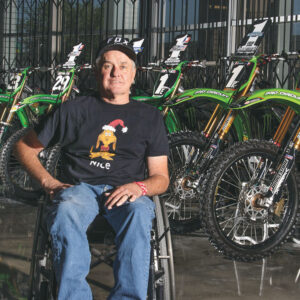
Mitch Payton’s career in desert racing was cut short by an accident that left him in a wheelchair for life. He got back up, in a manner of speaking, then settled into a wheelchair that became his business chair after he established what is now a thriving business. Pro Circuit reflects all that Mitch Payton could be, and that’s an inspiration to anybody within listening distance. Among those that he has inspired is a former Supercross and Motocross racer, Jeremy McGrath, ranked among America’s best motocross racers ever. During Payton’s induction, McGrath jumped up on the stage, loudly proclaiming “Mitch was more like a mentor!” Proof that Payton’s motto, “Be the best you can be!” works!
Ronnie Jones — Flat Track and TT Hall of Fame
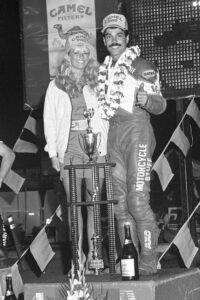
We wouldn’t be out of line if we titled this next Hall of Fame inductee as “Keeping up with the Joneses!” With the addition of Ronnie Jones, there now are more Trailblazers Hall of Fame members with the surname Jones (7), than any other name. (That fact might, one day, win you a beer at the bar!)
But Ronnie Jones is more than a name on a list — Ronnie Jones represents the old-school privateer flat-trackers who lived and survived in their vans and station wagons, and who were known to search for the most affordable meals made famous by diners and fast-food eateries that gained the nickname, “greasy spoon.” Overnight accommodations? Vans, station wagons, and pickup trucks were their second homes. And it’s also true that those original privateer flat track racers often relied on “local” motorcycle dealers, too. Many opened their shop doors to the traveling racers to facilitate service of their race bikes for the upcoming Grand National or local regional race, all in hopes of making the program for the Mains, and the money. Mr. Jones and his late brother, David, represent that kind of racers… and more.
Jeff Ward — Motocross Hall of Fame
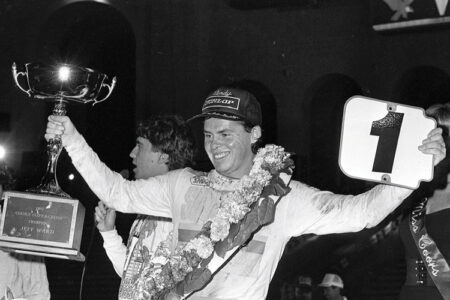
Read Jeff Ward’s racing resume and you won’t be the first person to suggest that this man is in a world (or racetrack) of his own. Begin with his seven AMA Motocross and Supercross National Championships (all of them with the same manufacturer’s team — Kawasaki!). Scroll further down his racing credentials and you’ll see the phrase “Indy Car Racing,” pop up. Indy CAR racing? Wait, that’s four-wheel racing, not two-wheel! In truth, though, Ward finished four Indy 500 races and nearly won at the Brickyard during his Rookie race! Before that chapter of his racing career ended, Ward recorded an Indy Car win. Next stop? Off-road trucks (more four-wheelers!), and his racing resume continued to expand, and eventually it spilled into bicycle racing, and, get this — he even competed successfully in the Race Across America (RAAM). This guy is a regular “modern-day Ralph Hepburn,” a racer who competed on motorcycles and cars back in Van Order’s days. Hepburn is also a Trailblazers Hall of Fame member. After one of his “retirements,” Ward realized that his three sons and daughter had never seen him race (read: win) motorcycles. Ward’s dad had been very instrumental in his son’s racing career, so it was only fitting that Jeff Ward, the father of four, should share some of his racing success with his family, prompting him to return for a stint in Super Moto. And, of course he won there, too!
Looking back, perhaps that old television program “Father Knows Best” was right. Afterward, Jeff Ward officially retired from all power sports racing. The Ward family can now exhale… Oops, but there’s one more race… the 860 mile (BICYCLE) Race Across the West, last June 16th. Jeff Ward and teammate Micky Dymond pedaled to win the two-person male 60-69 division! MC
Inside the Trailblazers Bike Show
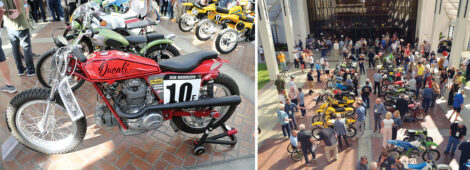
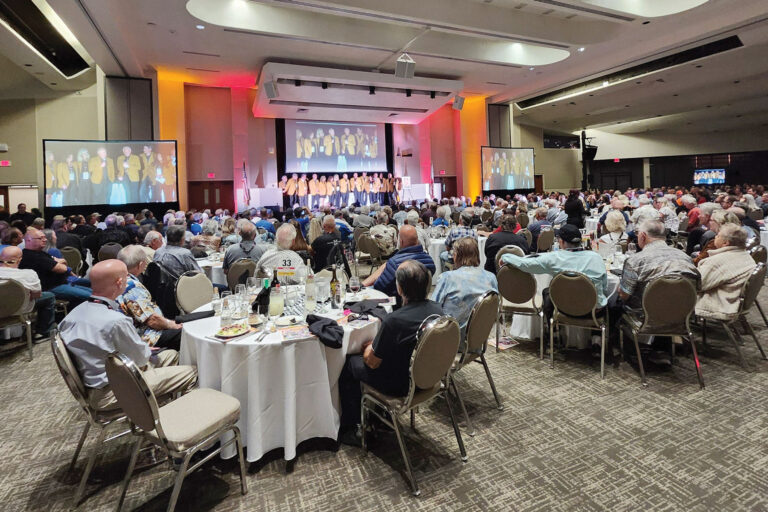
The most recent banquet, held March 14, 2026, was held at the Carson Center in Carson, California. The event opens its doors early afternoon when bikes for the Trailblazers Bike Show begin to roll in. Among the Bike Show awards are the Trailblazers Spirit Award, the Tom White Competition Award, People’s Choice, as voted by Trailblazers members themselves, and finally Best of Show, voted on by a special committee, the bike that Motorcycle Classics features in Bevel-Headed: 1974 Ducati 750 Sport.