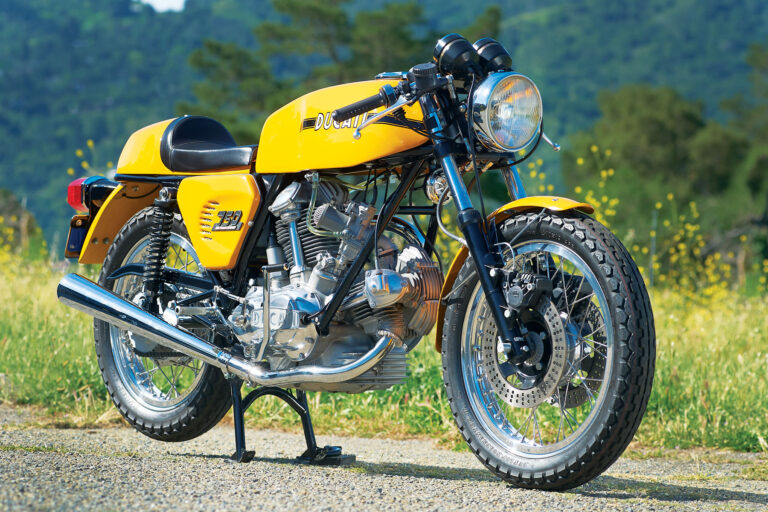
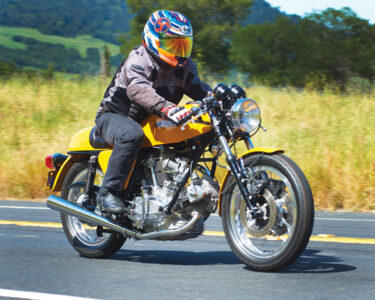
1974 Ducati 750 Sport
- Engine: 748cc air-cooled 4-stroke 90-degree SOHC V-twin, 80mm x 74.4mm bore & stroke, 62hp @ 8200rpm, 9.3:1 compression ratio
- Top speed: 131mph (period test)
- Carburetion: Two Dell’Orto PHF32AD/AS carburetors
Classic motorcycles come to us in many different ways. Dennis Etcheverry had a friend who brokered high-end collector cars. The friend was older, and his health began to fail. He had stored some cars and two bevel drive Ducatis in a damp storage unit and did not seem to be able to move them to a better environment.
With the help of other friends, Dennis got the bikes and the cars into a safe and dry garage. After some time, the friend passed on, and Dennis bought the two Ducatis from the estate. “I knew about these gems,” he says.
Bevel drive Ducatis have been referred to as addictive. Well-known motorcycle writer Peter Egan has said that he was able to quit cigarettes, but not Ducatis. “Pure pleasure, a mechanical drug that seemed to mix some kind of opiate with an equal amount of caffeine.”
These 90-degree V-twins, built from 1971 through 1986, were not only works of industrial art, but also smooth and fast, with excellent handling. The Ducati company is now celebrating its 100th anniversary, but it probably would not be here now except for an inspired designer and a race that took place in 1972.
Ducati started out as a manufacturer of radio components in 1926. The factory was bombed during World War II and had to reimagine itself after peace finally came. Italy’s public transportation system was in ruins, and there was a desperate need for inexpensive transportation. While still seeing a demand for radio components, the company branched out into bolt-on engines for bicycles. These engines became popular, and Ducati along with a lot of other Italian manufacturers, began a transition into building small motorcycles.
As the 1950s progressed, Italy became prosperous, the public transportation system was rebuilt, and the market for small, economical motorcycles began to shrink. Many of the postwar Italian motorcycle factories decided to build something else at this point or just closed their doors. Winning races was the key to selling motorcycles in 1950s Italy, and Ducati was then eating competitors’ dust. It hired Fabio Taglioni away from Mondial, with instructions to put the factory’s racers at the front of the pack.
Taglioni, or Doctor T as he became known, is one of a small group of European and British designers who has had an outsized impact on motorcycle history. He had been experimenting with desmodromic valve trains since the late 1940s, but Ducati gave him his first chance to put his ideas into practice. After designing the 1955 Marianna, a 100cc bevel drive OHC single with normal valve actuation that won the first race it entered, Taglioni developed a 125cc version for Grand Prix racing, with desmo valves and three camshafts. Both machines created positive international publicity for the company, which helped develop the export markets Ducati needed to stay afloat.
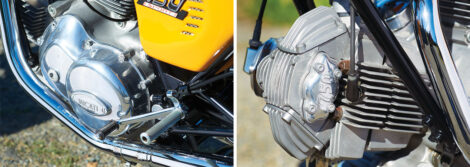
Ducati experienced modest success exporting 250, 350, and 450 single cylinder sport bikes to the U.S. and other countries, but really needed a twin to successfully compete in the motorcycle market of the 1960s. Dr. T, once given the go ahead from management in early 1970, quickly put a V-twin together that was ready for testing that summer and reached dealers in early 1971. This first twin, the 750GT, was envisioned as something of a touring machine. Once the company made sure there were no major bugs, it gave the go ahead for higher compression and sport tuning.
The Colin Seeley-designed Ducati 500 GP racer chassis, which used the engine as a stressed member, influenced Taglioni as he designed the 750GT chassis. The 90-degree V-twin engine had perfect primary balance, and the front cylinder was almost horizontal, lowering the center of gravity also helping with cooling the near vertical rear cylinder. Development time and costs were reduced by reusing as many components from the 350 singles as possible. The connecting rods were side by side on a common crankpin. The bevel gears that operated the overhead cam were expensive and difficult to produce and assemble, but a work of art. Carburetors were Amals, and stopping power was provided by a single disc in the front and a drum brake in the rear.
The 750GT handled well, but was not exceptionally fast, and initially did not gain much buyer attention. That all changed with the April 1972 Imola 200 race for production 750s, a highly publicized event that was advertised as the Daytona of Europe. Paul Smart and Bruno Spaggiari brought home first and second for Ducati on modified GTs with desmodromic valves. The roar of publicity after this race put Ducati on the map and probably kept the factory alive.
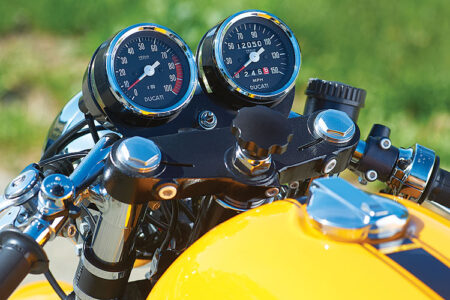
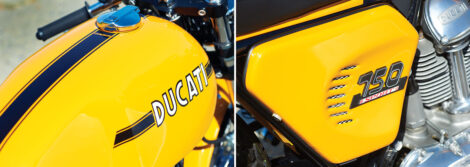
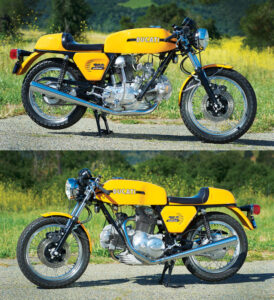
After the introduction of the 750GT went well, Ducati and Doctor T started developing a sport version of the V-twin. The first prototypes of the 750 Sport appeared in late 1971, with the official rollout in May 1972 after the Imola victory. Production started in September. The 1972 Sport had clip-ons and rearsets, a higher compression ratio, large Dell’Orto carburetors, a fiberglass fuel tank, and Marzocchi suspension. Body work was painted a rich orange-yellow with striking graphics and the frame was gloss black. In 1973, the rear subframe was made narrower, and the fuel tank remained fiberglass. The 1974 Sport had the same engine as the 1973 models but used Veglia instruments and was the only year for a steel fuel tank. Sports built later in the production year had 38mm Ceriani center axle forks and a single Brembo front disc brake. During this production year, a dual seat appeared as an option. The next step up in speed and tuning, the 750 Super Sport, a production racer which unaccountably was certified as street legal in the U.S., was provided for press testing in late 1973 and was sold in limited numbers to the public in early 1974. The nickname Green Frame was soon applied to the 750 Super Sport, a nod to the silver and green livery.
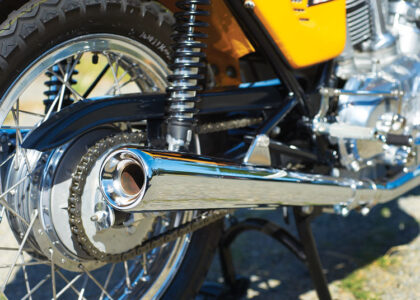
750 Sport production ceased in July 1974, although many machines were titled as 1975 models. Ducati launched the 860GT in late 1974, which did not appeal to customers and was slow to sell. Shortly afterwards, the 900 Super Sport was announced, with updated, “square” engine cases, as opposed to the 750’s round cases. The 900 Super Sport also had desmodromic valves, 40mm carburetors and electronic ignition. This bike was a production racing winner on the track and a best seller at Ducati dealerships. The bevel drive V-twin was always expensive to manufacture, and the last one came off the assembly lines in 1986.
The company’s history during the Seventies and beyond was melodramatic, with frequent economic crises. During the 1960s and 1970s, the Italian government was more or less in control. It sold Ducati to Cagiva in 1985, which in turn sold it to Texas Pacific Group, which owned Ducati from 1996 until the sale to InvestIndustrial in 2005, which in turn sold it to the Audi subsidiary of Volkswagen in 2012. The association with Volkswagen has apparently led to financial stability. Ducati is currently fielding a top MotoGP team, racking up wins in World Superbike and MotoAmerica racing, and selling a full line of glamorous and sporty motorcycles. The bevel drive V-twins have become collector’s items, sometimes selling for six figures. Collection value aside, a bevel drive twin is amazing to ride.
The right caretaker
Dennis Etchverry spends his days welding and doing metal fabrication, and his off time enjoying friends and his motorcycle collection. “I like fixing them up as much as riding them.” He tends to concentrate on British machinery, but when these two round case Ducatis more or less fell into his lap, he couldn’t say no. “I had a Sport in 1974-’75. It’s rare. The engine is amazing.”
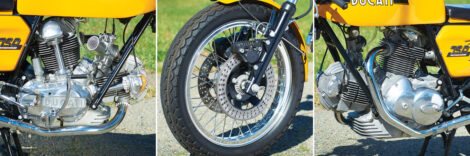
Dennis brought this 1974 Sport to his shop. It looked sad, with scratched and faded paint, and the general dilapidation that happens when a motorcycle is put away in a damp environment for years. He took the engine, covered with white aluminum corrosion, out of the chassis. He put it on a stand, at his shop and spent his evenings cleaning off the corrosion with a mild acid and water. “I cleaned a few inches a day,” he says. “I always loved the engines.”
After Dennis finished cleaning the outside of the engine, he removed both heads and cylinders. “The number of shims and bevel gears is incredible. The shafts are two piece, which makes assembly much easier. Steve Allen, who runs Bevel Heaven, (a resource for bevel geared Ducatis)was a real help. He sells parts and is very knowledgeable.” The engine had been apart once, and needed relatively little help, aside from replacement of the exhaust valves. “Time and sitting took its toll;” but the lower center cases still have the original lead seal, which is a big deal!
An orchestrated restoration toward perfection
James Banke of Banke Performance, relaced and restored the wheels. As Scott said at the time, “They looked so good that they set the bar for the whole restoration.” The coils had to be replaced. “The ones on the bike were huge, maybe off a Chevy.” The stock front brake is a single disc. However, the forks have all the mountings needed for a second disc, and it is very common to add a second Brembo front disc. The front brake rotors were drilled, which is not stock, but a common period modification. Rebuild kits are available for both the Brembo calipers and the Dell’Orto carburetors. Dennis says both are very good quality.
The Dynatec electronic ignition that replaced the stock points came from Bevel Heaven. The paint was matched to original and flawlessly painted using PPG paint by the inimitable Ginger Snap (which is actually her name) of Kiss My G. A. S. Industries. Ms. Snap mostly used paint, not decals, to do the striping. The upholstery is the original.
Back in the day, people used bevel drive Ducati twins for everyday transportation, although the steering head has limited lock to lock travel, the exhaust, while musical, is anything but quiet, and the riding position is full on race crouch. One BIKE (English motorcycle magazine) staffer made numerous round trips to European races on his, carrying his wife and all their luggage. He wrote in the English Ducati owner’s club magazine that the Ducati’s speed made it possible to catch ferryboats about to leave the harbor, and the smoothness of the engine made frantic 10 hour runs to distant racetracks bearable. Dennis concurs. “Just flog them — they will take it.”
“For me — I work all day welding and fabricating — working on a bevel drive Ducati is easy.” If you are not Dennis, there is a learning curve to adjusting the Dell’Orto carburetors and especially adjusting the valves. “You have to have a selection of shims. It has a roller bearing lower end. I don’t know how many roller bearings there are in the motor.” Ian Falloon has written a Ducati bevel twins restoration and authenticity guide, which has wiring diagrams, detailed specifications, and helpful suggestions on engine, chassis, and electrical restoration, as well as lots of photos of Italian rolling art.
Dennis says that pump premium fuel is fine if a bike is running the steel tank. Present day gas eats 1970s fiberglass, and successfully sealing the tank is very difficult. Starting is easy, even given the compression ratio, especially with the electronic ignition. “There is an enrichening device on the bars. The Sport has a strong center stand, and many people start the bike on the center stand. You just ease the bike up to TDC with the kickstarter and then kick — it should start on the first kick. Back in the day, people put big coils on the bike to make it start easier, which is why those Chevy coils were mounted on this bike.” Modern electronic ignitions make large unsightly coils unnecessary.
The shifter is on the right. Ducati started putting shift levers on the left several years later, due to the need to comply with American DOT rules. The shifting pattern is one up, four down, which is a common shifting pattern on race bikes. “It has a very flexible motor,” says Dennis. “It’s relatively short stroke, and will rev to 7,000-8,000rpm. Redline is 8,000.”
“The twin is smoother than an inline four, and Taglioni knew it. The bevel drive twin is literally a labor of passion, of love. The crankcase is so pretty. If you took it on a long, twisty road — that is where you want to be.” MC