Some manufacturers with long histories in the motorcycle industry have taken a whack at turning back the clock by offering what have come to be known as “modern retro” models inspired by their classic models. The goal is to merge modern technology such as EFI, ABS, electronic ignition, advanced suspension systems, liquid cooling, and the like with the overall look of the original.
Obviously, with a raft of modern technology upgrades, comparing the latest modern retro version with whatever classic original on nearly all performance criteria would produce predictable results, with the original coming up short. On the other hand, in many other aspects, the originals may have an edge, at least in perception, if not in data-driven fact.
Two brands that fall into the category of being both iconic and with a long history in the industry are Harley-Davidson and Triumph. Only one of the two has been in continuous production since its first models, and that is Harley-Davidson, which produced its first machine in 1903. Triumph leans into its claim of being around earlier — since 1902, but the fact is, the company was folded into the Norton/Villiers/Triumph combine in 1973 and soldiered on until 1983, when the brand went into receivership, but the intellectual property rights were acquired by John Bloor. Bloor invested in a new plant on a ten-acre site in Hinckley and by September, 1990, displayed the first generation of the reborn Triumph brand of motorcycles at the Cologne show. The Bonneville model name didn’t reemerge in the Bloor era until the modern retro came out in 2001. The styling of that model was based on a 1969 T120R that had been equipped for the U.S. market.
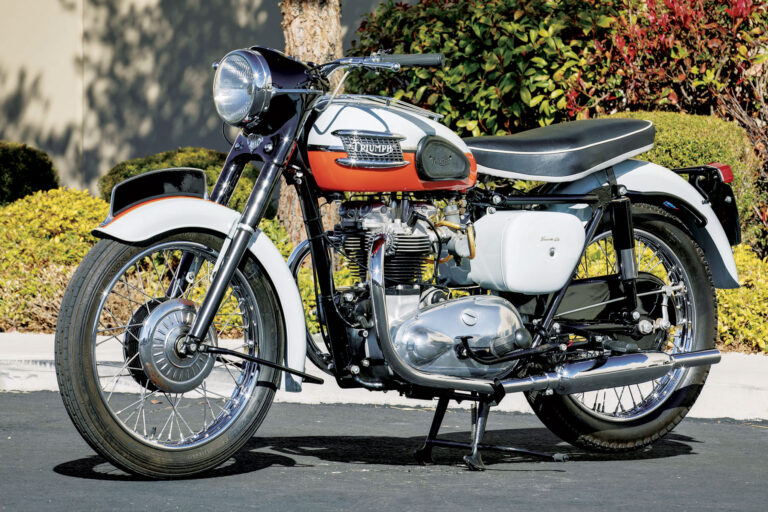
1959 Triumph T120 Bonneville Super Sport and 2015 Triumph T214 Bonneville Land Speed Limited Edition
One notable example of the modern retro exercise is the Triumph Bonneville. In September, 1956, Texan Johnny Allen piloted a Triumph 650-powered streamliner to a world land speed record of 214.40mph at the Bonneville Salt Flats. To commemorate — and capitalize on — that achievement, Triumph introduced the 650cc Bonneville for the 1959 model year. The sales brochure released in October 1958 boldly proclaimed it, “…the fastest Motorcycle made in the World today.”
Officially designated the T120 Bonneville Super Sport, the first Bonneville did, in fact, offer some real soup for Triumph nuts. The 650cc OHV air-cooled parallel twin had a splayed port alloy cylinder head and mounted dual 1 1/16″ special Amal Monobloc carburetors with a rubber-mounted remote float bowl, dual fuel taps to optimize fuel flow, 8.5:1 compression ratio, racing-spec inlet and exhaust cams, racing-spec valve springs, a new one-piece forged crankshaft with bolt-on flywheel, a new froth control tower on the dry sump oil tank for continuous high-performance operation, 6 volt electrics, four-speed, right-side shift transmission with chain final drive, straight-through “Hi-Fi” dual mufflers on down swept 1.5 inch exhaust headers. The engine produced a respectable 46bhp at 6,700rpm. Dry weight was about 403lb.
Full-width 8-inch internal expanding mechanical drum brake up front and 7-inch at the rear provided stopping power, and U.S. pattern handlebar (higher than British version with some pull-back) a full dual-level twin seat, folding passenger footpegs, side stand as well as center stand, folding kick start lever (no electric leg option), tank-top parcel rack, rubber tank-side knee pads, streamlined headlight nacelle and instrument panel, and an anti-theft lock were provided for creature comfort and rider convenience. This all was wrapped in sleek styling and came with the iconic two-tone tangerine and pearl gray livery on a black frame. Lots of high-performance goodies for its time and an MSRP to match its top-shelf specs: $1,060 — which, based on the U.S. Consumer Price Index, is equivalent to $11,442 in today’s money.
Perhaps the most direct descendant of that original Bonneville was another Bonneville model commemorating Johnny Allen’s world land speed record: the appropriately designated Bonneville T214 Land Speed Limited Edition, which was released as 1,000 numbered units for worldwide sale in 2015. There was another linkage to Triumph’s land speed racing legacy, which may account for the rather odd 59-year non-alignment with either the year of Allen’s record or the 56-year interval from the introduction of the Bonneville T120 model.

Triumph anticipated setting a new absolute motorcycle land speed record in the neighborhood of 400mph with the Castrol Rocket, powered by two modified Triumph Rocket 3 three-cylinder engines, which was the goal for 2014. The streamliner had development runs at Bonneville in 2013 with promising results, but no record, and the builders were optimistic about 2014. 2015 was to be the celebratory year, but it was not to be due to adverse weather in 2014 preventing any runs in competition. Triumph released the T214 as planned anyway.
As expected, the T214’s engine is a marked departure from 1959, though it is still a four-stroke parallel twin cylinder. Bumped up to 865cc displacement, with double overhead cams, and four valves per cylinder, 9.2:1 compression ratio, multipoint sequential electronic fuel injection, electronic ignition, air/oil cooling, wet sump lubrication, electric start, five-speed left-side shift transmission with wet multiplate clutch and X-ring chain final drive. Claimed output for the engine is 68bhp at 7,500rpm, 50.2ft/lb of torque at 5,800rpm. Dry weight is about 460lb.
The T214 carries single-rotor, non-ABS disc brakes with twin-piston calipers front and rear, black wire-spoked 17-inch rims, and has a tubular steel frame.
So, the physical differences are many, but there are some cool similarities and even a few areas where the T120 has an advantage over the modern T214. For example, the T120 came from the factory equipped with both a side and center stand; the T214 only had a side stand. The T120 was nearly 60lb lighter than the T214; a difference that could help offset the difference in horsepower a little — there is only about a .033hp per pound differential in the power-to-weight ratio between the T120 and T214.
In overall design, the T214 picked up on a number of styling cues from the T120. They both had the long, dual-level seat, rubber fuel tank knee pads, two-tone paint, the classic “harmonica” style 3-D plated tank badges, dual exhaust with pea-shooter style mufflers, vertical twin-style engine, and classic Brit-bike architecture.
While it can be said that the Limited Edition T214 Bonneville was intended to be one of those “instant collector’s items,” the moment each of the 1,000 ever built rolled off the assembly line, it’s probably safe to say that it will never take the place of a first-year T120 in the pantheon of the most desirable collector motorcycles.
1971 AMF Harley-Davidson FX Super Glide
Most vintage motorcycle fans, even many seasoned collectors, may be surprised to learn that the public was given a very uncommon chance to see the prototype Super Glide in the media two years before its release in 1971. It was in the Fourth Annual Motorcycle Sport Quarterly by Bob Greene, published in 1969. In a two-page spread entitled “Swap Chopper-Sportster and 74,” a Super Glide prototype was slipped into a multi-bike feature by Bob Greene called “Poppers to Choppers.” Unlike all the other bikes in the feature, the images of the Swap Chopper were clearly professionally done studio shots, and the owner/builder’s name was not included in the story; that being stated only as, “…a cyclist from distant shores.”
Some stories said that Willie G. Davidson on occasion would feed images and information about prospective models to the motorcycle media, allowing them to publish the de-identified material with the understanding that the publication would share any reader reactions received. Turns out, the Super Glide was one of them.
Dain Gingerelli, in an article about the Super Glide in Motorcycle Classics magazine, had the answer in 2018: “Today, Willie G. says that, following a special marketing survey conducted in early 1969, photos of the FX prototype appeared later that same year on the pages of Peterson Publishing’s Motorcycle Sport Quarterly, edited by the late Bob Greene. ‘We planted the photos of the bike in his [Greene’s] magazine to see if we could get some feedback from people,’ Willie G. recently explained.”
The first Super Glide (also sometimes referred to as “Night Train”) reviews were not entirely positive. Indeed, the November, 1970 issue of Cycle magazine featured the ’71 model FX Super Glide on the cover, resplendent in the red, white, and blue Sparkling America paint scheme, with the red, white, and blue Number 1 logo atop the tank, with an artistically set outdoor shot and the banner, “Harley-Davidson’s Outrageous Super Glide.” Unfortunately, the image also shows very noticeable fork oil leakage on both fork legs, and the leakage was mentioned in the article. Not a good start, but the article did confirm that the Motorcycle Sport Quarterly article was a plant by Willie G.

Styling sparked a love/hate response, perhaps akin to the way Edward Turner’s Triumph “bathtub” streamlining was viewed. The big fiberglass tail section was found to be both “unsubtle” and “possibly overdone.” The fuel tanks were also ripped: “…they are gross, designed with a heavy hand, intrusive, and they detract from the very impressive mien of the engine.” Despite the barbs, the review said, “…the Super Glide is an enormous visual improvement on the 74 series. Yet for the most part it remains in the first stage of mechanical beauty — beauty added on rather than designed in.” I can hear Willie G’s copy of this issue of Cycle striking the bottom of his trash can, even after all these years.
Styling wasn’t the only aspect of the Super Glide under fire. In both Cycle‘s review and Bob Braverman’s review for Cycle Guide, the brakes were found lacking, particularly the rather unusual (for a motorcycle) hydraulic drum rear brake. Both reviews found the brake only moderately effective in general use and very prone to fade in repeated use. To its credit, the Cycle Guide review tried to sort out the reason for the sponginess of the rear brake and found air in the system, which led them to bleed the brakes, improving the system’s performance somewhat. In any event, the Super Glide seemed to have one of those “better plan ahead” brake systems!
The gear shift mechanism also drew criticism for noisy, inconsistent operation, though the clutch proved light, easy to use, and indestructible. Despite imprecise shifting, Cycle Guide achieved a quarter-mile E.T. of 14.10 seconds with a terminal speed of 102mph.
Starting was another weakness, with the new 1 5/8″ Bendix carburetor with built-in fuel pump a puzzle to get right for cold starting. The Cycle Guide review said starting the Super Glide on the first day of its review had Braverman “kick till he was almost blue” and “was sure to have him laying on the ground with a heart seizure.”
Despite all the criticisms, some of which were not really minor, Cycle summed the ’71 Super Glide, saying: “…it will succeed in this country like no machine H-D has ever made or dreamed of making,” and Bob Greene’s conclusion in his review in the Fall 1970 Motorcycle Sport Quarterly was blunt: “…the Super Glide or Night Train is an instant winner.”
2026 Harley-Davidson FXD Super Glide Special Edition
To mark 55 years since the advent of the original FX Super Glide and the United States at 250 years — touted as the first factory custom — Harley-Davidson has rolled out a numbered limited edition Super Glide, which echoes many of the styling touches of the original, minus the various foibles.
The White Onyx Pearl base layer with the striking red and blue vintage graphic accents returns, as does a large, 5-gallon teardrop-style fuel tank. The fiberglass boat tail seat did not make the cut, however. Rather, a bobbed rear fender is featured. The chassis is a thoroughly modern single-shock version of the Softail. The heftier forks are leak-free, designed for the weight of the machine — not for a Sportster — and Brembo single-disc brakes front and rear make the brake shortcomings of ’71 ancient history.

The 74-cubic-inch Shovelhead mill of the ’71 FX has seen perhaps the most dramatic upgrade, with the FXD armed with the 117-cubic-inch Milwaukee Eight power plant. The engine’s 98 claimed bhp goes to ground through a six-speed transmission and low-maintenance belt final drive vs the FX’s four-speed and metallic roller chain. That’s an important upgrade from the original; the OEM Duckworth final drive chain failed after 14 standing-start speed runs during the road test in the Fall 1970 issue of Motorcycle Sport Quarterly, edited by Bob Greene. Technology not even dreamed of in the original FX’s time comes with the FXD. Straight line/cornering traction control, ABS, drag torque slip control, three ride modes, and tire pressure monitoring all included.
So, it’s true that manufacturers have done some great work in achieving reasonable visual facsimiles of their own classics in the modern retro versions. Fortunately for the owners of those modern retro versions, they’ve also stepped them up technologically for reliability and performance that the designers of the originals couldn’t even have dreamt of.