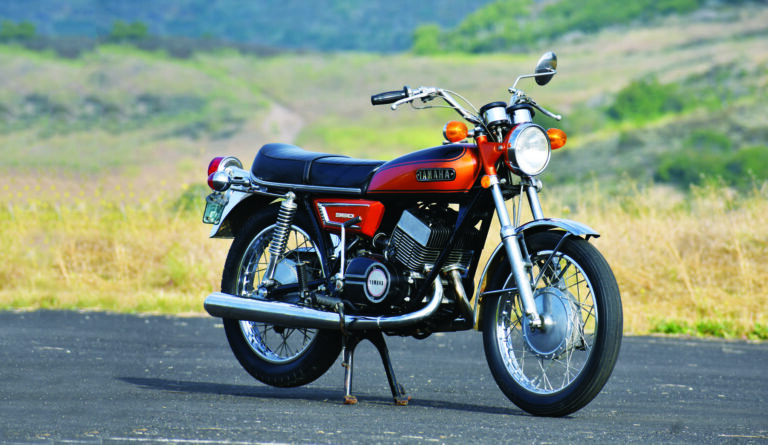
1972 Yamaha R5 350
Engine: 347cc air-cooled 2-stroke parallel twin, 64mm x 54mm bore and stroke, 7.5:1 compression ratio, 36hp @ 7,000rpm (claimed, 1970 model)
Top speed: 100mph (claimed), 95.31mph (period test, 1970 model)
Carburetion: Two Mikuni VMSC 28mm
Transmission: 5-speed constant-mesh, left-foot shift, chain final drive
Electrics: 12v, AC generator, ignition points
Frame/wheelbase: Tubular double cradle frame/52.8in (1,341mm)
Suspension: Telescopic forks front, dual coil-over shocks rear
Brakes: 7.2in (183mm) TLS drum front, 7.2in (183mm) drum rear
Tires: 3 x 18in front, 3.5 x 18in rear
Weight (dry): 326lb (148kg)
Fuel capacity/MPG: 3.2 gal (12.1ltr)/34mpg (period test, 1970)
Price then/now: $739/$2,000-$7,000
By the late 1960s Yamaha’s production racers, the TD (250cc) and TR (350cc) were enjoying unparalleled success on racetracks around the world. But the racers’ street bike counterparts — Yamaha’s bread and butter consumer products — were showing their age.
Compared to other contemporary middleweight models on the market, bikes like Honda’s CB350 and Kawasaki’s Avenger A7 350, Yamaha’s DS6 (250cc) and R3 (350cc) models relied on 10-year-old technology to lure customers into dealer showrooms. No surprise, sales began to lag.

That was about to change in 1970 with the launch of two all-new models — the DS7 (250) and R5 (350). Beyond engine displacement, these new models were joined at the hip in many ways, sharing similar and updated platforms.
But when Yamaha Motor Corporation released those two models (the R5 in particular) the folks at headquarters in Hamamatsu, Japan, had no idea that the new roadsters — both powered by all-new air-cooled twin-cylinder 2-stroke engines — would have a lasting impact on amateur road racing in America. And the R5, in particular, did exactly that.

The R5’s engine, like the DS7’s, had horizontally split cases, a welcomed improvement over the R3’s vertically split lower-end cases. The top end was a new design, too, meant to deliver a wider power band than the R3’s. Wrote Cycle Guide’s editors for their January 1971 issue, “The new 350’s power spread is a good deal broader and as a result, the rider doesn’t spend nearly as much time shifting gears as he used to [with the R3].”
That was fine and dandy for the street crowd, but road racers weren’t concerned whether or not their race engines had broad power bands. Then as now they wanted horsepower any way they could get it. And lots of it, but in 1970 Yamaha claimed the same basic peak horsepower figures for the R5 as with the R3 — 36 horsepower for either model. So why, then, did the street-going R5 create such a stir among amateur road racers in America?

Because the R5 was a complete and balanced package; power delivery, braking prowess, and ride and handling meshed to create a bike that shined not only on the highways and byways of America, but on racetracks, too, where amateur club racers easily prepped their R5s for production-class road racing. And they did so with success, typically beating the other brands that vied for 350cc class dominance at the time. Southern California club racers, especially, filled their display cabinets with cheap trophies won racing their R5s. Young racers like Mike Devlin, Dick Fuller, Bob Crossman, John Lassak and Alan Gingerelli, to name a few, rode R5s to success during the early and mid 1970s.
Shorter stroke, reduced piston speed
New cylinder bore and stroke specs, coupled with reconfigured intake and transfer ports, accounted for most of that engine improvement. Gone was the R3’s 61mm x 59.6mm long-stroke cylinders in favor of the R5’s 64mm x 54mm jugs that equated to less piston speed at any given rpm. The wider bore offered increased piston-port area, and the addition of a fifth, or boost, port helped further direct the fuel charge centrally to the combustion area for more efficient ignition. The sum total helped expand the engine’s powerband without sacrificing peak horsepower. And the savvy production-class racers who understood 2-stroke tuning altered their engines’ port timing to gain even more power, but that’s a story for another time.

For now, know that the R5’s refined engine was cradled in a frame boasting its own road racing heritage. Based on the fabled Featherbed design that Norton perfected years before, the R5’s double-cradle frame took its DNA from Yamaha’s first-ever successful Grand Prix road racer, the RD56 that debuted on European racetracks in 1963. The following year Englishman Phil Read joined the factory team to race his RD56 to Yamaha’s first-ever Grand Prix World Championship. Little did Read know at the time that he, along with the entire factory team effort, was helping lay the groundwork for future TD and TR privateer race models as well as the R5 street bike that was to come six years later.
“Going around corners,” wrote Cycle Guide‘s editors about the R5, “the chassis is absolutely rock steady. So much so, that the rider gets a distinct impression that the wheels are running in a slot,” also citing that the swingarm pivot area had been “greatly beefed up,” further accounting for that rock-steady handling.

Cycle World, buoyed by editor Ivan Wager’s road race experience, was more succinct in its praise for the R5’s chassis. “This capable frame design,” they wrote in the June 1970 issue, “is the direct result of knowledge gained from racing, with the benefit passed on to the consumer. Rigidity is one of the R5’s virtues.”
Interestingly, Cycle’s editors were less impressed with the R5’s handling, stating in the December 1970 issue’s 350cc middleweight shootout (pitting the R5, Avenger, CB350, Bridgestone GTR 350, Suzuki T350, and the thoroughly outgunned Harley-Davidson Sprint SS 350 against one another) that the “front forks continued to oscillate through some of Lime Rock’s [Raceway] turns.” Soon enough, though, amateur road racers discovered that by replacing stock fork oil with a slightly heavier aftermarket mixture, and by replacing the stock rear shock absorbers with aftermarket suspenders from companies like Koni or S&W Engineered Products, along with fresh Dunlop K81 tires front and rear, the R5 rewarded its rider with world-class handling on the racetrack, thank you. Much like Read’s RD56 must have performed in 1964.

Whoa, Nellie!
Other than what was on Honda’s CB750, motorcycle disc brakes in 1970 were pretty much a thing of the future; most consumer bikes at the time were equipped with cable-operated expanding-shoe drum brakes for whoa-ing and slowing. Yamaha’s R5 was no different, relying on 7.2-inch-diameter drum brakes front (double-leading shoes) and rear (single-leading). Cycle World praised the R5’s brakes in its June 1970 issue, stating, “The R5’s smooth, progressive, grab-free [brakes] show only a slight tendency to fade under repeated use.”
Meanwhile at Cycle Guide the editors wrote: “The braking department was kind of ho-hum … it never felt as though there was a surplus of stopping power.”

And Cycle‘s Jess Thomas wrote, “I had to pull extremely hard on the Yamaha brake, but the feeling of control was reassuring. The cable required adjusting a lot after the first stop, but sensitivity remained good. The stops were all straight, with no tendency to swerve or lock suddenly.” There you have it, three magazines, three different opinions, but we can check back with the racers at the track to see that, even with the coming of the RD350 and its front disc brake by 1973, some of the stubborn Southern California club racers stuck with their R5’s front drum brakes, and were rewarded with considerable success.
Three-year run
Indeed, ultimately it was the RD350 that helped put the R5 out to pasture. A 6-speed transmission, reed-valve cylinders for improved low-end response and that trusty (yet heavier) front disc brake combined for a much better and congenial street bike — and racer. One thing that didn’t change, however, was the snappy handling because like the R5, the RD350’s potent little engine was straddled by one of the best frames on the market at the time.
And it was the R5/RD350’s road race prowess that helped a wide-eyed teenager from Thousand Oaks, California, change his allegiance from motocross to road racing in 1977. Thad Wolff was a 17-year-old motocross racer when his friend and racing cohort, Bryan Cathey, read a Cycle magazine article about another young SoCal racer, Scott Clough, competing and winning at local road race tracks aboard his RD350. “We can do that,” Cathey suggested.
Before he knew it, Wolff found himself standing in Cycle magazine’s front lobby, which happened to have its editorial offices just a stone’s throw from Wolff’s home. That also happened shortly after editor Cook Neilson won the 1977 Daytona Superbike race.
“I’m not sure what I was thinking,” recalls a more mature and worldly Thad Wolff today. “I asked to see Cook,” he continues, “and guess what? He actually came out, introduced himself, and then invited me to his office.” A brief Q&A session followed, prompting the ever-so-patient Neilson to halt their discussion while he reached into his desk’s bottom drawer, reappearing with an AFM (American Federation of Motorcyclists, the leading amateur road racing club in the country at the time) rule book. He tossed the book, no doubt its cover marred with greasy fingerprints and the pages inside dog-eared and highlighted for quick reference, into Wolff’s surprised hands.
“Here,” began the Daytona Superbike winner, “read this.” He added sternly, “And be sure to wire the engine’s drain plug.”

“He told me more than once to do that [wire the drain plug],” Wolff recalls. “He probably didn’t want me to be the guy whose drain plug popped out and oiled the track right in front of him.”
Wolff read that rule book and applied his newfound knowledge to an aging 1972 R5 that he purchased on the cheap. Next, young Wolff applied his talents at the racetrack to ultimately win the 410cc Production Class Championship with his much-modified R5 (see RD350 engine, transmission and disc brake upgrade reference prior) in 1979. The following year Cycle’s managing editor, Phil Schilling, connected Wolff with Neil Sorensen from Minnesota, and the pair invested in a brand-new Yamaha TZ250 for Wolff to ride in the 1980 AMA Novice class. Wolff won his first race on the bike, and kept on winning to wrap up the championship. He advanced to the Expert class, competing in AMA Superbike (Suzuki GS1000) and Formula 1 (riding an aging Suzuki RG500), finishing the 1982 Superbike season sixth in championship points and fourth overall in the Formula 1 class.
A footnote about his pro racing career: To raise funds for that TZ250, young (but growing older … and wiser) Wolff sold his 1972 R5-cum-RD350 production-class racer. Which brings us to the gold-and-black, all-original 1972 bike featured here that belongs to — you guessed it — Thad Wolff!
It followed me home — really
“I spotted it in a used car lot,” begins Wolff. “The bike was for sale, and in really clean and complete condition,” he added, right down to its original tires. That was in the autumn of 1993, and by then Wolff had well established himself as a member of the motorcycle industry, posing and riding as a professional photo model for magazine road tests and manufacturers’ advertisements. He also served double-duty transporting bikes to photo locations. It was during one of those outings that he spotted the R5, a bike in surprisingly original condition.
“I was able to get back to the lot after delivering the bikes and I bought it [the R5].” He pauses to let that sink in, and then: “I wanted that SOB real bad!”
He rode the bike, off and on, for several years before parking it in his storage shed where it idly sat until he and I got to talking one day — him doing most of the talking — about that bike. I told him that we must photograph his R5, and that was all there was to it. After much prompting and bullying on my part, he finally relented, fetching the bike — original tires, its acquired patina and all — to see the light of day. That’s when the fireworks really began after a thorough cleaning.

Smoke gets in your eyes
“It fired up right away,” recounts a proud, older and wiser Thad Wolff. “Second kick. And when it did fire up the garage filled with smoke. Of course, beforehand I forgot to shut the door leading into the house, so the whole place filled with 2-stroke smoke.” His story gets better: “And guess who comes home just then?” Yep, The Boss, aka Mrs. Jody Wolff, initially greeted by a blaring smoke detector, followed by billowing blue smoke. “She thought the house was on fire, but she soon realized it was 2-stroke smoke, so she figured out that it had something to do with me and my bikes instead,” Wolff says so sheepishly today. As most of us diehard gearheads have come to realize, it pays to have an understanding and tolerant — and very patient — spouse.
Wolff suspects that his consequential oil boom had something to do with the oil injector pump sticking open and, over the years, allowing oil to seep into the engine’s nether regions. In any case, he rectified the problem and as you can see by the riding shots, the old R5 runs smoothly down the road. And, in certain terms, it preserves the dreams and aspirations of countless aspiring and wannabe road racers alike. Because, regardless of what race bikes that came before or after Yamaha’s R5, there’s no taking away the impact that this model had on the sport of motorcycle road racing at all levels.
And that’s something that the Cycle editors realized way back in 1970 from their middleweight shoot-out. Because when all was said and done, the editors proclaimed: “And we proudly present you with a winner: Yamaha’s brilliant R-5, the best production street 350 in the world.”
Truly, the R5 was the bike that successfully bridged the gap between the racetrack and the public roads of America for Yamaha Motor Corporation. In the process the R5 etched a legacy that will never be taken away by future models from the motorcycle company with the tuning fork logo. MC