When I interviewed Cycle magazine’s former editor, Cook Neilson, about his role in Kawasaki’s 1973 24-hour speed record with the then-new Z1 (Kawasaki Heritage Hall) our conversation drifted to our personal experiences riding the Big 4’s 1970s bikes that eventually rolled into customers’ and readers’ garages.
During the interview, Cook steered us back to the future, recalling that, when Masahiro Wada, Kawasaki’s test rider and a key member of the 24-hour record team, slipped into his leathers, “I noticed that his [body’s] sharp edges had been considerably ground down.”
Yeah, that happens to fallen riders when landing hard on asphalt, the durable surface of choice for road race and test tracks such as those used by the Big 4 in Japan. Cook also pointed out, and I agreed, that a major factor that accounted for many of those test-bike crashes back then was often traced to weak suspension and weaker frames.
Cook continued, recalling a specific incident: “During the 1970s, Yamaha introduced the XS11, a large, powerful shaft-drive 4-cylinder sport/touring bike. We were at Yamaha’s test track for the unveiling, and after a few brisk laps, I pulled into the pits and asked if there might be a Yamaha chassis or suspension engineer in attendance. One was produced. I suggested he find a helmet, and off we took. My intention wasn’t necessarily to scare him; I wanted him to experience how bad the thing behaved at speed with hot shocks connected to a flimsy chassis. We did a couple of laps; he was pale when he got off,” recalled Cook.
He added, “I hoped then that at least one engineer/executive understood what we (journalists) had been talking about since the early 1970s.”
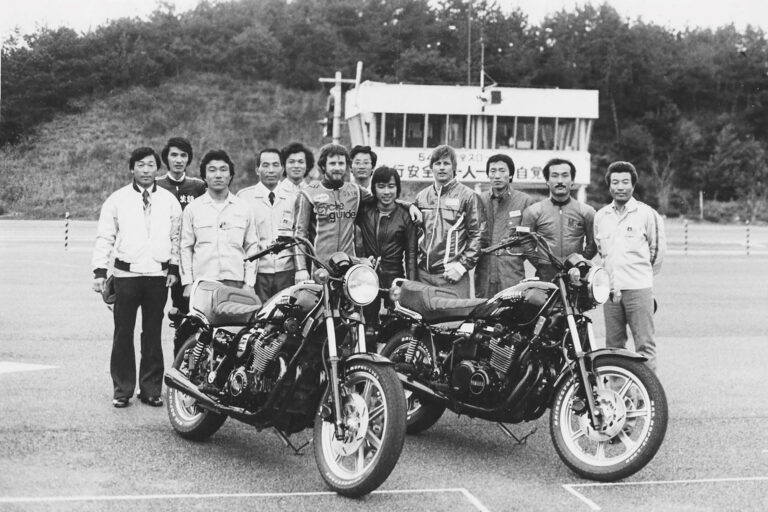
I shared with Cook the time in 1979 when I joined fellow Cycle Guide magazine staffer, Executive Editor Michael Jordan, on a goodwill/fact-finding tour that included visits to the Big-4 manufacturers. Our stop at Yamaha’s refurbished test track included a ride on the new XS11 Special, among the top custom cruisers in 1979. Rain the previous night left the smooth and tacky track slightly slippery, which reduced the fun factor considerably for me. Despite the conditions, the track was the crown jewel of Yamaha’s test facility. Their top test rider was chosen to guide me around the track. He also was testing Yamaha’s XS1100 police model. We had quite a nice time playing cat and mouse during that “test ride,” slowly building up speed as the track dried. Like me, my riding companion understood the benefits of full throttle. We had fun.
But the track conditions weren’t dry enough at one corner where my Black-with-Gold trim Special started to slide on the pavement. I kept it upright as I approached the grass that lined the course, managing to keep the heavy bike’s tires rolling in the same direction over the wet turf. After some serious brake-feathering, I came to a complete stop several feet from the cement barrier that, initially, appeared far away.
Later, Michael told me that Yamaha’s engineers, observing from the trackside with him, ranked my riding skills right up there with my host guide! But my concern, whether or not I realized it at the time, was that my body’s sharp edges were still intact. Maybe another day….