- Years produced: 1958-1986
- Claimed power: 4.5hp @ 9,500rpm – 8hp @ 8,000rpm
- Top speed: 43mph – 68mph
- Engine: 49cc (40mm x 39mm bore and stroke)
- 97cc (50 x 49.5mm) air-cooled,
- OHV(OHC) four-stroke single.
- Transmission: Three- (later four-) speed, semi-automatic with centrifugal clutch
- Weight: 143-205lb
- MPG: Up to 200mpg
- Price then/now: $215 (1962)/$1,500-$5,500
It was a trip to Europe by Soichiro Honda and company finance director Takeo Fujisawa that led to the development of the Super Cub. While Honda-san was more interested in European race bike technology, Fujisawa was looking for a killer product that would sell in vast numbers. He would have noted the success of Vespa, NSU and Kreidler: between 1953 and 1958, NSU sold more than a million of its 50cc Quickly mopeds, while in 1959, a third of all German motorcycles were Kreidlers, principally the 50cc Florett. 15 million Vespas were reported to have been built between 1946 and 1964. Fujisawa saw an opportunity and the company grabbed it.
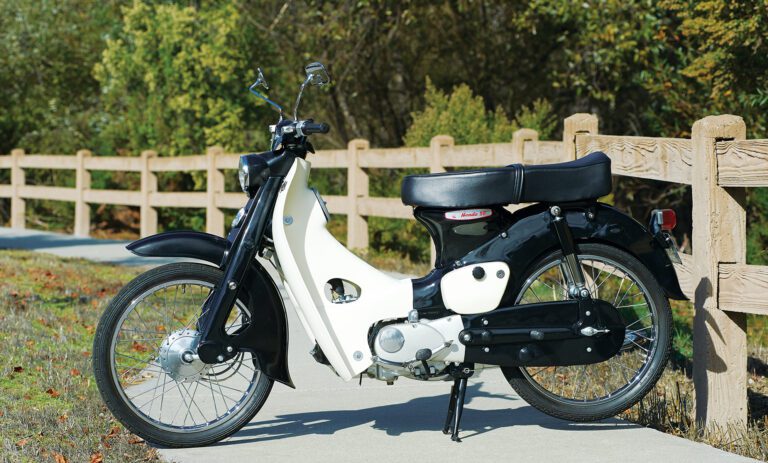
Honda designed a step-through motorcycle around a hybrid frame combining steel pressings and a single downtube. The engine sat low and was centrally located in the frame with large 17-inch diameter wheels for stability. Power initially came from a 49cc pushrod air-cooled 4-stroke engine with splash lubrication and a washable oil screen: (“Not more complicated than the engine in a lawnmower,” noted moto-guru Kevin Cameron). The semi-automatic 3-speed transmission used a centrifugal clutch which was also disengaged by the footshift lever.
These features were said to have been required by Fujisawa-san so a soba delivery rider had a spare hand to carry a tray of noodles! Cables and wiring were hidden behind a combined legshield/fairing molded in polyethylene, and the final drive chain was fully enclosed for cleanliness.
At first ignition was by flywheel magneto and only a kickstarter was fitted. Curiously, the Super Cub eschewed moped-style pedal-assist, presumably to indicate that it had sufficient power of its own — but this choice restricted sales in some European markets where pedals would have meant no motorcycle license was required. (A moped version, the C310S was produced during the 1960s) The bike’s name incidentally, was derived from Honda’s clip-on engine of 1952, the Cub F.
The durability and utility of the Super Cub have become legendary. In a feature for Discovery TV, Charley Boorman tried to destroy one, swapping out the engine oil for cooking fat, seriously overloading it, and, ultimately dropping it from 70 feet onto concrete! The Super Cub, like that famous watch, still kept on ticking.
To say that the Super Cub changed the course of motorcycling is an understatement. For the first time, there was a reliable, family- and user-friendly commuter motorcycle that also spoke quality and economy. And unlike most of its contemporaries (to say competitors implies there were any), it used a quiet, efficient 4-stroke engine that didn’t require mixing oil with the fuel — a fiddly, smelly, onerous, and potentially dangerous task. The Super Cub was the antithesis of bad-boy biker culture.
And Honda didn’t stop developing the Super Cub (which became the Passport the U.S. after 1980). The launch model 50cc C100 was produced to the mid-Sixties alongside the C102 with electric start and coil ignition. The C50, 71.8cc C70 and OHC 89.5cc C90 ran from 1966 to the 1980s, replaced in 1986 by the 4-speed 97cc C100EX with CDI ignition. The 2000s introduced the Super Cub 50 and 110. The latest Super Cubs are available in 50 and 125cc with programmable fuel injection. Power has gone from 4.5 horsepower in 1958 to more than 9 horsepower.
The Super Cub’s success has generated some staggering production and sales numbers. Over 50 years from 1958-2008, Honda built more than 60 million units in at least 15 factories around the world. When completed in 1960, Honda’s Suzuka factory alone could produce 50,000 units a month running two shifts. Correctly anticipating income growth and the need for inexpensive transportation in developing countries, Honda has kept in step with demand. Total production is now estimated at over 100 million! And that’s without the further millions of knock-offs built around the world.
Ironically, given the numbers produced, early Super Cubs are becoming quite collectible, with a restored 1966 C100 selling for $5,500 at the January 2023 Mecum auction in Las Vegas. MC
More small alternatives to the Super Cub
1963-1984 Suzuki M30, F50 Suzy, F70, F80, FR50, FR70, FR80

- Years produced: 1963-1984
- Claimed power:5hp @ 6,000rpm – 6.8hp @ 6,500rpm
- Top speed: 46mph (FR80)
- Engine: 79cc (49mm x 42mm bore/stroke) reed-valve 2-stroke single (FR80)
- Transmission: 3-speed semi-automatic with centrifugal clutch
- Weight: 161lb
- MPG: 85mpg
If imitation is the sincerest form of flattery, Suzuki paid Honda one of its greatest compliments in emulating the Super Cub. First came the M30 with kickstart and its 2-stroke engine using 15:1 fuel/oil premix lubrication. Like the Honda, It featured an underbone step-through frame (but in pressed steel) with plastic legshields and 17-inch wheels. Similarly, it used a 3-speed transmission with automatic clutch, leading-link front suspension and swingarm rear. It was followed by the reed-valve U50 dual-seat Suzy and single-seat F50 and F50 deluxe models in 1969 with Suzuki’s CCI oil injection system. The larger displacement F70 was launched in 1969. Revised versions of the F-range (FR50 and FR70) arrived in 1973, with the FR80 replacing the FR70 in 1976. FR50 and 80 production continued into the 1980s.
Such was the apparent similarity with the Super Cub that a glance could persuade a casual onlooker that it was a Honda. Layout and functionality were similar, and performance comparable, though one tester found the FR80 delivered “appreciably more acceleration” than the Honda 90. It easily climbed a test hill cresting the ridge at 45mph, having “hardly slowed at all.” Brakes had “more than adequate performance,” and the Suzuki “rode comfortably enough on its suspension and seems to steer OK.” Production numbers are difficult to find, but based on the number of survivors, it seems likely Honda handily outsold its competition in the U.S. at least.
1960-65 Yamaha MF-1, 1965-1972 Yamaha U5 and U7 Mate, 1971-86 Yamaha V50, V70, V80, V90

- Years produced: 1960-1982
- Claimed power: 4.5hp @ 6,000rpm (V80)
- Top speed: 52mph (V90)
- Engine: 89cc (50mm x 45.6mm bore/stroke) reed-valve 2-stroke single (V90)
- Transmission: 3-speed semi-automatic with centrifugal clutch
- Weight: 156lb
- MPG: 85mpg
Like Suzuki, Yamaha’s offerings in this class followed Honda’s lead closely, though with some notable differences — a 2-stroke reed-valve engine instead of Honda’s 4-stroke, for one. Most visibly, Yamaha put the electrical controls including the turn signal switch on the left handlebar — not so convenient for soba delivery! It seems the U7 model was available either with 6-volt electrics and kick starter, while the U7-E had 12-volts and electric start — depending on market. For example, a U.K.-market 1972 V90 test bike was fitted with 12-volt electrics yet was kickstart only. No front brake light switch was fitted either, so riders had to remember to use the rear brake to activate the stop light.
One tester found the V90 “had good brakes,” with “strong acceleration and good usable power on tap,” and “absolutely stormed” the test hill. However, the tester also reported that the suspension was “diabolical … it handles like a La-Z-Boy armchair, with soft and bouncy springs and no effective damping: watchout, it’s all over the road!” The tester also thought the V90 was under geared and would probably pull a higher ratio with ease.
It seems the Yamaha U and V models were sold sporadically in the U.S. over the years. The V-range was discontinued in 1985, replaced by the 4-speed, 4-stroke T-80 Townmate with shaft final drive.
Originally published as “Game Changer: 1958-1968 Honda Super Cub” in the May/June 2023 issue of Motorcycle Classics magazine.