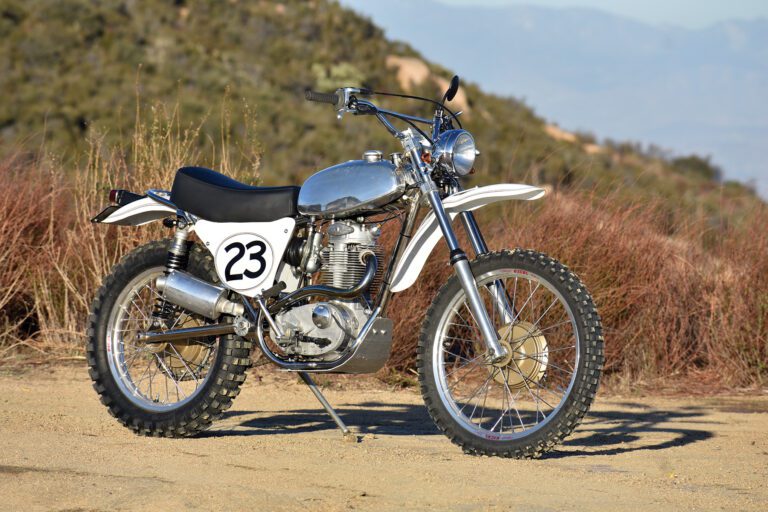
- Engine: Stock-spec BSA B50MX 4-stroke air-cooled single cylinder, 84mm x 90mm bore and stroke, 8:1 compression ratio, 34hp @ 5,500rpm (est.)
- Top speed: NA
- Carburetor: Amal 32mm
- Transmission: 5-speed, right side shift, down for low
- Electrics: Boyer Bransden capacitive discharge
- Frame/wheelbase: Single downtube cradle frame/55.2in (1,402mm)
- Suspension: 1973 CZ telescopic front fork, Ohlins rear shocks
- Brakes: CZ drums front and rear
- Tires: 3 x 21in (front), 4.6 x 18in (rear)
- Weight (wet): 260lb (118kg)
- Fuel capacity: 2gal (7.5ltr)
- Price then/now: $1,750/$3,000-$11,000
“As the saying goes, when one door closes, another one opens.”
And it was in 1971 that dwindling corporate resources forced BSA, for years one of Great Britain’s leading motorcycle brands, to close the doors to its factory-backed motocross racing team. It appeared to be the end of a proud era that included two 500cc Motocross World Championships (1964 and 1965) among other achievements by BSA-mounted Jeff Smith and teammates of the time. The sun was slowly setting on the British Empire’s crumbling motorcycle industry.

Yet, practically before anyone wearing a BSA shop apron had time to secure the latch, another door in another part of England opened that would keep the Beezer flame alive on motocross and scrambles tracks throughout the historic island. Alan Clews, a reputable privateer motocross, scrambles and trials rider from Bolton (a suburb of industrial Manchester), had dedicated himself to building a race bike of his own design that would use BSA’s B50MX engine for power. He called his one-off bike a Clews Stroka, but he really had no intent on selling it; Clews was a racer and, simply, he wanted to build his own unfair advantage into the bike that he would race. As the story goes, before Clews had a chance to race the completed bike another competitor spotted it, liked what he saw, and offered to buy it from Clews for a handsome sum that the builder most definitely liked. Done deal, and Alan Clews the racer now had a few more schillings jingling in his pocket, although he was no closer to the finish line with his own race bike than he was the day before.
Pause now while we follow Clews as he frantically points his shop truck towards the BSA race shop in Small Heath (just north of another industrial city, Birmingham) where he offers to buy whatever factory-racing parts that team manager Brian Martin is willing to sell him. Eventually the lot includes about a dozen scrambles (proper English in 1971 for the term “motocross”) racing frames plus as many other components as any industrious race bike builder could want. Young Clews ceremoniously delivers the lot into his home garage where he begins, with the help of a younger lad named Martin Hemingway (who would become Clews’ first employee), creating a replacement Clews Stroka.

That, of course, is the Reader’s Digest version of what happened 50 years ago, and by early 1972 Clews and his business partner (in the guise of Mrs. Gail Clews) opened a dedicated race shop on Shiffnall Street in beautiful Bolton, England. The first batch of bikes built and sold wore the Clews Stroka label, but that name was soon dropped in favor of the more professionally sounding Clews Competition Machines, or CCM, moniker. A new, and rather exciting, chapter in BSA racing lore began. The door was now wide open for CCM to conduct its own business.
The door to success
What soon passed through that open portal was a rather unique motocross racer for its day. And each CCM motorcycle that Clews and his workers produced was for sale; CCM was now fully ingrained in the motorcycle industry. As Alan Clews was quoted by author Peter Henshaw in his book about CCM, Rolling Thunder, the plan was “to build a business making lightweight B50-based MX bikes.”

Eventually the supply of original BSA racing frames and complete B50 race engines ran out, forcing Clews to source out his own frame, although worthy donor engines remained relatively attainable. Fortunately for Clews another industrious young man, Mike Eatough, was nurturing his own upstart business of making motorcycle frames, including one for the B50. His company, Eaton Motors Components (EMC), crafted frames from lightweight, yet strong, Reynolds chrome-moly tubing. Each bare frame he built for CCM weighed a mere 27 pounds due in large part to ingenious engineering that included storing the engine’s oil in the frame itself.
Additionally, a bevy of lightweight components including forks and triple clamps, Girling shock absorbers, wheels, brakes and hubs, an alloy gas tank and featherweight fiberglass body and trim items kept overall weight to a minimum. Clews and Eatough incorporated many other weight-saving components into the design, including engine case-mounted foot pegs, the result being an Open Class motocross racer weighing a reported 201 pounds, although Andy Ainsworth’s race bike officially checked in at 209 pounds. Either figure was credible for a racer toting a heavy 4-stroke engine such as the B50.

Clews’ creativity found its way to the engines that he built as well. Although the B50MX engine had a reputation for power and durability, young Clews elected to improve upon it, the result being two basic variants of the fabled Beezer single.
Sweet “sixsess”
Perhaps the most famous engine during CCM’s breakout year was what became known as the Big Six. As the name suggests, the engine displaced 600cc — 608 to be precise. Taking advantage of a handicapping rule that allowed larger displacements for heavy 4-stroke engines, the Big Six achieved its displacement by altering the B50’s original 84mm x 90mm bore and stroke (498cc) to a remarkable 88mm x 100mm. According to Henshaw’s book, “most of the bikes built in 1972 were 608cc, though there were also some Short Fives,” another Clews-engineered B50 engine that shifted bore and stroke specs to 88mm x 82mm to alter performance characteristics in an entirely different direction than the Big Six’s. For comparison, a standard B50 generated about 34 brake horsepower at 5,500rpm, while Clews’ 498cc Short Five developed a claimed 45 brake horsepower at 7,000rpm. As you can imagine, the Big Six had them both beat, leaving the dyno after pounding out 50 brake horsepower at 6,500rpm, not to mention gobs of torque.

The package of a torque-laden engine cradled in a lightweight frame proved sufficient enough to be competitive on the race track, too. Sales for the first year, 1972, were beyond Clews’ expectations, with most bikes available (about 40 are known to have been sold) in kit form that spared customers from having to pay Great Britain’s heavy purchase tax.
By 1973 CCM’s “factory race team” scored its first British National Motocross win by rider Bob Wright. Reflected Clews in Henshaw’s book, “I knew he [Wright] was going to win when I saw him going up the big, bumpy hill. He was hanging on for grim death, and apart from his grip on the bars, most of him was off the bike for most of the time!” Clews’ description of Wright’s win is not to suggest that the CCM handled poorly, either. On the contrary, as another team rider, Ainsworth, described how well balanced his CCM racer actually was. “It was beautifully balanced,” Ainsworth told author Henshaw. “He [Clews] would hold the bike upright, feel for the balance, and then let it go. It would stand out on its own for quite a time.”

That balance feat is especially surprising considering the drivetrain’s layout. The BSA’s countershaft sprocket, located between the clutch and the inner case, prompted positioning the engine slightly off center, to the left of the frame’s centerline.
The British are coming!
With many of the bike’s kinks worked out, Clews looked to expand CCM’s sales to America, so in late 1973 he dispatched a team to compete in the Trans-AMA Series that filled the AMA’s winter racing calendar. That’s when Cycle World magazine publisher Joe Parkhurst experienced a ride aboard the British thumper and liked the bike so much that he purchased one for himself. The magazine’s CCM track test appeared in the January 1974 issue, and right out of the gate the editors made two things known. First, they had forgotten Alan Clews’ first name, referring to him as Ed, not Alan, in the article. The second point? The bike was surprisingly light: “Take the Clews out on a motocross course and the first thing you notice is an absence of weight,” cited the test. The CW staff had further praise for the CCM’s on-track manners, touting the steering as “beautiful … the front end doesn’t push to the outside at all,” a common trait among many big-bore thumpers of the time.

Parkhurst and the CW crew especially enjoyed the big-bore CCM on fire roads and back trails. After changing the final-drive sprocket gearing to boost top speed they hit the trail, leading them to suggest that the bike “becomes a play bike supreme. Really, the bike is the best fireroader we’ve had in years. Feet up slides using the throttle for control are child’s play and there is plenty of power to keep the rear end out.” The CCM wasn’t without its faults, though. CW testers were annoyed by the staggered placement of the case-mounted foot pegs, citing “the right hand [side] peg is almost 1 -1/2 inches farther forward than the left hand [side] one and both pegs are mounted rather far forward when compared to other motocross machines.”

“Our biggest complaint with the CCM,” concluded Cycle World, “is its propensity to leak oil from beneath the engine. British Singles have never been known to be oil tight, but this one is ridiculous,” something we also discovered when photographing our feature bike, owned by vintage bike enthusiast and racer Tim McIntyre of Lake Elsinore, California.
On the road again
Tim, a retired firefighter now in his early 60s, still has plenty of fire in the furnace when it comes to off-road riding and racing. He participates with enviable success in California Vintage Moto Cross (CALVMX) events, “and of course, the Elsinore Grand Prix,” he’ll remind you. He’s also a big fan of BSA’s B50MX racers.

“I had wanted a B50MX since I was about 12 or 13 years old,” recalls Tim, citing his first exposure to a used one that he spotted for sale at the local bike shop in Dana Point, California, where he grew up. But it wasn’t until nearly 40 years after that first B50MX encounter that something rekindled the B50MX flame within Tim: “I was watching my son Reed compete in the Harvey Mushman Race [an Elsinore GP feature event] when I got motivated to compete in the Vintage Class.” Purchase of a 1973 CZ 250 followed, along with success on the race track. He also encountered what appeared to be a rather scuffed up B50MX for sale.

“It looked like a B50 frame, or at least a copy of one, and it was nickel plated,” he said. It was also California plated — a banged and bruised California license plate was attached to its rear fender. The whole package piqued Tim’s interest until eventually he exchanged money for the bike. Further investigation told him that the bike was a CCM bearing frame number C7223. A volley of emails with CCM and various respondents to an online thread that Tim started on the b50.org website concerning frame numbers confirmed that the bike was, indeed, one of the first-year models by Clews Competition Machines. Finally Tim received an email from the late Alan Clews’ son Russel, now CCM’s production manager, confirming that this bike was part of the company’s first-year models, even though frame number C7223 wasn’t listed on the official manifest, which Tim thought to be peculiar. Russel Clews’ email read:
“C7222 and C7224 are on our records, but C7223 is not. Sometimes, but not often, certain motorcycles weren’t recorded but your motorcycle is probably authentic. It is not a Clews Stroka, but a CCM. Clews Stroka’s were earlier. Your machine was produced in early 1972.”
The mystery solved, Tim elected to restore the bike to its former glory by keeping it street legal. Besides, how often do you see a dual-sport CCM? Furthermore, as a member of the BSA Owners Club of Southern California club, he feels the bike, with its nickel-plated frame and B50/CCM hybrid engine, would make a classic addition to the dual-sport and road rides that the club promotes throughout the year.

Tim does much of his own work during a bike restoration, but this time he called on several suppliers and friends in the industry to help see this project through. For instance, the white fiberglass body parts were sourced from CCM Britain, and various replica CCM hard parts such as the brake pedal, cable and swing arm protector — even the CZ front brake hub — he sourced locally. (Tim says that the CZ hubs can be found on Joe Maxwell Engineering’s website.)
The frame required extensive work, so Doug Farron, of T&T Welding in nearby Corona, California, was commissioned to smooth things out, including relocating the lay-down shock mounts and struts (installed by a previous owner) to their more upright position as per 1972 specs, replacing worn or damaged mounting hardware and fabricating the kickstand mount (original CCMs didn’t have that feature). Tim’s son Reed lent his welding expertise at times, too, and when all the cutting, grinding and welding was complete, the frame was sent for a soaking at MJB Plating in Rialto, California. What emerged from their vat was a nickel-plated frame that was jewel-like in its finish.
“Charlie Richardson,” Tim added, “helped with specialty items such as the billet triple clamps, steering bushings and a custom rear axle to accommodate the CZ rear hub.” Charlie owns CR High Performance, a vintage CZ specialty shop in Fallbrook, California, so he’s familiar with 50-year-old bikes like this.

After thoroughly rebuilding a donor stock B50MX engine, Tim ceremoniously removed the tired original unit that came with the bike to make room for its replacement that boasted fresh CCM cast aluminum cases (with kickstart provision; many CCM racers had no kickstarters!) and their signature foot pegs. He also nestled an Amal 32mm up top, making sure it was securely fastened to the air filter box. The exhaust is a Tim creation, too: “I made a cardboard mock-up for a pattern,” he said, “and by the end of the afternoon I had a pipe.” The Bill’s Pipes silencer (“It even has a spark arrestor!” boasts Tim) keeps the bike street and trail legal.
Following a quick trip to Tim Bartee at T.A. Bartee Designs for some tasteful gold and black pinstriping, plus the number “23” painted onto each side cover, the bike was ready for fire up. By the way, the “23” pays tribute to the bike’s frame number, a fitting touch to a CCM that otherwise could be considered an orphan among the Clews Competition Machines family of racers.
So how does the biked perform? First, the bad news: those CCM engine cases insist on leaking oil, so Tim’s still working on that part of the project. But when it comes to riding and sliding, he says the bike feels masterful.
“It’s tight. It really rides nice, with good manners,” he says. It’s light weight lends to its predictable ride on the trail, too. Our photo session included taking a few jumps at nearby Wildomar OHV Park where Tim let his CCM dual-sport bike stretch its legs and shake off some dust. No doubt the late Alan Clews would be proud.
CCM continues making bikes today. After surviving a buyout that shifted ownership from the Clews family to a private firm, the company eventually returned to its original owners. Today CCM continues making specialty bikes in the same spirit that led to the Big Six and Short Five that helped launched the company nearly half a century ago. MC