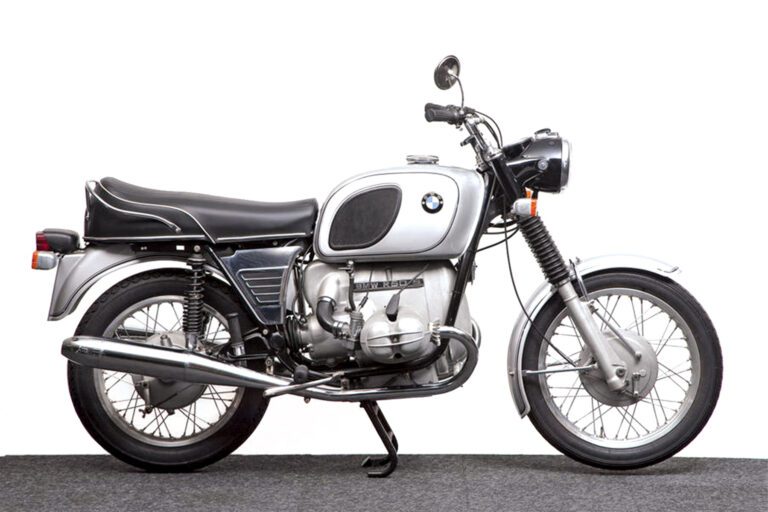
BMW R50/5
Years produced: 1969-1973
Claimed power: 32hp @ 6,400rpm
Top speed: 97mph (est.)
Engine: 498cc air-cooled OHV flat twin
Transmission: 4-speed, shaft final drive
Weight: 451lb (wet)
MPG: 45-55mpg
Price then/now: $1,025 (1970/est.)/$1,500-$4,000
It seems almost unthinkable now, but in the mid-1960s, BMW came close to abandoning motorcycle production altogether. Sales were in decline, with potential buyers questioning whether they should pay as much for a motorcycle as a small car. BMW was also focused on developing its automobile business, which meant its motorcycle range got somewhat neglected.
The Bavarian maker enjoyed a reputation for expensive, solidly engineered and beautifully built bikes that were reliable, sedate tourers. The then-contemporary R50/2, R60/2 and R69S used a heavy, plunger-derived frame and Earles front fork (telescopic in the U.S. only), while featuring anachronisms like magneto ignition and a 6-volt electrical system powered by a DC dynamo.
In 1964, BMW made the crucial decision to continue making motorcycles, recognizing in the process that a complete redesign of its range would be required. Once committed, BMW lured engineer Hans-Günther von der Marwitz away from Porsche to complete the makeover. The bikes would be built at a new factory in Spandau, near Berlin.
The “Slash 5” series (R50/5, R60/5 and R75/5 of 500cc, 600cc and 750cc) was announced for the 1970 season, and represented a revolution in BMW motorcycle design. Though the basic flat-twin “boxer” engine layout remained, just about everything else was new. Gone was the built-up crankshaft and gear-driven camshaft of the previous range. The new engine used a forged one-piece crankshaft, and borrowed plain-bearing rods from BMW’s 2.8-liter 6-cylinder car engine. The duplex chain-driven camshaft now ran below the crank instead of above. Iron-linered light-alloy cylinders replaced the previous cast iron types and were capped with redesigned cylinder heads fed by dual Bing slide carbs (CV on the R75/5). The specification included 12-volt electrics with push-button start, though the kickstarter was retained. Power went through the traditional single-plate, engine-speed clutch to a 4-speed gearbox. The tubular steel frame used duplex tubes with the drive shaft built into the right-side rear swingarm.
The rear spring/shock units were adjustable for pre-load with a simple hand lever. Telescopic forks (a BMW innovation from the 1930s) replaced the Earles fork at the front end. Wheels were 19-inch diameter front and 18-inch rear, with 3.25 x 19-inch front and 4.00 x 18-inch rear tires. Brakes were twin-leading-shoe drum front and single-leading-shoe rear, both of 7.87-inch (200mm) diameter.
Though similar in weight to the earlier R50/2, the R50/5 gained 6 horsepower, giving it livelier performance, while the new frame and suspension improved handling. Moving the camshaft below the crank also meant the cylinders sat higher up, improving ground clearance. For 1972, the 4.5-gallon, chrome-paneled “toaster” tank replaced the bulky 6.3-gallon gas tank, and during 1973 the swingarm was lengthened by 2 inches. The idea persists that this was done to correct handling issues, though there’s no evidence to support this. However, it did allow for a bigger battery box, while still retaining the kickstarter.
No contemporary U.S. road tests of the R50/5 are extant: It seems testers at the major magazines only rode the 600cc and 750cc versions. Yet some general observations of the range would apply. Of the larger bikes, testers noted a narrow powerband that was higher in the rev range. They also experienced some torque reaction in the rear suspension from the driveshaft, especially at low speeds — though this would likely be less noticeable in the 500 with its lower power. Its claimed 32 horsepower was 8 horsepower down on the R60/5 and 18 horsepower down on the R75/5. There was also some “stiction” in the front fork, an issue that was corrected during 1973 with changes to the fork valves.
And while performance may not be its strong point, the R50/5 has developed a reputation for reliability and longevity matched only by its “Slash 2” forebears. Yet while the 600cc and 750cc engines were carried over to the disc-braked, 5-speed “Slash 6” range in 1974, the 500cc engine was quietly dropped and a 900cc added.
The R50/5’s early exit from the range means it’s also the rarest of the bunch, with fewer than 8,000 made against more than 38,000 R75/5s, the most popular model. Excellent build quality means they hold up well, but low production makes finding an R50/5 a little harder, as owners seem to hold onto them. MC
Two-Cylinder Competitors to BMW’s R50/5
1965-1974 Honda CB450K/SS

Claimed Power: 43hp @ 8,000rpm (1965-1967)
Top Speed: 112mph
Engine: 444cc air-cooled DOHC parallel twin
Weight: 420lb (half tank fuel)/45-55mpg
Price then/now: $957 (1968)/$750-$4,500
Though the CB750 is widely considered the nail in the British motorcycle industry’s coffin, the CB450 was arguably the shroud. With performance comparable to Triumph’s Bonneville, the CB450 also boasted top-drawer features like double overhead camshafts, a twin-leading-shoe front brake (single disc from 1970-on) and, importantly, electric start. Perhaps even more important, unlike earlier pressed-steel-frame Hondas, with a tubular steel frame, it looked the part.
Available only in black, the CB450K was built around a short-stroke, 180-degree, 4-main-bearing crankshaft (360-degree for the Japanese market) driving two overhead camshafts by chain. Valves were closed by torsion bar springs with eccentric adjusters. Drive to the 4-speed gearbox was by wet multiplate clutch with chain final drive. The drivetrain fitted into a single-tube cradle frame with conventional telescopic fork and dual spring/shocks on the rear swingarm. For 1969, the new Super Sport K1 got larger valves and revised camshaft timing for two more ponies, a 5-speed gearbox and nitrogen-filled de Carbon rear shocks.
Cycle magazine tested the revised CB450 in November 1968, and while they found the suspension stiff and the front brake “marginal,” its handling was “on a par with the good middleweights, its toughness on a par all its own. Best of all, the bike feels right — everything tight, snug, rubber-mounted where necessary and working together.” They concluded: “The new Honda is beautifully engineered, clean, stylish, easy to maintain and quick … what more could you want in a motorcycle?”
1965-1974 Triumph Daytona 500

Claimed Power: 41hp @ 7,500rpm
Top Speed: 105mph
Engine: 490cc air-cooled OHV parallel twin
Weight: 396lb (wet)/45-55mpg
Price then/now: $1,199 (1968)/$2,500-$4,500
What if the BSA Group had copied BMW in the late 1960s and invested in a new factory with an updated range of motorcycles? Unfortunately they didn’t, so we’ll never know. Instead, they soldiered on with Edward Turner’s superannuated 1937 parallel twin design with its exposed pushrod tubes, leaky vertical-split crankcases and separate (though now cast in unit) transmission.
Instead of developing something new, Triumph’s answer was to screw as much performance as they could from the old engine at the expense of smooth running and durability. After Buddy Elmore won the Daytona 200 race in 1966 on a Triumph 500, a commemorative model with even more performance was inevitable. The new T100R Daytona got a pair of 26mm Amal Monobloc carbs (Concentric from 1968), higher compression and “race” camshafts for a claimed 41 horsepower. A twin-leading-shoe 7-inch front drum brake was fitted for 1969.
Where the Triumph scored was in its rugged simplicity. The 500cc engine was only 5 horsepower down on the 650 Bonneville and smoother in the mid-range. However, to make this power, the Daytona’s peak output had been pushed to 7,500rpm, where vibration became a major issue. Ease of maintenance apart, Cycle concluded, the only thing the T100R excelled at was “being a Triumph.” By 1974, time had passed the Daytona by: Kickstarters and drum brakes were dirt bike territory.