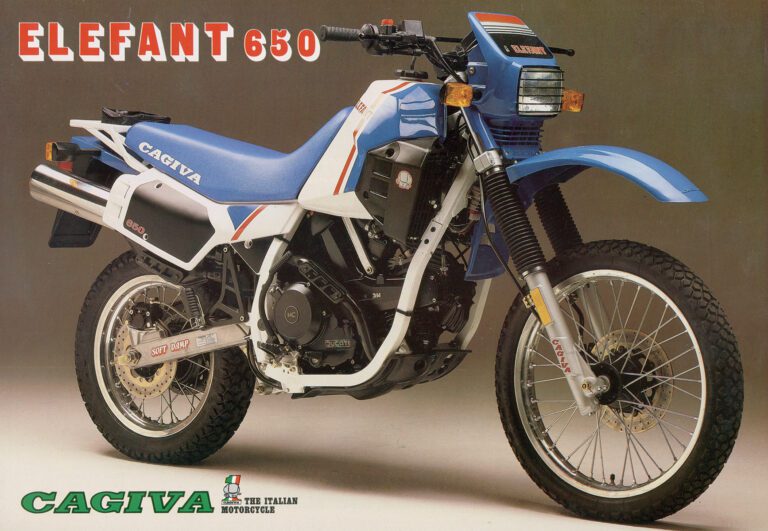
1984-1987 Cagiva Elefant 650
Claimed power: 55hp @ 7,500rpm
Top speed: 115mph (indicated)
Engine: 649cc air-cooled SOHC desmodromic V-twin
Weight: 454lb (wet)
Fuel capacity/MPG: 38mpg (avg.)
Price then/now: $4,632 (1986)/$1,750-$3,000
The present-day fad for adventure touring motorcycles has, like most fashions, a precedent in a previous generation. But it wasn’t Ewan McGregor and Charley Boorman’s parents who sparked the European craze for dual sports in the 1980s: It was BMW’s success in the Paris-Dakar race, which they won four times (1981 and again from 1983-1985). Seeing a “me too” sales opportunity, several Italian manufacturers followed suit with adventure bikes in the 1980s: Morini had the 500 Camel, Moto Guzzi the V65NTX, Laverda the 600 Atlas, and Cagiva the 650cc Elefant.
From launching its first street bikes in 1978, Cagiva was by the early 1980s the biggest motorcycle manufacturer in Europe by number of units produced — mostly small 2-strokes. In order to break into the bigger-bike market, Cagiva reached a deal with Ducati for the then government controlled company to supply them with 650cc engines. Three motorcycles resulted from this initiative: The sporty Allazzura, the Indiana cruiser, and the dual-sport Elefant.
The Elefant’s engine was a development of Ducati’s desmo 2-valve, air-cooled L-twin Pantah with a bore and stroke of 82mm x 61.5mm for 649cc, and with the rear cylinder head reversed, as on the 750 Paso. But instead of the Paso’s troublesome Weber down-draft carb, the Elefant breathed through a pair of Dell’Orto PHF36 pumpers. Ignition was Bosch electronic, and drive to the wide-ratio 5-speed transmission (sharing cogs with the Indiana) was by multi-plate clutch — wet on early bikes before changing to dry.
Unlike the lithe, ladder-type frames of its Ducati contemporaries, the Elefant used a full cradle of square-section tubes under a broad, sturdy spine that also served as a plenum, feeding air to the carbs from an airbox under the seat. Ducati street bikes typically have the swingarm pivot in the gear case and the Elefant did as well, augmented by stout frame plates. A pair of bolt-on bars also triangulated the power unit to the spine. And to ensure the well-buried rear cylinder stayed cool, an oil cooler was added, bolted to the frame downtube.
The box-section alloy swingarm traveled through 8 inches and worked an Ohlins shock — adjustable for preload, compression and rebound damping — through Cagiva’s “Soft Damp” rising-rate linkage. Wheels were laced up with Akront alloy rims, 17 x 2.75-inch at the rear and 21 x 1.85-inch at the front, the latter controlled by 9-inch travel, air-adjustable Marzocchi 41.7mm forks. Brakes were Brembo with a 10.2-inch front disc and four-piston caliper and a 9.4-inch disc with two-piston caliper at the rear. They were all top drawer components intended to create a quality product. So did it work?
Although almost a tiddler by today’s monster trailie standards, with a seat height of 35 inches the Elefant was a big, tall bike in 1984. And at a curbside 454 pounds, the Elefant’s weight — “twice that of a 250 motocrosser,” said Cycle magazine in December 1985 — suggested a different purpose from dirt-digging: “The Elefant loves to run in wide-open spaces,” wrote Cycle, “across the desert, down fast sweeping fireroads. The desmo engine is a powerhouse off road — smooth, torquey — and the rigid long wheelbase chassis provides unshakeable high-speed stability.”
Cycle also praised the Elefant’s “powerful brakes, excellent steering, near-perfect suspension calibration,” all of which made it “a formidable fire road flyer.” That said, compromises became apparent in tighter offroad conditions: “When 454 pounds of motorcycle gets away from you, the chances of snatching it back are slim,” wrote Cycle, noting that in an uphill get-off, their tester had to wait until help arrived to lift the bike off him.
Back on blacktop, however, the Elefant excelled: ” … you’d be surprised how quickly they can carve the twisties,” wrote Cycle, with “virtually unlimited cornering clearance.” Cycle‘s praise included “high speed stability unrivalled in the dual-purpose class.” The only limitations were the Elefant’s Pirelli MT40 universal pattern tires. Though they were “versatile performers, they quickly get skittish when pushed on the street.”
But perhaps the Elefant’s biggest limiting factor was its price: At $4,632 in 1986, it was as pricey as the gold-standard BMW R80G/S. State-side, Cagivas were a relatively unknown commodity in the early Eighties, and when the versatile and capable Kawasaki KLR650 arrived in 1987 priced at $2,999, the Elefant looked far too rich. A capacity hike to 750cc for 1988 helped, but by then the market hade been joined by Honda’s excellent Transalp and the new Paralever BMW R100GS. MC
Contenders: Offroad rivals to Cagiva’s Elefant
1987-on Kawasaki KLR650

Claimed power: 48hp @ 6,500rpm
Top speed: 97mph
Engine: 651cc liquid-cooled DOHC single
Weight: 398lb (wet)
Fuel capacity/MPG: 48mpg
Price then/now: $2,999/$1,000-$2,500
The longevity of the KLR650 speaks volumes for its popularity. Introduced in 1987, almost 30 years later it’s the fourth best- selling Kawasaki of all time. Derived from the more dirt-focused KLR600, the KLR650 added electric start (no kickstarter was fitted), liquid cooling, a 6-gallon gas tank, a handlebar fairing, a dual seat for two-up riding, a luggage rack for in-town duties and extended riding, and the now-familiar crossover dirt/street tires.
The KLR’s offroad chops came from a suspension travel of more than nine inches front and rear, almost 10 inches of ground clearance, and a (relatively) low weight of 398 pounds gassed up. And on the street, the Kawi motor’s dual balance shafts ensured reasonable smoothness, and 48 horsepower meant perfectly acceptable highway performance. The only downside was that the front brake was weak and prone to fade under heavy use.
And while there were more focused offroad machines available, and certainly more comfortable street bikes, the KLR managed to be jack of all trades at a very competitive price and has remained in production, with minor upgrades, for 27 years.
Road Rider perhaps summed up the KLR best, comparing the great bike to a Jeep, “something that could go anywhere, do anything. Now we have a two-wheeled version from Kawasaki.” Except, “the KLR650 can go where even Jeeps can’t go.”
1980-1987 BMW R80G/S

Claimed power: 50hp @ 6,500rpm
Top speed: 108mph
Engine: 798cc air-cooled OHV flat twin
Weight: 450lb (wet)
Fuel capacity/MPG: 47mpg
Price then/now: $4,800 (1981)/$3,500-$6,500
It’s almost hard to believe now, but there really was a time before we had adventure touring bikes — that is, a time before the R80G/S. In the Seventies, BMW significantly ramped up its offroad racing effort, with factory endurance machines outwardly similar to the production G/S. Meanwhile, BMW employee Rudiger Gutsche was racing home-built R75-based offroad BMWs with great success. Named R80G/S project developer, it was his “Red Devil” street prototype that spawned the dynasty of boxer twin GS bikes that’s still running today.
Cycle magazine proposed that, while most contemporary dual-purpose bikes would rank 6/4 in street/dirt performance, the G/S was nearer 8/2. Yet the G/S boasted nearly 8 inches front and 7 inches rear suspension travel, 8 inches of ground clearance, a seat height of 34 inches and a 21-inch front wheel. Also fitted were a heavy duty bash plate, high-level exhaust and front fender, and a kickstarter as backup for the electric starter, an important feature for offroad use.
The G/S made No. 8 in Rider‘s list of Most Significant Motorcycles in its 25th anniversary 1999 issue. Cycle Guide called it “a superb unit. If you live or ride where very long, choppy roads are the rule, this is the bike you’ve been waiting for. Very simply, nothing else will come even close and you’ll recognize it right away.”