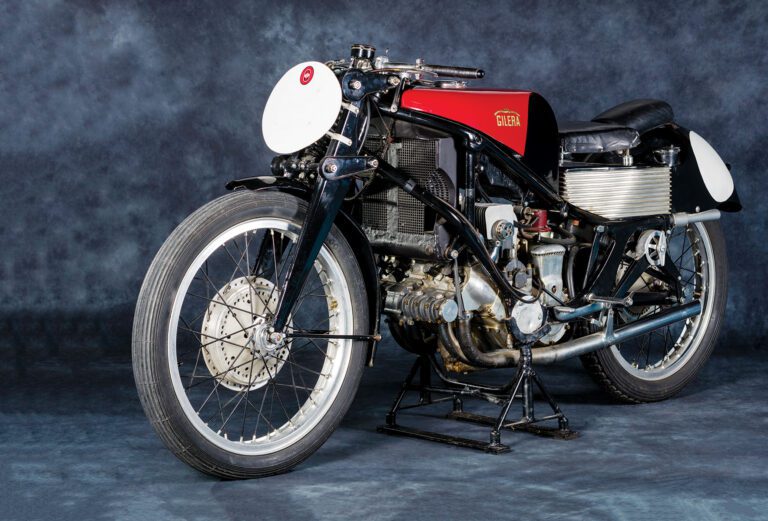
1939 Gilera 500 Rondine
Engine: 492cc liquid-cooled DOHC inline four (inclined 60 degrees forward), 52mm x 58mm bore and stroke, 7.2-7.5:1 compression ratio, 80hp @ 9,000rpm
Top speed: 140mph
Carburetion: Weber w/Roots supercharger
Transmission: 4-speed, chain final drive
Electrics: Magneto ignition
Frame: Tubular perimeter w/engine as stressed member
Suspension: Girder fork front, swingarm rear w/horizontal springs and adjustable friction dampers
Brakes: SLS drum front and rear
Tires: 3 x 21in front, 3.25 x 20in rear
Weight: 400lb (182kg)
Fuel capacity: 5.8gal (22ltr)

Honda transformed motorcycling when it released the CB750 in 1969, its radical multi-cylinder design launching the era of the Seventies Superbike. But was it as radical as the very first across-the-frame 4-cylinder?
That bike would be the Italian Rondine, developed in the 1930s. How radical was the Rondine? Try this: water-cooling versus the original CB750’s air-cooling; double-overhead camshafts versus Honda’s single-overhead cams; forced-induction supercharging instead of a bank of four conventional carburetors.
To be sure, the Rondine was a specialist racer, but all modern across-the-frame 4-cylinder motorcycles owe a debt of gratitude to the original version. To appreciate how advanced it was, one need only look at the history books: The Rondine won the 1939 European championship, the precursor to the post-World War II Grand Prix World Championship.
Free thinkers get working
The Rondine’s design dates back to the early 1920s, and was developed by young Italian engineers Carlo Gianini and Piero Remor. It wasn’t the first 4-cylinder motorcycle, as Belgium’s FN and America’s Henderson companies had been making them at least a decade earlier.
However, both those designs were mounted in-line with the frame, making for a long motorcycle with an engine that tended to overheat its rear cylinders for lack of air flow. Initially an air-cooled, single-overhead cam four, the Rondine showed promise, producing around 28 horsepower, around 10 more than its rivals.

Reliability issues and a lack of financial backing hobbled the project, although rider-engineer Piero Taruffi regularly ran at the front of the field in major Italian races. The project slowed, however, and was finally taken over by aircraft engine company C.N.A., with Gianini and Taruffi still involved. More resources meant major improvements could be made to the design. The engine was changed from a single overhead camshaft to double overhead cams, the cylinders were inclined forward, and full water cooling was added along with a supercharger.
The result was the world’s most powerful motorcycle, its 60 horsepower unheard of in the early 1930s. Finally it showed its true potential, coming first and second in Italy’s Tripoli Grand Prix of 1935. By now it was named the Rondine (meaning swallow, although it is also claimed it was named after a famous Italian airplane). One swallow doesn’t make a summer, and with more finances poured in six examples of the Rondine were eventually built.

Later in 1935, Taruffi broke the world flying kilometer record in the 500cc class at 152mph. More success seemed assured but C.N.A.’s owner, long-term Rondine supporter Count Giovanni Bonmartini, decided to sell his company and retire.
Fortunately, Guiseppe Gilera was waiting in the wings. He founded the Gilera motorcycle company in 1909, when he was just 22 years old, and taking full advantage of the two-wheel boom of the 1920s he turned Gilera into one of Italy’s largest motorcycle manufacturers.
Forward thinker gets moving
Guiseppe Gilera had the foresight to realize that if the radical Rondine could continue winning major races, it would provide the ultimate advertisement for his company. Little did he know the impact his decision would have on motorcycling. MV Agusta and Honda would later develop similar GP racers, and Honda and Kawasaki would ultimately bring that technology to the everyday road rider to create the big-bore “Universal Japanese Motorcycle” of the 1970s.

But before any of that, Gilera first had to turn the Rondine into a European championship contender. Its previous wins had mainly come about when its rivals, usually Moto Guzzi, had retired from the lead.
Taruffi went with the project to Gilera, where even more changes were made to the Rondine, turning it into the motorcycle you see in these photographs. A new tubular frame was designed to replace the previous pressed-steel version, along with engine modifications revolving around a more reliable crankshaft setup. The engine was now producing nearly 80 horsepower and holding together for entire GP-length races.
Its capacity was confirmed with several world records in 1937, including the absolute world record over the flying kilometer of 170mph. Although that record would soon be beaten by BMW’s supercharged Boxer, at 173mph, the Rondine’s record average of 127mph set over a full hour stood for more than a decade.
This was just the start of what would become a legendary GP engine design. The tubular frame had swingarm rear suspension and the unit-construction engine gave great design strength. The cylinders were inclined 60 degrees forward and the twin cams were driven by a train of gears running up the center of the engine. The 4-speed positive-stop gearbox was also advanced for its day.

Campaigned all over the Europe in the late 1930s, the Rondine was up against some mighty supercharged competition. Supercharging had first appeared in the aviation industry during World War I. By the 1930s, the technology had been adopted in U.S. automotive racing, with a supercharged Duesenberg winning the 1924 Indianapolis 500. By the late 1930s, the world’s fastest racing motorcycles were supercharged. There was Velocette’s “Roarer” twin and the AJS V4, but BMW’s awesome and reliable Type 255 Boxer twins were the ones to beat.
At the 1939 Isle of Man TT the BMWs took first and second. Later that year, at the Ulster Grand Prix, two AJS V4s led from the start and set the event’s first-ever 100mph lap average. However, Gilera’s Dorini Serafini swooped to a famous win after the cantankerous V4s retired.

The Ulster GP had been named that year as a European Championship event. Serafini’s win also gave him the series title, meaning the state-backed BMW giants had been beaten by a small factory team. This victory was also the last international race in Europe before World War II intervened.
Legacy of the Rondine
Supercharging was banned after the war, before the Grand Prix World Championship was launched in 1949. Early factory testing quickly proved that resorting to traditional carburetors neutered the Rondine. Now producing just half the power of the 1930s, it was obviously time for a clean-sheet version.
Gilera brought back Remor, who had been working in automotive engine design, and he developed an all new air-cooled transverse 4-cylinder racer. Unveiled in 1948, it weighed just 275 pounds (125 kilograms) while producing 55 horsepower.

The next year, Gilera factory rider Nello Pagani finished runner-up to Les Graham and his AJS “Porcupine” double overhead cam twin by just two points in the inaugural World Championship. However, Gilera riders criticized the new machine’s handling and Remor quit the factory, moving to MV Agusta.
Gilera then hired back long-time Rondine engineer Taruffi as race team director. His efforts helped Umberto Masetti to a convincing world championship title win in 1950. However, the Gilera still had handling issues and was beaten to the title in 1951 by Norton’s Geoff Duke. The masterstroke was to employ Duke for the 1953 season. Once he turned the Gilera into a Manx Norton-type road holder, the 4-cylinder delivered both Duke and Gilera three 500cc titles in succession.
Meanwhile, Remor was busy at MV Agusta working his magic on an engine design that would bring that famous brand an unrivalled run of GP successes for many years to come. That engine was based on his post-war Gilera design, and both had their basis in the original Rodine engine, the world’s first across-the-frame 4-cylinder motorcycle engine.
Where are they now?
Taking pride of place inside the entrance to the Piaggio Museum in Italy are the two most famous Rondine racers; the 1937 record-breaker and the 1939 championship winner are the last known Rondines in existence. Called the Carenata, the record-breaker’s engine is housed in a longer frame with modified wheels and a fully enclosed aerodynamic shell developed in an aircraft factory wind tunnel. By contrast, the 1939 racer (the bike featured here) is unfaired, and viewers can pore over its design detail. The large museum space that now houses Piaggio’s company history used to be Gilera’s tool shop.
There is no knowledge of the whereabouts of the original air-cooled engines of the late 1920s and early 1930s. However, what appeared to be one of the original air-cooled engines appeared briefly in an open-wheeler racing car in the 1950s, before disappearing from sight. MC