Excerpt from Curtiss Motorcycles: 1902-1912, Chapter 9, Schiffer Publishing
Before Glenn Curtiss was recognized as one of the world’s true aviation inventors and pioneers, his focus was on motorcycles. A contemporary of the men developing Indian and Harley-Davidson motorcycles, he brought us the V-Twin design before any of them. Knowing that top speed brought great attention from the public, ultimately, he put his then-most-developed air-cooled aviation engine into a specially fabricated chassis and set out to be not only the fastest man on a motorcycle, but the fastest man on earth. Noted Curtiss historian and writer Richard Leisenring tells the story in chapter nine of his book Curtiss Motorcycles 1902-1912.
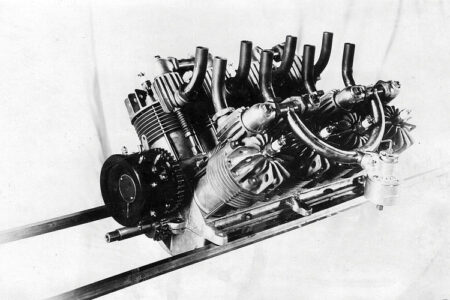
Clarence White, the Curtiss shop superintendent, was put in charge of assembling the air-cooled V-8 engines with Glenn’s input. The engine for C. O. Jones, once completed, was run on a test stand before being installed on the cycle frame and not tested again.
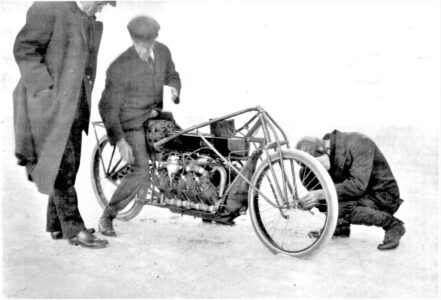
Henry Kleckler (a new employee and later a major asset for the company in engine design) was put in charge of the night shift crew building the cycle and was given the task of creating and installing the beveled gears and universal joint for its driveshaft. He was also responsible for overseeing Charlie Wixom, the company carpenter, in the shipping department and with getting the cycle ready for shipment to the speed trials at Ormond Beach (Glenn’s second and last visit), being held the fourth week in January. The finished cycle was huge — slightly over eight feet long and heavy, weighing around 280 pounds. It was equipped with an automobile tire in the rear and a cycle tire on the front.
According to Kleckler, once the cycle was completed: “there was considerable speculation how it would handle on the road. It was not possible to road test such a thing and also there was over a foot of snow on the ground. We cleared a path about ten feet wide up the steep grade between the shops and shoved the machine up to the top and Mr. Curtiss got on and we all ran and pushed it down the hill while he tried out the balance. It did not give much of a test. But he said he thought he could handle it where he had room and under motion.”
The V-8 motorcycle was immediately crated and shipped at the last possible moment with two other cycles, accessories, and other items. Kleckler also noted that this was how they normally did things around the plant in “those days.”
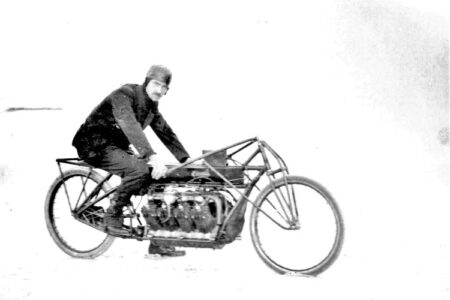
Accompanied by Tank Waters and Thomas Baldwin, Glenn would run the “freak bike” (a nickname given to it and others, not built for commercial sale) along with other Curtiss motorcycles for various trials at Ormond. Since the V-8 was untested, it proved to have a number of problems, so Glenn left it to Waters to work out the bugs while racing the other cycles first.
According to Tank, he had to get the handle grip twist throttle to work correctly, since it controlled two Curtiss-brand carburetors located on either side of the engine. Originally designed for smaller engines, the Curtiss carburetors proved to be inefficient, not allowing proper gas flow. This setback was corrected by replacing them with two larger Schebler-brand carburetors that Baldwin managed to borrow at the event. Proper ignition also proved to be a problem. This was solved with the use of eight dry-cell batteries. The only way to attach them was to wrap them around the oil tank, under the seat, with friction tape. Unfortunately, in order for this to work the seat had to be removed. As a substitute, a luggage rack was attached over the rear tire for Glenn to sit on. After several long days of fine-tuning, the monster was finally ready to run. It should also be noted that the cycle also had a handle grip twist spark advance.
Obviously not a standard cycle, the V-8 could not be entered into any race on the docket. However, officials did agree to a time trial covering 4 miles on the evening of the twenty-fourth. This was to be overseen by a team using stopwatches. The group leader in charge of the team was Mr. James T. Sullivan, an event official. Allowing a two-mile start to get up speed, Curtiss managed to get the engine started, and the cycle proceeded to lurch forward while Baldwin and Waters tried running alongside to help Glenn keep his balance.
As he gained speed, and to cut wind resistance, Glenn leaned forward until he was practically lying flat on the bike (this was a practice he originally learned while racing bicycles). He covered the next timed mile in 26.4 seconds — 136.4 miles per hour! It took him another mile to bring the bike to a stop. Minutes later, he would learn that he had shattered the world speed record, becoming the fastest man on Earth — going a mile per hour faster than any man in history.
In order to make the time an official standing world record, Glenn was required to complete a second run as fast as or faster than the first. After refueling, he took off again. He managed to build speed up to 90 mph when suddenly the universal joint on the driveshaft broke, causing it to flail about, bending and damaging the frame of the cycle. Miraculously, he was able to stop without injury to himself. While Glenn was disheartened and a bit shaken over the damage to his motorcycle and not completing the second run, most everyone there that day agreed that he had set the record. The press proclaimed that on that day, only a speeding bullet could rival him.
Glenn’s personal comments on the record-breaking V-8 run were a bit subdued due to his typically modest nature. In a magazine interview, he was quoted as saying, “Riding an eight-cylinder motor cycle is not likely to become very popular,” and at such a high speed, “all I could see was a streak of beach with wild surf on one side, sand hills on the other, and a black spot where the crowd was. The machine set up a terrific and inexplicable vibration; it was so great that it did not create wholly comforting thoughts.” However, he did say of the experience: “It satisfied my speed craving.”
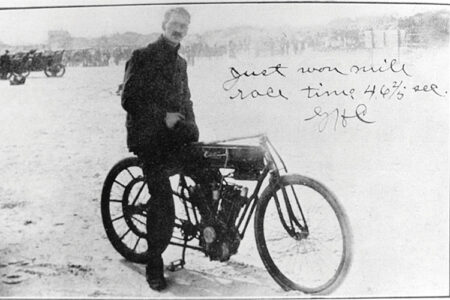
He also set an officially timed record of one minute, two seconds for the mile run in the single-cylinder class on January 22. Competing in the mile race for two-cylinder motorcycles on the twenty-third, Glenn came in first and yet again set another world record time of 46.4 seconds. Both were medal winners.
Looking to set a fourth record on the twenty-fifth, Glenn and Tank were scheduled to make a try for the mile run with two riders on a tandem. Having installed a tandem attachment to the two-cylinder cycle, the pair arrived at the starting line, waiting their turn, when they witnessed the wreck of Fred Marriott’s Stanley Steam Racer “the Rocket.” While not fatal, the incident put an end to the speed trials, robbing the Curtiss/Waters team of a chance at another record.
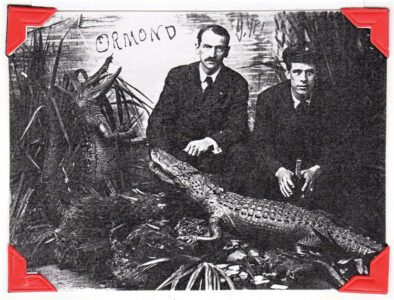
Baldwin headed out to California immediately after the event, while Glenn and Tank lingered, taking time to have a souvenir photo taken of them posing with a stuffed alligator. The two booked passage on a ship heading back to New York and subsequently ended up with an unpleasant case of seasickness due to rough seas.
Glenn made the initial decision not to return to the Ormond Beach speed trials after 1907 for one basic reason. He felt that the motorcycle events were poorly covered or ignored by the news media, with too much emphasis on the automobile. However, another underlying factor may have been the unforeseen problem with the eight-cylinder cycle. While people thought of Glenn as a daredevil — and to some, a “Hell Rider” — Glenn did not take unnecessary chances, and safety was foremost in his mind. He always studied the courses he would run ahead of time as a precautionary measure and also scrutinized those whom he would be competing against. It would be fair to say that the second run of the V-8 was more of a risk than he was willing to take.
On his return to Hammondsport, Glenn suspended all work for the night shift employees responsible for constructing the cycle and entertained them with his experiences while serving them all a treat of fresh oranges. The V-8 engine was removed from the cycle and turned over to C. O. Jones for his experiments and replaced with a dummy engine. The cycle was also repaired and made to look as it did before it was sent to Ormond, in order to be ready to fill requests for display at various automobile shows.
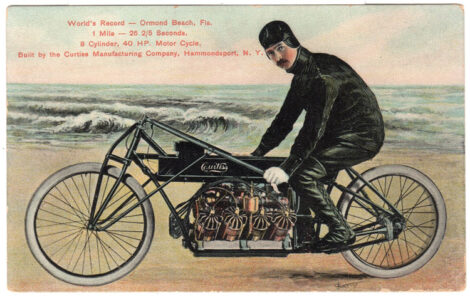
Over the years, stories have arisen as to how the V-8 was actually started. While documented details were never recorded in period accounts that can currently be located, it has been speculated by early biographers and over the last few years by motorcycle enthusiasts (some even publicly doubting the run ever happened) that the cycle was either towed by a car or pushed to start. As stated before, Tank specifically said that he and Baldwin ran alongside, not pushing.
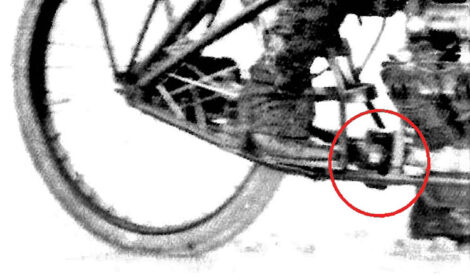
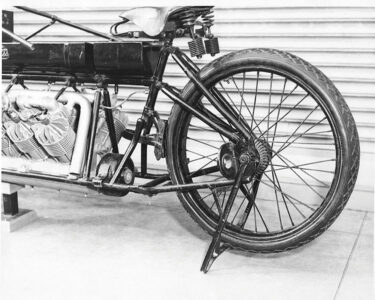
It has always been suggested that the cycle was direct drive without a clutch. If so, the rear wheel could have been elevated, either with a portable stand or by two men lifting the back end off the ground in order for the wheel to spin freely when the engine started. The combination stand / luggage rack — which can be seen on the back of the cycle in the beach run photographs taken during the event — was an item that Glenn offered in his retail catalog, and may possibly have been used as intended. However, contemporaneous photographs from 1907, right up to 1990 photos, also show a large, round object just behind the engine and bolted to the frame. This may actually have been a gearbox or a centrifugal clutch, similar to those introduced in 1889 for use on early Daimler automobiles.
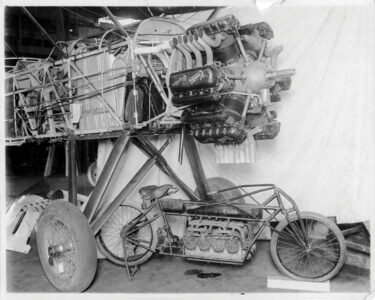
There is an additional aspect of the V-8 motorcycle that has seemed to have gone overlooked through the years. That is the possibility that a second V-8 cycle was built strictly for exhibition. The Hammondsport Herald reported on November 20 that “at the works just now is also being completed a monster eight cylinder motorcycle, practically a counterpart of that which Mr. Curtiss made a world’s record at Ormond Beach.” This motorcycle was to be displayed at the Chicago Auto Show being held during the first week of December. Harry Genung, Curtiss plant business manager, was the representative in charge at that weeklong event. However, a V-8 motorcycle had already been displayed at the New York Auto Show the first week of November. This article raises an interesting question: Are there actually two V-8 cycles?
Assuming there was only one V-8 cycle, it would sporadically go on tour over the next few years, starting with the New York Auto Show held November 2-9 and then the Chicago Auto Show in December. It would appear again in 1909 at the Wanamaker Department Store in New York City, and then at the Dayton Dry Goods Store, in Minneapolis, Minnesota, in 1910, along with the 1909 “Rheims Racer” airplane at both locations. The cycle was last featured at the third annual Binghamton Auto Show in Binghamton, New York, at the Charles Wakeman booth, and also at his dealership in Lestershire (now known as Johnson City, New York) in February 1912.
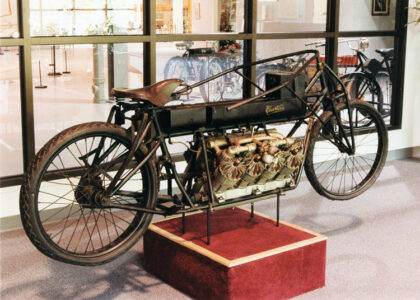
Eventually, the V-8 was moved from Hammondsport to Buffalo sometime during the early years of World War I, and then over to Long Island in 1917. There it was put on display in the front lobby of the Garden City facility until 1920, after which it quietly disappeared until 1929, when it was photographed with a Curtiss-Chieftain radial engine for size comparison.
At some point, the V-8 returned to Buffalo, where, during World War II, it was discovered in the storage area of the Flexlume Plant of the Curtiss-Wright Corporation in January 1943. Unfortunately, the Curtiss Wright-er, a company newspaper, printed a not-so-factual story identifying the cycle as being constructed in 1901. They also stated that it had set a record of 108 mph on Long Island while racing against two French cyclists the following year. The article went on to report that Glenn personally used it to commute from his home to the factory on Long Island until 1908. Sadly, this shows that even a company can get its own history wrong.
After its reemergence from storage, the motorcycle would be brought out occasionally to display at special company events. Curtiss-Wright employee George A. Page Jr., chief engineer, saw to it that the cycle was donated to the Smithsonian Institution in 1952, where it currently resides. It should also be noted that the Schebler carburetor that appears on the cycle in later years is a Model H, not available until around 1914.
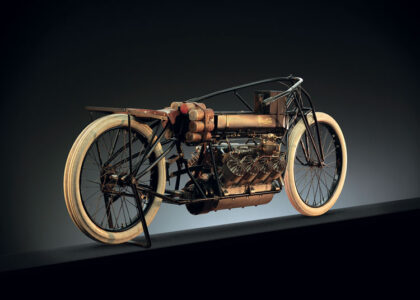
The original V-8 did, however, return home to Hammondsport, New York, in 1975 for exhibition at the Glenn H. Curtiss Museum, where it remained until 1988. It was reloaned from 1992 to 1995, so that an exact replica could be built by the Mercury Aircraft Company of Hammondsport and museum volunteers for permanent display at the Curtiss Museum. At some time during its return to the Smithsonian between 1988 and 1992, the “transmission” was removed and the universal joint, shaft, and gear were added.
In 1996 the Smithsonian conducted an examination and conservation of the cycle in their possession, with these initial findings offered to the Curtiss Museum:
- X-ray and chemical analysis showed only the frame was original,
- the gas tank was a replacement, and
- the engine was a shell with used defective cylinder heads.
In addition, when several layers of paint and reproduction decal were removed, the original Curtiss decal on the gas tank was revealed, as well as a “red racing decal” (no description) on the front column.
Also changed during the Smithsonian’s conservation, the black-tubing handlebar was replaced with a nickel-plated one, and the missing twist grips were added. In addition, the vintage black tires on the machine were switched to white tires to represent those originally used at Ormond.
In 2021, the cycle would undergo a second conservation at NASM before being installed in a display titled Nation of Speed. MC
Motorcycle Classics is grateful to author Richard Leisenring and Schiffer Publishing for permitting us to publish this chapter from the book Curtiss Motorcycles: 1902-1912 by Richard Leisenring Jr., ISBN 978-0-7643-6808-0. www.SchifferBooks.com. The highly detailed, very well illustrated book has a superb index and an extensive bibliography, allowing readers to learn even more about Glenn Curtiss’s motorcycle and aviation achievements. Curtiss Motorcycles 1902-1912 is available everywhere books are sold.