Learn about the National Infantry Museum in Columbus, Georgia, and see how to make the most of your motorcycle trip to get there.
The Skinny
- What: The National Infantry Museum, 1775 Legacy Way, Columbus, Georgia 31903. Open 9 a.m. to 5 p.m. Tuesday through Saturday, and 11 a.m. to 5 p.m. Sunday. Closed Monday. Telephone: (706) 685-5800. Admission is free.
- How To Get There: From Atlanta, take Interstate Highway 85 south to Interstate Highway 185, take Exit 1B to U.S. Highway 280 West, and then left on Fort Benning Road. From points south, follow the Chattahoochee River north for a ride through Eufaula, Alabama (you can thank me later).
- Best Kept Secret: The lush, scenic, and curvy roads in western Georgia and in eastern Alabama.
- Don’t Miss: The museum’s interactive Congressional Medal of Honor exhibit. Enter the name of any MOH winner and get a surprisingly thorough history of the recipient and their actions leading to the award.
- Avoid: Crawling under the guard rails or barriers in any of the exhibit areas.
- More Info: www.NationalInfantryMuseum.org
- More Photos: Exhaust Notes blog
National Infantry Museum, Columbus, Georgia
I first visited Fort Benning in August 1972 to attend the U.S. Army’s Airborne School. I remember heat, humidity, cockroaches that would fight you for the covers at night, long runs, thousands of pushups, and a tiny Infantry Museum housed in Fort Benning’s old hospital. The Infantry Museum in those days was woefully inadequate for the Queen of Battle’s treasures and mementos. Fort Benning is the U.S. Army’s Infantry Center and a fitting location for the new National Infantry Museum, and I’m happy to report things are much improved from 1972.
The National Infantry Museum Foundation started raising funds in 1998 for a new museum, and in 2008, the new museum opened just outside Fort Benning’s main gate. Designated as one of America’s best free museums by “USA Today” and often included in lists of top military museums worldwide, the National Infantry Museum is impressive. The museum’s 190,000 square feet and three levels include 16 halls and numerous display areas. 30,000 items are in its archives, nearly 2,000 artifacts are on display, and exactly one motorcycle is presented for the public’s viewing pleasure.
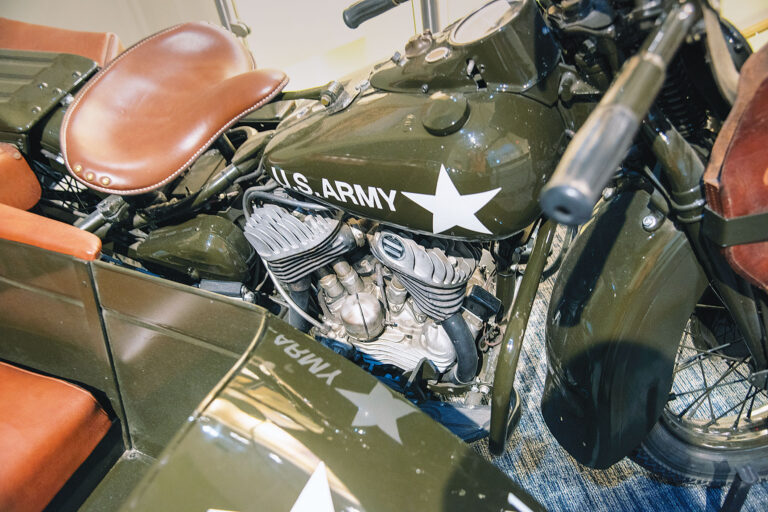
The National Infantry Museum’s sole motorcycle is a shiny and showy high-gloss olive drab sidecar-equipped Harley-Davidson WLA. It is on the museum’s second story, but if you don’t look for it, you might miss it. The museum’s WLA, a motorcycle donated by Harley-Davidson Motor Company, is perhaps a bit over-restored, much prettier than any WLA I had ever seen, including those I recently viewed at the Harley-Davidson Museum in Milwaukee.
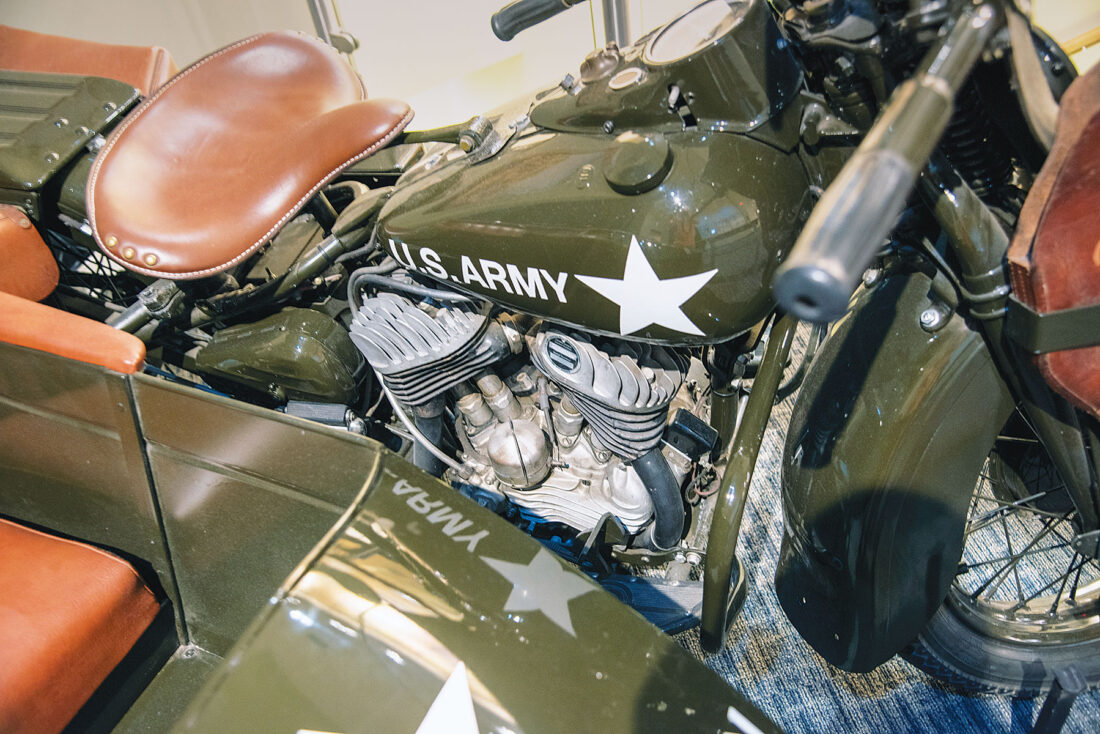
Harley-Davidson’s history prior to and during World War II is fascinating. As war clouds gathered, the War Department directed Harley-Davidson and Indian to cease civilian production, develop a 500cc V-twin for military service, and focus all attention on military production. Indian did so, lost their civilian market during the war, and went out of business less than ten years after World War II ended. Harley ignored the War Department’s directive and told the Army they made a 750cc twin, and if the Army wanted Harleys, that’s what they could purchase.
The War Department acquiesced and later acknowledged that Harley was right; the WLA was a better motorcycle than the Indian Model 741 (Army Mission). Per the military’s specifications, there were interesting military Harley and Indian variants, some based on their civilian models, but also a new in-line crankshaft flathead boxer twin model from Harley, à la BMW, and a flathead Indian V-twin à la Moto Guzzi. Ultimately, the Army lost interest in motorcycles and canceled remaining production contracts. The Army’s new general-purpose utility vehicle, the “Jeep,” served the Army’s needs much better.
The Georgia roads and the riding in and around Columbus, Georgia, are marvelous, mostly two-lane blacktop through lush green forests. One popular ride is a loop on State Route 27 north to State Route 190 through Franklin Delano Roosevelt Park, with a return to Columbus on State Route 27 ALT south. Warm Springs, where President Roosevelt vacationed, is just north of this loop. Nearby State Route 52 through the Fort Mountain State Park is another great ride.