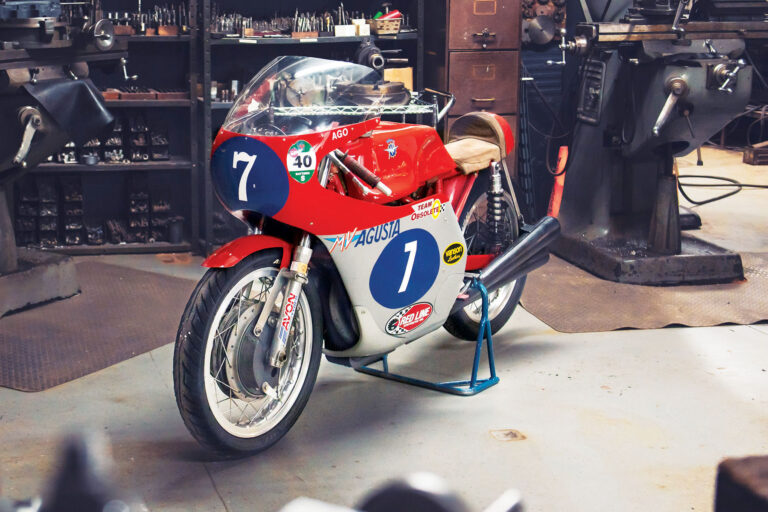
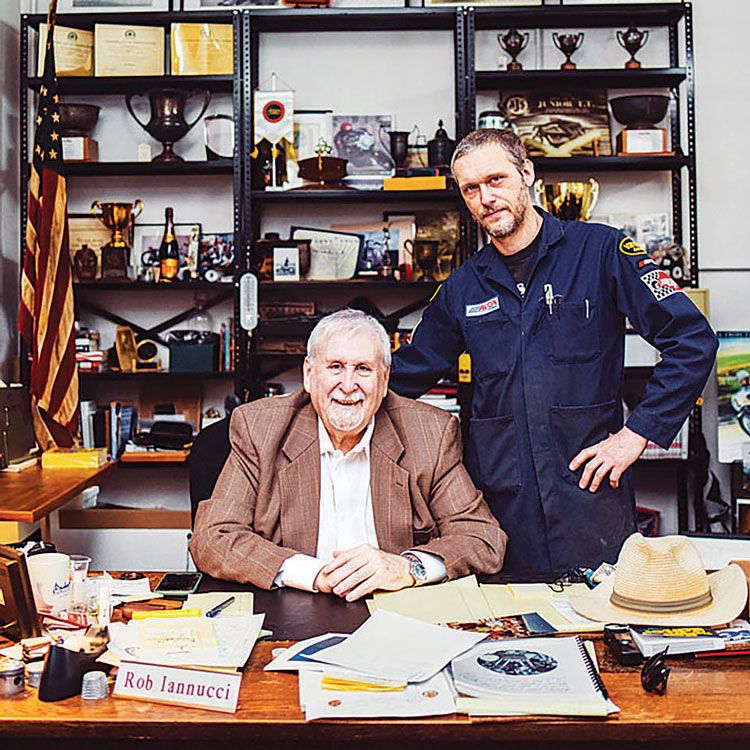
Team Obsolete, the “World’s First and Foremost Classic Race Team,” holds an annual Christmas party each year that sees guests come from far and wide to the team’s headquarters in Brooklyn, New York. Team owner Robert Iannucci graciously agreed to an interview this year so we could examine what his team achieved this past year.
Unlike previous seasons, where the team raced two to three different motorcycles over the course of the year, 2024 was one for the books with six different 350cc classic motorcycles being raced at tracks around the country at select AHRMA (American Historic Racing Motorcycle Association) events. The 350 Grand Prix class was the featured class for 2024. Mr. Iannucci was the founder of AHRMA, and he started racing a Matchless G50 on Northeast tracks in the 1980s. He begins his love affair with AMC motorcycles, owners of the AJS and Matchless brands, and the focus of his obsession is machines and the men who raced them during the class era of Grand Prix, from 1947-1975.
As Robert Iannucci’s curiosity and knowledge grew during the 1980s and 1990s, he became increasingly interested in authentic Grand Prix racing motorcycles, specifically the 350 and 500cc classes. This is where some of the most innovative technology was taking place for European manufacturers and individual specialist tuners in the classic period of racing.
The arrival of multi-valve cylinder heads and gear-driven double overhead cams on both single and multi-cylinder engines meant higher revolutions per minute were achievable. New lightweight materials and improved metallurgy were used for engine and gearbox components, too. Frame designs improved, and innovative suspension set-ups were also central to this evolutionary effort. Additionally, better cooling methods and increased aerodynamic aids, such as dustbin or dolphin fairings, meant speeds were up significantly, too. Many of these tricks were learned while building World War II aircraft and were applied here. Small batches of factory hand-made motorcycles or “works bikes” as they were known, were created to give the team’s star riders a better chance to win the World Championship, which in turn promoted the manufacturer’s own road motorcycles that, at least in theory, increased sales. In many ways, these motorcycles offered a balance of performance and handling that often outshone their larger competitors. These machines were ridden by the most legendary riders of the era, like Freddie Frith, Geoff Duke, John Surtees, Mike Hailwood, Jim Redman, Phil Read, and Giacomo Agostini, with great success.
Interview with Robert Iannucci (RI) and John Lawless (JL)
JL Team Obsolete took on an ambitious challenge year by racing six different 350cc grand prix motorcycles, and that’s what I’d like to hear about today. That’s quite a departure from your more typical approach, where a single bike is developed over the course of the season. What motivated this decision and what are the complexities involved in racing and preparing multiple vintage racing machines simultaneously?
RI Well, I think the big impetus is that we haven’t been very active here in the United States for the last few years. We’ve been doing a lot of things in Europe. We go to the Isle of Man. Every year we go to Italy once or twice a year and so forth. It was time for the pendulum to swing back, swing back in the other direction. Also, AHRMA got it together this past year. And this guy, Dan May, who’s the new executive director, he’s like a blessing. And he’s put together a really great operation.
JL It certainly brought back some excitement to AHRMA racing. It was missing recently when there have been so many replica bikes; to see the original Grand Prix machines in action again is a rare treat.
RI Well, that was the final reason, that I see it as more a kind of an educational process. Because, you know, everybody gets older. There’s a generational thing that’s impacting the older bikes. And I thought that if we brought back some of the older real classic bikes, maybe it would stimulate some activity for those bikes by other people who own them as well. But what I’m hoping is that for next season, there will be some real classic bikes that are returning to the track. But like it was, you know, back in the old days of Manx Nortons and the G50s and the 7Rs and that sort of thing… XR750 Harleys, the truth is that’s where my heart is. And if I can stimulate some activity in that direction, I feel great. Fantastic.
1967 MV Agusta Agostini’s 350/3
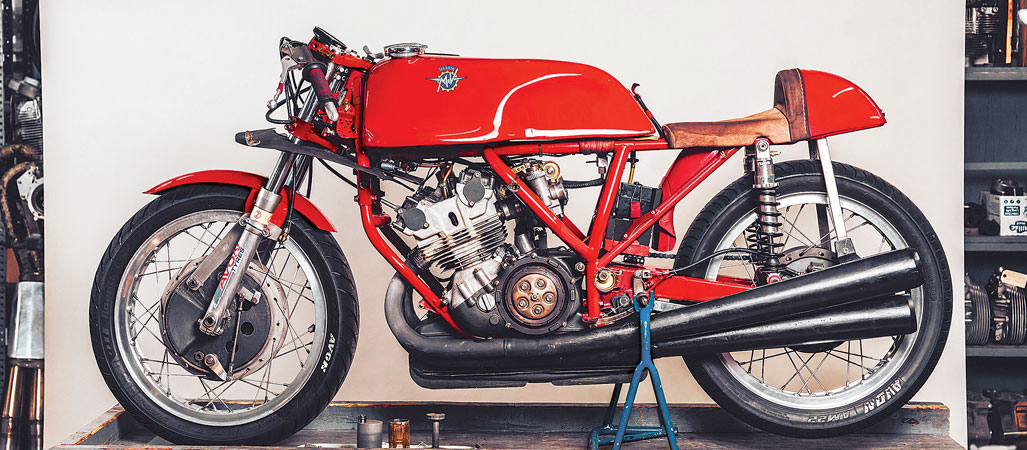
- Engine: three cylinder, gear driven DOHC, 4 valves/cylinder, bucket pushers
- Bore & Stroke: 62.6mm x 54mm
- Capacity: 349cc
- Carburetion: 3, Dell’Orto SS1 31mm
- Ignition: Total loss points & battery ignition
- Transmission: 6-speed
- Clutch: Dry, multiplate
- Primary: Indirect gear driven
- Weight: 286lb
1967 MV Agusta 350 Triple
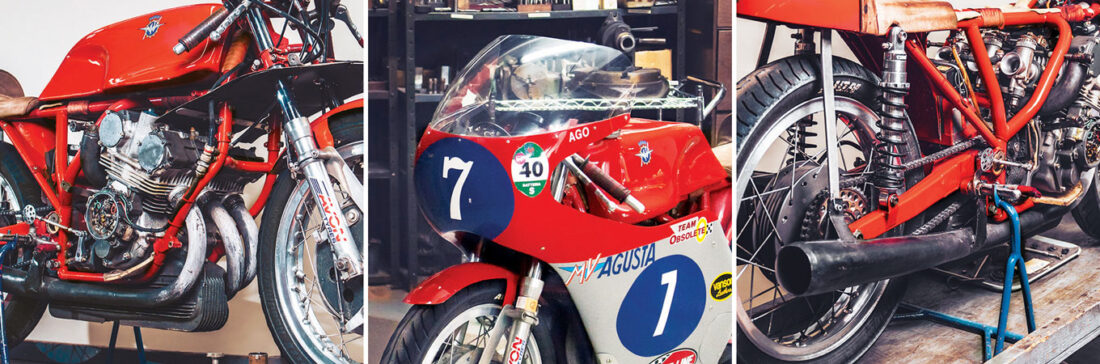
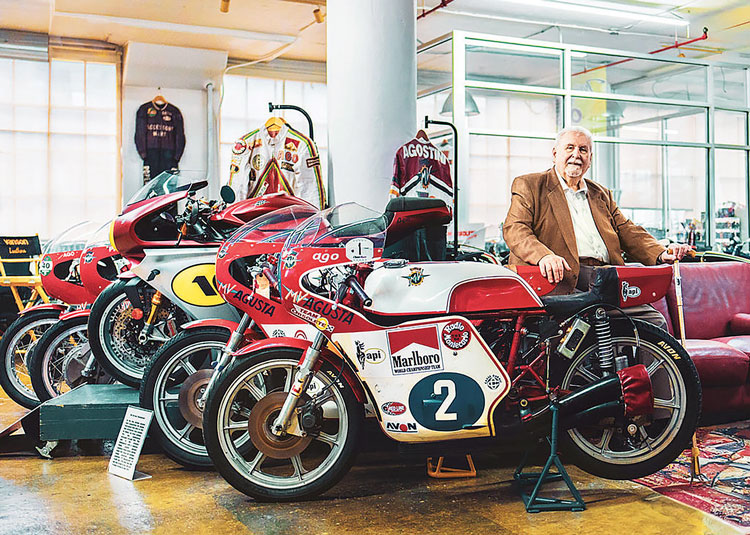
In 1971, Giacomo Agostini secured his 10th world title, having become nearly unbeatable on the MV Triples. Though a small company, they leveraged their meager resources on consistent incremental development, resulting in this final version of the 350cc, a transverse in-line three-cylinder DOHC 4v featuring a dry clutch and six-speed gearbox.
Power had risen by this point to 68hp at 13,000rpm with a claimed top speed of 158mph. 1971 became a turning point for MV with the death of Count Agusta that year. The next year would see the new fours doing most of the rounds, by ’73, Ago had left for Yamaha, leaving Phil Read at the helm of the MV racing efforts.
JL So, no history of Team Obsolete would be complete without recognizing the pivotal role of David Roper, the man who spent so many hours at the helm of these machines. How does his riding style influence the tuning and the set-up of the bikes to optimize performance for Dave on the race track?
RI I mean, Dave’s been riding for us since the early ’80s. And personally, I like his riding style because it’s well-suited for the classic bikes.
JL High cornering speeds?
RI Yeah, you know, these days with the modern bikes, you have guys who go charging into a corner and grab the brakes, do a quick turn, and then they accelerate out. Doesn’t work well with a classic bike because classic bikes don’t have any brakes. They don’t have any power compared to a more modern bike. From time to time we put some modern riders on the bikes for track tests. And initially they tried using a modern riding style, which didn’t work out too well. After some conversations and some practice, they were able to go much faster by going slower. (To quote the late, great Bob McIntyre, “Make haste slowly, laddie.”) And so David’s always been very graceful. And he’s easy on the bikes. And he has a good perception when something’s about to go wrong. I mean some guys, something goes wrong, they don’t know, and run it until it blows up.
JL He perseveres and works through it?
RI Yeah, when something’s starting to go wrong with the bike, he senses it early on. And minimizes damage that might occur. You know, if something’s loose in the motor or something like that.
JL The kind of sensitivity that only comes with many miles on those bikes.
RI Yeah, many miles on those bikes. So, you know, that’s a good thing.
1951 AJS Works 7R
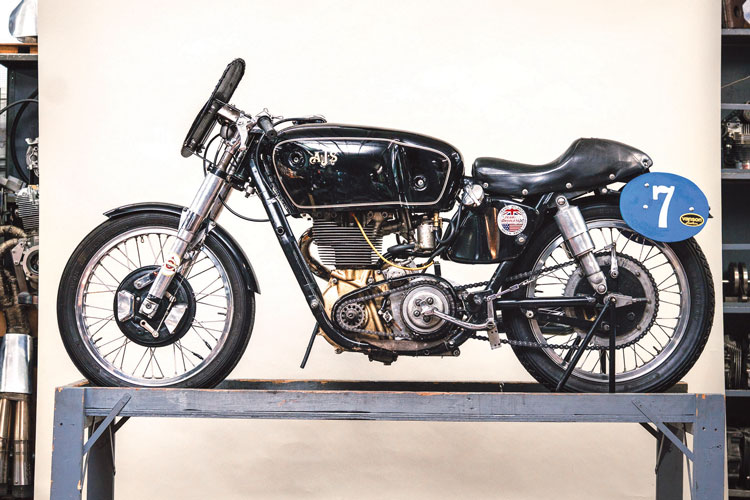
- Engine: Air-cooled single, 2-valve, chain driven, roller rockers SOHC
- Bore & Stroke: 74mm x 81mm
- Capacity: 349cc
- Carburetion: Amal GP, 1 5/32″
- Ignition: Lucas TT magneto
- Transmission: Burman 4-speed, chain primary
- Clutch: Multi-plate dry clutch
- Weight: 283lb
1951 “Works” AJS 7R
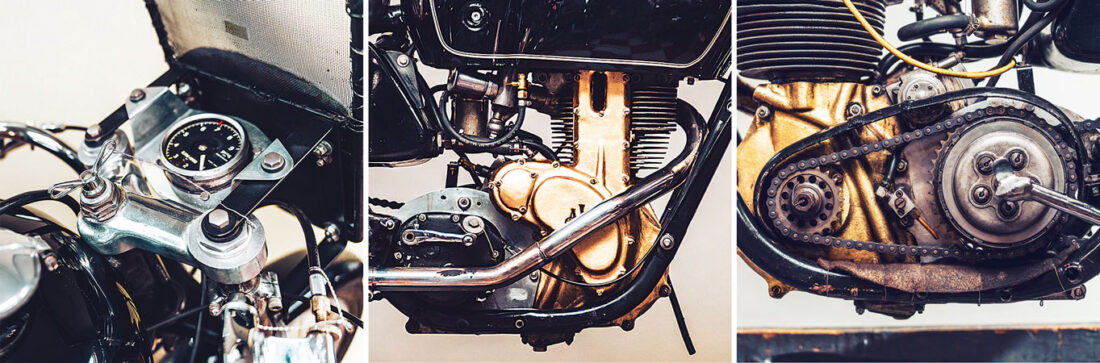
This motorcycle exemplifies the cutting edge of British racing technology in the very first years of the world championship. A top-to-bottom redesign of the 7R campaigned by the legendary ‘works’ team of Doran, Armstrong, Featherstone, and then Clark, Farrant, and Bob McIntyre.
How it all began
JL So what initially drew you to start collecting racing motorcycles, especially 350cc Grand Prix machines?
RI I spent some years in the Caribbean as a Peace Corps volunteer. Before that, I was into drag racing small block Chevys. But you know, we weren’t allowed to have cars there. But we were allowed to have motorcycles, so my first bike was a 160 Honda. And then, about the time I was ready to go on to the next stage of my life, I ordered a brand new Norton Commando roadster right from the factory and had it delivered to the Caribbean. That bike is right over there, the blue and white one. And I’ve had it since 1970. When I got back to the United States, I was steeped in motorcycles and British bikes, and I met a bunch of enthusiasts that used to go to some of the local races. That was my real exposure to motorcycles, and then a life changing event occurred.
JL And that was…
RI I discovered G50 Matchless motorcycles.
JL I was going to ask you about that. How did you end up being a Norton fan, then suddenly becoming an AMC Matchless and AJS marque specialist?
RI Well, they all have the same roots. They were all built by Associated Motorcycles. They were designed over the years by the same group of people. And I thought that part of a motorcycle is art. And when I came back here, I found an article on the G50 Matchless, actually the street bike version, in a magazine that was many years old. I saw the engine from a design point of view, and it’s an overlap between mechanical design and style. And I fell in love with the G50 Matchless motorcycle engine, and the love affair continues.
JL So, when adding a new bike to the Team Obsolete collection, what are the key factors that you consider? Is it about the bikes’ historical pedigree, or is it about the technology at the time it was built? Or is it something altogether different?
RI It’s all of the above, but the most important and most satisfying thing is to get a motorcycle that has, in many ways, some true historical provenance, and you prepare it for racing, and then you go racing.
1953 AJS 7R2 “South Africa”
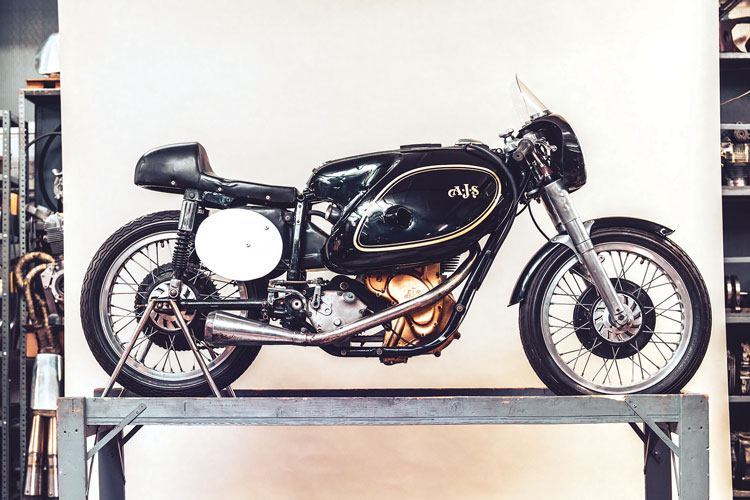
- Engine: Air-cooled single, 2-valve, gear driven, roller rockers SOHC
- Bore & Stroke: 74mm x 81mm
- Capacity: 349cc
- Carburetion: Amal GP, 1 5/32″
- Ignition: Lucas 2MTT
- Transmission: Chain primary, Burman 4-speed, dry multi-plate
- Weight: 288lb
1953 AJS 7R2
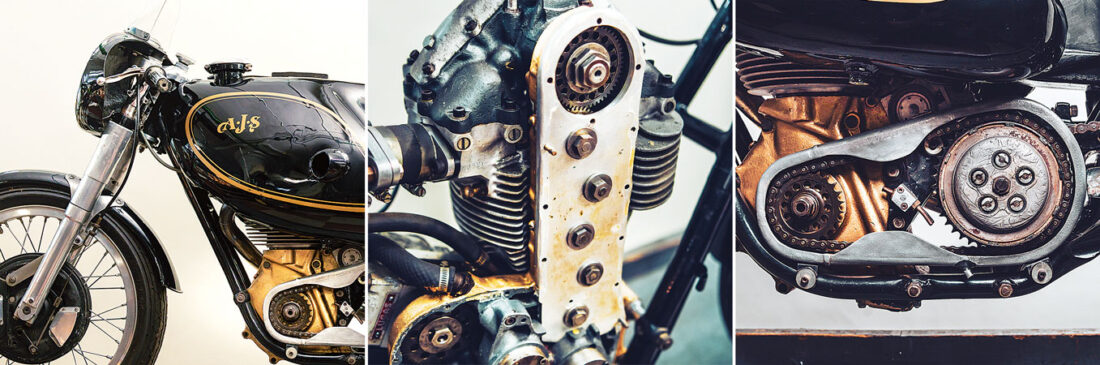
Uniquely, this machine was delivered from the factory pairing a three-valve 7R3 chassis with a standard two-valve 7R engine. The 7R2 was raced with great success in South Africa by Keith Campbell.
The challenge of finding and buying
JL Can you share a particularly challenging or rewarding motorcycle acquisition story? Is there a balance between the seller wanting to see something done with it and what you want to do with it? Or is it often just that you’re the right guy at the right time with the money to buy the bike?
RI Well, it’s a mix. There’s a lot of effort that goes into acquiring some of these bikes, sometimes in terrible condition. Sometimes the bikes have been scattered and the motor is in one place and the chassis in another place. Of course, having a lot of first-hand knowledge as to what the bikes actually are is a big help. Look, the truth of the matter, and it sounds a little over the top, but to some extent, you got to be a real badass to get this stuff. Because you know, you’re not the only guy that wants it.
JL I know that one that’s right behind us, the “South African 7R” is one that took you a long time to get.
RI Yeah. 25 or 30 years. And a lot of the other bikes here have taken a long time to get them. They were scattered. Yeah, a lot of it is beyond perseverance.
JL In the end, how did that acquisition go down? Did the owner call you or did you finally give him one last call and got the deal done?
RI He was on his deathbed, and he had his brother call me up. I’ve been trying to buy it off him since the late 1990s. And that was specially built for him by the factory. The only one of its type.
JL And that one is unique because it has the gear-driven cam?
RI Yes, and it’s in an AJS “triple knocker frame” with standard engine converted to geared driven cam as well. And they built it just for him. And in fact, the serial number of the frame and the engine match.
JL And so he had success with it in South Africa?
RI And in England, too. When I got it he was an old man. I mean, he got the bike in the mid-50s.
1960 AJS 7R Bob McIntyre Special
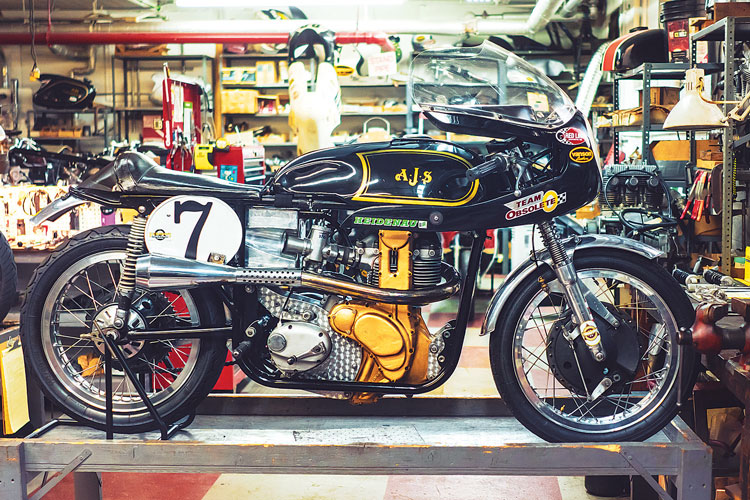
- Engine: Air-cooled SOHC single, 2-valve, chain-driven cam, roller rockers
- Bore & Stroke: 75.7mm x 78mm
- Capacity: 350cc
- Carburetion: Amal GP, 1 3/8″
- Ignition: Lucas 2MTT magneto
- Transmission: Early Schaffleitner 6-speed, chain primary
- Clutch: Multi-plate dry clutch
- Weight: 283lb
1960 “Bob Mac Special”
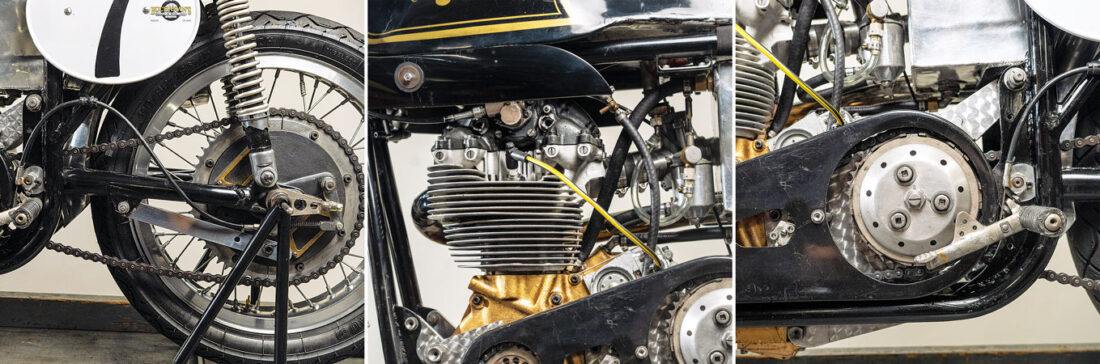
A very interesting ‘special’ built as a collaboration between Bob McIntyre and his long-time sponsor and fellow Scotsman Joe Potts. Featuring a featherbed-style frame built in Reynolds 531 tubing. The resulting chassis is lightweight and nimble. A prime example of how hometown tuners and fabricators of the time were able to match or surpass the factory efforts.
JL What is the emotional and technical journey you experience when pursuing a rare, historically significant motorcycle? Are there specific criteria that it must meet to be part of this collection? I know you don’t buy any replicas, that you’re only interested in the real deal.
RI I didn’t start out as a collector. I started out as a racer and a tuner. And I enjoyed the tuning and the racing and the rebuilding. I enjoy the fact that we’ve been able to attract excellent riders because the machines are excellent. My approach has always been that I want to go racing with that bike. I’ve become a kind of a quasi-collector by default. You know, simply because I got old.
JL When you started out, you were racing yourself, before Dave Roper came into the picture.
RI Well, only briefly, but it was a good exercise because it helped in having a dialogue with David and also other people. To understand the feedback. It’s very difficult for a rider to give a tuner good feedback. I mean, it’s easy for a rider to come in and say “I don’t like this thing, the way it handles, so make it handle.” It doesn’t get you very far. But if you could say, “Look, the front end is pushing out a little bit, and maybe I’m not getting as much traction on the rear tire as I could, or the primary gear ratio has to be altered.” That creates a tremendous advantage for the whole program for that particular bike because you know as a tuner what to do.
JL You’ve been doing this for 40-plus years.
RI Well, I first started racing as a street racer in the early 70s, both in the Caribbean, and, foolishly, when I got back to the United States, I briefly raced the G50 in an AJS 7R.
JL Running a race while simultaneously managing the restoration of historical motorcycles for Concours events must offer unique challenges. What do you think has been the most technically difficult aspect of this while keeping true to the historical nature of the machine? I know that your Honda RC165 (the Honda 250cc, six cylinder works Grand Prix racer) has given you so much joy and so much grief.
RI There’s no red line between different aspects. It’s all part of the same process. I mean, the Honda in particular was quite a challenge because in the early years, we didn’t have any spare parts. So eventually, we took over the work on the engine ourselves. Which maybe brings me to my next point: In the beginning, we were running G50s and 7Rs, which are pretty simple.
JL That’s quite a change in the sophistication of technology.
RI Then we got the Dick Mann BSA triple that he won the Daytona 200 with in 1971, and I fell in love with the three-cylinder BSAs. Eventually, we had to learn by doing what it takes to rebuild an MV Agusta or a Honda 6 or something like that, because there was no manual.
1963 AJS 7R “Kirby” Ultra Short Stroke
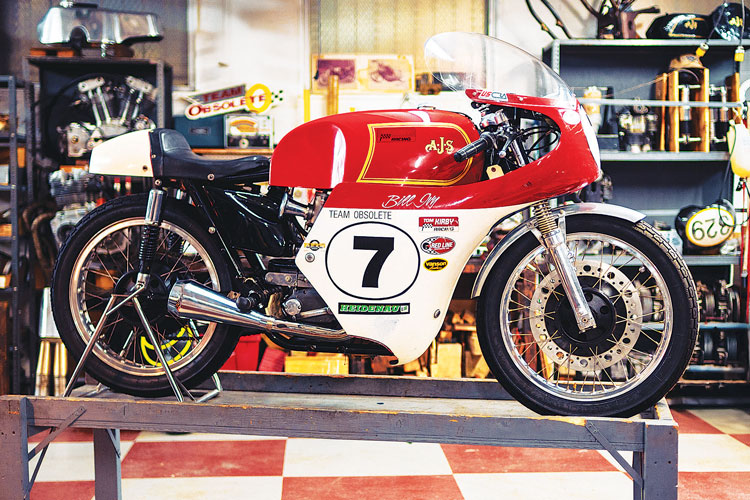
- Engine: Air-cooled, SOHC single, 2 valves per cylinder, dry sump, chain-driven roller rocker cam
- Bore & Stroke: 81mm x 68mm
- Capacity: 349cc
- Carburetion: Amal GP2, 1 3/8″
- Ignition: Lucas 2MTT
- Transmission: Quaife 5-speed, chain primary drive
- Clutch: Dry, multi-plate
- Weight: 289lb
1963 Tom Kirby Racing AJS 7R
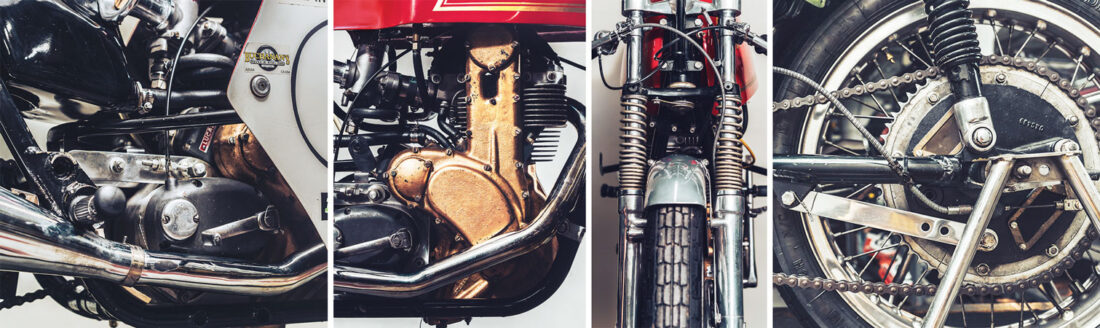
When the AMC factory ceased official racing efforts, some back-door support was given to the up-and-coming Tom Kirby racing team. With Riders like Bill Ivy, Paddy Driver, and Phil Read, they were a force to be reckoned with. Using well-prepared machines considered well past their expiration date, they racked up a long list of impressive finishes. This “Ultra-Short Stroke” engine was the final development of AMC Engineer Jack Williams (father of Peter Williams) and the subject of his highly regarded engineering paper on engine development. This special engine was given to Kirby in ’63 and is believed to be the bike behind a few of the noteworthy finishes.
JL Clearly one of the things you’re most well-known for was buying the factory bikes from MV Agusta and bringing them out, sharing them with audiences around the globe, and you faced some challenges with these machines.
RI The biggest challenge is time. I mean, I don’t think that particular motorcycle is any more difficult to restore than an MV triple or an MV vertical four. We just haven’t had the time because we’ve been busy racing.
JL But as an unfinished prototype, even from the factory, you had to then take it to the next level to complete the machine. They were to be destroyed by the factory if they weren’t going to be raced.
RI Well, I mean, there is that story. Because I started negotiations in 1980 with the MV factory in Italy, which was going through a lot of corporate changes, and ultimately was taken over by the Italian Government while I was negotiating.
JL So how many motorcycles were in that purchase?
RI About 18. And I got most of them.
JL Is there one that you feel is the pinnacle of that technology that excites you? Is it the AJS Porcupine? Is it a BSA triple? Is it the titanium framed MV four?
RI Look, my first love was the G50 and it’s a simple motorcycle. That was love at first sight.
JL So that was more about the aesthetics that caught your eye before you were driven by mechanics of it.
RI Yeah, and I had to learn how to tune it and operate it, you know? And I was self-taught, because nobody in the U.S. was racing G50s when I started racing them. So it was all about me — teaching me.
JL And it’s your contention that the G50 democratized racing at that time, instead of the Manx, which may have been more successful ultimately, but was much more costly and challenging to keep going?
RI Well, the G50 was a better bike for short circuits. It’s lighter and it accelerates better. The Manx Norton is more like a Grand Prix machine for fast circuits. So, they’re different, but we refer to the Manx Norton as brand X.
1967 Benelli 350/4 Ex-Renzo Pasolini
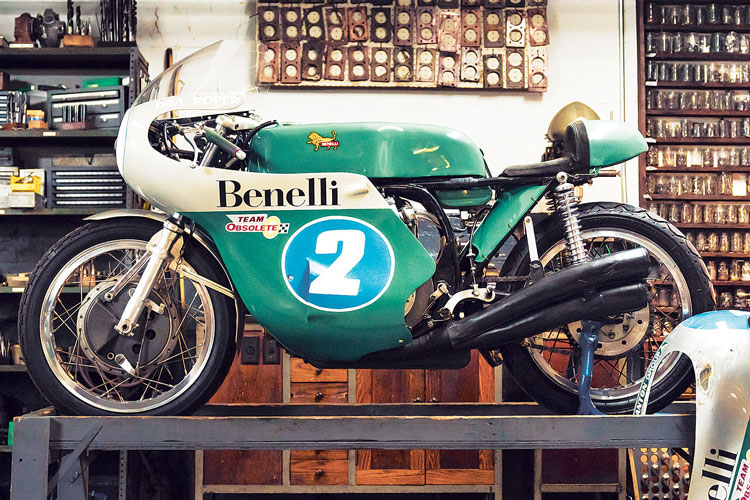
- Engine: In-line four-cylinder, gear driven DOHC, 4 valves/cylinder
- Bore & Stroke: 52.48mm x 40.6mm
- Capacity: 349cc
- Carburetion: 4, Dell’Orto SS1 30mm
- Ignition: Mercury magneto
- Transmission: 7-speed, indirect
- Clutch: Dry, multiplate
- Primary: Gear driven
- Weight: 316.1lb
1967 Benelli 350/4: ex-Renzo Pasolini
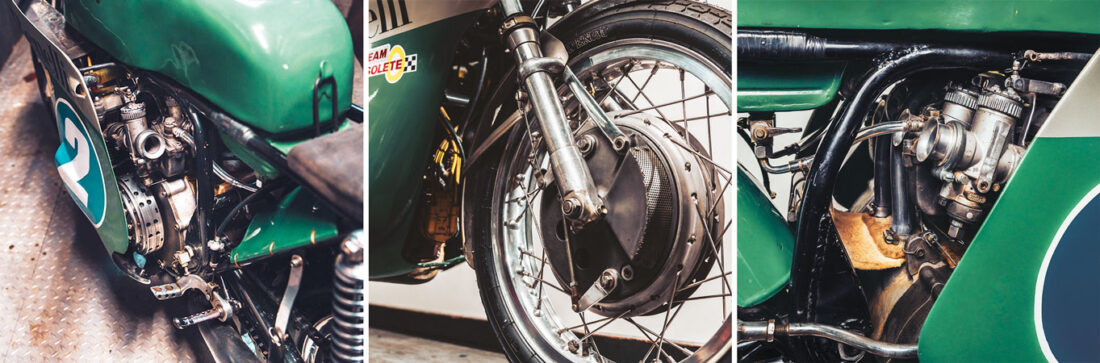
Four valves per cylinder, 7-speed gearbox. The Benelli 350 Four of 1967 is the very same machine that Renzo Pasolini used to finish second in the 1968 Isle of Man TT, just behind Giacomo Agostini on the MV Agusta. Ex-works, one of two built.
Acquired by Team Obsolete in the 1980s, but it was not until 1993 that the machine was returned to race condition in time for Daytona that year. There, pilot Dave Roper won the 350 race before crashing in the Premier race. Back to the workshop for repairs, and the machine was ready to go again in time for the 1993 Classic Manx at the Isle of Man. Roper had a promising 30-second lead before crashing in spectacular fashion at Kerromoar. The rider and bike both worse for wear, we shelved the machine for a few years, finally dusting it off and getting it race-ready in time to celebrate the 50th anniversary of the machine’s historic finish at the Manx Classic TT in 2013.
JL So in these 40-plus years, you’ve traveled the globe, you’ve witnessed legendary racers from the classic era ride your motorcycles. What do you think has been the most significant event that your team has been involved in?
RI Well, I think the one that people talk about the most is when we won the Isle of Man TT in ’84. But we’ve done a tremendous amount of racing other than that.
JL Does it give you a lot of satisfaction to see some of your racing heroes like Giacomo Agostini, Jim Redman, these people riding your motorcycles, you reuniting them with the bikes that they had their greatest moments on?
RI Oh, absolutely. You know, one of the characteristics of Team Obsolete is that we’ve had this incredible number of really top riders and mechanics that have been associated with our team. And because of the bikes that we were running, these guys were welcomed and happy to be here. Agostini has ridden for us 15 times. He doesn’t race, but Jim Redman raced and paraded; he’s a six-time world champion. Phil Read is a seven-time world champion, and the list of the American riders, national caliber riders, AMA Grand National champions, and FIM World champions is huge. No other team is even close in terms of the people that we’ve been associated with.
JL I do have a question for you, and this may be a difficult one: if you had to choose one motorcycle that you, in your prime, could race a full race on, what would that motorcycle be?
RI They’re all my children. But it would probably be a G50 Matchless.
JL So are there still specific motorcycles that you’re seeking? Is there something out there that you must have?
RI Everything that I hoped for is here, and everything that we have is a candidate to put on the racetrack. There was also this philosophical issue, and that is: should the bikes be raced hard? Or should they just be putt-putt-ing around the track? And there were two schools of thought. And my view was that if you don’t race them, then the sport is never going to grow.
JL So how do you balance the personal enjoyment with historical preservation in your collection?
RI Well, nothing goes out on the track until we completely rebuild it. And you know that virtually nothing that you acquire is track-ready. So you rebuild it from the ground up the way it was built from the ground up initially, and along the way, you learn what is wrong with it, and you correct whatever goes wrong with it. And that’s a big part of the process. There’s a lot of pleasure and satisfaction in restoring an old bike. If you’re prepared to be dedicated in the way that you do it, it’s not an impossible task. You just have to be prepared to put the time, and to some extent, the money into it.
JL What’s next for Team Obsolete in terms of restoration projects or the upcoming season?
RI I want to get the Honda Six running again, and the MV Boxer. And, you know, we’ve had a lot of satisfaction with this kneeler.
JL Some of the motorcycles that we’re looking at behind us today, we’ve got the Joe Potts Special, the Tom Kirby AJS 7R. You seem to be drawn to some of these specialists. They were building the bikes to make them something different from the works bikes. Is there a reason why these bikes have a special appeal to you?
RI Well, those bikes are kind of one-off specials, but they were built by really dedicated people who brought a lot to the table before they started that particular project. And I have great respect for the fact that they were able to, you know, take a standard 7R or G50 and take it to the next level.
JL As someone who’s dedicated much of their life to preserving the sport of classic racing, what are your thoughts on the future of the sport?
RI Well, it’s a generational issue, and I don’t know how that’s going to turn out. But when we started this thing in the late ’70s and ’80s, and going into the ’90s, the bikes that are near and dear to my heart were common. G50s, 7Rs, Manx Nortons, XR750 Harleys, and there’s not many on the track anymore because the guys that are racing now are much younger guys.
JL I think it’s fair to say that, more than any other race team, certainly in America, and maybe even internationally, Team Obsolete has been paying it forward. They’ve brought in a new audience, showing younger people these machines they’ve never had the chance to experience outside of a static display — what they sound like, what they smell like, and what it means to see them actually raced in anger.
RI Absolutely. And I’m hoping that what we did this past season will have some impact on that.
JL Well, seems it already has. MC
David Roper on becoming Team Obsolete’s top rider
“Rob had brought the Norton Challenge (Nortons’ last gasp) to Bridgehampton in 1978 to be paraded by Rich Schlachter during the lunch break after Kevin Cameron offered to help get the bike running. Rich decided not to ride the Norton because he had a practice session before lunch and a race afterwards. So Kevin said, ‘How about Roper?’ We were both aware of each other as we were both racing oddball British bikes. I rode the Challenge for a lap or two, and then he asked me to ride an AJS 7R at Briar Motorsports. This was before there was any formal “Vintage racing.” We raced it in Formula 4, and I did pretty well against the more modern bikes and went from there. That was in 1978, that was the beginning, that’s when it took off.” — David Roper