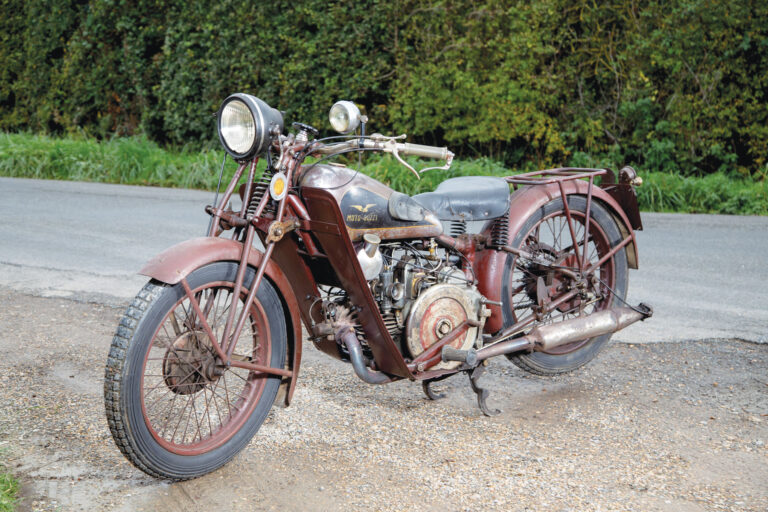
1933 Moto Guzzi Sport 15
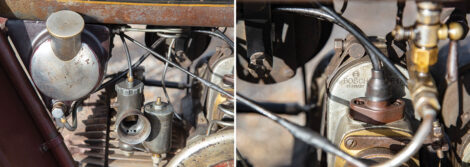
- Engine: 498.4cc air-cooled, four-stroke horizontal single, side valve induction/overhead valve exhaust, 88x82mm bore and stroke, 4.5:1 compression ratio, 13.2bhp @ 3,800rpm
- Carburetion: Amal type 6/142 or Dell’Orto MD 27F
- Ignition: Bosch magneto
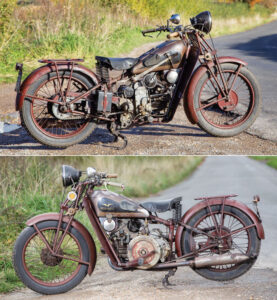
Even though all I had to go on were three or four dark and dingy pixelated photos of what looked like a brown and rusty old machine, and a similarly sparse five-word description, I had a gut feeling that this bike was possibly, in my eyes at least, something special.
17 years of longing and a couple of months of trawling various Italian websites and Facebook groups had led me to this point, so I sent off a message to the seller of the 1933 Moto Guzzi Sport 15, described only as “conserved and running, with documents,” and hoped for a response.
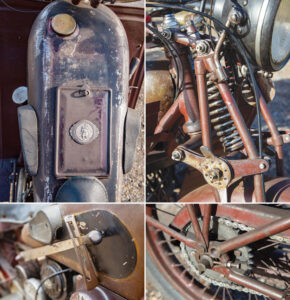
That same evening, the son of the elderly owner and seller replied and sent through many more much-improved photos with details. The old Guzzi looked like it had literally been put into a shed 40 years ago and left there under an old blanket. I was transfixed. It was the one I had been looking for.
Of course, buying an old and valuable motorcycle sight unseen and from another country is fraught with risk. I’m in the U.K., and the bike was in its homeland, Italy, and though I had brought over a few bikes from Italy in the past, it was all easy enough before the U.K. left the European customs union. So there were more complications and, without doubt, more expense than there used to be. But sometimes you have to go directly to the source to find what you want, and although I had amazingly seen another Sport 15 for sale in the U.K., it was too expensive and too modified from standard for my taste.
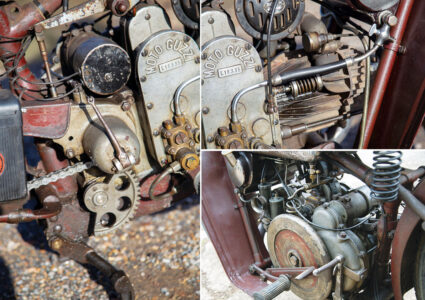
Although it’s another story altogether, I had been fortunate some 17 years ago to test a restored 1932 Sport 15, among other rare Guzzi singles, on a racetrack not far from Florence, Tuscany, for another article, and it just stuck with me. Thumping single cylinder 500cc side valve motor, big upright Bosch headlamp, imperious riding position, hand gear change, and a big spinning flywheel just one inch from your left ankle. A lever throttle that was so delicate between the fingers as well as in its action of opening up the big carburetor that the contrast between its lightness of use and the brusque manner with which it propelled the big single forwards with momentum and ease was almost shocking. The rigid frame and girder forks gave a stable ride, and the generous, sprung seat allowed some rider comfort. Add in an advance and retard working a Bosch magneto, and a left foot reverse heel rear brake, and it was an utterly involving and thrilling ride. It was a machine that, despite its advancing years and very simple technology, felt robust and eager to cover mile after mile. A wonderful example of Moto Guzzi’s pre-war output, a machine that would take you to work, and then allow you to travel on the weekends. Or bolt on a sidecar for family transport, or possibly a third wheel and wooden platform or box, and transport goods from place to place. But the one I tested was very shiny, its chrome work glinting under the Tuscan sun, its hand-applied pinstripes and deep amaranth paint resplendent as the result of a superb and correct restoration. In fact, the man responsible was Sandro Laici, Moto Guzzi big singles guru in Italy, and after that day, a friend, happy to have arranged such a choice of fantastic Italian motorcycles for me to test that day. I didn’t want “restored and polished” for my Sport 15.
Mechanical ghosts of Italy
I had lived in Italy for several years and was struck by two different Sport 15s owned by two friends. Antonio had found his hidden and abandoned at the back of a garage behind an ancient fridge freezer, dragged it into the sunshine, and brought it back to life. “Bingo,” as he’s known, and a proper character, had, however, owned his for decades and rode it regularly, and still does today, well into his eighties. Both bikes were, and are, unrestored survivors. The paint is the same paint applied in the factory at Mandello del Lario at the beginning of the 1930s: peeling, scratched, and battered. Chrome is corroded, oily ragged to preserve what’s left. The engines run well, and a couple of years ago, after following Bingo by chance up a hilly ascent while driving to Pisa airport, I stopped at the café at Nuvolari corner at Castellaccio (yes, he raced there) and admired Bingo’s amazing bike, equipped with old wartime military leather side bags. I wanted it, to the point that I asked him if he’d possibly consider selling. “No,” he rightly replied, laughing, “I’m still using it.” I had to leave to catch the flight, but was determined to find my own survivor Sport 15.
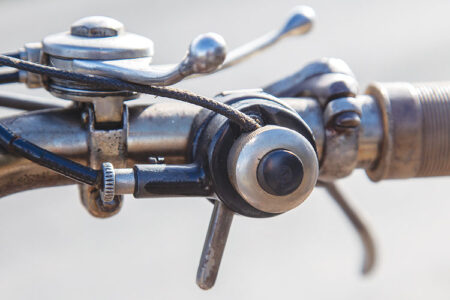
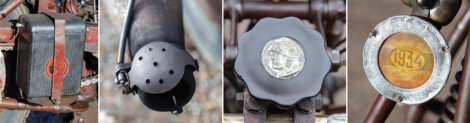
I was fortunate to come into a little money and sold a couple of my own bikes to finance any possible purchase. My conversations with the seller in Italy, whose name turned out to be Luciano, were going well. I had done my research and knew what the bike should at least look like, and his Sport 15 had all the correct original parts, as far as I could see in photos. It also had — and all of this was of great appeal to me — period extras such as a supplementary lamp on the handlebar, a period correct leather and wood pillion seat, original tax disc holder from historic Guzzi dealer and probably the supplying dealer of Siena Giuseppe Giannetoni, a type of metal pannier or box bolted to the rear rack, and what in Italian is called a chiusino a hand and cable operated cover for the end of the exhaust silencer, intended to quiet down the fruity exhaust note when passing through villages and enclosed streets. An early sort of DB killer, if you like. The bike was also equipped with leg shields, which were a neat period extra, and pretty hard to find nowadays, too. Most surprising of all was the medallion impressed into the steering damper, featuring the image of Benito Mussolini, fascist Duce of Italy, and keen motorcyclist, too. Of course, this old Guzzi was manufactured when Mussolini was in power, and it was apparently common to see these devotional images fixed to motorcycles at the time. On the lid of the toolbox built into the top of the fuel tank, there was also an old placchetta or plaque of St Christopher, patron saint of travelers. Perfect for the superstitious Italian rider!
A documented life
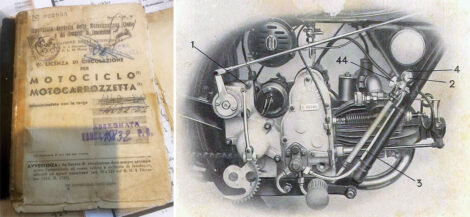
Most importantly, the frame and engine numbers matched what was written on the original logbook, demonstrated as Luciano sent copies of all of the original documents. Unlike here in the U.K., in Italy, you can purchase a vehicle’s registration history from the Italian authorities, and I asked my father-in-law in Italy to do this for me. The document that came back was incredible. Though difficult to read the spidery handwriting, the names of every owner and the places and dates of every time it had been bought and sold were documented. Once constructed, it was registered first to “Moto Guzzi of Genova” (Genova being the city where the Guzzi brand and societa was first formed) on July 27, 1933, then sold new for 5,850 Lire ($130 U.S.) on December 10, 1933, to Marlio Gallii in Siena, Tuscany. Over the years, it made its way slowly west to Cortona, into Arezzo, towards Perugia, and eventually over the Apennine mountains to the Adriatic coast, north of Rimini. On June 17, 1935, it was sold to a Pietro Boscherini of Cortona and then of Arezzo, and remained in his possession throughout WWII and the German occupation of Italy until 1952. I looked up Boscherini’s name, and the same surname came up in a couple of documents online discussing fascism in Cortona and Arezzo — was he a fascist sympathizer, so, was the image of Mussolini attached by him? And would the bike have been hidden once he saw that the Germans started retreating in the face of the Allied advance up through Italy and commandeered civilian and military vehicles alike? I’ll never know, but the fact that this Moto Guzzi survived the war intact is amazing in itself.
Eventually, it seems the bike fell into disuse — last road tax paid in 1969, and in 1983, it was forcibly removed from the Italian registration system for non-payment of accumulated road tax. This was of advantage to me, as it would have been difficult to re-register it for road use in Italy. Having the bonus of being able to speak fluent Italian, I had a long and very friendly conversation with Luciano one Saturday evening to try and gauge his character, and he mine. Eventually, after asking every question I needed to and knowing the bike had a cast-iron and full history, I made him an offer that I think he couldn’t refuse and made the commitment to buy the Sport 15.
Fortunately, I was put into contact with a reliable and efficient transporter who made runs up through Italy to the U.K., and some weeks later, he collected the Guzzi from Luciano. Two days later, with customs charges paid and a reduced rate of 5% VAT for classic vehicles — and in my case, it was handy to have a bike that looked like it needed a full restoration — the old Guzzi was unloaded at my workshop. My heart was beating fast — after all, this had been for me a once-in-a-lifetime purchase, and you never really know what you are going to get from just photos. I could see the “DB killer” was missing, and this turned out to be a genuine error by Luciano, and he did send it on. But the rest looked fantastic and just what I had hoped for. The tires seemed new, and the wiring loom was in excellent yet original-looking condition.
I put some fuel in (any stuff will do, as the compression ratio is so low, but I use the higher octane anyway), checked the ancient-looking Lodge plug for a spark, checked the oil level, opened up the oil tap, opened up the petrol taps, kicked it to compression, lifted the valve lifter, and kicked. Nothing, apart from the sound of the kickstart ratchet jangling. I tried again, and it burst into life, settling after a minute into a very slow and hollow tun-tun-tun, the momentum of the bacon slicer flywheel pushing the motor over time and again. Amazing. No terrible rattles, no awful smoke, I didn’t actually need to adjust anything — it just happily sat there with what must be the slowest tick over in the world.
First ride
On checking that the oil pump was returning oil to the tank, I did then empty the old oil and cleaned the filters in the oil tank and bottom of the crankcases and replaced it with three liters of low detergent SAE 40 oil. I also changed the spark plug for a new NGK equivalent, tightened a few levers, and washed the clutch plates (in situ) with some petrol because they can stick. I added two six-volt batteries wired in parallel to the already hollowed-out and period-correct battery box to power the lights and horn and discovered that the dynamo charges strongly, too. I applied, of course, to register it over here, and being a member of the Moto Guzzi Club GB made this simple, as they supplied a DVLA-approved dating letter. Once I received the age-related registration, I made up a number plate from an old aluminum shelf and hand-painted the letters as they would have done in the early ’30s. No road tax and cheap insurance. The sun is out, so helmet on, pump up the tires, and I take my first ride.
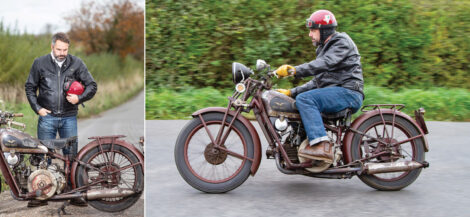
Amazing. The Sport 15 is everything I hoped for, and more, because I’ve had to do very little to it. Touch wood it remains so, and I suspect that the person who found the Sport 15 in its state of abandonment, before selling it on to Luciano, really knew his stuff and recommissioned it expertly. The Sport 15 starts easily (apart from when friends turn up!), the brakes are decent for the design and age, and everything else works. The old fuel taps don’t even leak, and there’s no oil on the floor after a long ride. The hand gear change is easily mastered and needs a little patience, but on the road and once into top or 3rd gear, the old Guzzi is strong, and can sit at 50-55mph without problem. Its exhaust note is sublime, and the engine is elastic, pulling you up hills, with adjustment of the advance/retard and throttle levers. Just keep your fingers clear of that bacon slicer and don’t wear flared trousers while riding! MC
Sport 15 model history
The Sport 15 of 1933 was directly related to the very first production Moto Guzzi model, called the “Normale,” 17 of which were built 12 years earlier in 1921, after the company’s founding on March 15, 1921. The 500cc over square 88mm x 82mm bore and stroke flat single engine featured an inlet over exhaust arrangement, with the inlet valve in the head actuated by a long pushrod and rocker, and a side valve exhaust. The “bacon slicer” external flywheel and unit engine and transmission construction, in a rigid frame, remained Guzzi’s production mainstay for years to come. In 1922, the “Tipo Sport,” with a higher lift camshaft and 4.5:1 compression piston, raised the output of the Normale to 13bhp at 8,000rpm, with a decent 62mph top speed.
By 1929, after years of consistent sales and driven by racing success, too, the Sport was renamed the Sport 14 in light of its improvements, including a front brake as standard, improved forks and steering geometry inspired by track experience, and a large silencer. In 1931, the Sport 15 was announced, and it was to become Guzzi’s best seller up until 1939. It was Guzzi’s first ever machine to be offered in bright red paint, but more importantly, it had been given, as was the innovation coming from manufacturers in England, a saddle tank with curves — easier on the eye than the previous angled design, and giving Guzzi’s flagship 500 a more modern line. Improvements to the motor included a new and strengthened con rod, and the earlier Amal carb was substituted with a Dell’Orto. 5,979 Sport 15s were sold before it disappeared from production in 1939, but the robust and simple Guzzi remains a favorite of Italian Guzzisti 90 years later.