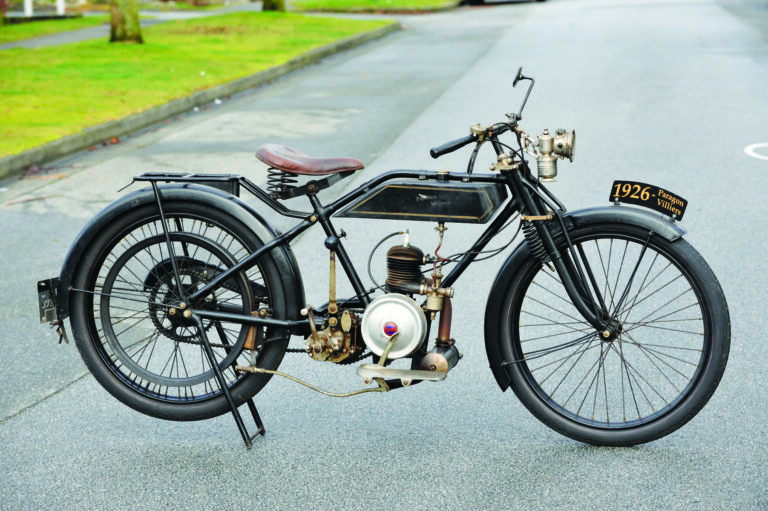
Engine: 147cc piston-port 2-stroke single, 55mm x 62mm bore and stroke, 3.2hp @ 3,500rpm, Petroil mix 16:1
- Top speed: 30mph (approx.)
- Carburetion: Villiers carburetor
- Transmission: Chain primary, dry clutch, 2-speed Albion gearbox, handshift, chain final drive
- Electrics: Flywheel magneto ignition
- Lubrication: Petroil mix 16:1
- Frame: Open, single tube
- Seat height: Adjustable
- Suspension: Druid Mk1 girder fork front, rigid rear
- Brakes: No front brake, rod operated, external acting on steel channel rear
- Tires: 26 x 2.125in front and rear
Ubiquitous is a word that has become … well, ubiquitous.
Defined as “seeming to be found everywhere,” the word is frequently misused. But it would be true to say that, in the British motorcycle industry, Villiers 2-strokes really were ubiquitous. Dozens of makers from Aberdale to Zenith used them to power mopeds, commuter bikes, sports bikes, trials and motocross machines, even racers and sidecar outfits. Just about every British bike builder except the majors (Ariel, BSA, Triumph, Matchless, Norton, Velocette, Vincent) made a Villiers-powered machine at some time. And while they were generally reliable by the standards of the day (even with minimal maintenance) they also had inherent problems — the flywheel magneto being one of them.
Case in point: in the 1960s, back in the Old Country, my uncle Ted rode an Ambassador motorcycle. At least, he did until the Villiers engine quit. I was 15 and motorcycle mad. And in a conversation that probably didn’t involve my parents, Uncle Ted told me I could have the bike, and see if I could get it running.
I knew nothing about engines and what made them work, but I started messing with the bits I could see. I do remember that there was a wire coming from the spark plug that didn’t seem to go anywhere. I had no idea that it should be connected to the magneto. Deciding the fault must lay within, I took the cylinder head, barrel and piston off. Seeing nothing obviously wrong, I started reassembly — but I couldn’t find the wrist pin. That was the end of the rebuild and the Ambassador, which was consigned to the wreckers. And I had forgotten this episode until I first saw Terry Frounfelker’s 1926 Paragon and its Villiers 2-stroke engine.
Made in Canada

The list of Canadian motorcycle brands is not a long one. It pretty much starts with Can-Am and ends with CCM. And while the Hendee Manufacturing Company once built Indian motorcycles in Toronto,that was more than a century ago. Slightly more recently, though, you could buy a motorcycle that was “built” in Vancouver: the Paragon-Villiers.
Alfred Deeley opened his retail business in Vancouver in the early years of the 20th century. As well as British light cars, Deeley sold bicycles, and Triumph and Harley-Davidson motorcycles. At some point in the 1920s, Deeley began importing what were essentially kit motorcycles from the Birmingham, England Sun Cycle & Fittings Co. Ltd. The Sun frame was supplied with other proprietary parts, including the Villiers MkVIII C 2-stroke engine and Druid Mk1 sprung fork. These parts were assembled into a complete motorcycle by Deeley’s company and sold through their premises on Granville Street in Vancouver, Canada. The brand name “Paragon-Villiers” was hand-painted onto the gas tank.
The specification of the Paragon was very much in line with period practice for economy machines. The 147cc Villiers MkVIII engine was announced for 1923 with a new iron cylinder head featuring radial fins, and used a 16:1 petroil fuel mix for lubrication. The 150cc (55mm x 62mm) 2-stroke also used an iron cylinder and iron piston. The engine unit was supplied complete with Villiers flywheel magneto, Villiers carburetor, canister muffler, and even the handlebar throttle lever. The engine drove the rear wheel by chain via a 2-speed Albion gearbox with hand shift. (The rear wheel, incidentally, showed its heritage by retaining its belt-drive pulley attached to the spokes, which, on the chain drive bike, was called into service as a brake drum!)

There are many aspects of the Paragon that would flummox modern motorcycle riders: there’s no ignition key or switch — the engine is “live” all the time — though it does need to be spinning to generate a spark; and it’s stopped by operating a compression release lever. There’s no front brake, as front brakes were considered of questionable value at the time After all, a skid was easier to control if it was the rear wheel rather than the front. There’s no rear suspension, and the front springs are undamped.
Finding the Paragon
Canadian Vintage Motorcycle Group member Terry Frounfelker heard about the Paragon through another local member, Dan Smith. A goldsmith shop in Vancouver had gone out of business, and the premises were being cleared. Smith thought he had seen a flat-tank motorcycle in the basement. Expecting a box of parts or a basket case bike, Terry went to take a look. And while covered in more than 90 years of dust, the Paragon was complete and in one piece — though the original Hutchinson tires had completely rotted away but for the carcass. Terry bought it on the spot — especially after he saw the decal on the headstock: “The Paragon: Assembled in Vancouver BC.”

The Paragon looked like it would run without too much work. So, after Terry refreshed the fluids in the gas tank and Albion gearbox, he tried to start it. It soon became apparent why the Paragon had been parked: there was no spark from the Villiers flywheel magneto. Fortunately, Villiers built millions of their 2-stroke engines, many of them with the same flywheel magneto, so parts are easy to find. Terry ordered a new condenser, ignition parts and a spark plug from the U.K.
Terry’s bike has a number of interesting features. The Paragon came without lights, so he has fitted a period acetylene headlight while searching for a taillight and acetylene canister. And instead of the standard footpegs, his machine boasts cast aluminum footboards, a “factory” option.

Then came time for the first start after almost a century. The Villiers MkVIII’s carburetor is mounted on the front of the engine, directly over the muffler and just in front of the flywheel mag with its stamped aluminum cover. So before starting it for the first time, “I made sure I had a fire extinguisher handy!” Terry says. It started without much fuss, and the ancient Villiers was soon puffing out its familiar pall of blue oil smoke. The Paragon is perfectly rideable as long as you’re not in a hurry — and have plenty of room to stop, Terry says. He claims to have seen around 30mph, though, “it doesn’t do well with hills,” he admits.
That the Paragon survived is a remarkable and rare event. Utility machines like these were typically bought for commuting, being only marginally faster (but requiring slightly less effort) than a bicycle. New owners typically had little experience of internal combustion engines and their quirks, and a simple electrical fault would often consign them to the wrecker’s yard.
Terry’s Paragon-Villiers may well be the only survivor from one of motorcycle history’s darker and dustier corners, and it provides a fascinating glimpse through the stained glass of time at a long-lost era.

The Deeley Dynasty
Alfred Deeley was a well-known bicycle racer in the industrial Midlands of England who established a bicycle store in the early years of the 20th century. The sign over the door said “Fred Deeley — the Cycle Man.” It wasn’t long before Deeley branched out into motorcycles.
But it was a bout of illness and some encouragement from a friend that prompted Fred Deeley to set off for Canada. He arrived in Vancouver, B.C., with his wife and two sons, Fred Jr. and Ray, and letters of introduction from a number of U.K. manufacturers, including BSA. The “Cycle Man” soon opened a store in Vancouver selling imported Raleigh and BSA bicycles, adding BSA motorcycles and Austin cars.
It was during and after World War I when the supply of motorcycles and cars from the “old country” dried up that Fred cast around for a new line. He was impressed by the competition record that Harley-Davidson had racked up, knowing that his business success back in the U.K. was partly a result of his own involvement in bicycle racing. So Deeley’s began its long relationship with the Motor Company.

In 1919, 16-year-old Fred Jr. decided he would rather travel the world instead of joining the family business. Fortunately for the dynasty, Fred Jr.’s girlfriend became pregnant, which helped persuade him to stay in Vancouver after a quick trip to the altar. Fred Jr. officially started with the family firm in 1919. Frederick Trevor (“Trev”) Deeley was born in 1920.
Some years later, Trev proved to be an aggressive competitor both as a flat-track rider on his #22 Harley-Davidson and as a businessman. Taking effective control of the family business in the 1950s, Trev realized that, with the increasing affordability of automobiles and declining sales of Harley-Davidsons, he would need another product line. In 1957, he took delivery of a 250cc Honda Dream and was so impressed, he placed a large order with the Japanese company. This did not go down well with his father, Fred Jr., and Trev had to set up a separate company to handle the Japanese brand.

Thus Deeley’s became the first Honda dealer in North America and its exclusive Canadian distributor. But in the mid-1960s, Honda tried to sidestep Deeley’s, appointing other distributors. Not one to be intimidated, Trev pulled off a similar deal with Yamaha in 1967 to become the exclusive distributor for Canada.
The relationship soured somewhat in 1972 when Yamaha tried to “dump” 13,000 snowmobiles on to Deeley’s following a warm winter in the Eastern U.S. It was then that Trev got a call from Milwaukee. The upshot was that the Deeley organization would become the exclusive Harley-Davidson distributor for Canada — the only country with an independent H-D distributorship. Trev reported direct to Milwaukee, and eventually gained a seat on the parent company’s board.
For the next 42 years, every Harley-Davidson motorcycle sold in Canada was distributed through the Deeley organization. The relationship continued until 2015 when H-D took over distribution in Canada. Trev Deeley died in 2002.
(Trev Deeley Motorcycles maintains a rotating exhibition of vintage and classic motorcycles of all brands at their dealership in Vancouver, B.C. 604-293-2221, www.deeleyexhibition.ca)

Villiers and Sun
Both Villiers and Sun had their origins in the manufacture of bicycles and bicycle parts. Entrepreneur John Marston’s Sunbeam company gained an enviable reputation in the late 19th century for the quality and finish of its bicycles. However, Marston was unhappy with the outsourced pedals he was obliged to buy, not having the machinery to make them. His son Charles was dispatched to the U.S. with instructions to visit the Pratt & Whitney factory to see their production methods and perhaps source some appropriate technology.
What the younger Marston did bring back to the U.K. was an understanding of the assembly line process, and the unsuitability of the Sunbeam company’s existing premises in Birmingham. The company bought a new facility on Villiers Street in nearby Bromsgrove and started pedal manufacture, expanding into “freewheel” sprockets, and becoming one of the world’s largest manufacturers of cycle parts. In 1902, John Marston sold his business, including the Villiers Street operation, to his son, Charles.
Around 1912, and now called Villiers Engineering, the company experimented with engines for motorcycles. Though they did produce an “F-head” inlet-over-exhaust 4-stroke engine, the first commercially successful Villiers engine was based on a simple 2-stroke design pioneered by the Levis company with only three moving parts: piston, connecting rod and crankshaft. One of the Villiers Engineering Company’s first customers for its 1913 269cc 2-stroke engine was the Sun Cycle and Fittings Co. Ltd. of Birmingham.

The 269cc Villiers proprietary engine with external flywheel was an instant success and was soon installed by many motorcycle manufacturers. More than 2.5 million were eventually produced for use in lawn mowers, invalid carriages (think: mobility scooter), outboards and farming equipment as well as motorcycles. So Villiers became a sort-of “Briggs & Stratton” of Britain. Emulating the Ford Motor company, Villiers installed its own foundry, machine tools and assembly line, performing almost all manufacturing steps itself, believing this gave them the best control over quality and price.
The Mk. VIII C engine was introduced in 1924 and featured radial finning on the cylinder head, and a bore and stroke of 55mm x 62mm for 147cc.
Villiers continued to supply 2-stroke engines to scores of British motorcycle manufacturers through the 1950s, from 98cc pedal-assist autocycle engines to a sporty 325cc twin. A combination of factors (European and Japanese competition in the scooter and autocycle market, and the popularity of small cars) killed off most smaller British motorcycle makers and thus the demand for proprietary engines. Production ceased, and Villiers Engineering was bought by Manganese-Bronze Holdings in 1966.

Starting out as yet another Birmingham-based bicycle fittings maker, James Parkes & Son made its first motorcycles in 1911 under the Sun brand. Most were powered by proprietary engines, including the Villiers “F-head” and 269cc 2-stroke. However, by the end of World War I, Sun had acquired the Valveless Two-stroke Company and its principal product: a rotary disc-valve 2-stroke engine called the VTS. Sun entered the Isle of Man TT in 1921 with two VTS-powered machines, finishing 9th and 10th in the 350cc Junior class, followed with a 12th/13th finish in 1922.
Though the VTS continued with a new name (Vitesse), most of Sun’s motorcycles used proprietary engines including, of course, Villiers 2-strokes. The company ceased making motorcycles in 1932, then resumed production in the 1950s. Sun produced its last motorcycle, a Villiers-powered 98cc autocycle, in 1961. MC